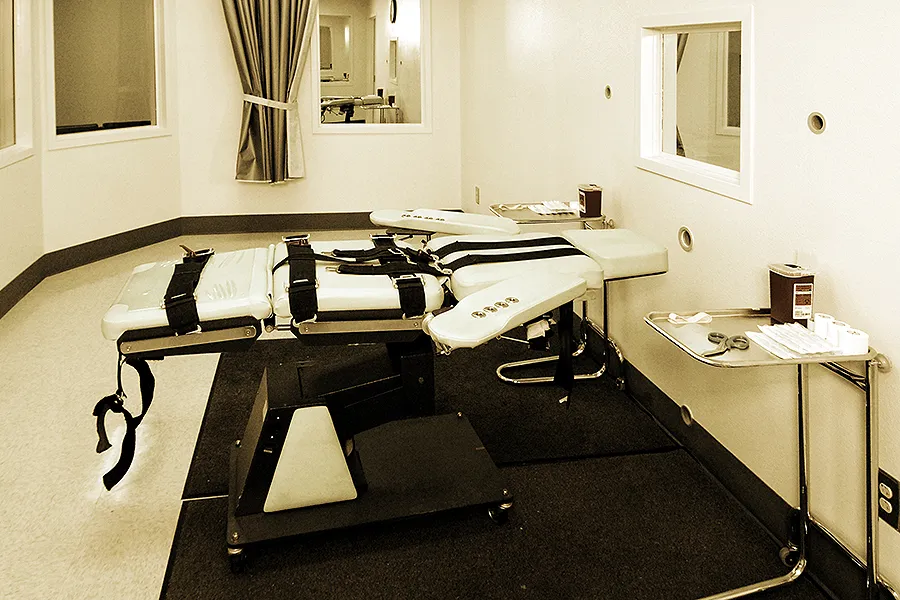
Washington D.C., Jul 20, 2018 / 12:00 pm (CNA).- The Church has consistently taught that the state has the authority to use the death penalty. But, in recent years, popes and bishops have become more vocal in calling for an end to its use. Many Catholics instinctively favor life over death, even after the worst crimes, and some are left wondering if the Church’s mind is changing.
Two recent cases highlighted an apparent tension between traditional teaching and modern circumstances.
On July 13, the bishops of Tennessee wrote to Governor Bill Haslam asking him to halt a slate of planned executions. In their letter, Bishops Mark Spalding of Nashville, Richard Stika of Knoxville, and Martin Holley of Memphis emphasized the value and dignity of every human life, even those who have committed the worst possible crimes.
One day earlier, on July 12, Cardinal Malcolm Ranjith, Archbishop of Colombo, expressed his “support” for the Sri Lankan government’s decision to introduce the death penalty for drug traffickers and organized crimes bosses.
“We will support [Sri Lankan] President Maithripala Sirisena’s decision to subject those who organize crime while being in the prison to [the] death sentence,” he told local media. The cardinal went on to add that more needed to be done to prevent drug traffickers and crime bosses from operating with impunity while in jail.
The state’s authority to execute criminals is explicitly sanctioned in the Bible, including by St. Paul. Historically, the Church has recognized the use of the death penalty in a practical way: executions were carried out in the Papal States well into the nineteenth century, with the last official executioner retiring in 1865.
For much the twentieth century, attempted assassination of the pope was a capital crime in Vatican City; Pope Paul VI only removed the death penalty from the law in 1969.
Today, the Church still officially teaches that the death penalty is a legitimate option for states to employ.
The Catechism of the Catholic Church teaches this: “Assuming that the guilty party’s identity and responsibility have been fully determined, the traditional teaching of the Church does not exclude recourse to the death penalty, if this is the only possible way of effectively defending human lives against the unjust aggressor.”
This formulation contains a heavy qualification. When exactly is the death penalty the only effective means of defending human life? That’s a thorny question.
St. John Paul II was outspoken in his opposition to the use of capital punishment. In an address in the United States, in 1999, he called for Christians to be “unconditionally pro-life” and said that “the dignity of human life must never be taken away, even in the case of someone who has done great evil.” He also spoke of his desire for a consensus to end the death penalty, which he called “cruel and unnecessary.”
That address, given in St. Louis, was credited with helping persuade to Missouri Governor Mel Carnahan to commute the death sentence of inmate Darrell Mease to life in prison.
More recently, Pope Francis has denounced capital punishment in even stronger terms. Speaking in October 2017, he called it “contrary to the Gospel” because “it is freely decided to suppress a human life that is always sacred in the eyes of the Creator, and of which, in the final analysis, God alone is the true judge and guarantor.” He has, however, stopped short of revising the official teaching contained in the Catechism.
But Catholic thinkers do not unanimously agree that a total renunciation of the death penalty is appropriate, or even possible.
Cardinal Joseph Bernadin, in his famous “Consistent Ethic of Life” speech delivered at Fordham University in 1983, explicitly recognized the legitimate authority of the state to resort to capital punishment. Cardinal Avery Dulles, writing in 2001, observed that “the Catholic magisterium does not, and never has, advocated unqualified abolition of the death penalty.”
While there is real scope for debate about when and how sparingly capital punishment should be used, Dulles concluded that “the death penalty is not in itself a violation of the right to life.”
His conclusion was informed by the constant teaching of the Church that judicial executions are licit, even if regrettable and to be avoided whenever possible.
In the City of God, St. Augustine wrote that the state administers justice under divine concession. “Since the agent of authority is but a sword in the hand, and is not responsible for the killing, it is in no way contrary to the commandment, “Thou shalt not kill”… for the representatives of the State’s authority to put criminals to death, according to law or the rule of rational justice.”
While the trend of recent papal statements has been towards a relegation of the death penalty to, at most, a theoretical possibility, scholars have urged caution about going too far.
Dr. Chad Pecknold, associate professor of systematic theology at the Catholic University of America, told CNA that it was important distinguish between changing circumstances and a change in what the Church has always taught.
“The Church has always held that the death penalty is a just option available to the state, even if we do not welcome its use. St. Augustine says that the death penalty is just, but the Church should plead for mercy.”
Pecknold stressed that relationship between mercy and justice is a live concern. In seeking mercy, he said, we must implicitly recognize the validity of justice.
“Mercy isn’t calling something that is just ‘unjust.’ Mercy relieves the punishment properly due to the guilty. As the Catechism recognizes, there can be circumstances in which the death penalty is a legitimate service to justice. This is qualified by a preferential option for other means, whenever they can serve the same ends.”
These alternative means have not been always and everywhere available. “The common and constant teaching of the Church can be applied to different circumstances. Alternatives available to us in modern western countries simply have not been present at other times, or may not be now in other places.”
There is a crucial difference between applying a consistent teaching to changed circumstances and appearing to suggest humanity has evolved beyond a previously valid doctrine, Pecknold said.
“The death penalty is not, and has never been a positive end in itself. It is a means towards serving justice. If we find we can now serve the same ends and express a preferential option for life, this is doubly good.”
“But we should not fall into a false understanding that what was once ‘good’ is now ‘bad.’ The Church doesn’t evolve out of a true teaching, nor does humanity progress beyond natural law.”
“We should prize our increasing opportunities to serve mercy and justice together, but be wary of giving ourselves too much credit, we have not progressed to a new, higher level of justice.”
Cardinal Dulles agreed. He considered the argument that Church sanctioning of capital punishment was an “outmoded” concession to past ages of “violence” and “barbarity,” one which could yield to “the signs of the times” and “a new recognition of the dignity and inalienable rights of the human person.” He dismissed this as “a tempting simplicity” which found “no echo” among Catholic theologians of the past.
The consensus against capital punishment in modern western nations, it must be observed, has grown in line with increased prosperity, political stability, and states’ ability to deploy credibly effective alternatives to execution.
In the recent Sri Lankan case, the government acted in response to the ineffectiveness of prison sentences, with drug traffickers and crime bosses seeming to continue operating with impunity, even behind bars. Following local complaints at his expression of support, Cardinal Ranjith issued a clarification, making clear his support for the government announcement was not a “carte blanche” advocacy for the death penalty, but noting that he could not “close my eyes and do nothing before this terrible phenomenon our country is faced with.”
“[The drug trade] causes death and violence in the streets and the destruction of the cream of our youth, who become drug addicts at an age as early as their adolescence, being exposed to drugs even in their schools. This is being done by drug cartels operated at times from the prisons,” he said.
For Ranjith, such a context seems to find a place within the Catechism’s criteria that capital punishment be reserved for the final defense of innocent life when other options fail.
In the West, conditions seem to be narrowing the scope for the death penalty’s use, and bishops are responding, which has led to a sense, especially after Pope Francis’ comments last year, that the Church might declare the death penalty absolutely unjust. Yet, as was recently seen in Sri Lanka and Tennessee, things are not yet the same everywhere.
That serves as a good reminder about the importance of understanding the Church’s global perspective, and the importance of distinguishing between teachings which supply criteria through which Catholics must make moral judgments, and teachings which declare that certain actions are, in fact, immoral everywhere and always.
The Church’s teaching on the death penalty expresses, essentially, a criteria by which state authorities should make judgments about the just use of the death penalty. While in the developed West, use of the death penalty may, in fact, be almost completely unnecessary, not all parts of the world are as developed.
The divergence of views from bishops around the world on this issue reflects the role that the circumstances of time and place can play in moral reasoning. That is instructive, and a reminder about the complex richness, and importance, of Catholic moral teaching.
If you value the news and views Catholic World Report provides, please consider donating to support our efforts. Your contribution will help us continue to make CWR available to all readers worldwide for free, without a subscription. Thank you for your generosity!
Click here for more information on donating to CWR. Click here to sign up for our newsletter.
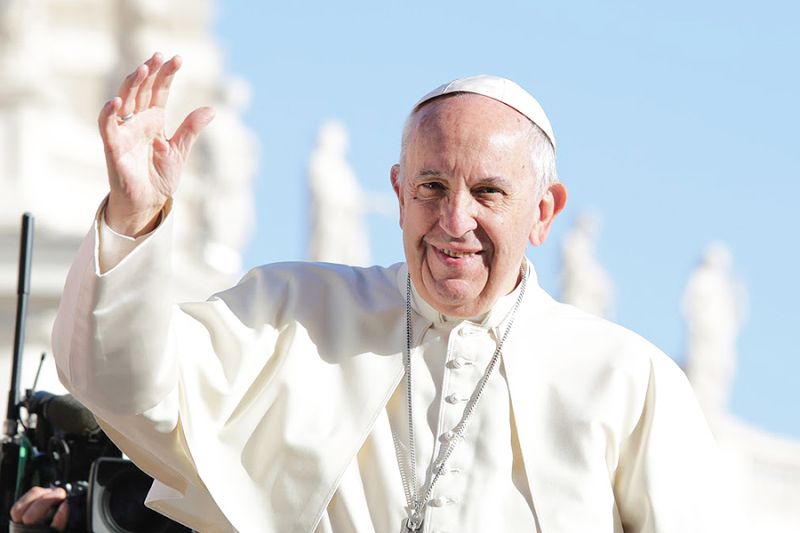
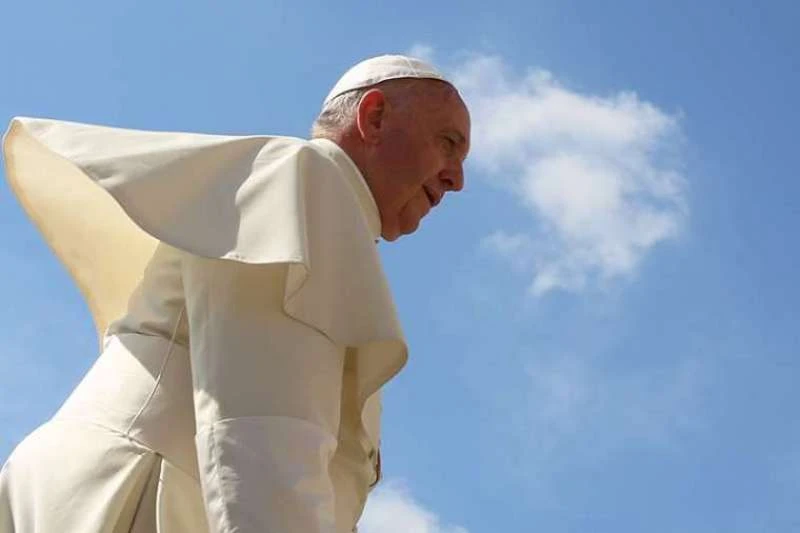
Pope Francis at the general audience in St. Peter’s Square, Oct. 5, 2016. / Credit: Daniel Ibanez/CNA
CNA Staff, Mar 13, 2025 / 04:00 am (CNA).
March 13 marks the 12th anniversary of the election of Pope Francis as the 265th successor of St. Peter. Here is a timeline of key events during his papacy:
2013
March 13 — About two weeks after Pope Benedict XVI steps down from the papacy, Cardinal Jorge Bergoglio is elected pope. He takes the papal name Francis in honor of St. Francis of Assisi and proclaims from the central balcony of St. Peter’s Basilica: “Let us begin this journey, the bishop and people, this journey of the Church of Rome, which presides in charity over all the Churches, a journey of brotherhood in love, of mutual trust. Let us always pray for one another.”
March 14 — The day after he begins his pontificate, Pope Francis returns to his hotel to personally pay his hotel bill and collect his luggage.
July 8 — Pope Francis visits Italy’s island of Lampedusa and meets with a group of 50 migrants, most of whom are young men from Somalia and Eritrea. The island, which is about 200 miles off the coast of Tunisia, is a common entry point for migrants who flee parts of Africa and the Middle East to enter Europe. This is the pope’s first pastoral visit outside of Rome and sets the stage for making reaching out to the peripheries a significant focus.
Pope Francis gives the Wednesday general audience in St. Peter’s Square on Oct. 2, 2013. Elise Harris/CNA.
July 23-28 — Pope Francis visits Rio de Janeiro, Brazil, to participate in World Youth Day 2013. More than 3 million people from around the world attend the event.
July 29 — On the return flight from Brazil, Pope Francis gives his first papal news conference and sparks controversy by saying “if a person is gay and seeks God and has goodwill, who am I to judge?” The phrase is prompted by a reporter asking the pope a question about priests who have homosexual attraction.
Nov. 24 — Pope Francis publishes his first apostolic exhortation Evangelii Gaudium (The Joy of the Gospel). The document illustrates the pope’s vision for how to approach evangelization in the modern world.
2014
Feb. 22 — Pope Francis holds his first papal consistory to appoint 19 new cardinals, including ones from countries in the developing world that have never previously been represented in the College of Cardinals, such as Haiti.
March 22 — Pope Francis creates the Pontifical Commission for the Protection of Minors. The commission works to protect the dignity of minors and vulnerable adults, such as the victims of sexual abuse.
Pope Francis greets pilgrims during his general audience on Nov. 29, 2014. Bohumil Petrik/CNA.
Oct. 5 — The Synod on the Family begins. The bishops discuss a variety of concerns, including single-parent homes, cohabitation, homosexual adoption of children, and interreligious marriages.
Dec. 6 — After facing some pushback for his efforts to reform the Roman Curia, Pope Francis discusses his opinion in an interview with La Nacion, an Argentine news outlet: “Resistance is now evident. And that is a good sign for me, getting the resistance out into the open, no stealthy mumbling when there is disagreement. It’s healthy to get things out into the open, it’s very healthy.”
2015
Jan. 18 — To conclude a trip to Asia, Pope Francis celebrates Mass in Manila, Philippines. Approximately 6 million to 7 million people attend the record-setting Mass, despite heavy rain.
March 23 — Pope Francis visits Naples, Italy, to show the Church’s commitment to helping the fight against corruption and organized crime in the city.
May 24 — To emphasize the Church’s mission to combat global warming and care for the environment, Pope Francis publishes the encyclical Laudato Si’, which urges people to take care of the environment and encourages political action to address climate problems.
Pope Francis at a Wednesday general audience in St. Peter’s Square on June 17, 2015. Bohumil Petrik.
Sept. 19-22 — Pope Francis visits Cuba and meets with Fidel Castro in the first papal visit to the country since Pope John Paul II in 1998. During his homily, Francis discusses the dignity of the human person: “Being a Christian entails promoting the dignity of our brothers and sisters, fighting for it, living for it.”
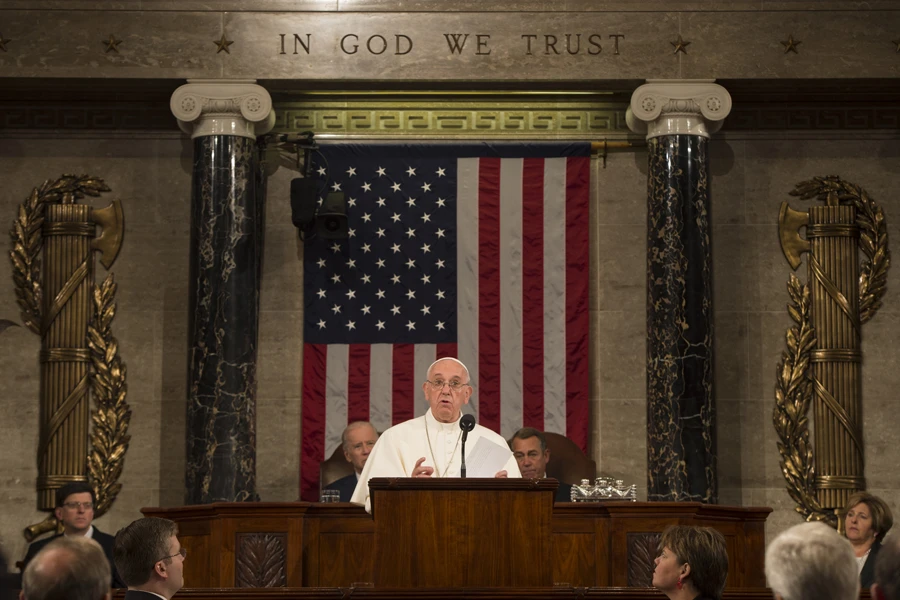
Sept. 22-27 — After departing from Cuba, Pope Francis makes his first papal visit to the United States. In Washington, D.C., he speaks to a joint session of Congress, in which he urges lawmakers to work toward promoting the common good, and canonizes the Franciscan missionary St. Junípero Serra. He also attends the World Meeting of Families in Philadelphia, which focuses on celebrating the gift of the family.
Pope Francis speaks to the U.S. Congress in Washington, D.C. on Sept. 24, 2015. . L’Osservatore Romano.
Oct. 4 — Pope Francis begins the second Synod on the Family to address issues within the modern family, such as single-parent homes, cohabitation, poverty, and abuse.
Oct. 18 — The pope canonizes St. Louis Martin and St. Marie-Azélie “Zelie” Guérin. The married couple were parents to five nuns, including St. Therese of Lisieux. They are the first married couple to be canonized together.
Dec. 8 — Pope Francis’ Jubilee Year of Mercy begins. The year focuses on God’s mercy and forgiveness and people’s redemption from sin. The pope delegates certain priests in each diocese to be Missionaries of Mercy who have the authority to forgive sins that are usually reserved for the Holy See.
2016
March 19 — Pope Francis publishes the apostolic exhortation Amoris Laetitia, which discusses a wide variety of issues facing the modern family based on discussions from the two synods on the family. The pope garners significant controversy from within the Church for comments he makes in Chapter 8 about Communion for the divorced and remarried.
April 16 — After visiting refugees on the Greek island of Lesbos, Pope Francis allows three Muslim refugee families to join him on his flight back to Rome. He says the move was not a political statement.
Pope Francis at the General Audience in St. Peter’s Square, Feb. 24, 2016. Daniel Ibanez/CNA.
July 26-31 — Pope Francis visits Krakow, Poland, as part of the World Youth Day festivities. About 3 million young Catholic pilgrims from around the world attend.
Sept. 4 — The pope canonizes St. Teresa of Calcutta, who is also known as Mother Teresa. The saint, a nun from Albania, dedicated her life to missionary and charity work, primarily in India.
Sept. 30-Oct. 2 — Pope Francis visits Georgia and Azerbaijan on his 16th trip outside of Rome since the start of his papacy. His trip focuses on Catholic relations with Orthodox Christians and Muslims.
Oct. 4 — Pope Francis makes a surprise visit to Amatrice, Italy, to pray for the victims of an earthquake in central Italy that killed nearly 300 people.
2017
May 12-13 — In another papal trip, Francis travels to Fatima, Portugal, to visit the Shrine of Our Lady of Fatima. May 13 marks the 100th anniversary of the first Marian apparition to three children in the city.
July 11 — Pope Francis adds another category of Christian life suitable for the consideration of sainthood: “offering of life.” The category is distinct from martyrdom, which only applies to someone who is killed for his or her faith. The new category applies to those who died prematurely through an offering of their life to God and neighbor.
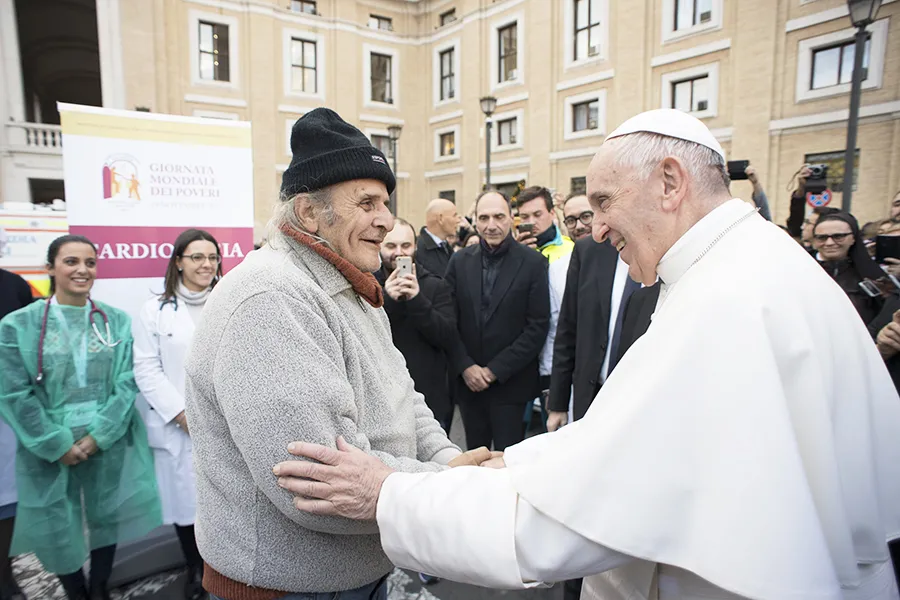
Pope Francis greets a participant in the World Day of the Poor in Rome, Nov. 16, 2017. L’Osservatore Romano.
Nov. 19 — On the first-ever World Day of the Poor, Pope Francis eats lunch with 4,000 poor and people in need in Rome.
Nov. 27-Dec. 2 — In another trip to Asia, Pope Francis travels to Myanmar and Bangladesh. He visits landmarks and meets with government officials, Catholic clergy, and Buddhist monks. He also preaches the Gospel and promotes peace in the region.
2018
Jan. 15-21 — The pope takes another trip to Latin America, this time visiting Chile and Peru. The pontiff meets with government officials and members of the clergy while urging the faithful to remain close to the clergy and reject secularism. The Chilean visit leads to controversy over Chilean clergy sex abuse scandals.
Aug. 2 — The Vatican formally revises No. 2267 of the Catechism of the Catholic Church, which concerns the death penalty. The previous text suggested the death penalty could be permissible in certain circumstances, but the revision states that the death penalty is “inadmissible.”
Aug. 25 — Archbishop Carlo Viganò, former papal nuncio to the United States, publishes an 11-page letter calling for the resignation of Pope Francis and accusing him and other Vatican officials of covering up sexual abuse including allegations against former Cardinal Theodore McCarrick. The pope initially does not directly respond to the letter, but nine months after its publication he denies having prior knowledge about McCarrick’s conduct.
Aug. 25-26 — Pope Francis visits Dublin, Ireland, to attend the World Meeting of Families. The theme is “the Gospel of family, joy for the world.”
Pope Francis at the 2018 World Meeting of Families in Ireland. Daniel Ibanez/CNA.
Oct. 3-28 — The Synod on Young People, the Faith, and Vocational Discernment takes place. The synod focuses on best practices to teach the faith to young people and to help them discern God’s will.
2019
Jan. 22-27 — The third World Youth Day during Pope Francis’ pontificate takes place during these six days in Panama City, Panama. Young Catholics from around the world gather for the event, with approximately 3 million people in attendance.
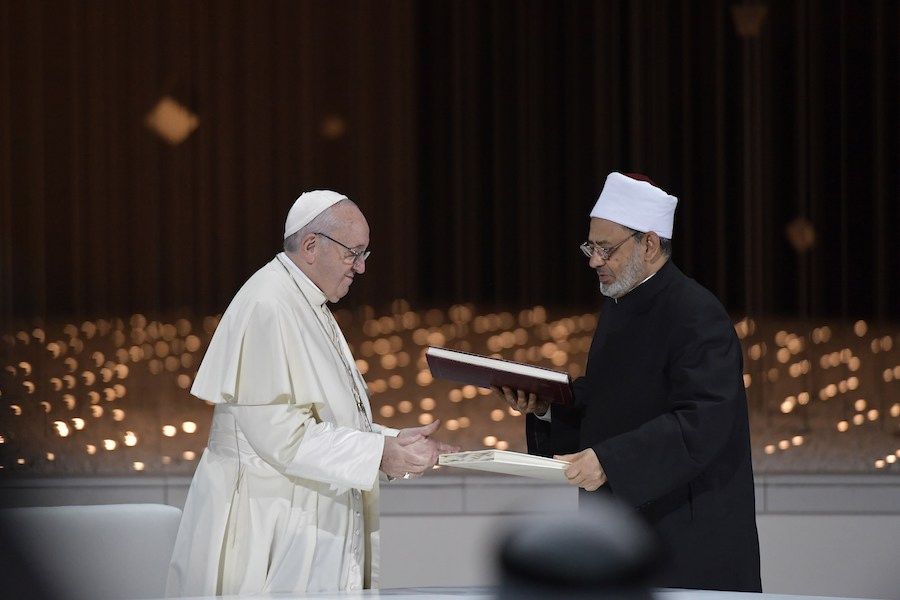
Feb. 4 — Pope Francis signs a joint document in with Sheikh Ahmed el-Tayeb, the grand imam of Al-Azhar, in Abu Dhabi, United Arab Emirates, titled the “Document on Human Fraternity for World Peace and Living Together.” The document focuses on people of different faiths uniting together to live peacefully and advance a culture of mutual respect.
Pope Francis and Ahmed el-Tayeb, grand imam of al-Azhar, signed a joint declaration on human fraternity during an interreligious meeting in Abu Dhabi, UAE, Feb. 4, 2019. Vatican Media.
Feb. 21-24 — The Meeting on the Protection of Minors in the Church, which is labeled the Vatican Sexual Abuse Summit, takes place. The meeting focuses on sexual abuse scandals in the Church and emphasizes responsibility, accountability, and transparency.
Oct. 6-27 — The Church holds the Synod of Bishops for the Pan-Amazon region, which is also known as the Amazon Synod. The synod is meant to present ways in which the Church can better evangelize the Amazon region but leads to controversy when carved images of a pregnant Amazonian woman, referred to by the pope as Pachamama, are used in several events and displayed in a basilica near the Vatican.
Oct. 13 — St. John Henry Newman, an Anglican convert to Catholicism and a cardinal, is canonized by Pope Francis. Newman’s writings inspired Catholic student associations at nonreligious colleges and universities in the United States and other countries.
2020
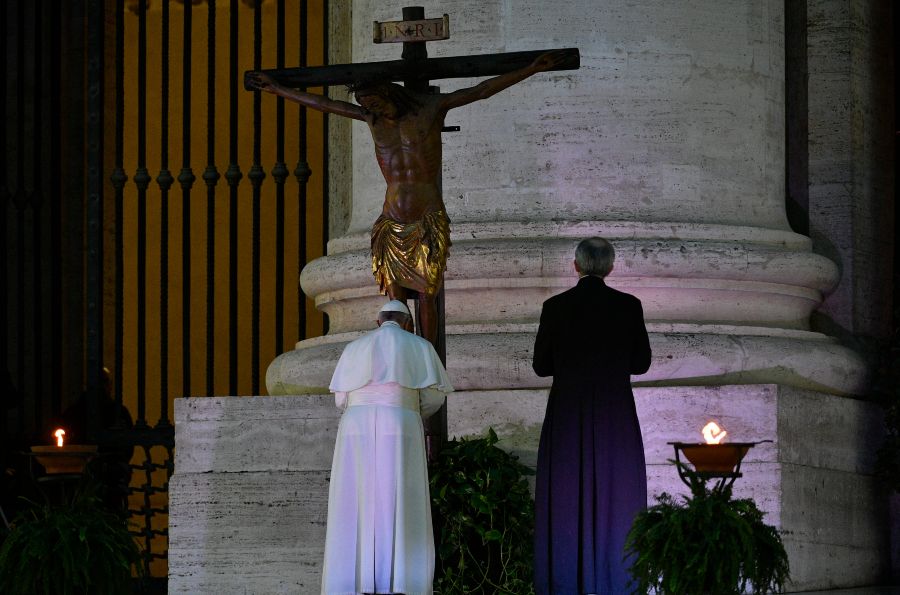
March 15 — Pope Francis takes a walking pilgrimage in Rome to the chapel of the crucifix and prays for an end to the COVID-19 pandemic. The crucifix was carried through Rome during the plague of 1522.
March 27 — Pope Francis gives an extraordinary “urbi et orbi” blessing in an empty and rain-covered St. Peter’s Square, praying for the world during the coronavirus pandemic.
Pope Francis venerates the miraculous crucifix of San Marcello al Corso in St. Peter’s Square during his Urbi et Orbi blessing, March 27, 2020. Vatican Media.
2021
March 5-8 — In his first papal trip since the start of the COVID-19 pandemic, Pope Francis becomes the first pope to visit Iraq. On his trip, he signs a joint statement with Grand Ayatollah Ali al-Sistani condemning extremism and promoting peace.
July 3 — Cardinal Giovanni Angelo Becciu, who was elevated to the College of Cardinals by Pope Francis, is indicted in a Vatican court for embezzlement, money laundering, and other crimes. The pope gives approval for the indictment.
July 4 — Pope Francis undergoes colon surgery for diverticulitis, a common condition in older people. The Vatican releases a statement that assures the pope “reacted well” to the surgery. Francis is released from the hospital after 10 days.
July 16 — Pope Francis issues a motu proprio titled Traditionis Custodes. The document imposes heavy restrictions on the celebration of the Traditional Latin Mass.
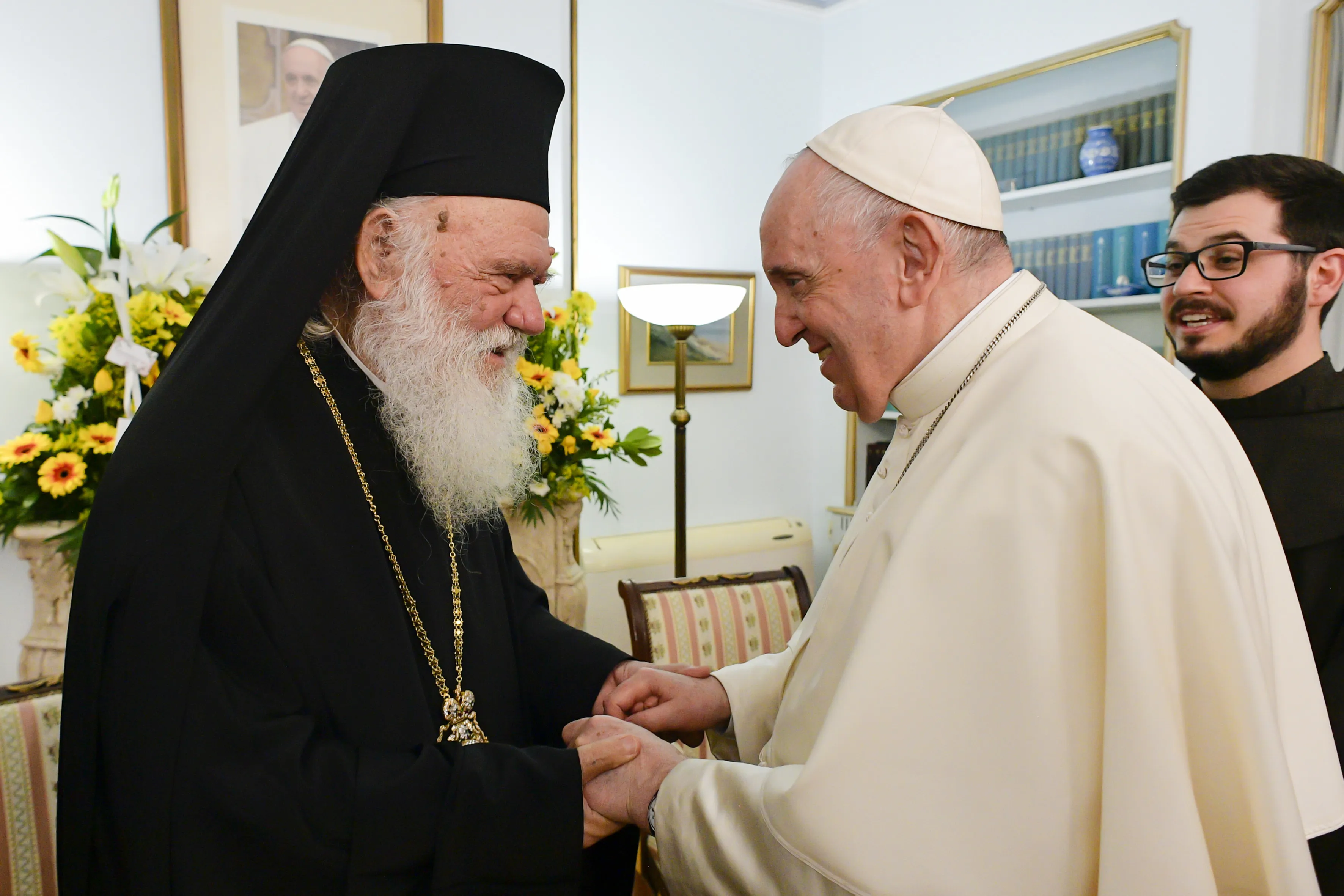
Dec. 2-6 — The pope travels to Cyprus and Greece. The trip includes another visit to the Greek island of Lesbos to meet with migrants.
Pope Francis greets His Beatitude Ieronymos II in Athens, Greece on Dec. 5, 2021. Vatican Media
2022
Jan. 11 — Pope Francis makes a surprise visit to a record store in Rome called StereoSound. The pope, who has an affinity for classical music, blesses the newly renovated store.
March 19 — The pope promulgates Praedicate Evangelium, which reforms the Roman Curia. The reforms emphasize evangelization and establish more opportunities for the laity to be in leadership positions.
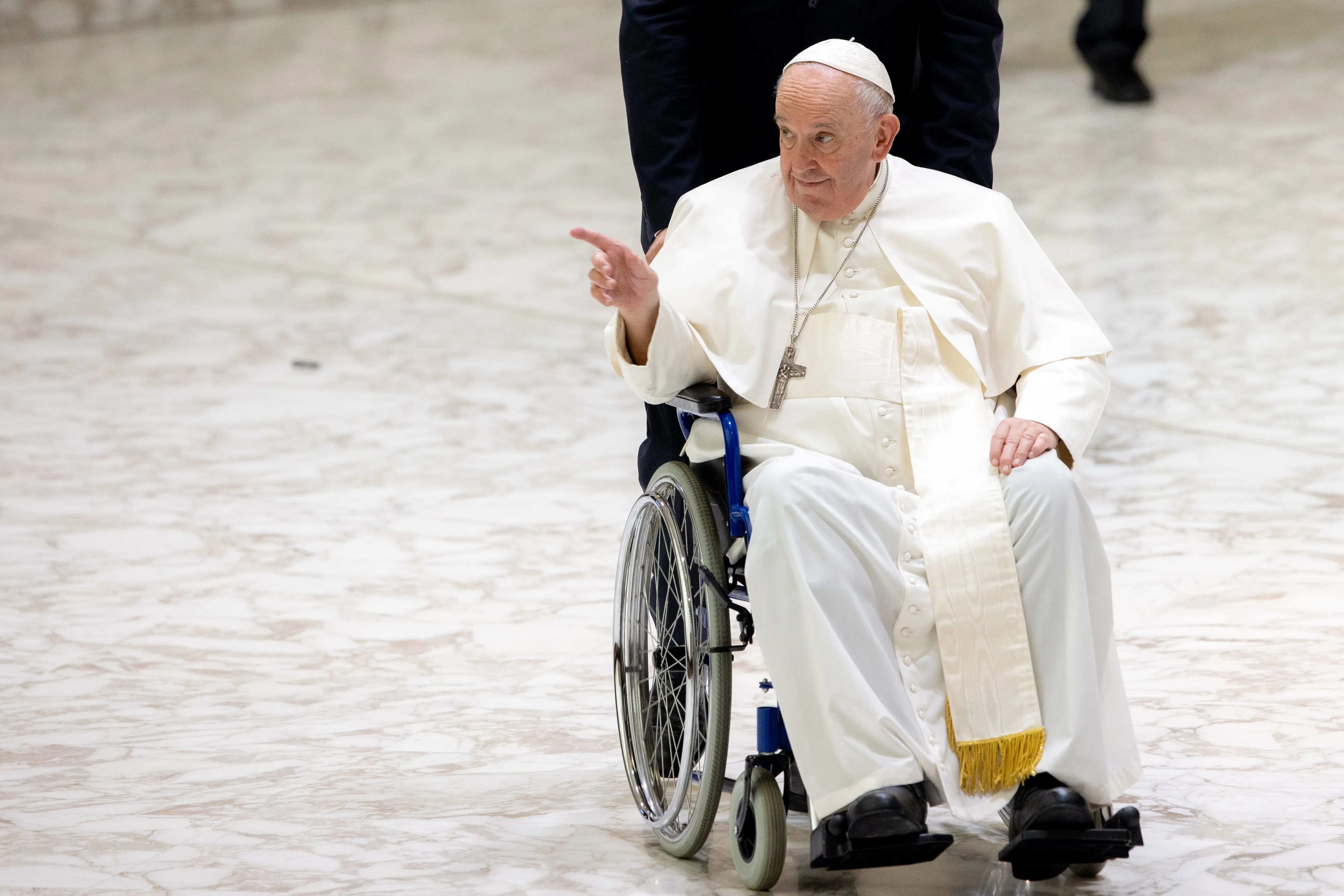
May 5 — Pope Francis is seen in a wheelchair for the first time in public and begins to use one more frequently. The pope has been suffering from knee problems for months.
Pope Francis greeted the crowd in a wheelchair at the end of his general audience on Aug. 3, 2022. Daniel Ibanez/CNA
July 24-30 — In his first papal visit to Canada, Pope Francis apologizes for the harsh treatment of the indigenous Canadians, saying many Christians and members of the Catholic Church were complicit.
2023
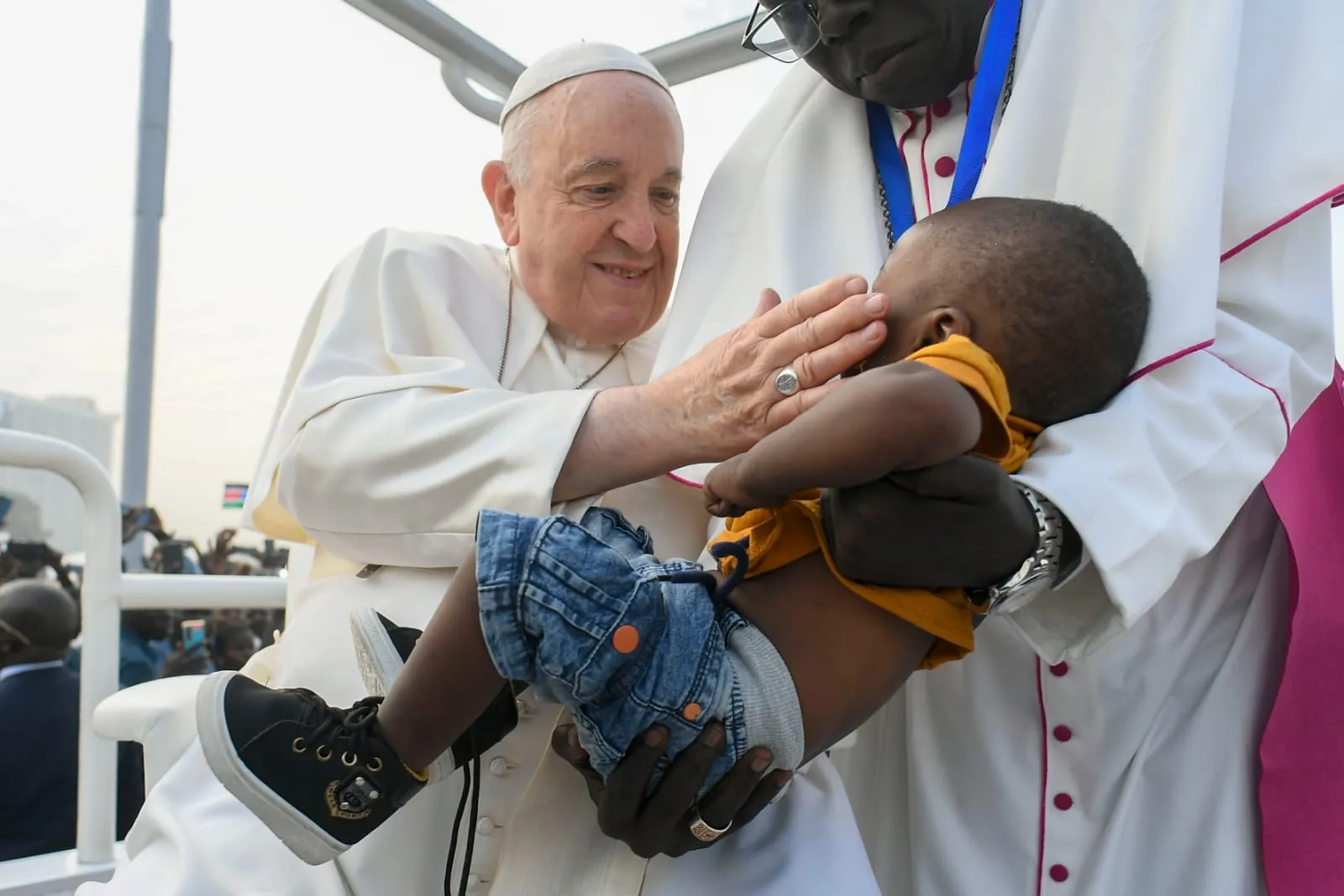
Jan. 31-Feb. 5 — Pope Francis travels to the Democratic Republic of Congo and South Sudan. During his visit, the pope condemns political violence in the countries and promotes peace. He also participates in an ecumenical prayer service with Anglican Archbishop of Canterbury Justin Welby and Moderator of the Church of Scotland Iain Greenshields.
Pope Francis greets a young boy a Mass in Juba, South Sudan on Feb. 5, 2023. Vatican Media
March 29-April 1 — Pope Francis is hospitalized for a respiratory infection. During his stay at Rome’s Gemelli Hospital, he visits the pediatric cancer ward and baptizes a newborn baby.
April 5 — The pope appears in the Disney documentary “The Pope: Answers,” which is in Spanish, answering six “hot-button” issues from members of Gen Z from various backgrounds. The group discusses immigration, depression, abortion, clergy sexual and psychological abuse, transgenderism, pornography, and loss of faith.
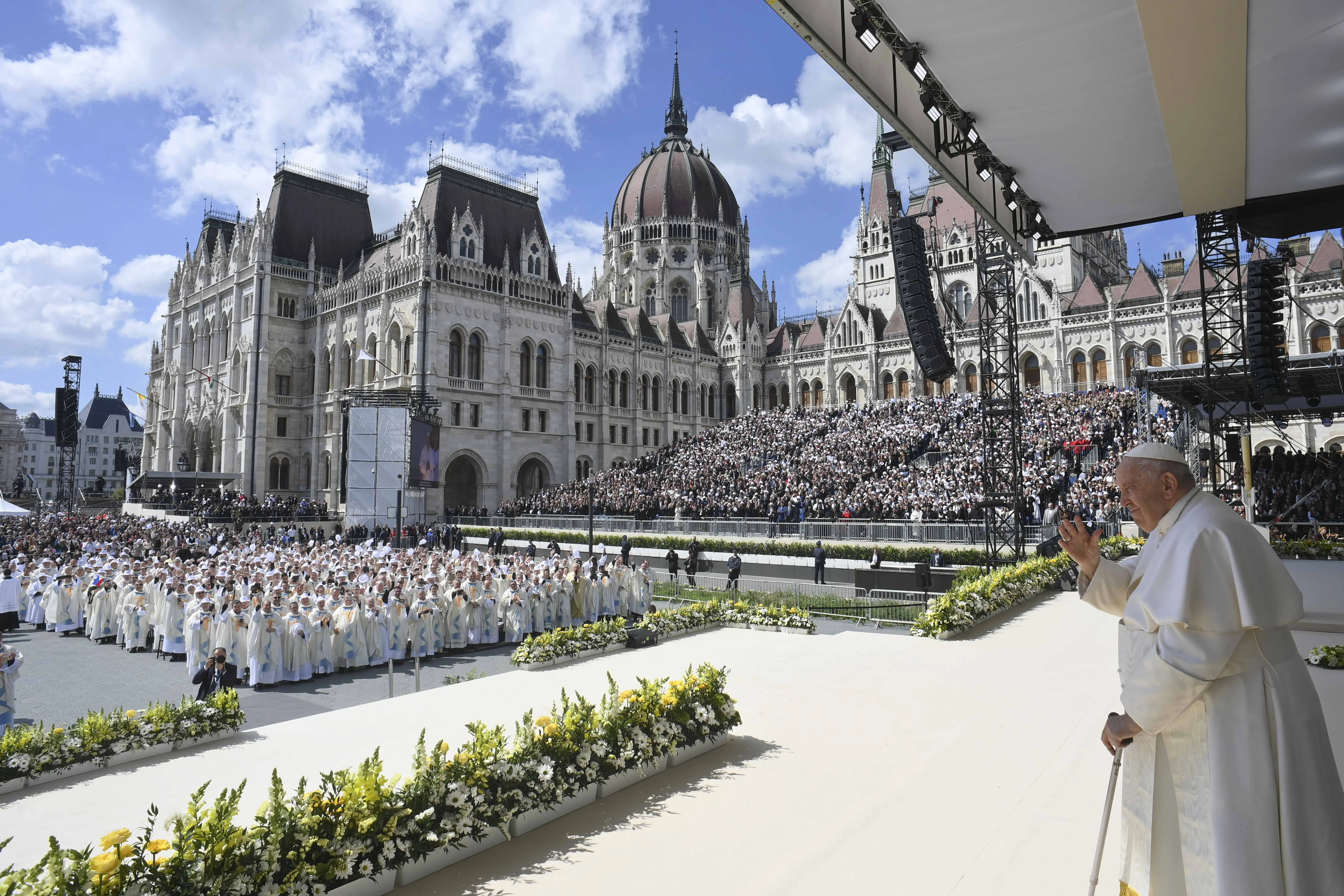
April 28-30 — Pope Francis visits Hungary to meet with government officials, civil society members, bishops, priests, seminarians, Jesuits, consecrated men and women, and pastoral workers. He celebrates Mass on the final day of the trip in Kossuth Lajos Square.
Pope Francis stands on an altar erected outside the Parliament Building in Budapest’s Kossuth Lajos’ Square during a public outdoor Mass on April 30, 2023. Vatican Media
June 7 — The Vatican announces that Pope Francis will undergo abdominal surgery that afternoon under general anesthesia due to a hernia that is causing painful, recurring, and worsening symptoms. In his general audience that morning before the surgery, Francis says he intends to publish an apostolic letter on St. Thérèse of Lisieux, “patroness of the missions,” to mark the 150th anniversary of her birth.
June 15 — After successful surgery and a week of recovery, Pope Francis is released from Gemelli Hospital.
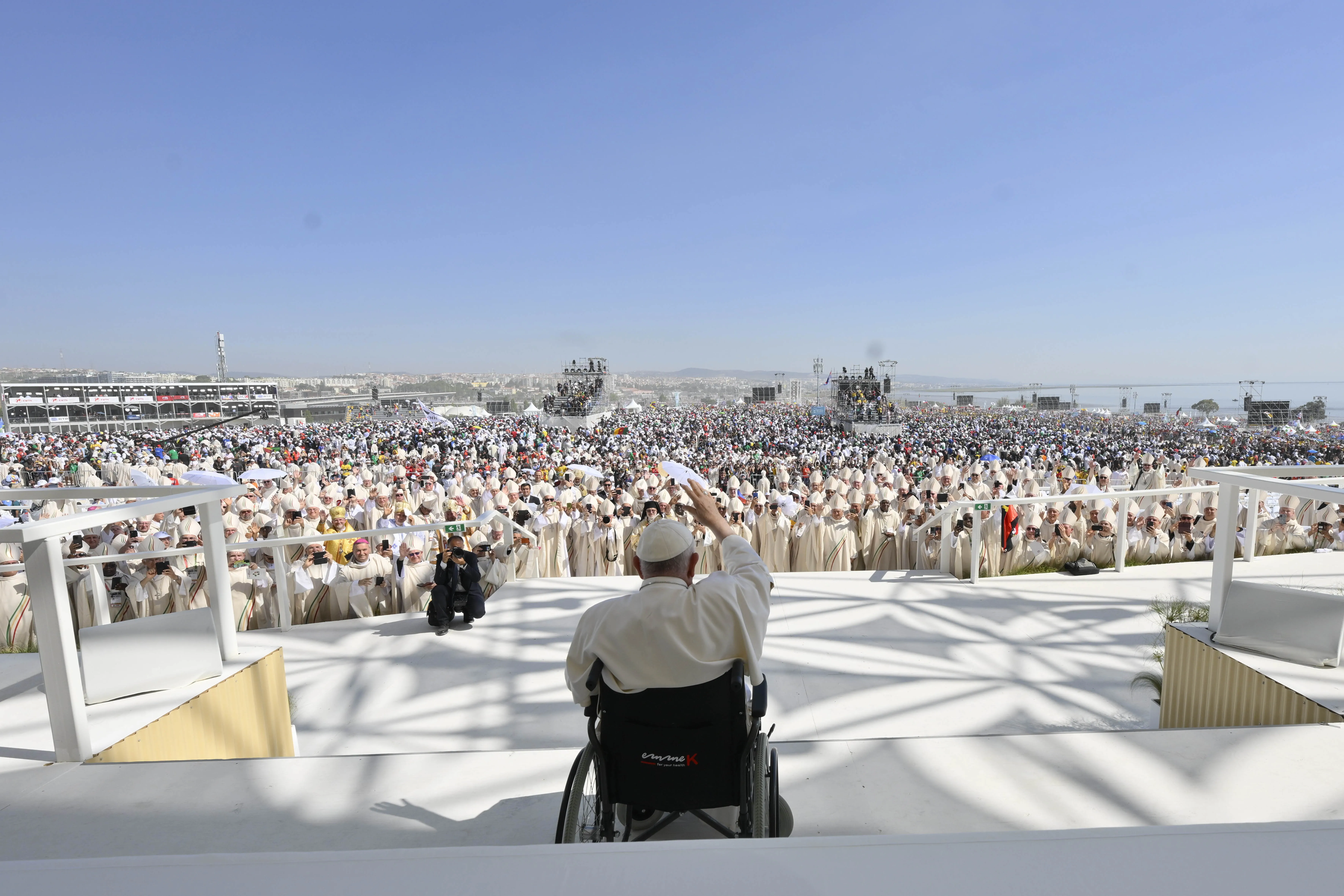
Aug. 2-6 — Pope Francis travels to Lisbon, Portugal, for World Youth Day 2023, taking place from Aug. 1-6. He meets with Church and civil leaders ahead of presiding at the welcoming Mass and Stations of the Cross. He also hears the confessions of several pilgrims. On Aug. 5, he visits the Shrine of Our Lady of Fátima, where he prays the rosary with young people with disabilities. That evening he presides over the vigil and on Sunday, Aug. 6, he celebrates the closing Mass, where he urges the 1.5 million young people present to “be not afraid,” echoing the words of the founder of World Youth Days, St. John Paul II.
Pope Francis waves at the crowd of 1.5 million people who attended the closing Mass of World Youth Day 2023 in Lisbon, Portugal on Aug. 6, 2023. Vatican Media.
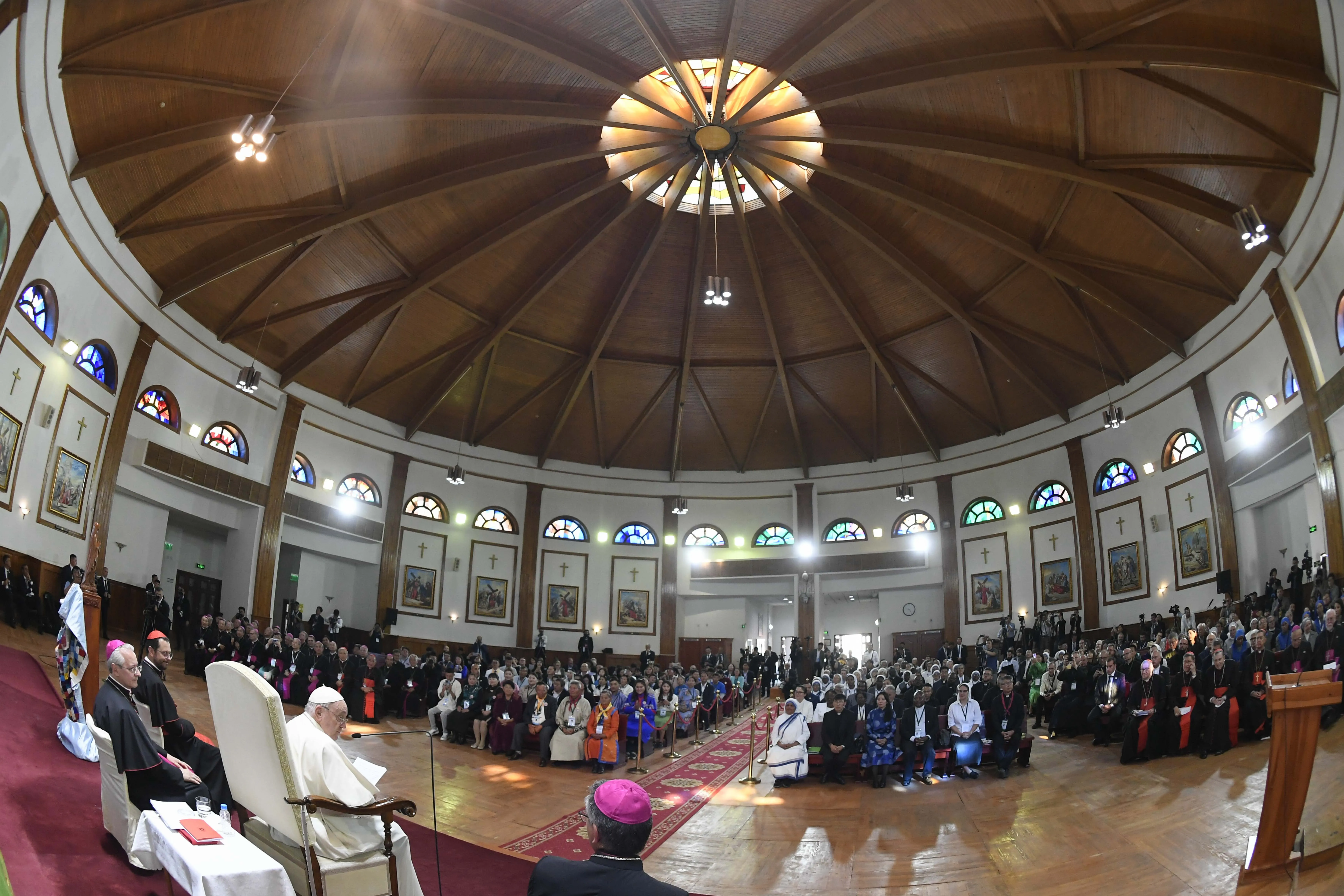
Aug. 31-Sept. 4 — Pope Francis travels to Mongolia, the world’s most sparsely populated sovereign country. The trip makes Francis the first pope to visit the Asian country that shares a 2,880-mile border with China, its most significant economic partner. Mongolia has a population of about 1,300 Catholics in a country of more than 3 million people.
Pope Francis meets with local priests and religious of Mongolia, which includes only 25 priests (19 religious and six diocesan), 33 women religious, and one bishop — Cardinal Giorgio Marengo — in Ulaanbaatar’s Cathedral of Sts. Peter and Paul on Sept. 2, 2023. Credit: Vatican Media
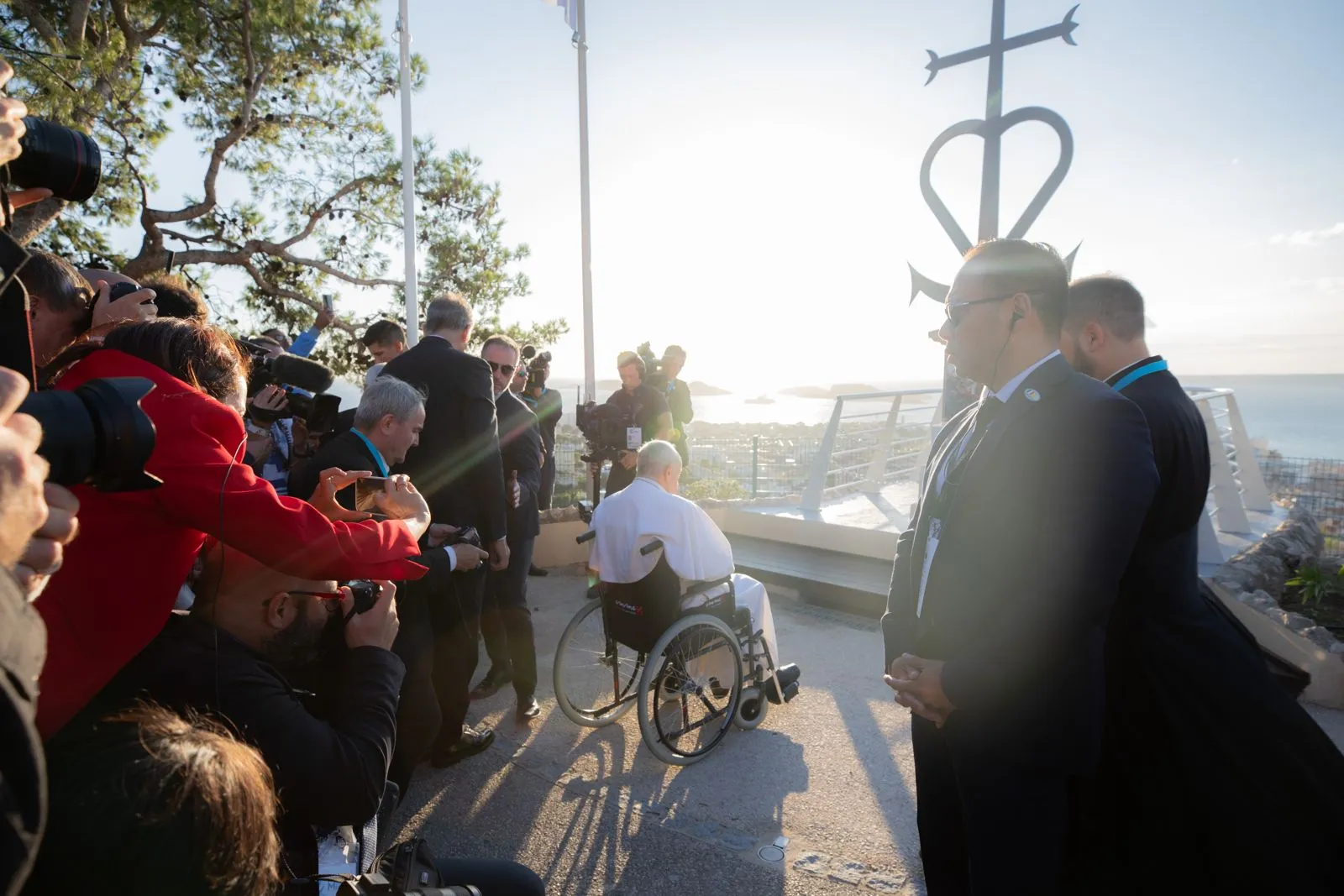
Sept. 22-23 — On a two-day trip to Marseille, France, Pope Francis meets with local civil and religious leaders and participates in the Mediterranean Encounter, a gathering of some 120 young people of various creeds with bishops from 30 countries.
Pope Francis asks for a moment of silence at a memorial dedicated to sailors and migrants lost at sea on the first of a two-day visit to Marseille, France, Sept. 22, 2023. A Camargue cross, which comes from the Camargue area of France, represents the three theological virtues of faith, hope, and charity. The three tridents represent faith, the anchor represents hope, and the heart represents charity. Credit: Daniel Ibañez/CNA
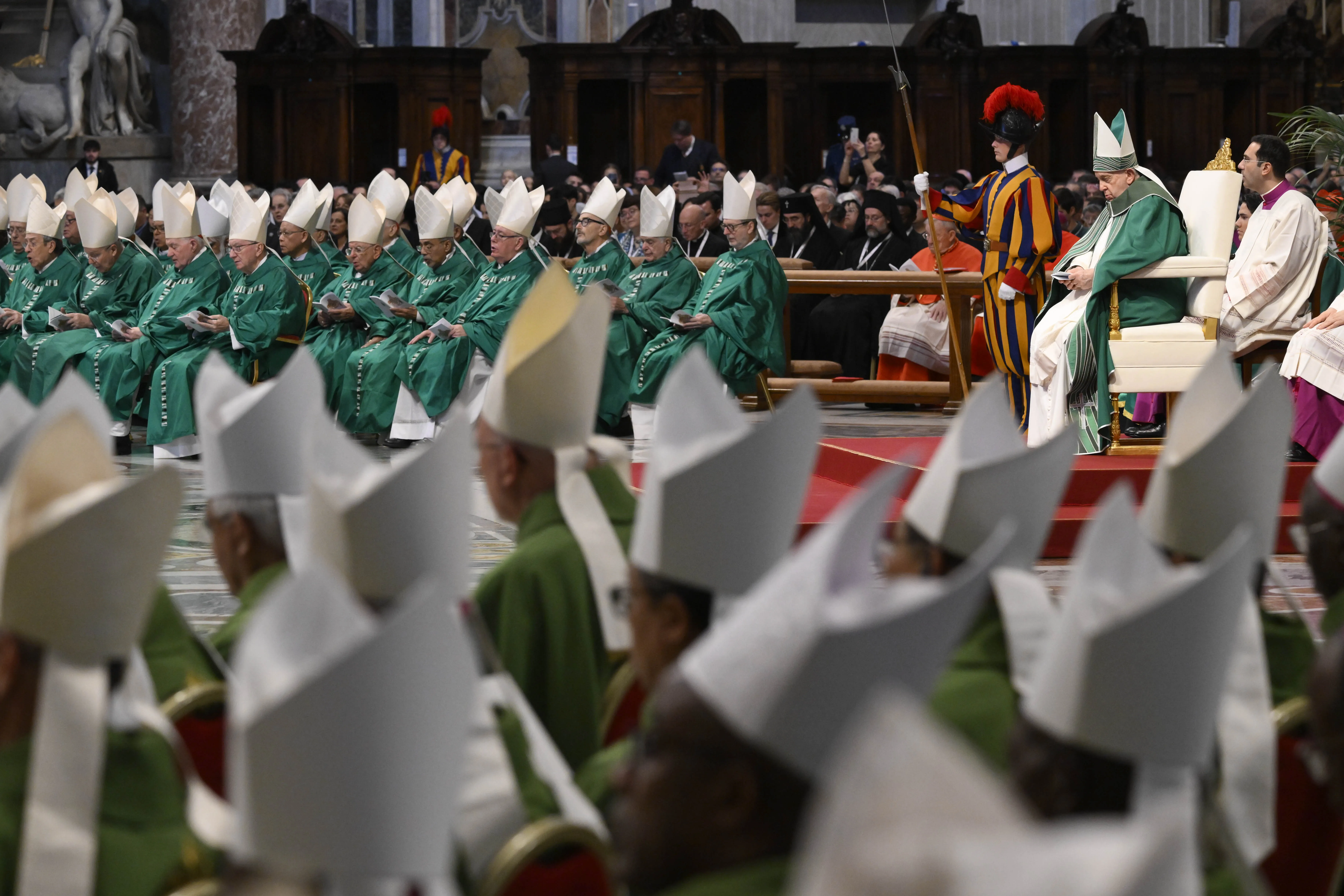
Oct. 4-29 — The Vatican hosts the first of two monthlong global assemblies of the Synod on Synodality, initiated by Pope Francis in 2021 to enhance the communion, participation, and mission of the Church. Pope Francis celebrates the closing Mass of the synod at St. Peter’s Basilica on Oct. 29. The second and final global assembly will take place at the Vatican in October 2024.
Pope Francis at the Synod on Synodality’s closing Mass in St. Peter’s Basilica on Oct. 29, 2023. Vatican Media
Nov. 25 — Pope Francis visits the hospital briefly for precautionary testing after coming down with the flu earlier in the day. Although he still participates in scheduled activities, other officials read his prepared remarks. The Vatican on Nov. 28 cancels the pope’s planned Dec. 1–3 trip to Dubai for the COP28 climate conference, where he was scheduled to deliver a speech, due to his illness.
Dec. 18 — The Dicastery for the Doctrine of the Faith issues the declaration Fiducia Supplicans, which authorizes nonliturgical blessings for same-sex couples and couples in “irregular situations.” Various bishops from around the world voice both support for and criticism of the document.
2024
Jan. 14 — Pope Francis for the first time responds publicly to questions about Fiducia Supplicans in an interview on an Italian television show. The pope underlines that “the Lord blesses everyone” and that a blessing is an invitation to enter into a conversation “to see what the road is that the Lord proposes to them.”
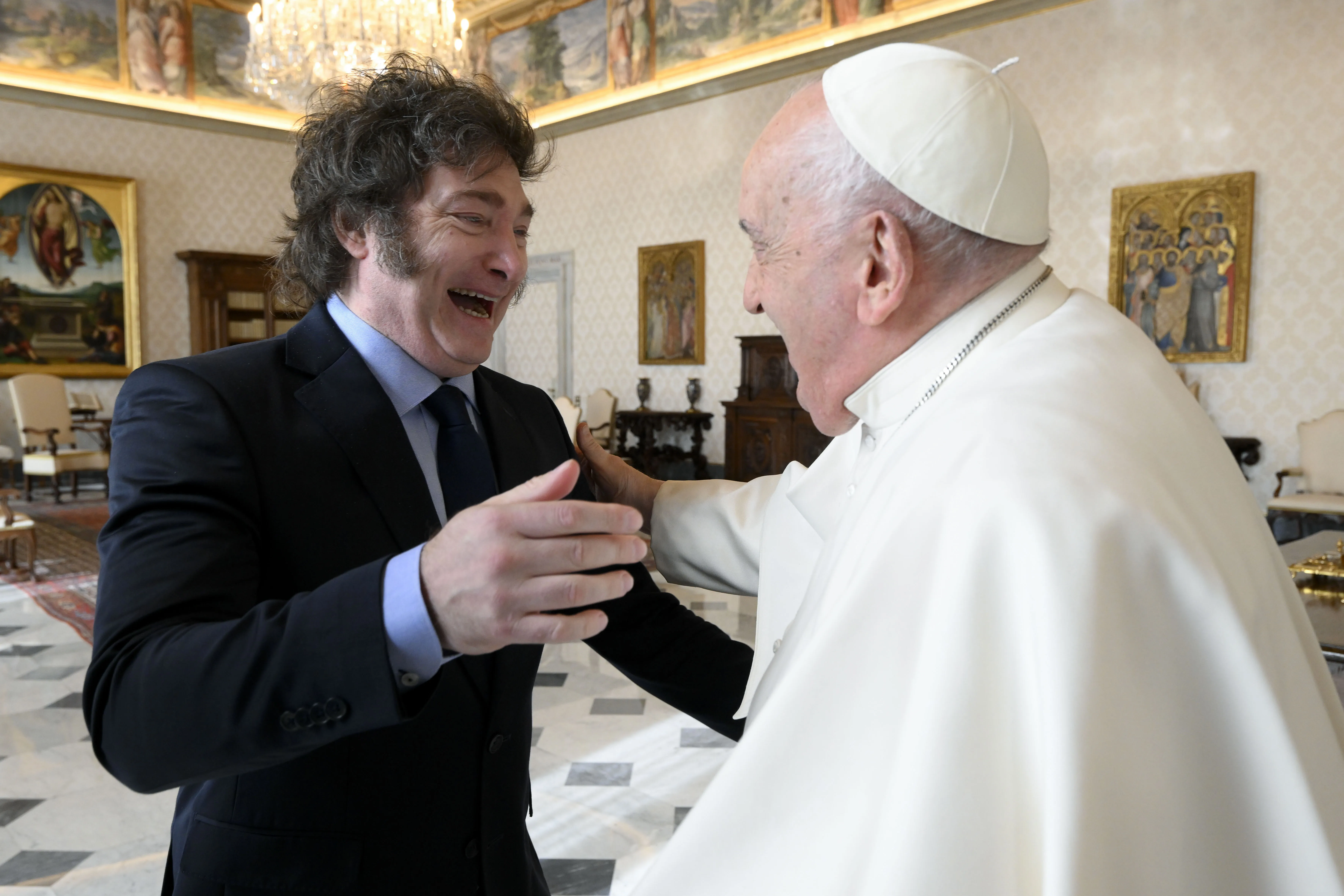
Feb. 11 — In a ceremony attended by Argentine president Javier Milei, Pope Francis canonizes María Antonia of St. Joseph — known affectionately in the pope’s home country as “Mama Antula” — in a Mass at St. Peter’s Basilica. The president and the former archbishop of Buenos Aires embrace after the ceremony. Pope Francis, who has not returned to his homeland since becoming pope in 2013, has said he wants to visit Argentina in the second half of this year.
Pope Francis meets with Argentina President Javier Milei in a private audience on Feb. 12, 2024, at the Vatican. Credit: Vatican Media
March 13 — Pope Francis celebrates 11 years as supreme pontiff of the Roman Catholic Church.
April 8 — The Dicastery for the Doctrine of the Faith releases Dignitas Infinita (“Infinite Dignity”), a document that reaffirms the Church’s perennial opposition to abortion, euthanasia, and gender ideology.
May 19 — Pope Francis appears on CBS’ “60 Minutes” in an interview with Norah O’Donnell, where he states categorically that women’s ordination to the priesthood and the diaconate is off the table.
In an interview with 60 Minutes’ Norah O’Donnell, Pope Francis took aim at his “conservative critics” in the United States. Credit: CBS News/Adam Verdugo
June 14 — Pope Francis becomes the first pope to address the G7 Summit in the southern Italian region of Puglia. In his remarks, he stresses that human dignity requires that the decisions of artificial intelligence (AI) be under the control of human beings. During the three-day event, the pope also meets with U.S. President Joe Biden.
Sept. 2-13 — Pope Francis embarks on a 12-day trip of more than 20,000 miles over seven flights through Asia and Oceania. The trip to Indonesia, Papua New Guinea, East Timor, and Singapore is his most ambitious international trip yet and the longest of his 11-year pontificate. In East Timor, 600,000 Catholics attend Mass with the Holy Father.
Pope Francis celebrates Mass at the Esplanade of Taci Tolu in Dili, Timor-Leste, Tuesday, Sept. 10, 2024. Credit: Daniel Ibáñez/CNA
Oct. 2-27 — The three-year Synod on Synodality concludes with the final session in Rome and the adoption of the final report, which in a surprise move Pope Francis signs immediately, stating he will not issue a separate postsynodal document.
Dec. 7 — Pope Francis holds a consistory at the Vatican in which he creates 21 new cardinals, including Archbishop Frank Leo of Toronto; Archbishop Dominique Joseph Mathieu of Tehran-Isfahan, Iran; and Archbishop Tarcisio Isao Kikuchi of Tokyo, reflecting the pope’s emphasis on the Church’s global mission.
Pope Francis places the red biretta on Cardinal Domenico Battaglia, archbishop of Naples, during the consistory for the creation of 21 new cardinals in St. Peter’s Basilica, Dec. 7, 2024. Credit: Daniel Ibáñez/CNA
Dec. 24 — On Christmas Eve, Pope Francis opens the Holy Door at St. Peter’s Basilica to officially launch the 2025 Jubilee Year of Hope.
Pope Francis opens the Holy Door of St. Peter’s Basilica before Mass on Christmas Eve, Dec. 24, 2024, officially launching the Jubilee Year 2025. Credit: Vatican Media
2025
Jan. 14 — “Hope,” Pope Francis’ autobiography, is released. The book marks the first time a pope has provided a first-person narration of the episodes that have marked his entire life, in this case from his childhood in Argentina in a family of Italian immigrants to becoming the successor of St. Peter.
Feb. 14 — Pope Francis is hospitalized with bronchitis and later develops double pneumonia.
March 13 — While still in Gemelli Hosptial in Rome for treatment for respiratory illnesses, Pope Francis celebrates the 12th anniversay of his election to the papacy.
Vatican City, May 24, 2018 / 11:08 am (CNA/EWTN News).- In a closed-door speech to Italian bishops on Monday, Pope Francis reportedly spoke about the number and quality of seminary candidates, including concerns about their sexual orientation.
At the start of his May 21 audience with Italian bishops, Pope Francis voiced three areas of concern for the Church in Italy, the first of which was the lack of vocations.
Francis’ brief remarks on his concerns, which also touched on evangelical poverty and transparency and the incorporation of Italian dioceses, were televised; however, his discussion with the bishops afterward was not.
In his public remarks on vocations, Pope Francis lamented the culture of the provisional, of relativism, and of the dictatorship of money, which hinder young people from discerning consecrated life. He also proposed that Italian dioceses with an abundance of vocations lend some of their priests to those Italian dioceses lacking in priests.
But according to Italian media sites, in the discussion that followed the pope was more direct, telling the bishops to care more for the quality of seminary candidates than the quantity.
He reportedly touched on the topic of homosexuality, particularly when it comes to individuals with “deep-seated tendencies” or who practice “homosexual acts”, yet who want to enter the seminary.
In these cases, “if you have even the slightest doubt it’s better not to let them enter,” Francis said, because these acts or deep-seated tendencies can lead to scandals and can compromise the life of the seminary, as well as the man himself and his future priesthood.
Pope Francis’ comments were allegedly made during the opening May 21 session of the 71st general assembly of the Italian bishops’ conference. Several Italian news sites have reported on the pope’s comments, but they have not been confirmed by the Vatican or by the Italian bishops.
However, the pope’s statements on the issue of homosexuality and the seminary reflect the Church’s teaching on the topic.
In the 2016 edition of the Congregation for Clergy’s ratio on priestly formation, the dicastery had written that “in relation to people with homosexual tendencies who approach seminaries, or who discover this situation in the course of formation, in coherence with her own magisterium, ‘the Church, while profoundly respecting the persons in question, cannot admit to the seminary or to holy orders those who practise homosexuality, present deep-seated homosexual tendencies or support the so-called “gay culture”.’”
The instruction noted that those who practise homosexuality, present deep-seated homosexual tendencies, or support the gay culture “find themselves in a situation that gravely hinders them from relating correctly to men and women. One must in no way overlook the negative consequences that can derive from the ordination of persons with deep-seated homosexual tendencies.”
It distinguished those with deep-seated homosexual tendencies from those “with homosexual tendencies that were only the expression of a transitory problem – for example, that of an adolescence not yet superseded.”
Men with transitory homosexual tendencies could be admitted to seminary, the congregation wrote, though “such tendencies must be clearly overcome at least three years before ordination to the diaconate.”
Though Pope Francis has not addressed the topic publicly, he alluded to problems of homosexuality in seminary formation during a recent meeting with Chilean bishops.
In a letter written to the bishops which was leaked to Chilean media, the pope issued a sharp correction of his brother prelates for a systematic cover-up of clerical abuse in the country.
One footnote in the letter noted how abuses were not limited to just one person or group, but was rather the result of a fractured seminary process.
In the case of many abusers in Chile, Francis noted how problems had been detected while they were in seminary or the novitiate, but rather than expelling these individuals, some bishops or superiors “sent priests suspected of active homosexuality to these educational institutions.”
Vatican City, Aug 4, 2020 / 05:28 am (CNA).- Pope Francis Tuesday appointed a Spanish layman with a long career in finance economics to the number two position in the Secretariat for the Economy.
Maximino Caballero Ledo, 60, is from Merida, Spain, but… […]





Leave a Reply