San Francisco, Calif., Jun 23, 2018 / 04:40 pm (CNA).- Becoming a surrogate mother seemed like a natural option for Kelly Martinez, who enjoyed helping people and liked being pregnant.
Just 20 years old, she thought working with big surrogacy agencies was a safe way for her to help couples have a family.
Instead, however, she says she was instructed to lie to the French consulate about being the biological mother of the children she was carrying. She was told to sign legal papers in French, which she did not understand. She did not receive a copy of the documents, and no translator was offered to her.
Ultimately, Martinez says she was manipulated, lied to, locked in a legal battle, and left with a stack of medical bills. She now sees the surrogacy industry differently – as an industry centered on profit.
Martinez’s story is being turned into a feature-length documentary called #BigFertility, a film produced by the Center for Bioethics and Culture Network, which aims to show the dangers behind the big money involved in the surrogacy industry.
“Kelly’s story is particularly unique because of the international dimension and how the industry exploited her over and over again,” said Jennifer Lahl, president of the Center for Bioethics and Culture Network.
“Her story shows how she was lied to, lied about, financially ruined and almost lost her life,” Lahl told CNA.
Martinez became a three-time surrogate mother. She became a surrogate for a French couple and a Spanish couple, despite the practice being illegal in all forms in the couples’ home countries. She also became a surrogate mother for a couple in the U.S. Throughout the documentary, Martinez talks about the medical risks, exploitation, and abuse she says she faced during the surrogacy process.
“I have now had my eyes opened to the fact that this is really about money, not about the children,” Martinez says in the trailer for #BigFertility.
The international scope of Martinez’s experiences, Lahl said, points to the overarching concerns that surrogacy around the globe presents. Martinez has now become an advocate against “big surrogacy,” and has spoken at various events around the world about her experience, including to members of Spanish Parliament and the United Nations.
Surrogacy has long been a controversial topic because of its connection with exploitation, abuses, and ethical concerns. The #BigFertility documentary is hoping to bring more of these concerns to light through Kelly’s story and experiences.
“Pushing back on the false narrative that surrogacy can be regulated and prevent problems, #BigFertility will show that the industry cares most about profits and least about the women used as paid breeders,” Lahl said.
The Center for Bioethics and Culture Network is also running a kickstarter page to finalize and market the documentary, which will be launched this fall.
If you value the news and views Catholic World Report provides, please consider donating to support our efforts. Your contribution will help us continue to make CWR available to all readers worldwide for free, without a subscription. Thank you for your generosity!
Click here for more information on donating to CWR. Click here to sign up for our newsletter.
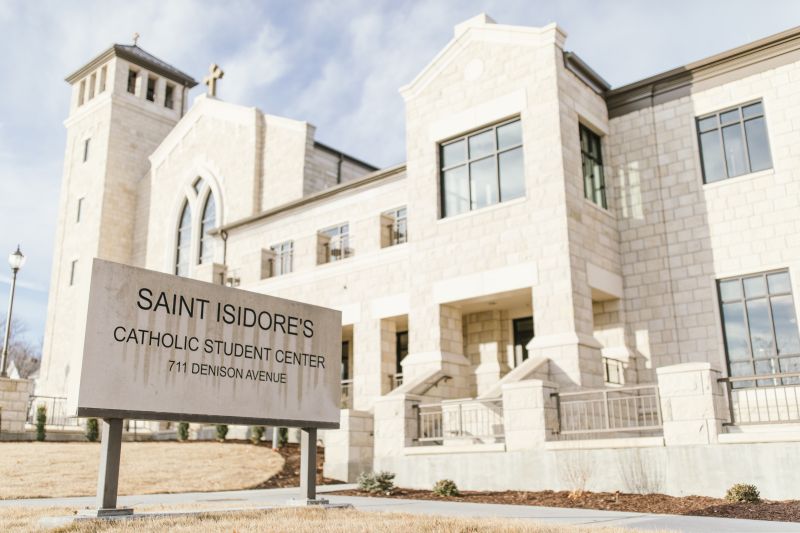
The exterior of the new St. Isidore’s Catholic Student Center at Kansas State University. / Credit: Jacob Bentzinger
CNA Staff, Oct 2, 2023 / 17:15 pm (CNA).
There’s a quote from Jerome Tang, head coach of the Kansas State University (KSU) basketball team, that Father Gale Hammerschmidt likes.
“I didn’t come to rebuild. I came to elevate,” Tang said after taking the team’s helm last year. (His team bowed out of the NCAA Tournament last spring after making it to the Elite Eight.)
Hammerschmidt, chaplain at St. Isidore’s Catholic Student Center at Kansas State, said he thinks “elevation” is an appropriate word for what the Catholic community he leads is doing right now. On Jan. 28, the local bishop dedicated the Catholic center’s brand-new, $20 million church — a project more than two decades in the making.
But now that the new church is open, the real work of bringing the Catholic faith to students on campus can continue. The grand new church presents an opportunity to “elevate everything we do here at St. Isidore’s,” Hammerschmidt told CNA.
“We know that the work is just now beginning. And if we’re going to create a beautiful space, we want to be able to do beautiful things in the space. And nothing is more beautiful than a soul encountering the living God,” the priest told CNA.
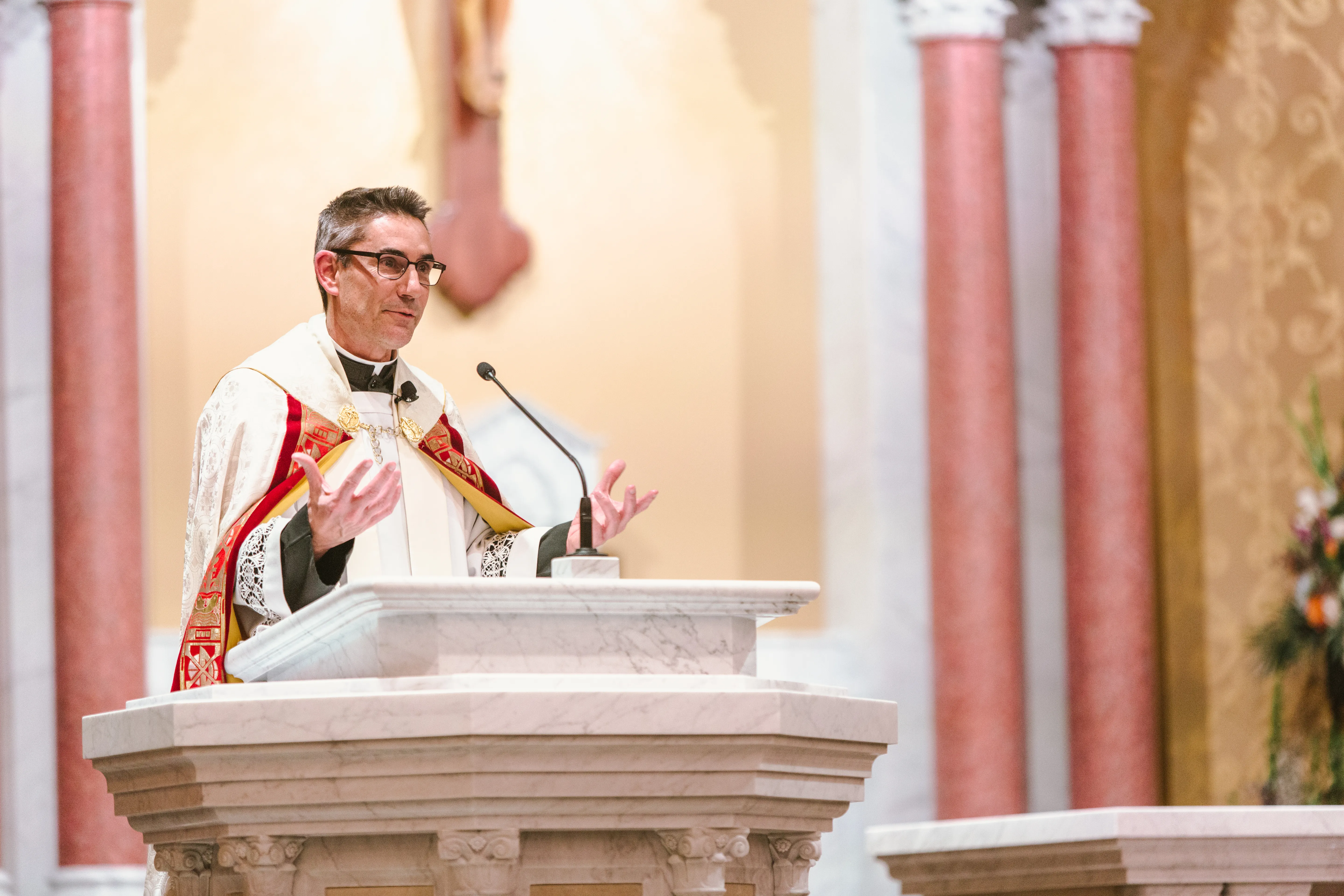
Hammerschmidt, a Kansas native and 1995 Kansas State alum, was ordained to the priesthood in 2012 and was assigned to St. Isidore’s in 2017. The Catholic center sits just across the street from the Kansas State campus, which is itself the lifeblood of the small city of Manhattan. There had been discussions about the need for a new church building for several years before he arrived.
“I already knew that there was a need to build a new church. This is something that had been talked about for probably 20 years, honestly, even since right around the time that I was graduating from college,” Hammerschmidt told CNA.
Father Gale Hammerschmidt. Credit: Jacob Bentzinger
Part of the reason was that the population served by St. Isidore’s had outgrown the old space, which sat about 400 and was regularly filled to bursting on Sundays with overflow seating in the student center library.
Grace Gorges, a K-State student studying graphic design, got involved with the Catholic community at the college as soon as she arrived at KSU. From the get-go, “the Masses were always crowded, always overflowing,” she said, adding that the fallout from COVID made things even worse when parts of the sanctuary had to be roped off for distancing purposes.
The campaign to raise money for a new church was dubbed “Home Away from Home.” About $5 million had already been raised before Hammerschmidt’s arrival, and the campaign ultimately raised nearly $20 million for the project, he said. Some 1,500 individual donors contributed to the campaign.
Nebraska-based lead architect Kevin Clark came to Manhattan in 2017 and began asking the community what they wanted their new church to look like. Countless students requested a beautiful interior, “traditional-looking in nature,” the priest said.
“We want this to look like a church that has been standing forever and will stand forever,” he recalled students telling him.
“We wanted to make sure that it was an epic-looking building” with an interior that would raise hearts and minds “to the beauties of heaven,” he said.
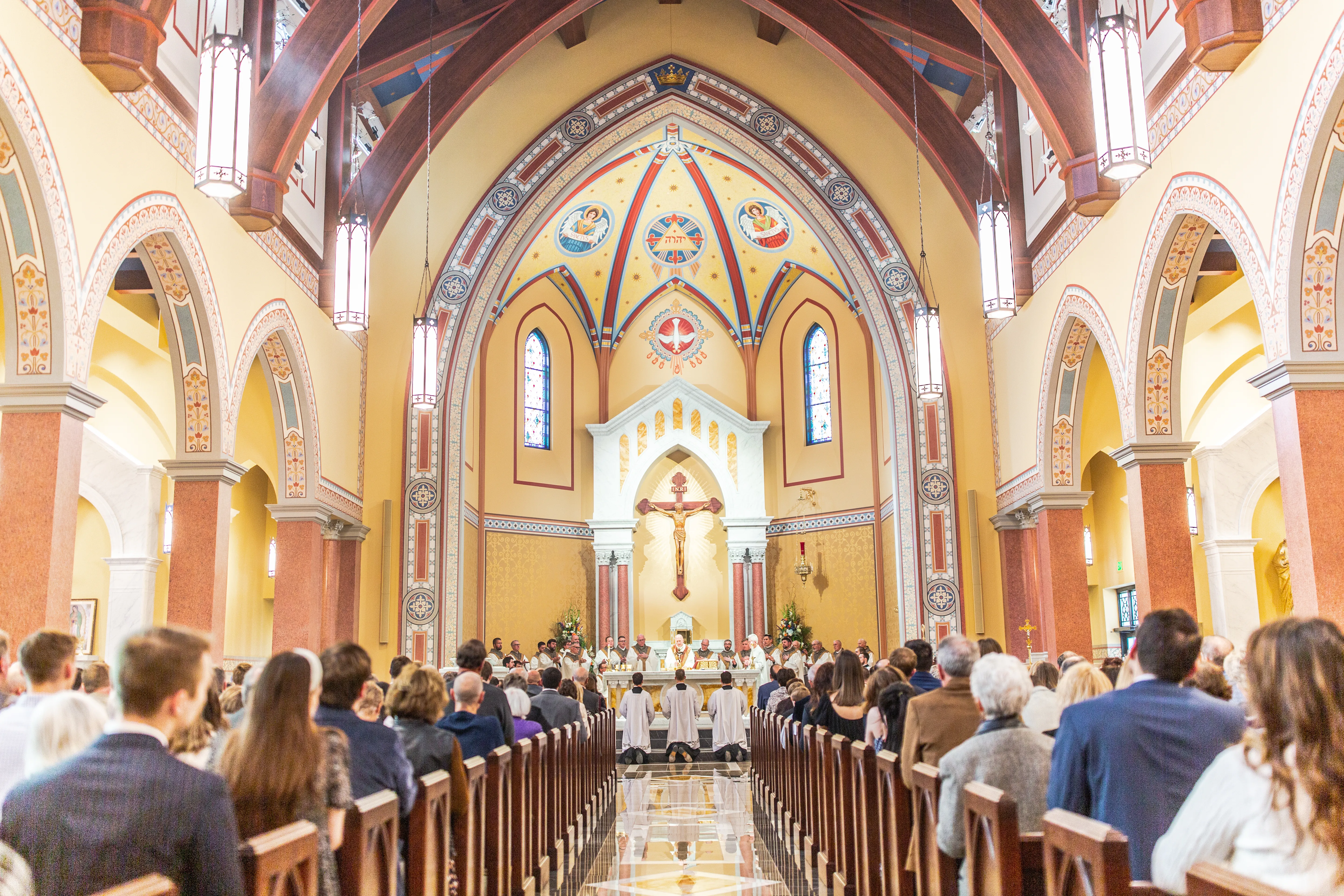
The congregation kneels during the dedication Mass for the new St. Isidore’s Catholic Student Center at Kansas State University. Credit: Jacob Bentzinger
Given her involvement in the community and her interest in beauty and design, Hammerschmidt asked Gorges to serve on the building committee, which meant she would have a say in the church’s aesthetic. Gorges said she was invited to help design the church’s tile flooring. She researched churches online for inspiration and also drew from her personal experience of visiting numerous beautiful sacred spaces on a trip to Italy.
Ridge Pinkston, a fifth-year senior when CNA spoke with him, studying medieval history, was also chosen to be on the building committee. He told CNA that the committee — which included Hammerschmidt, diocesan board member Doug Hinkin, and others — was given almost complete control over the look of the new church.
He said the committee had numerous meetings with the architect to figure out the look of everything in the new church — they spent an entire two-hour meeting designing the look of the altar, for example. He said the building committee “represented the body of owners” to the architect and designers, similar to how when a family builds a house, the architects and contractors consult them on how they want it to look. He said it was a “huge privilege” and a great learning process to be a part of the committee as a student.
Despite his interest in medieval architecture, the churches that Pinkston primarily drew inspiration from were mainly stateside; most are located in the Archdiocese of Denver. They included the medieval revival-style chapel at St. John Vianney Theological Seminary and the Cathedral Basilica of the Immaculate Conception and Holy Ghost Catholic Church, both in downtown Denver.
Ultimately, the architects and designers of St. Isidore’s produced a neo-Gothic interior with pointed arches that dropped many a jaw when it was unveiled. The interior also features numerous instances of vine imagery — an image of Jesus himself, but also a subtle nod to the college’s agricultural heritage. Evergreene Architectural Arts, a renowned design studio in New York, provided the decoration, Hammerschmidt said.
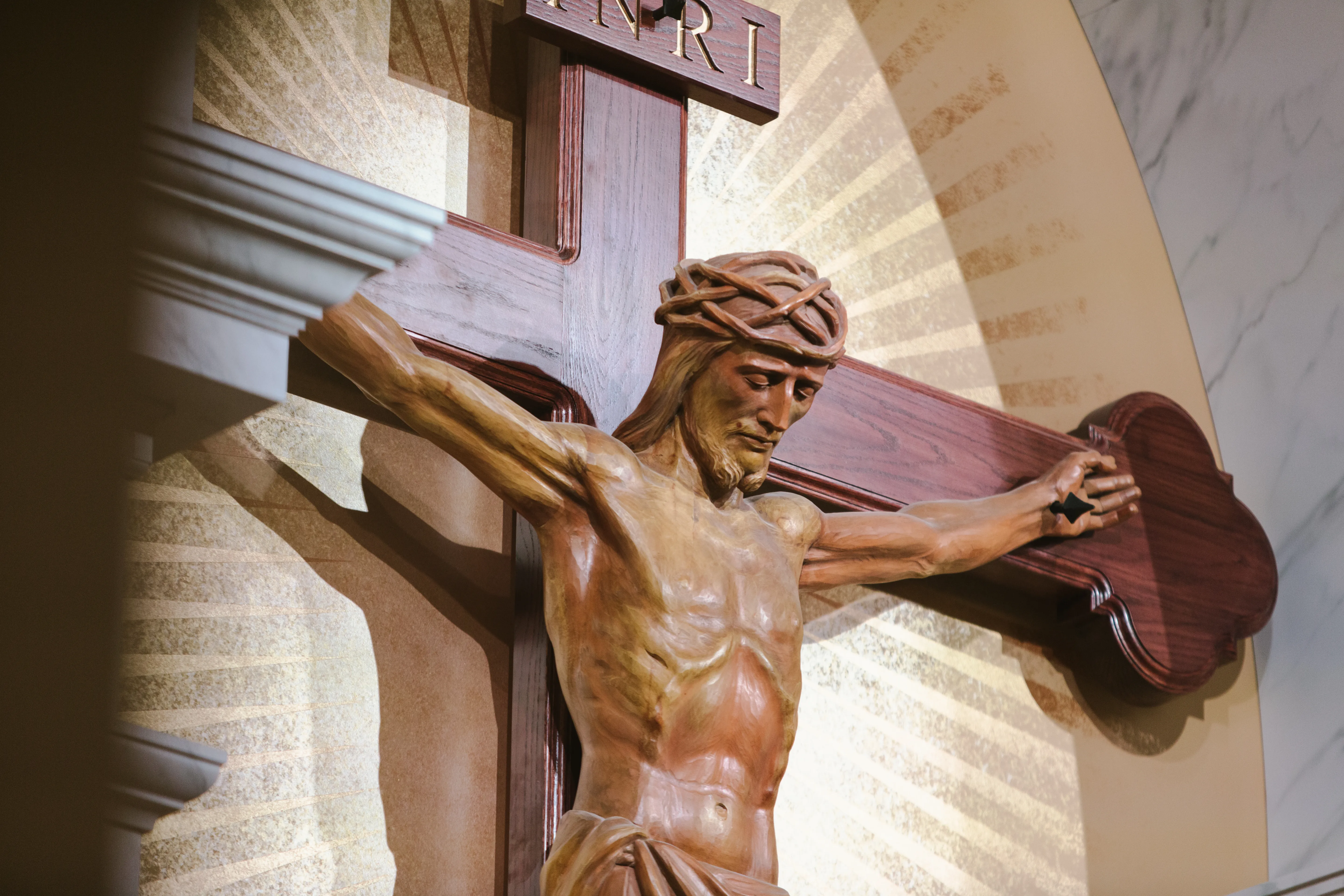
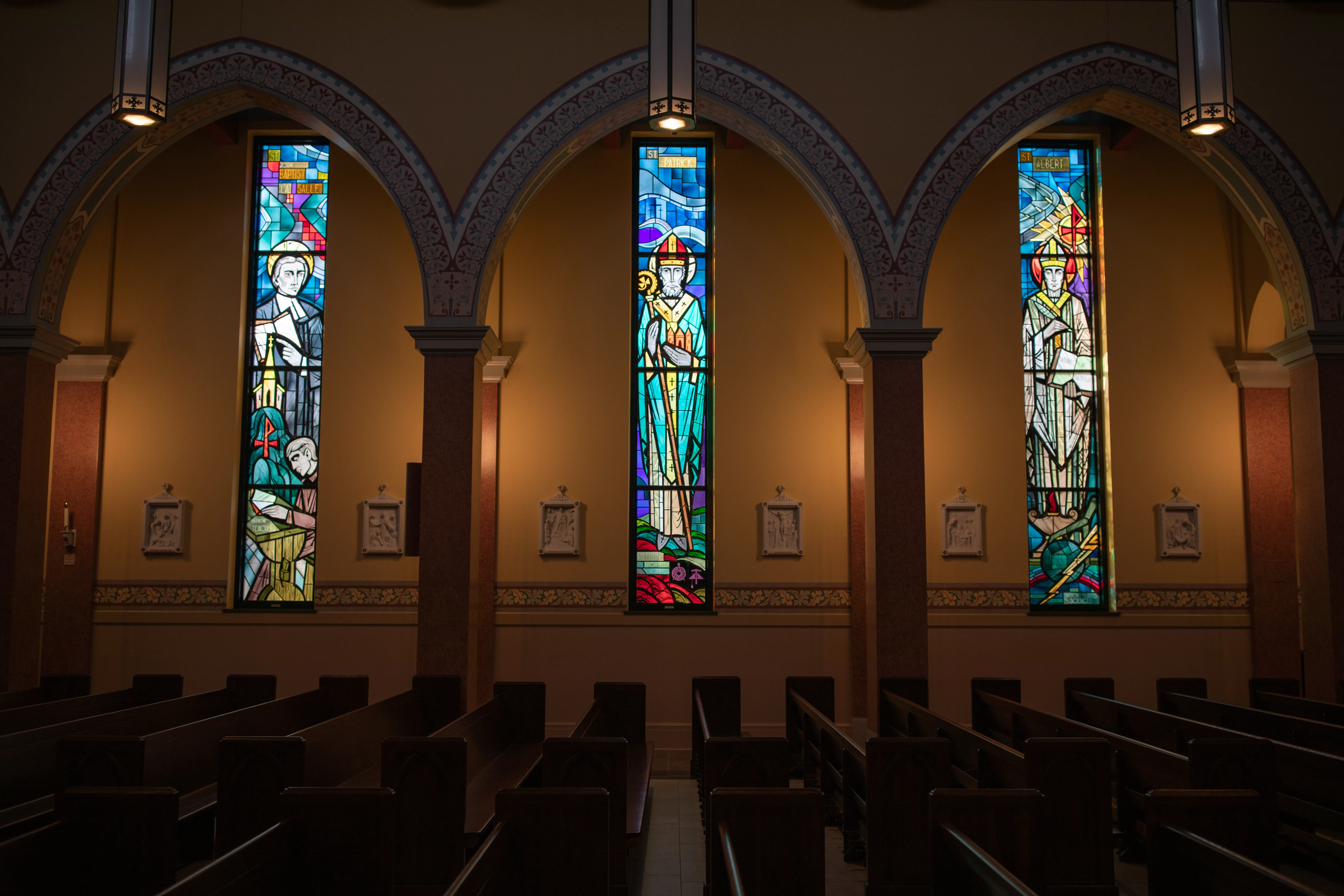
Not everything in the interior is entirely new, however. Hammerschmidt said at the request of students, stained-glass windows depicting the seven patron saints of the seven original colleges at Kansas State (the university was originally Methodist-founded) were saved and incorporated into the new church. Among those saints are the church’s namesake, St. Isidore — an 11th-century Spaniard and patron saint of agricultural workers — as well as the namesake of the student center, St. Robert Bellarmine. A much-loved crucifix that hung over the tabernacle in the old church was also used again in the new church.
The crucifix in the new St. Isidore’s Catholic Student Center. Credit: Jacob Bentzinger
Gorges said she loves the triumphal arch over the altar in the finished church, which draws one’s eyes toward the focal point of the crucifix, and onward to heaven. A beautiful church, she said, is “not the end-all-be-all by any means. But if it’s at all possible, beauty matters. And we should be trying to live that in our daily lives.”
Pinkston said his favorite design element in the new church, apart from the ceiling of the apse, is the new altar itself, which he said really strikes him as being designed in a way that calls to mind a place where sacrifices are made.
“Rightfully, that should be one of the most beautiful features,” he said of the altar.
The designers also took care to design the exterior of the church to match the native limestone buildings of Kansas State, in an effort to make the church an integral part of the campus it serves.
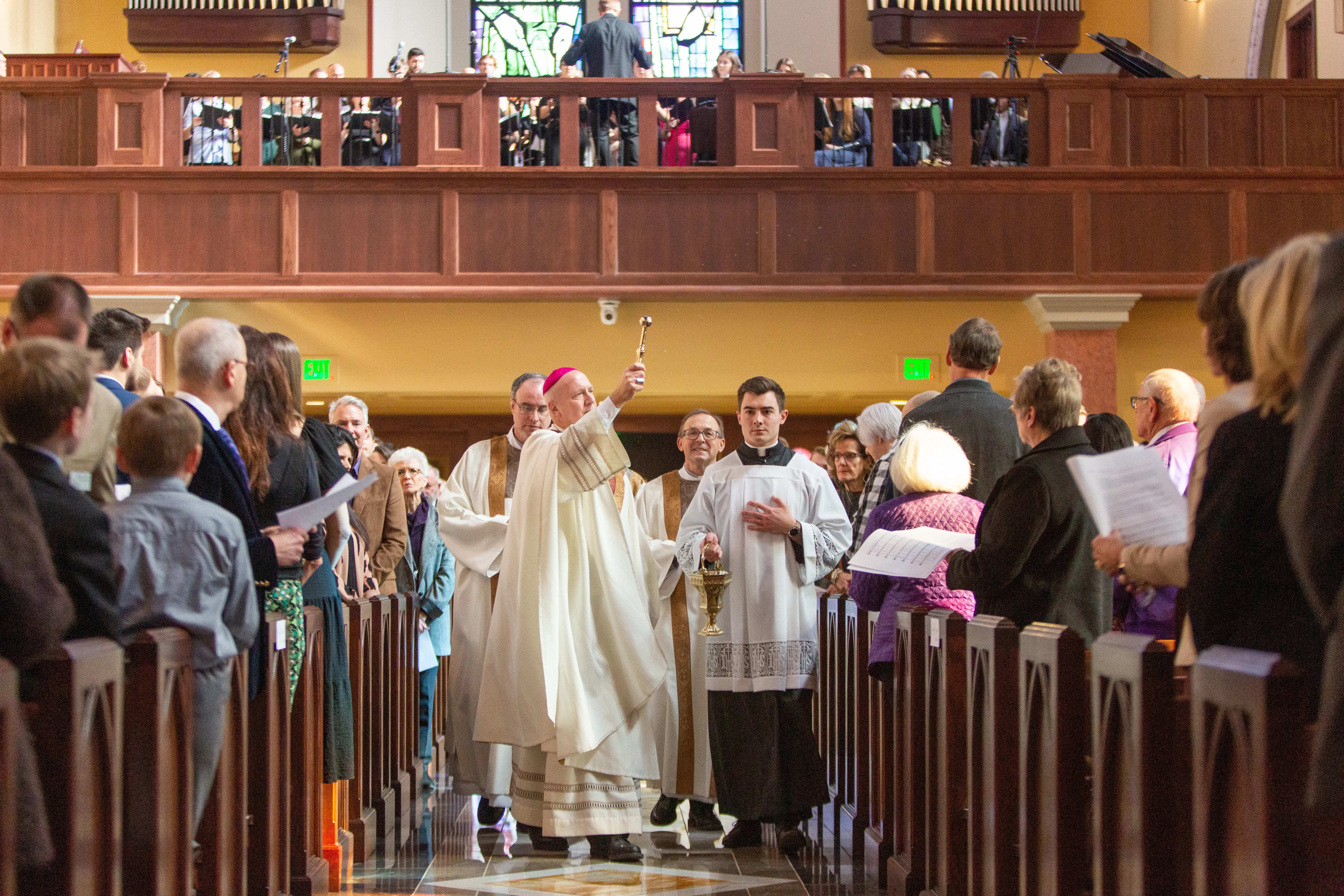
Bishop Gerald Vincke of Salina, Kansas, dedicated the diocese’s newest church on Jan. 28. The 14,000-square-foot structure can accommodate about 700 for Sunday Masses.
Bishop Gerald Vincke of Salina, Kansas, sprinkles holy water during the dedication of the new St. Isidore’s Catholic Student Center on Jan. 28, 2023. Credit: Jacob Bentzinger
Hammerschmidt said daily Masses at St. Isidore’s were already attracting nearly 200 students on a regular basis. A key part of the Catholic center’s success, he said, is the presence of missionaries from the Fellowship of Catholic University Students (FOCUS). FOCUS maintains a presence on college campuses with the goal of winning people to the Catholic faith through authentic friendships and forming others to go out and do the same through Bible studies, small groups, and retreats.
“We also work closely with the high schools in the state of Kansas, especially the Catholic high schools. And we have many strong Catholic high schools in our area. And so we just have students who, the first day they show up in Manhattan, they already know about us,” Hammerschmidt said.
In addition, he said, the Catholic center is in cooperation with the local Diocese of Salina and the nearby Diocese of Wichita, whereby Wichita — which has been blessed in recent years with large vocation numbers — sends a priest to serve as Hammerschmidt’s associate. Large numbers of students come to KSU from Wichita — Gorges among them — who get involved with the Catholic center thanks to strong word of mouth.
“It’s good for them to have one of their own priests looking after them … I think it’s working phenomenally well.”
Stained-glass windows in the new St. Isidore’s Catholic Student Center. Credit: Jacob Bentzinger
Working at St. Isidore’s, Pinkston said he has gotten to know “the regulars” that came to the church before the rebuild, but now with the new church, he said he sees many more people coming in to pray whom he has never seen before. He also said it was inspirational for him to see a friend — a man who is joining the Catholic Church this Easter — weeping openly when he first saw the new church’s interior.
“That was really the first time I’d ever seen him express emotion … That’s definitely a huge blessing to be able to see that happening,” he said.
Hammerschmidt was almost overwhelmed by the support of the many students, alumni, and others who made the new church possible. Months on from the chapel’s opening, the 9:09 p.m. daily Mass is always well attended, with about 300 students attending regularly. As of September, St. Isidore’s has 40 student-led Bible studies with around 400 Bible study participants.
“The outpouring of joy and gratitude has been incredible. The number of people who we will just see walking through the church from out of town is unbelievable,” Hammerschmidt said.
“And then beyond that, we had so many more hundreds of people praying for the project, and we just have been supported unbelievably well.”
Hammerschmidt said he wants the students and community of Kansas State to take ownership of the magnificent new church and to use it for their spiritual benefit.
“We want to let everybody in Manhattan and on K-State’s campus know that we built this church for them,” he said.
“If they just need a place of encounter with God to just come in to be seated, to be immersed in the beauty and the silence and to just let God speak. That’s our hope. For the Catholics, for the non-Catholics, for the students, for nonstudents, just for anyone who needs a place to encounter the living God, this would be the place for them.”
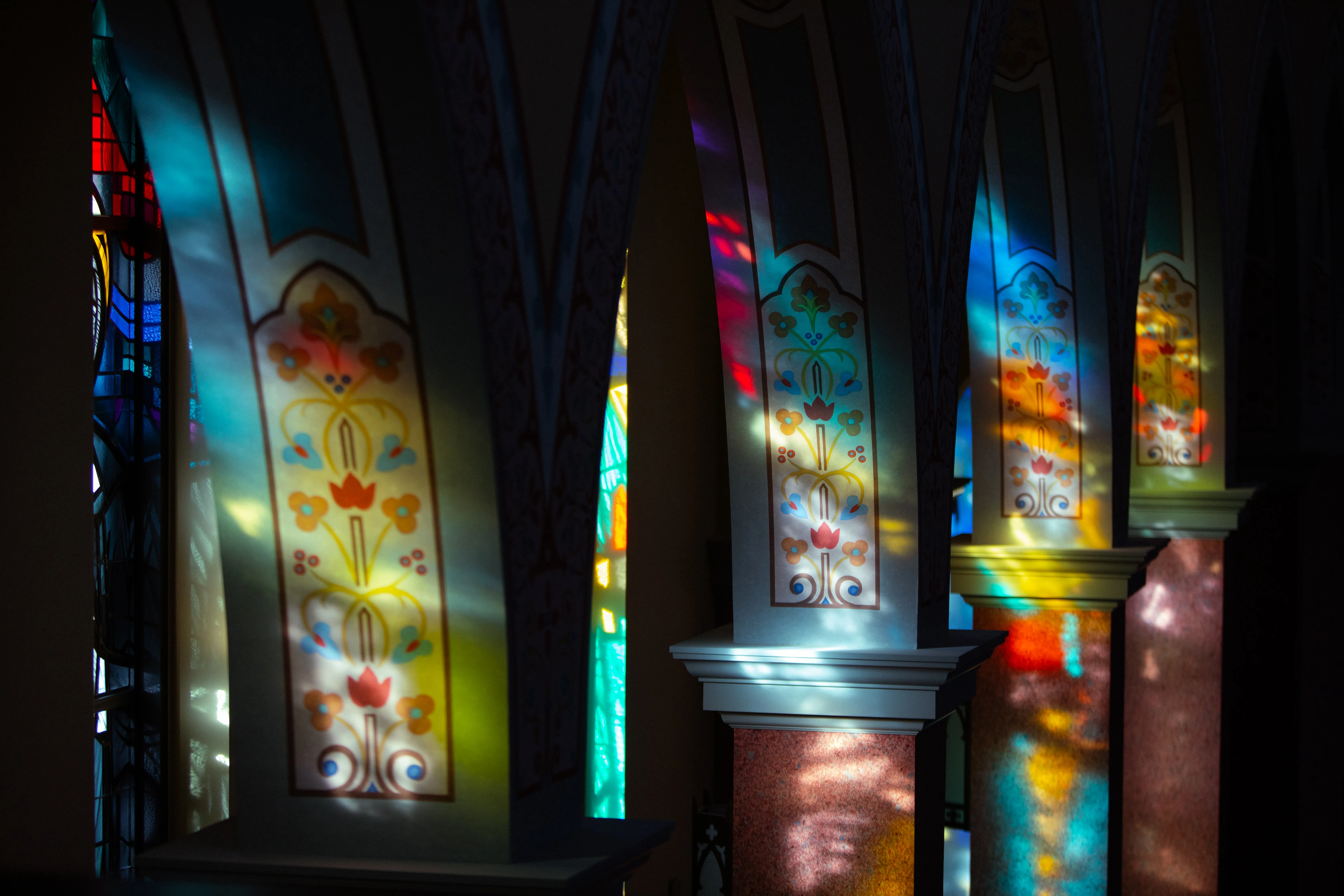
Light from the stained glass in the new St. Isidore’s Catholic Student Center. Jacob Bentzinger
Charleston, S.C., Apr 11, 2022 / 13:00 pm (CNA).
After the South Carolina Supreme Court set a date for the execution of Richard Moore, the Diocese of Charleston stated its opposition to capital punishment, a… […]
Albany, N.Y., Jul 30, 2018 / 12:37 pm (CNA/EWTN News).- Bishop Edward Scharfenberger of Albany wrote to the clerics of his local Church Sunday, saying that abuse of authority and sexual abuse by clerics is, more than a crisis of policies and procedures, a spiritual crisis.
His comments come amid a scandal centered on Theodore McCarrick, the Archbishop Emeritus of Washington. Last month the Archdiocese of New York announced that it had concluded an investigation into an allegation that McCarrick had sexually abused a teenager, finding the claim to be “credible and substantiated.” Since then, media reports have detailed additional allegations, charging that McCarrick sexually abused, assaulted, or coerced seminarians and young priests during his time as a bishop.
McCarrick resignation from the office of cardinal was accepted by Pope Francis on Saturday.
“Let me be clear,” Bishop Scharfenberger wrote, “in stating my firm conviction that this is, at heart, much more than a crisis of policies and procedures. We can – and I am confident that we will – strengthen the rules and regulations and sanctions against any trying to fly under the radar or to ‘get away with’ such evil and destructive behaviors. But, at its heart, this is much more than a challenge of law enforcement; it is a profoundly spiritual crisis.”
The Bishop of Albany’s July 29 letter was sent to clerics and seminarians, as well as parish life directors and department heads at the diocesan chancery.
He began by reflecting on the betrayal of Christ, saying that “Like Jesus in the Garden of Gethsemane, many of our faithful are now feeling betrayed and abandoned by their spiritual fathers, especially the bishops.”
“No doubt you have been and will be hearing from your people about how shaken and discouraged they are over public revelations of despicable behavior on the part of a very popular and charismatic Cardinal with priests and seminarians in his care.”
Bishop Scharfenberger shared that he had been texted by a friend who conveyed “his family’s utter despondency over this and that the USCCB should disband itself: ‘[t]heir credibility is shot, probably for decades.’”
The bishop said that further “words are not going to repair, let alone restore, the damage that has been done. Lawyering, pledges and changes in the bureaucratic structures and policy – however well intentioned – cannot do it either. I do not see how we can avoid what is really at the root of this crisis: sin and a retreat from holiness, specifically the holiness of an integral, truly human sexuality.”
Bishop Scharfenberger repeated “as clearly and directly” as he could the Church’s teaching that sexual activity outside a valid marriage is a grave sin: “A cardinal is not excused from what a layperson or another member of the clergy is not … This is what our faith teaches and what we are held to in practice. There is no ‘third way.’”
Gravely sinful sexual activity outside marriage “includes grooming and seduction,” the bishop wrote. Such acts of McCarrick were detailed by a priest of the Diocese of Albany, who was once a seminarian under the former cardinal, in an interview with America magazine published July 25.
“The psychological and spiritual destructiveness of such predatory behavior, really incestuous by a man who is held up as a spiritual father to a son in his care – even if not a minor – cannot be minimized or rationalized in any way,” Bishop Scharfenberger wrote. “On that, it seems to me, we are experiencing an unusual unity amidst the many political and ecclesial tensions in our communities.”
“Abuse of authority – in this case, with strong sexual overtones – with vulnerable persons is hardly less reprehensible than the sexual abuse of minors, which the USCCB attempted to address in 2002.”
He noted that the Charter for the Protection of Young People, adopted by the USCCB in 2002, “unfortunately … did not go far enough so as to hold cardinals, archbishops and bishops equally, if not more, accountable than priests and deacons.”
Bishop Scharfenberger said he believes the vast majority of clerics “live or, at least, are striving to live holy and admirable lifestyles. I am ashamed of those of my brothers, such as the Cardinal, who do not and have not. As your Bishop, you can be sure of my support for you and all the faithful during this very difficult time.”
He expressed gratitude for “all of those who have come forward to expose these patterns of sin in the lives of some – as well the institutional sins of denial and suppression of those brave witnesses whose warnings went unheard or unheeded, so that some of the harm might have been prevented.”
“I hope and pray that others who may have suffered such traumatic experiences at the hands of their spiritual fathers will find the courage to say so. To you, if you are among them, and to them I offer my support and assistance in any way the resources I have can muster.”
Bl. Paul VI’s Humanae vitae “prophetically warned … of the long-range consequences of the separation of sexuality and sexual behavior from the conjugal relationship,” he said.
“Contemporary culture in our part of the world now holds it normative that sex and sexual gratification between any consenting persons for any reason that their free wills allow is perfectly acceptable. This is not a sexuality befitting of human beings that responds to the need and true desire of every human person to be respected and loved fully and unconditionally.”
Clerics “must practice what we preach and teach,” he emphasized. “We also need to uphold what our faith proclaims about the gift and beauty of human sexuality, fully lived in its essential conjugal meaning.”
“A culture of virtue and chastity – in short, personal holiness – rooted in a trusting and committed relationship with Jesus Christ is the path toward healing and wholeness, even as we seek to drive the evil behaviors among us from the womb of the Church.”
Bishop Scharfenberger commended preparation for a Eucharistic Congress as “a time of spiritual renewal for all of us seeking to follow in the footsteps of our Lord and Master who was himself betrayed by his closest friends, but died for us to save us from ourselves and to offer us a way to living our humanity fully in this life and in the heaven to come.”
This is a matter of priorities. I would like to know how bad it is to be defined “gravely immoral”? Catholics have a penchant for labeling those who seek to defy their dogma. The damning of a poor soul is not so prevalent in other Christian faiths. They walk a tight rope to heaven while Catholics use a piano wire, (much more difficult). We seem to be struggling with a barren woman and wishes to assign a surrogate to the duty of bearing the embryo. I ask, what priority does this have in the broader scheme of life? Is there priority of casting dispersions on the mother and surrogate over caring for the Trump abandoned babies on the Mexican border? How can we have a higher priority than aiding the people being raped and murdered in Syria, Yemen, Rwanda and Myanmar? Who would not place a high priority on nuclear annihilation? Even Pope Francis is on the side of the world’s Eco scientists. I am not a tree hugger. I am a forest hugger. Perhaps the highest priority order is getting the global warming souls to accept that human activity is the greatest contributor to climate change. My fourth degree knight brother-in-law thinks in old Catholic terms when he rejects controlling the expanding population. He was quick to support the church’s pedophile disgrace by saying “it was only a small number of priests”. If SM is the highest priority, I may be missing the point. I will try to save my soul if one cannot be “gravely” damned for speaking out. However, I must exercise caution… I have neuropathy in my feet and I would have a problem walking a piano wire.
No, morgan, it is not a “matter of priorities.” It is clearly evil – or clearly to anybody who isn’t blinded by hatred of any sort of discipline or dogma that disagrees with something that person wants to do.
“Catholics have a penchant for labeling those who seek to defy their dogma.”
Well, well, well: you’re finally admitting that you aren’t Catholic, having pretended that you were as you did your concern troll postings.
“The damning of a poor soul is not so prevalent in other Christian faiths.”
People can damn only their own souls, by sinning.
“They walk a tight rope to heaven while Catholics use a piano wire, (much more difficult).”
No; Catholics have a clear path, and there are strong fences protecting them from falling off the nearby cliffs.
“We seem to be struggling with a barren woman and wishes to assign a surrogate to the duty of bearing the embryo.”
So? Nobody has an absolute right to give birth to a child. And that’s the issue not “I want a child,” because there are many children who need parents; but that’s just not good enough for someone who demands *MY OWN BABY!*
Dragging in all those issues is ridiculous. “Well, it’s not nuclear annihilation, so I can go out and fornicate and steal and murder because that’s not nearly so bad.”
“Is there priority of casting dispersions on the mother and surrogate over caring for the Trump abandoned babies on the Mexican border?”
Presumably you mean aspersions. And the two are completely unrelated. In any case, those parents who put their children into extremely dangerous situations by using illegal methods to enter the United States don’t seem like the ideal people to have custody of a child.
“Perhaps the highest priority order is getting the global warming souls to accept that human activity is the greatest contributor to climate change.”
“My fourth degree knight brother-in-law thinks in old Catholic terms when he rejects controlling the expanding population.”
In other words, your brother-in-law is a faithful Catholic and a decent man.
“He was quick to support the church’s pedophile disgrace by saying ‘it was only a small number of priests’
The number of pedophile scandals in the Church is very, very, very small. The number of predatory homosexual ephebophile priests, on the other hand, appears to be much larger.
“I will try to save my soul if one cannot be “gravely” damned for speaking out.”
What are you babbling about?
“However, I must exercise caution… I have neuropathy in my feet and I would have a problem walking a piano wire.”
Your problem is not with your feet, it’s with your mind and your will. You hate the Church’s teachings because like a small child you’re screaming, “Mommy, you never let me do *anything* I want to do! It’s not fairrrrrrrrrr!”




This is a matter of priorities. I would like to know how bad it is to be defined “gravely immoral”? Catholics have a penchant for labeling those who seek to defy their dogma. The damning of a poor soul is not so prevalent in other Christian faiths. They walk a tight rope to heaven while Catholics use a piano wire, (much more difficult). We seem to be struggling with a barren woman and wishes to assign a surrogate to the duty of bearing the embryo. I ask, what priority does this have in the broader scheme of life? Is there priority of casting dispersions on the mother and surrogate over caring for the Trump abandoned babies on the Mexican border? How can we have a higher priority than aiding the people being raped and murdered in Syria, Yemen, Rwanda and Myanmar? Who would not place a high priority on nuclear annihilation? Even Pope Francis is on the side of the world’s Eco scientists. I am not a tree hugger. I am a forest hugger. Perhaps the highest priority order is getting the global warming souls to accept that human activity is the greatest contributor to climate change. My fourth degree knight brother-in-law thinks in old Catholic terms when he rejects controlling the expanding population. He was quick to support the church’s pedophile disgrace by saying “it was only a small number of priests”. If SM is the highest priority, I may be missing the point. I will try to save my soul if one cannot be “gravely” damned for speaking out. However, I must exercise caution… I have neuropathy in my feet and I would have a problem walking a piano wire.
No, morgan, it is not a “matter of priorities.” It is clearly evil – or clearly to anybody who isn’t blinded by hatred of any sort of discipline or dogma that disagrees with something that person wants to do.
“Catholics have a penchant for labeling those who seek to defy their dogma.”
Well, well, well: you’re finally admitting that you aren’t Catholic, having pretended that you were as you did your concern troll postings.
“The damning of a poor soul is not so prevalent in other Christian faiths.”
People can damn only their own souls, by sinning.
“They walk a tight rope to heaven while Catholics use a piano wire, (much more difficult).”
No; Catholics have a clear path, and there are strong fences protecting them from falling off the nearby cliffs.
“We seem to be struggling with a barren woman and wishes to assign a surrogate to the duty of bearing the embryo.”
So? Nobody has an absolute right to give birth to a child. And that’s the issue not “I want a child,” because there are many children who need parents; but that’s just not good enough for someone who demands *MY OWN BABY!*
Dragging in all those issues is ridiculous. “Well, it’s not nuclear annihilation, so I can go out and fornicate and steal and murder because that’s not nearly so bad.”
“Is there priority of casting dispersions on the mother and surrogate over caring for the Trump abandoned babies on the Mexican border?”
Presumably you mean aspersions. And the two are completely unrelated. In any case, those parents who put their children into extremely dangerous situations by using illegal methods to enter the United States don’t seem like the ideal people to have custody of a child.
“Perhaps the highest priority order is getting the global warming souls to accept that human activity is the greatest contributor to climate change.”
Pope Francis isn’t a scientist, and neither are you. https://www.thegwpf.org/content/uploads/2018/10/Lindzen-2018-GWPF-Lecture.pdf
“My fourth degree knight brother-in-law thinks in old Catholic terms when he rejects controlling the expanding population.”
In other words, your brother-in-law is a faithful Catholic and a decent man.
“He was quick to support the church’s pedophile disgrace by saying ‘it was only a small number of priests’
The number of pedophile scandals in the Church is very, very, very small. The number of predatory homosexual ephebophile priests, on the other hand, appears to be much larger.
“I will try to save my soul if one cannot be “gravely” damned for speaking out.”
What are you babbling about?
“However, I must exercise caution… I have neuropathy in my feet and I would have a problem walking a piano wire.”
Your problem is not with your feet, it’s with your mind and your will. You hate the Church’s teachings because like a small child you’re screaming, “Mommy, you never let me do *anything* I want to do! It’s not fairrrrrrrrrr!”