Dhaka, Bangladesh, Jun 5, 2018 / 12:10 am (CNA/EWTN News).- A United Nations-led campaign to provide contraception to Rohingya refugees in Bangladesh camps fails to show respect for the views of the already vulnerable community, said one human rights group.
“I am deeply concerned, but not surprised, that UNFPA views the deeply held values of an already victimized community as an obstacle to their goals rather than something to be respected,” said Nadja Wolfe, director of advocacy at the World Youth Alliance, a human rights group which promotes the dignity of the human person.
“Rohingya women deserve healthcare that meets their needs and respects, rather than undermines, their values,” Wolfe told CNA.
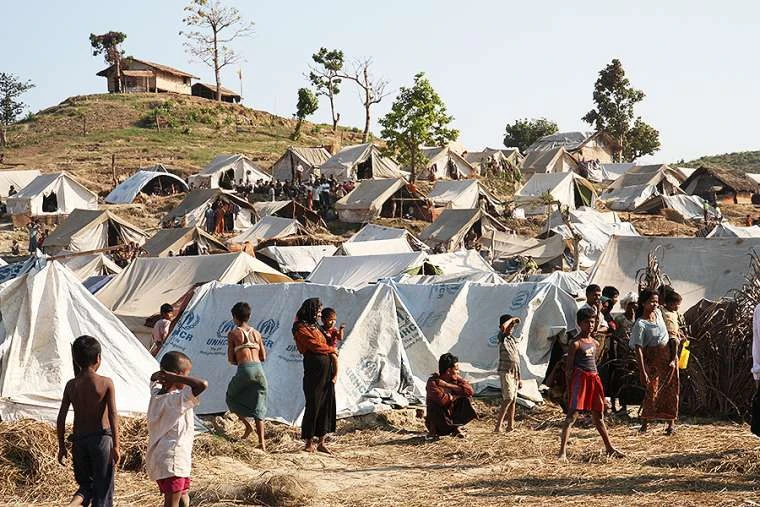
The Rohingya are a largely Muslim ethnic group who reside in Burma’s Rakhine State. Facing state-sponsored violence in their homeland, more than 660,000 have fled to neighboring Bangladesh for refuge and currently reside in camps.
On April 17, the United Nations Population Fund (UNFPA) and the Bangladesh Family Planning Directorate signed an agreement to provide Rohingya refugees both short and long-term contraception, maternal health services, and record keeping. The campaign is offering around 8,600 implants and 600 other IUDs for the refugees in camps, as well as other methods of birth control, such as pills and condoms.
However, many of the refugees hold deep-seated cultural and religious objections to birth control.
Bangladesh and UN officials promoting the contraception campaign said they are recruiting interpreters, midwives, volunteers and paramedics in an attempt to convince the Rohingya women to accept contraception.
“We plan to recruit eight interpreters who can provide counseling to convince them [about contraception],” said Kazi Mustafa Sarwar, a family planning official for Bangladesh, according to The Irrawaddy.
“It’s our main challenge, as we have yet to make them convinced,” Sarwar continued, noting that many Rohingya women “threw condoms away when our staff supplied them,” although others have accepted short-acting injectable contraceptives.
Some of the refugees have said that they wanted big families to help them survive in the camps, while other voiced religious objections to birth control. Others believe that short-term contraception is acceptable, but will refuse any long-term devices.
According to the World Health Organization, around 100,000 Rohingya children are expected to be born in Bangladesh in 2018.
If you value the news and views Catholic World Report provides, please consider donating to support our efforts. Your contribution will help us continue to make CWR available to all readers worldwide for free, without a subscription. Thank you for your generosity!
Click here for more information on donating to CWR. Click here to sign up for our newsletter.
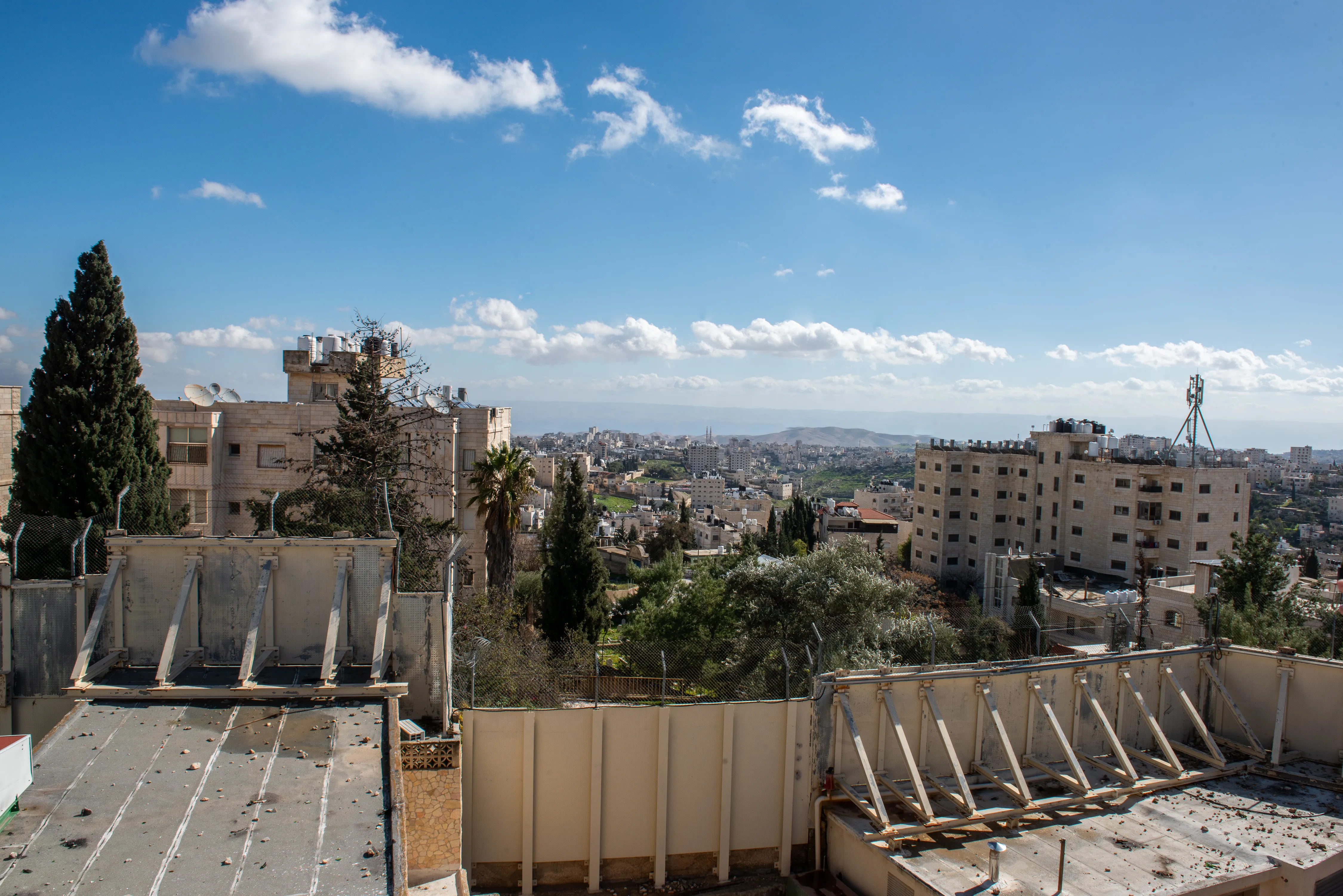
A view of the separation wall between Israel and the Palestinian Territories from behind a window in the Comboni Sisters’ house in East Jerusalem. / Credit: Marinella Bandini
Jerusalem, Feb 17, 2024 / 06:00 am (CNA).
The Comboni Sisters have been living on the border of East Jerusalem since 1967. Running along the border of their property is a wall, constructed by the Israelis in 2009, dividing the village of Bethany/al-Eizariya — renowned as the site of the resurrection of Lazarus. The sisters’ residence remains on the Israeli side, while the church and the tomb of Lazarus are on the Palestinian side, on the other side of the wall.
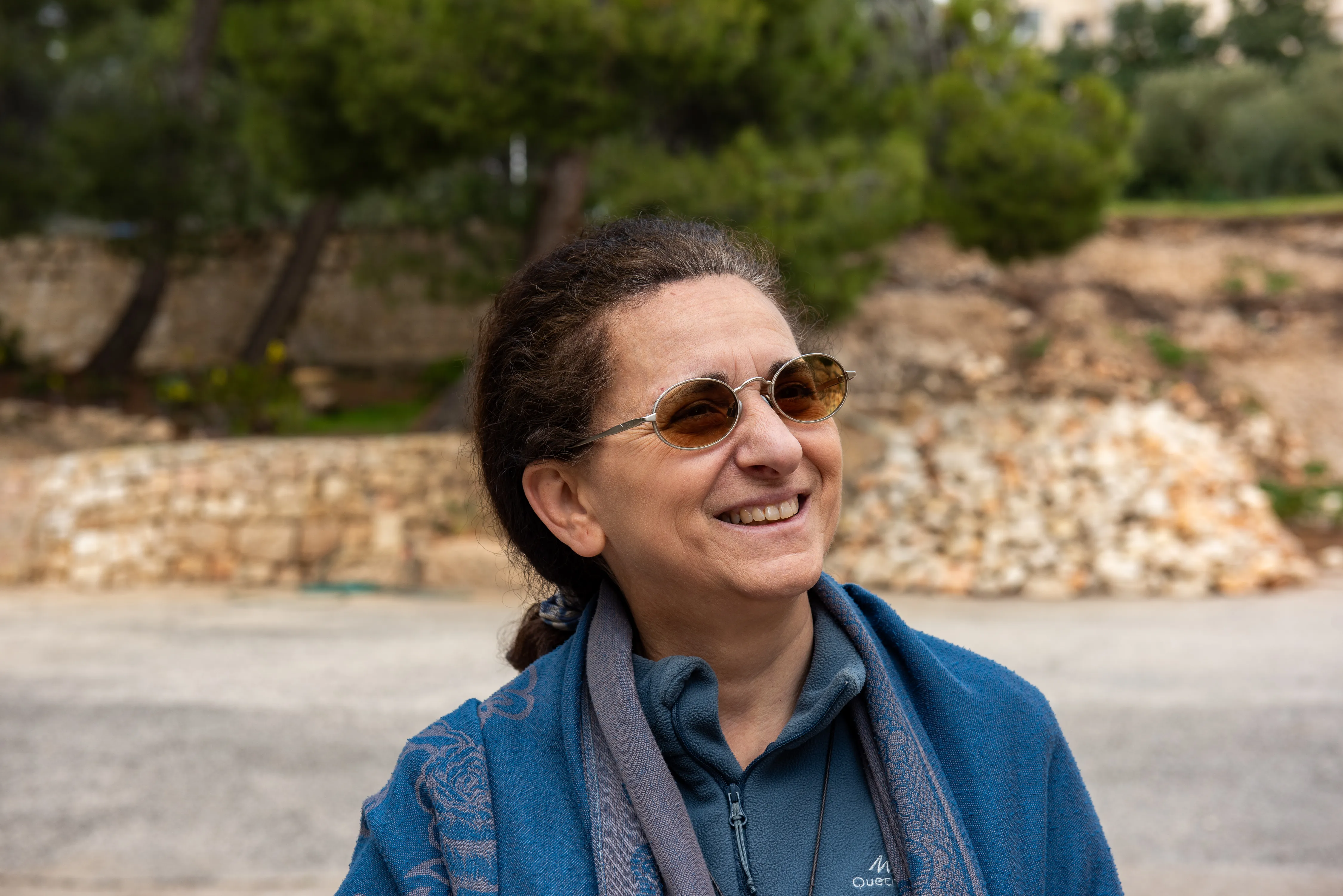
“For us, the passage from Scripture that says ‘in Christ the wall of separation between peoples has been broken down’ is very powerful [Eph 2:14], especially when there is a physical wall in front of us that clearly indicates this separation,” Sister Anna Maria Sgaramella, provincial councilor and coordinator of the Middle East Zone for the Comboni Sisters, told CNA.
Sister Anna Maria Sgaramella, provincial council and coordinator of the Middle East Zone for the Comboni Sisters. Credit: Marinella Bandini
Sgaramella arrived in Jerusalem for the first time on Sept. 26, 2000. The very next day, the second intifada — a major uprising by Palestinians against Israeli occupation — erupted. She witnessed the siege of the Basilica of the Nativity in Bethlehem, where she taught theology.
Later, she was transferred to Egypt, where in 2011, she witnessed the uprising known as the “Arab Spring.”
Since 2013, Sgaramella has permanently returned to Jerusalem and now faces another long and bloody conflict. “I have always been struck by the deep sense of hope and determination to move forward among the Palestinian people. With this war, I see it weaker; people are more exhausted,” she said.
A view of the separation wall between Israel and the Palestinian Territories from the terrace of the Comboni Sisters’ house in East Jerusalem. The wall, constructed by the Israelis in 2009, runs along the border of their property, dividing the village of Bethany/al-Eizariya in two, believed to be the site of the miracle of the raising of Lazarus. The sisters’ residence remains on the Israeli side, while the church and the tomb of Lazarus are on the other side of the wall. Credit: Marinella Bandini
There are currently six Comboni Sisters in Jerusalem and each is involved in a specific ministry. They usually come together for morning Mass and evening vespers as well as for meetings and reflection. Their community house is open to religious individuals seeking periods of study or discernment and serves as a center of spirituality for both the congregation and the local Church. The sisters host educational workshops and spiritual exercises as well as welcome pilgrims.
The Comboni Sisters in Jerusalem in a recent photo at the Jordan River. The Comboni Sisters’ community in Jerusalem currently consists of six sisters and each is involved in a specific ministry. Credit: Photo courtesy of Sister Anna Maria Sgaramella
Sgaramella shared with CNA what it’s like to live on the border.
“With the construction of the wall, we found ourselves in the middle, between Palestinians and Israelis,” she explained. “The Palestinians attempt to bypass the wall — especially to pray at the Dome of the Rock — while the Israelis try to repel them in an endless game.”
“Being in the middle is a physical position that has also become a spiritual one,” Sgaramella continued. “We had to reflect and decided to ‘stay in the middle,’ between these two peoples, to serve as a bridge between them. By placing ourselves in the middle, we listen to the injustice faced by the Palestinians and also to the fears of Israeli families.”
For this reason, the religious community has chosen to maintain a small presence in the Palestinian area. Two sisters reside in an apartment beyond the wall, about 100 feet from the Comboni Sisters’ residence.
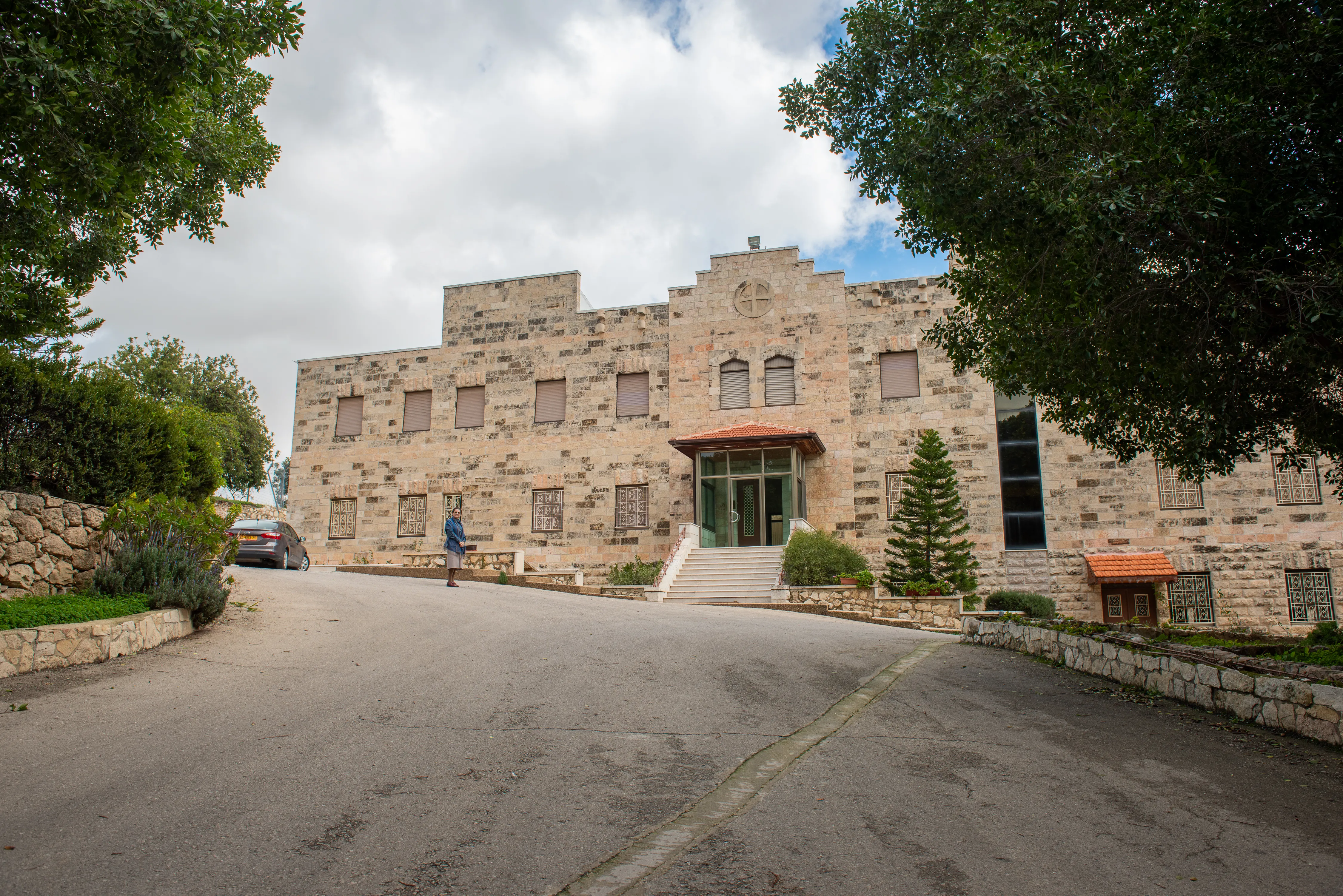
The exterior of the Comboni Sisters’ house in East Jerusalem where the Comboni Sisters have been living since 1967. Credit: Marinella Bandini
“We desired to stay and share the lives of those people and accompany the small remaining Christian community there. Every time they need to reach the community, they have to travel 18 kilometers [about 11 miles] passing through the Israeli checkpoint,” Sgaramella explained.
The sisters do not do this simply in the spirit of altruism, explained Sgaramella, who is also involved in ecumenical and interreligious dialogue. “We understood from the beginning that being in the middle comes at a cost. It often means getting hit from both sides. On one hand, there are stones and Molotov cocktails from the Palestinians that land on our property; on the other hand, we are under the smoke of tear gas launched in response by the Israelis,” she said.
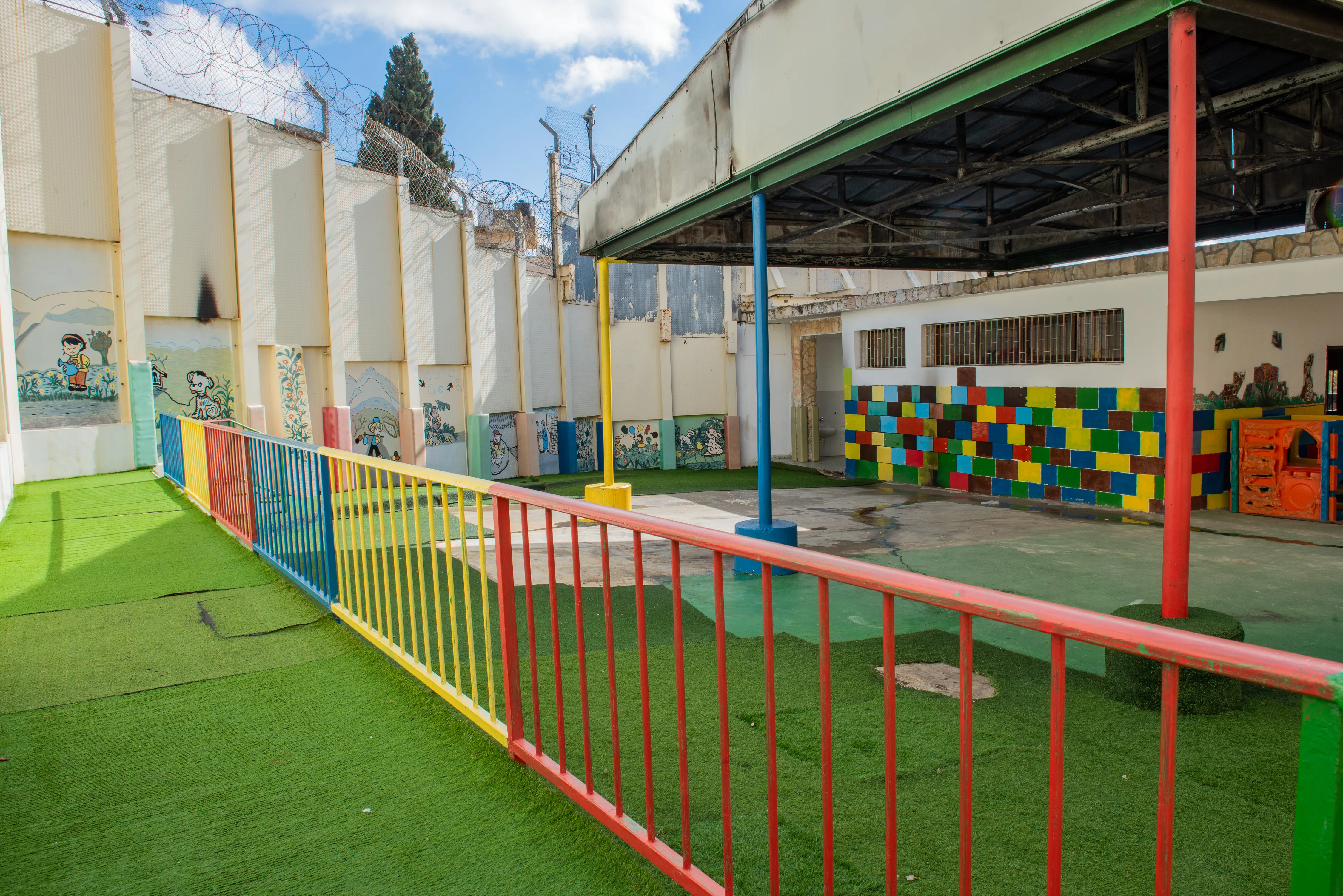
One incident happened the night of Oct. 6, just hours before the Hamas attack on Israel. Some Molotov cocktails landed on the synthetic grass in the part of the property that houses the kindergarten, causing a fire — the signs of which are still visible today. The fire destroyed the grass, playground equipment, and blackened the recently painted wall.
The exterior of the kindergarten, housed on the Comboni Sisters’ property. In the background is the separation wall that was erected on the edge of the Comboni Sisters’ property in 2009.
The kindergarten is a work that the Comboni Sisters have been carrying out since their arrival and today it serves as an important point of connection with the surrounding community. This significance has grown, especially after the construction of the wall.
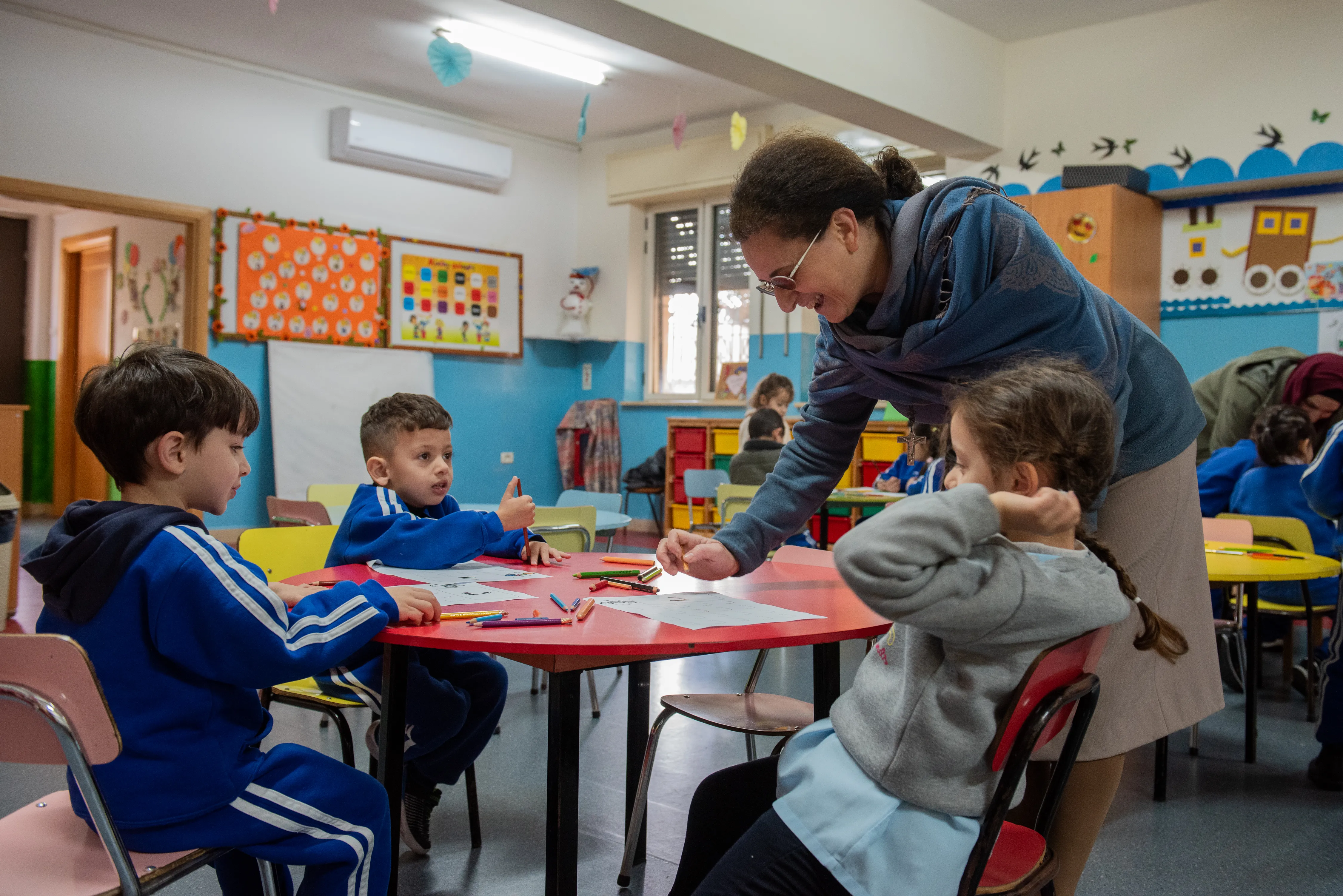
“The presence of the kindergarten has never been questioned, neither with the wall nor with the war,” said Sgaramella, who is the director. The kindergarten is attended by approximately 40 children, all of whom are Muslims, divided into two classes. Formally, it is under the jurisdiction of the Palestinian Ministry of Education. “It is a project that meets the needs of the people; furthermore, episodes of violence never occur during the day when the children are present,” she added.
Sister Anna Maria Sgaramella of the Comboni Sisters talks with the children in one of the kindergarten classes hosted at their home in East Jerusalem. The presence of the kindergarten has never been questioned, said Sgaramella, the director. Credit: Marinella Bandini
Every morning, the children begin with a prayer. “We tell the parents right from the start,” Sgaramella explained. “It’s a prayer of thanksgiving for what God has created, for the day, for life, a blessing for parents, neighbors, friends, and also for children who suffer. We pray for peace in the world and in this country.”
Regarding the families, she shared: “There is great trust and respect. They usually choose to send their children here, especially for moral education and English-language instruction.”
Most of the children come from East Jerusalem, but some also come from al-Eizariya. One of the two teachers, Nihal Hashmime, who is also the vice director, has to pass through the checkpoint every day to get to work.
“With the war,” the sister told CNA, “we faced some educational challenges because initially, some children were absent. The work we do with them is to impart certain values, such as peace, friendship, love, and respect for differences.”
Play is also an important aspect. “Children here do not find toy weapons, and they are not allowed to bring them from home,” Sgaramella said.
“Our attempt in education and all other activities is to break down this wall that leads to seeing the other as an enemy,” Sgaramella said. “Sometimes it is difficult to recognize the universality of salvation. We know that Jesus died for everyone, but in certain conflict-ridden contexts, it is challenging to acknowledge the other as a brother. Personally, the field of teaching theology provides me with the space to build bridges among believers. Because in every religion, there are sincere believers seeking truth.”
Jos, Nigeria, Jun 25, 2018 / 06:02 pm (CNA/EWTN News).- More than 80 people were killed over the weekend in clashes between farmers and herders in Nigeria’s central Plateau State.
This series of clashes is the latest in a several-years’ conflict between nomadic Fulani herdsmen, most of whom are Muslim, and the largely Christian farmers of the region, over resources.
This weekend’s violence was reportedly begun by an attack of Berom farmers on Fulani herders June 21, AFP reports. The farmers attacked a group of five herdsmen travelling with their cattle in the Barkin Ladi Local Government Area, fewer than 30 miles south of Jos.
The following day two Berom children were killed in area villages in apparent reprisal attacks.
There were then clashes in Berom villages Saturday and Sunday. Plateau State officials have said 86 bodies had been found a search of the villages after the violence. 50 houses were burned, and well as vehicles.
Berom youths erected roadblocks on Sunday, attacking travellers who looked “Fulani and Muslim”, the AFP reported.
The state government has imposed a 6pm – 6am curfew in the Barkin Ladi, Riyom, and Jos South local government areas to “avert a breakdown of law and order”.
Nigerian President Muhammadu Buhari called the attacks “painful and regrettable,” and offered his “deepest condolences to the affected communities.”
“We will not rest until all murderers and criminal elements and their sponsors are incapacitated and brought to justice,” Buhari said on Twitter.
US Rep. Chris Smith (R-NJ), chair of the House Subcommittee on Africa, stated June 25 that “The increasing cycle of violence and impunity we have observed in Nigeria over the past few months warrants a firm response from Nigeria’s civil leaders, beginning with President Buhari. I implore Nigeria’s moral voices, especially the Sultan of Sokoto, to speak out against the Fulani extremists’ growing disregard for the life and property of Nigerian Christians.”
There was a separate incident between Fulani herdsmen and Bachama farmers in Adamawa state June 22. Farmers prevented the herders from grazing in a field outside their village, and in the ensuing violence both Fulani settlement and Bachama houses were burnt down. Six people were killed, and seven injured.
The recent violence comes in the wake of other deadly attacks involving Fulani herders, including an incident in April when herdsmen opened fire at St. Ignatius Catholic Church in Benue State, leaving 19 dead.
The International Crisis Group found the conflict tallied around 2,500 deaths from 2011-2016, according to reports from NPR.
The clash between farmers and Fulani herdsmen has been ongoing for years, particularly hitting the states in the Middle Belt, such as Benue, Taraba and Plateau. In 2016, dozens were massacred in southeast Nigeria by armed militants believed to be Fulani herdsmen who were targeting Christians.
The conflict has escalated over the years, as climate issues have pushed herders into the southern region Nigeria, where their cattle have overtaken some farmed fields.
In May, Nigeria’s Catholic bishops encouraged dioceses around the nation to unite in prayer and peaceful processions to honor the victims who have died at the hands of the herdsmen and for the end of violence.
Critical of the response of Buhari, who is himself Fulani and Muslim, the Catholic bishops in Nigeria have also called for his resignation, saying he “has failed in his primary duty of protecting the lives of Nigerian citizens.” However, it is expected that Buhari will run for re-election in February.
A group of bishops met with Buhari in February, urging him to step in and address the mounting conflict.
“Herdsmen may be under pressure to save their livestock and economy, but this is never to be done at the expense of other people’s lives and means of livelihood,” the bishops told Buhari at their meeting.
“As the voice of the voiceless, we shall therefore continue to highlight the plight of our people.”





Leave a Reply