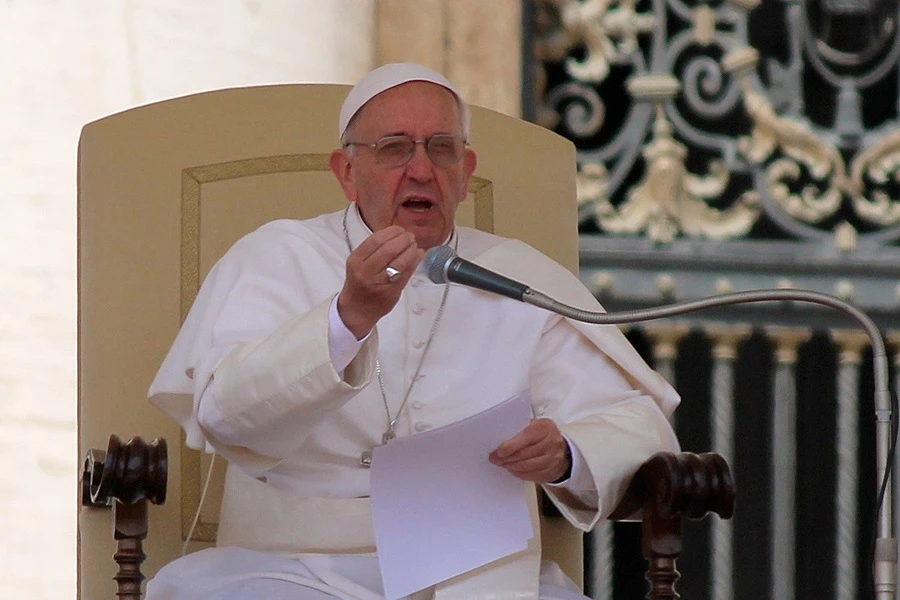
Vatican City, Apr 26, 2018 / 11:53 am (CNA/EWTN News).- Pointing to Jesus’ words during the Last Supper, Pope Francis offered meditations on love, service and humility during his homily at daily Mass on Thursday.
The Pope reflected on the day’s Gospel, John 13, which recounts the moments of the Last Supper where Jesus instituted the Eucharist and washed the feet of his disciples. Christ’s actions in these moments, Pope Francis said, teach the Church three“foundational truths.”
The first lesson is the commandment of love, which is exemplified in the Eucharist, the pope said April 26.
“Love is without limits. Without it, the Church cannot move forward; the Church cannot breathe. Without love, she cannot grow, and is transformed into an empty institution, made up of appearances and actions without fecundity,” the Holy Father said.
“In his bodily actions, Jesus tells us how we should love, that is, until the end,” he continued, saying that just as Jesus gave himself “to eat and drink, he tells us to love one another in this way.”
The second gesture of washing His disciples’ feet points to another commandment: service.
“Washing the feet, he tells us to serve each other in like manner,” the pope reflected.
In this gesture of service, he noted, lies the third lesson of humility, because “no servant is greater than his master.”
“The awareness is that He is greater than all of us, and that we are servants who cannot go beyond Jesus,” Pope Francis said. “He is the Lord, not us. This is the Lord’s will.”
“But beware: no servant is greater than the one who sent him, the master. These blunt words and actions are the foundations of the Church. If we proceed in like fashion with these three points, we shall never fail.”
The pope additionally underscored the witnesses of the saints of the Church whose actions radiate what it means to truly serve and who lived “with the awareness of being servants.”
Pope Francis ended his homily inviting the faithful gathered to enter into silence, so as to welcome the gaze of the Lord.
“Let Jesus’ gaze enter into me. We will feel many things: love, maybe nothing… we might feel trapped there or feel shame,” he said. “But always let Jesus’ gaze in. It is the same gaze with which he looked at his disciples at supper.”
If you value the news and views Catholic World Report provides, please consider donating to support our efforts. Your contribution will help us continue to make CWR available to all readers worldwide for free, without a subscription. Thank you for your generosity!
Click here for more information on donating to CWR. Click here to sign up for our newsletter.

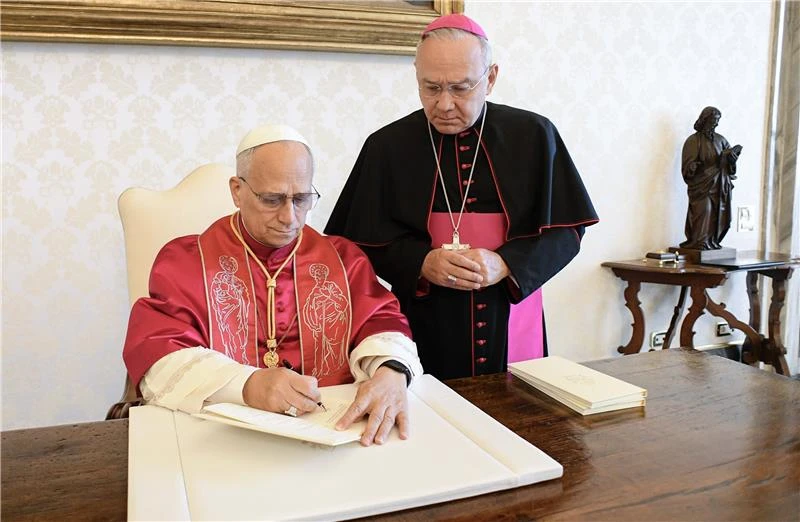
Pope Leo XIV reads his homily at Mass in St. Peter’s Square at the Vatican on Nov. 1, 2025. / Vatican Media
Vatican City, Nov 1, 2025 / 08:45 am (CNA).
Pope Leo XIV has declared St. John Henry Newman a Doctor of the Church, recognizing the English cardinal and theologian—one of the most influential converts from Anglicanism—as a towering figure of faith and intellect in modern Catholicism.
The declaration took place at the beginning of Mass for the Solemnity of All Saints on Nov. 1, celebrated in St. Peter’s Basilica as part of the Jubilee of Education. Cardinal Marcello Semeraro, prefect of the Dicastery for the Causes of Saints, read Newman’s biography and formally requested that the Pope proclaim the saint a Doctor of the Church.
Pope Leo then read in Latin the solemn formula declaring Newman the 38th doctor of the Universal Church. The pope also named Newman co-patron of Catholic education, putting him alongside St. Thomas Aquinas in that role.
“An inspiration to new generations”
“Newman’s impressive spiritual and cultural stature will surely serve as an inspiration to new generations whose hearts thirst for the infinite, and who, through research and knowledge, are willing to undertake that journey which, as the ancients said, takes us per aspera ad astra, through difficulties to the stars,” the pope said in his homily.
St. John Henry Newman near the end of his life, in 1887. Credit: Babouba, Public domain, via Wikimedia Commons
“The lives of the saints teach us that it is possible to live passionately amidst the complexity of the present, without neglecting the apostolic mandate to ‘shine like stars in the world,’” the pope continued, quoting St. Paul’s Letter to the Philippians. “On this solemn occasion, I wish to say to teachers and educational institutions: ‘Shine today like stars in the world’ through your authentic commitment to the collective search for truth and to sharing it with generosity and integrity.”
Referring to Newman’s famous hymn “Lead, Kindly Light,” Leo added: “The task of education is precisely to offer this Kindly Light to those who might otherwise remain imprisoned by the particularly insidious shadows of pessimism and fear. For this reason, I would like to say to you: let us disarm the false reasons for resignation and powerlessness, and let us share the great reasons for hope in today’s world.”
Pope Leo also emphasized that “life shines brightly not because we are rich, beautiful or powerful. Instead, it shines when we discover within ourselves the truth that we are called by God, have a vocation, have a mission, that our lives serve something greater than ourselves.”
Finally, he recalled Pope Benedict XVI’s words to young people: “‘What God wants most of all for each one of you is that you should become holy. He loves you much more than you could ever begin to imagine.’ This is the universal call to holiness that the Second Vatican Council made an essential part of its message. And holiness is intended for everyone, without exception, as a personal and communal journey marked out by the Beatitudes.”
“I pray that Catholic education will help each person to discover their own call to holiness,” the pope said.
What is a Doctor of the Church?
The title “Doctor of the Church” is given to saints recognized for their eminent learning, deep holiness, and significant contribution to Catholic theology.
To receive the title, a saint must have demonstrated outstanding sanctity confirmed by canonization, excellence in doctrine through writings of lasting influence, and a formal declaration by the Pope.
The most recent Doctor of the Church before Newman was St. Irenaeus of Lyon, proclaimed by Pope Francis in 2022 as the “Doctor of Unity.”
Other Doctors of the Church include St. Augustine, St. Ambrose, St. Thomas Aquinas, St. Teresa of Ávila, St. Catherine of Siena, St. Thérèse of Lisieux, St. Anthony of Padua, and St. Francis de Sales.
Who is St. John Henry Newman?
St. John Henry Newman was born in London on Feb. 21, 1801. Originally an Anglican priest, he became one of the leading figures of the Oxford Movement, which sought to return the Church of England to its ancient roots. His theological reflections led him ever closer to Catholicism, and in 1845 he entered the Catholic Church.
In remarks after Saturday’s Mass, Pope Leo welcomed an official delegation of the Church of England, led by Archbishop Stephen Cottrell of York, and prayed that Newman might “accompany Christians on their journey towards full union.”
Ordained a Catholic priest in 1847, Newman founded the Oratory of St. Philip Neri in England and went on to produce an immense body of work — more than 40 books and some 20,000 letters — spanning theology, philosophy, and education.
Pope Leo XIII made him a cardinal in 1879. Newman chose as his motto Cor ad cor loquitur (“Heart speaks to heart”), reflecting his conviction that true conversion is a return to the innermost dwelling of God in the heart.
He died in Edgbaston, England, in 1890. Pope Benedict XVI beatified him in 2010, and Pope Francis canonized him in 2019. His remains rest in the Catholic cemetery of Rednal, Birmingham.
This story was first published by ACI Prensa, CNA’s Spanish-language news partner. It has been translated and adapted by CNA.
Leave a Reply