


Distribution Service: Netflix
FCC Rating: TV-PG
Reel Rating: 4 out of 5 stars
I was vaguely aware of the Little House book series as a child, but it was for girls, and I was expected to read Hardy Boys or My Side of the Mountain. (I am also aware of the long-running television series, from 1973 to 1984, but I’ve never watched it.) My perception of the series was that it consisted of boring recounting of making straw dolls, braiding hair, and churning butter.
I was wrong, pleasantly so. Instead, this story, in an excellent Netflix adaptation, weaves a daring tale of a family on the margins of existence, where life is a daily struggle and truth impossible to ignore. It’s a blessed life, and while it is one not too far removed from us in time, it is one few people today would endure.
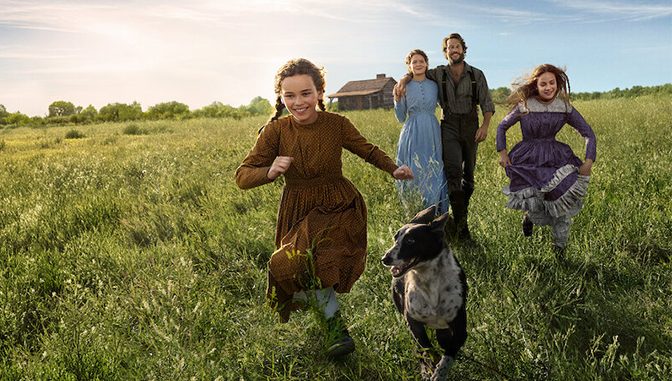
The first episode begins in 1868, shortly after the end of the Civil War. Charles Ingalls (Luke Brace), lured by free land and the chance to start over, moves his family from rural Wisconsin to the frontier prairie of Kansas. Accompanying him is his faithful wife, Caroline (Crosby Fitzgerald), once a teacher, whose family is not fond of Charles. They have two daughters: Mary (Skywalker Hughes), the older and more sophisticated one, and Laura (Alice Halsey), the younger, more inquisitive child and our protagonist.
They have only two horses, a dog, a wagon of supplies, and a dream. Even before they arrive in the tiny town of Independence, an accident ruins most of their food, and their dog is lost. Things don’t get much better in the next few months. There’s sickness, betrayal, violence, natural disasters, sibling angst, and, worst of all, the “free land” might not be available.
When Laura, the autobiographical author of these books, died on February 10, 1957, my father was already in elementary school. Chronologically, it was not that long ago, but it is light-years in terms of day-to-day existence. The Ingalls had to make, grow, catch, or discover nearly everything they had. Charles builds their log cabin from scratch, and the family sleeps in tents every night until it is built. Water must be drawn and boiled from a stream every day. Although only nine, Laura provides food for the family by catching rabbits and picking berries.
It is a life lived in small moments where even the most basic of necessities are never guaranteed. Paradoxically, the Ingalls are pleasant, well-adjusted, and mostly happy. They never believe they are poor and frequently express gratitude. There is no governmental system or social media to shield them from the truth or give unreasonable expectations. It is a life that is truly “blessed” in the biblical sense of the term, a life that is still available to modern man, but a life that most reject or even fear.
Throughout the series, many themes are explored, but gradually the relationship between the local Osage tribe and the settlers becomes the central focus. It would be easy to paint these natives as violent and primitive, as was common when the book was published in the 1930s and 1940s. More likely, there is a temptation today to portray them as noble and the victims of cruel oppression. Instead, Little House does an amazing job showing this relationship as nuanced and empathetic to both sides, a history full of saints and sinners.
This plot line is primarily told through Mitchell (Meegwun Fairbrother), the translator and liaison between the Osage elders and the mayor of Independence. The tribal members were facing an intense decision between holding out on their reservation (which they were already forced to inhabit decades earlier) or selling their land to the government. Mitchell believes that as the settlers keep coming, they should profit from the inevitable.
Younger warriors are less certain. One brutally invades the Ingalls home while Charles is away and takes much of their food and belongings, fortunately leaving the women unharmed. When Mitchell confronts the youth, he is indignant. “They are on our land,” he hisses, “They hunt our game, eat our berries, I’m only taking what is ours.” “Does this help us?” Mitchell responds, “Is this right?” Part of the problem is that Mitchell and his family have embraced Christianity and understand the value of “loving your enemy.” He is easily the best character in the first season, whose genuine desire to honor the past of his people but also their future makes for a thrilling story arc.
There are many engaging twists and turns throughout the series, including some revolving around Charles’ guilt over sitting out the Civil War and the town doctor facing a new romance while still technically married. I do not want to spoil much, except to say that for every great victory, a terrible defeat is right around the corner. In the end, however, faith in God and love of family will always triumph, a lesson that does not come easy but makes a small heaven on Earth.
Initially, I was not very interested in reviewing this series. But now I look forward to watching the second season with my family.
If you value the news and views Catholic World Report provides, please consider donating to support our efforts. Your contribution will help us continue to make CWR available to all readers worldwide for free, without a subscription. Thank you for your generosity!
Click here for more information on donating to CWR. Click here to sign up for our newsletter.

Our family lived the series as we commuted 50 miles every day between Danielson CT to Fall River MA in the cab of a VW pick up truck. We traveled to a Christian School where my wife and I were teachers and our two young daughters were students. My wife would read the books aloud with one daughter on her lap and the other squeezed next to her on the ample bench seat. We were traveling pilgrims absorbing the Engles pilgrimage over a century earlier. Their wagon was our truck. As we learned about them, we understood them. Over the months we too experienced hardships like blowing an engine, loosing our wipers in a heavy rain and breaking an excellerator cable. We solved the wiper problem by attaching a cord to wiper ends and me pulling one way and my wife the other. We quickly learned to synchronize and developed a rhythm. For the Brocken cable, I attached a strong string to the lever in the rear engine compartment and ran it up through my driver side window and I would pull one way it to gain speed and let out slack to slow down. By meeting challenges as we confronted them we were able to make it safely home. Like the Engles family we didn’t have much money(many times we didn’t get a pay check on time!) but we had each other, and enjoyed a happy life. Laura and Mary were very real to us and we understood their life and challenges.
My mother used to read to us on long drives also and I never figured out how she managed it without getting car sick. I guess some people are more gifted that way than others.
🙂
I trust your Pops was driving?
Pioneer Girl is the more recent annotated version of the series. life was tough, and then they had to deal with the Long Winter, which actually happened.
I thought Carrie came with them from Wisc, the Big Woods