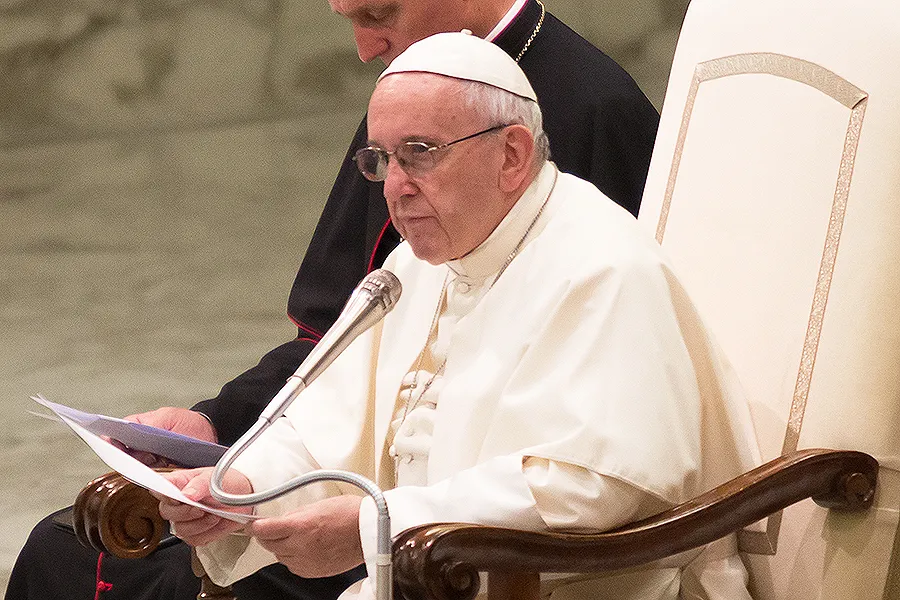
Vatican City, Oct 11, 2017 / 10:41 am (CNA/EWTN News).- In an Oct. 11 speech to members of the Pontifical Council for the Promotion of the New Evangelization, Francis said the topic of the death penalty should have “a more adequate and coherent space” in the Catechism of the Catholic Church.
This topic “cannot be reduced to a mere memory of a historic teaching” without taking into account the works and teachings of recent popes, he said, adding that it must also consider the “mutual awareness of the Christian people, who refuse a consensual attitude toward a penalty which seriously undermines human dignity.”
“It must be strongly confirmed that condemning a person to the death penalty is an inhumane measure that humiliates, in any way it is pursued, human dignity.”
The death penalty, he said, “is in itself contrary to the Gospel because it is voluntarily decided to suppress a human life, which is always sacred in the eyes of the Creator and of which God only in the final analysis is the true judge and guarantor.”
Pope Francis spoke to participants in a special day-long conference marking the 25th anniversary of the publication of the Catechism of the Catholic Church, promulgated by Saint John Paul II in 1992.
The Catechism currently explains that the death penalty is morally impermissible “if bloodless means are sufficient to defend human lives against an aggressor and to protect public order and the safety of persons.”
During their pontificates, Pope St. John Paul II and Pope Benedict XVI repeatedly called for abolition of the death penalty. Both popes encouraged nations to work towards just means of punishment and public order without recourse to the death penalty.
In his speech, Pope Francis said that in past centuries, where defense measures were poor and the maturity of society “still had not met a positive development,” the death penalty seemed like a “logical consequence of the application of justice they had to follow.”
He noted that “unfortunately” even the papal state at times adopted this “extreme and inhumane means” of punishment, “neglecting the primacy of mercy and justice.”
Francis stressed that God is a Father “who always waits for the return of the son who, knowing he has erred, asks forgiveness and begins a new life.”
“No one, therefore, can have their life taken from them, nor the possibility of a moral and existential redemption that goes back in favor of the community.”
“Let us take responsibility for the past, and let us recognize that these means were dictated by a more legalistic mentality than Christian,” he said.
Concern for maintaining power “led to an overestimation of the value of the law, impeding it from a deeper understanding of the Gospel,” he said. “However, to stay neutral today in the face of the new demands for the reaffirmation of personal dignity, would make us more guilty.”
Pope Francis said that “harmonious development of doctrine” requires that new treatments on the death penalty “leave out positions in defense of arguments which now appear decisively contrary to the new understanding of Christian truth…It is necessary to reiterate that, not matter how serious the crime committed, the death penalty is inadmissible because it is an attempt against the inviolability and dignity of the person.”
If you value the news and views Catholic World Report provides, please consider donating to support our efforts. Your contribution will help us continue to make CWR available to all readers worldwide for free, without a subscription. Thank you for your generosity!
Click here for more information on donating to CWR. Click here to sign up for our newsletter.
Vatican City, Sep 25, 2018 / 04:00 pm (CNA).- Pope Francis said Tuesday that renewed procedures and priorities in handling sex abuse cases have yielded results in the Church, and have developed alongside a greater moral awareness of the dangers of chil… […]
Image of Our Lady of Guadalupe in the Vatican. / Credit: Daniel Ibañez/EWTN News
Vatican City, Dec 11, 2025 / 16:54 pm (CNA).
“Do not let your heart be troubled. Am I not here, I who am your mother?” With this consolation — with which Our Lady … […]
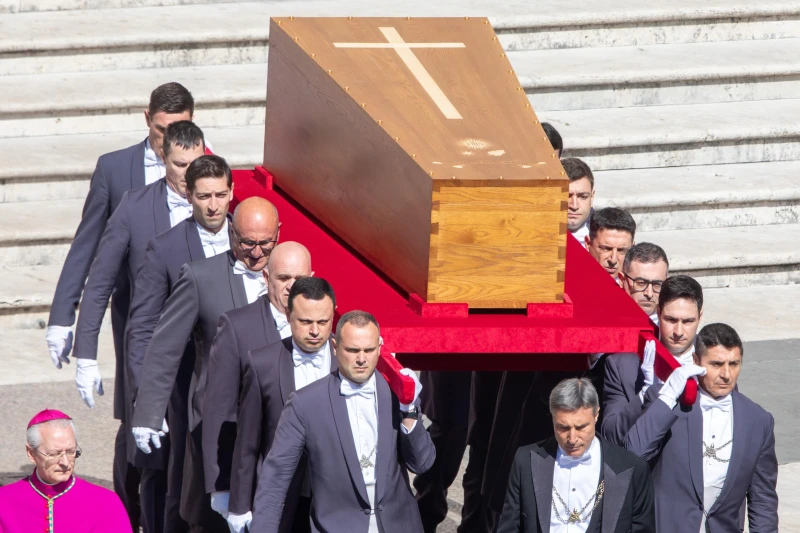
Pallbearers carry the wooden coffin of Pope Francis, marked with a cross, into St. Peter’s Square for the funeral Mass on April 26, 2025. / Credit: Daniel Ibáñez/CNA
Vatican City, Apr 26, 2025 / 05:03 am (CNA).
More than 200,000 people filled St. Peter’s Square for the funeral of Pope Francis on Saturday as the world said goodbye to the first Latin American pope who led the Catholic Church for the past 12 years.
Under the bright Roman sun and amid crowds extending down the Via della Conciliazione, the funeral Mass unfolded within the great colonnade of St. Peter’s Basilica. Heads of state, religious leaders, and pilgrims from across the globe gathered for the historic farewell.
An aerial view of St. Peter’s Square filled with thousands of mourners, clergy, and dignitaries gathered for Pope Francis’s funeral Mass under clear blue skies in Vatican City on April 26, 2025.`. Credit: Daniel Ibáñez/CNA
Cardinal Giovanni Battista Re, the dean of the College of Cardinals, presided over the Mass, delivering a homily that paid tribute to Francis’ missionary vision, human warmth, spontaneity, witness to mercy, and “charisma of welcome and listening.”
“Evangelization was the guiding principle of his pontificate,” Re said.
Pope Francis “often used the image of the Church as a ‘field hospital’ after a battle in which many were wounded; a Church determined to take care of the problems of people and the great anxieties that tear the contemporary world apart; a Church capable of bending down to every person, regardless of their beliefs or condition, and healing their wounds.”
As bells tolled solemnly, the funeral rite began with the intonation of the entrance antiphon: “Eternal rest grant unto him, O Lord, and let perpetual light shine upon him.”
The late pope’s closed plain wooden coffin lay in front of the altar throughout the Mass.
A view of the coffin of Pope Francis resting before the altar at the funeral Mass on St. Peter’s Square, April 26, 2025. Credit: Daniel Ibáñez/CNA
“In this majestic Saint Peter’s Square, where Pope Francis celebrated the Eucharist so many times and presided over great gatherings over the past twelve years, we are gathered with sad hearts in prayer around his mortal remains,” Re said.
“With our prayers, we now entrust the soul of our beloved Pontiff to God, that he may grant him eternal happiness in the bright and glorious gaze of his immense love,” he added.
View of St. Peter’s Basilica during the Funeral Mass of Pope Francis on April 26, 2025. Peter Gagnon / EWTN
Among the more than 50 heads of state present were U.S. President Donald Trump and First Lady Melania Trump, alongside former President Joe Biden. Also in attendance were Ukrainian President Volodymyr Zelensky, Argentine President Javier Milei, Italian Prime Minister Giorgia Meloni, French President Emmanuel Macron, and European Commission President Ursula von der Leyen.
Philippine President Ferdinand Marcos Jr. and Brazilian President Luiz Inácio Lula da Silva joined the throng of international dignitaries along with representatives of religious traditions from around the world.
Royal families also paid their respects, with Prince William representing King Charles III and Spanish King Felipe VI and Queen Letizia seated near the altar.
Pilgrims arrived before sunrise to claim their spots in St. Peter’s Square for the Mass with the first in line camping out the night before.
The funeral followed the Ordo Exsequiarum Romani Pontificis, the official liturgical order for papal funerals, which was updated at Pope Francis’ own request in 2024. Scripture readings included Acts 10:34-43, Philippians 3:20–4:1, Psalm 22, and the Gospel of John 21:15-19 — a passage in which the risen Christ tells Peter: “Feed my sheep.”
More than 200 cardinals and 750 bishops and priests concelebrated the funeral Mass. More than 4,000 journalists representing 1,800 media outlets reported on the event. All told, the Holy See said more than 250,000 mourners attended.
In his homily, Cardinal Re reflected on key moments in Pope Francis’ pontificate from his risk-defying trip to Iraq to visit Christians communities persecuted by the Islamic State to his Mass on the border between Mexico and the United States during his journey to Mexico.
“Faced with the raging wars of recent years, with their inhuman horrors and countless deaths and destruction, Pope Francis incessantly raised his voice imploring peace and calling for reason and honest negotiation to find possible solutions,” the cardinal said, causing the crowd to erupt in spontaneous applause.
Pope Francis’ coffin lies in St. Peter’s Square during the papal funeral Mass on Saturday, April 26, 2025. Credit: EWTN News
“Pope Francis always placed the Gospel of mercy at the center, repeatedly emphasizing that God never tires of forgiving us. He forgives, whatever the situation might be of the person who asks for forgiveness and returns to the right path,” Re reflected. “Mercy and the joy of the Gospel are two key words for Pope Francis.”
The cardinal presided over the final commendation and farewell for Pope Francis, praying: “Dear brothers and sisters, let us commend to God’s tender mercy the soul of Pope Francis, bishop of the Catholic Church, who confirmed his brothers and sisters in the faith of the resurrection.”
“Let us pray to God our Father through Jesus Christ and in the Holy Spirit; may he deliver him from death, welcome him to eternal peace and raise up him on the last day,” he said.
After the crowd chanted the Litany of Saints in Latin, Cardinal Baldassare Reina, vicar general of the Diocese of Rome, offered a final prayer: “O God, faithful rewarder of souls, grant that your departed servant and our bishop, Pope Francis, whom you made successor of Peter and shepherd of your Church, may happily enjoy forever in your presence in heaven the mysteries of your grace and compassion, which he faithfully ministered on earth.”
A poignant moment followed as Eastern Catholic patriarchs, major archbishops, and metropolitans from the “sui iuris” Churches approached the coffin while a choir chanted a Greek prayer from the Byzantine Funeral Office.
Re blessed the coffin with holy water and incense as the choir sang in Latin: “I know that my Redeemer lives: on the last day I shall rise again.”
At the end of the Mass, the traditional antiphon “In Paradisum” was sung in Latin, asking for the angels to guide the pope’s soul to heaven.
“May the angels lead you into paradise; may the martyrs come and welcome you and take you to the holy city, the new and eternal Jerusalem. May choirs of angels welcome you and with Lazarus, who is poor no longer, may you have eternal rest.”
In keeping with his wishes, Pope Francis will not be buried in the Vatican grottoes alongside his predecessors. Instead, his body will be taken in procession through the streets of Rome in a vehicle to the Basilica of St. Mary Major, a church he visited over 100 times in his lifetime to pray before an icon of the Virgin Mary, “Salus Populi Romani,” particularly before and after his papal journeys.
Pope Francis’ wooden coffin is transported on the popemobile through the streets of Rome as crowds of faithful line the procession route from St. Peter’s Basilica to the Basilica of Santa Maria Maggiore, April 26, 2025. Credit: Daniel Ibáñez/CNA
In Rome’s most important Marian basilica, Pope Francis will be laid to rest in a simple tomb marked with a single word: Franciscus.
Remembering Pope Francis
Jorge Mario Bergoglio was born on Dec. 17, 1936, in Buenos Aires, Argentina, and entered the Society of Jesus at age 21. Following his ordination in 1969, he served as a Jesuit provincial, seminary rector, and professor before St. John Paul II appointed him auxiliary bishop of Buenos Aires in 1992. He became archbishop of the Argentine capital in 1998 and was created cardinal in 2001.
The surprise election of Cardinal Bergoglio on March 13, 2013, at age 76 marked several historic firsts: He became the first Jesuit pope, the first from the Americas, and the first to choose the name Francis, inspired by St. Francis of Assisi’s devotion to poverty, peace, and creation.
His 12-year pontificate was characterized by a focus on mercy, care for creation, and attention to what he called the “peripheries” of both the Church and society. He made 47 apostolic journeys outside Italy, though he never visited his native Argentina.
During his tenure, Pope Francis canonized 942 saints — more than any other pope in history — including his predecessors John XXIII, Paul VI, and John Paul II. He published four encyclicals and seven apostolic exhortations while promulgating 75 motu proprio documents.
Throughout his papacy, Francis significantly reshaped the College of Cardinals through 10 consistories, creating 163 new cardinals. His appointments reflected his vision of a global Church, elevating prelates from the peripheries and creating cardinals in places that had never before had one, including Mongolia and South Sudan.
Health challenges marked the pope’s final years. He underwent surgery in July 2021 and in June 2023. In November 2023, he suffered from pulmonary inflammation, and in February 2025, he was hospitalized at Rome’s Gemelli Hospital for bronchitis and a respiratory infection.
His papacy faced unprecedented challenges, including the global COVID-19 pandemic, during which he offered historic moments of prayer for humanity, notably the extraordinary urbi et orbi blessing in an empty St. Peter’s Square in March 2020. He also repeatedly called for peace amid conflicts in Ukraine and the Holy Land.
Francis convoked four synods, including the Synod on Synodality, whose second session concluded in October 2024. He implemented significant reforms of the Roman Curia and took several steps to address the clergy abuse crisis, including the 2019 motu proprio Vos Estis Lux Mundi.
Pope Francis’ funeral marks the first day in the Catholic Church’s traditional nine-day mourning period that will include nine days of requiem Masses to be offered for the repose of his soul.
“Pope Francis used to conclude his speeches and meetings by saying, ‘Do not forget to pray for me,’ Re recalled at the end of his homily.
“Dear Pope Francis, we now ask you to pray for us. May you bless the Church, bless Rome, and bless the whole world from heaven as you did last Sunday from the balcony of this Basilica in a final embrace with all the people of God, but also embrace humanity that seeks the truth with a sincere heart and holds high the torch of hope.”
Sadly, more nonsense from this pope. Convicted killers still escape in modern times. Whether from actual prisons or with the legal system played.
The Church has always, and wisely, left it to the state on capital punishment. To say now that the Church has a “new understanding” of the truth is to proclaim that the Church did not have this truth prior…how can the Church now oppose in direct contradiction to the Catechism? An “evolving” truth or doctrine that now changes to its opposite?
And when a murderer commits another murder will the Church still stand on the ridiculous mercy expounded by a pope who only sees mercy but never judgement?
Utter contempt of and non mention of Romans 13:4….” not without reason does it( the state) carry the sword for it is God’s minister, an avenger to execute wrath on him who does evil.”
The recent Catholic position utilized previously in northern Latin America by secular governments gets about 49,000 extra murder victims killed in Brazil every year because China’s regime hypothetically moved to Brazil could slowly save 49,000 murder victims per year in Brazil.
This error of three late life ( declining testosterone) pacifist Popes can be undone by looking at non death penalty Brazil compared to death penalty China which by the way has decreased their executions in recent years but not for murderers. They are comparable countries because both have tens of millions of poor….unlike Europe, Canada, New Hampshire etc. The poor do most criminal rather than spousal murders which is why the USA’s inner cities have 6 times the murder rate of the US in general….31 per 100,000 vs 4.7 per 100,000.
China had a drug problem and severity from the communists ended it…Brazil will have a drug problem forever if it keeps it’s non death penalty approach.
Brazil, the largest Catholic population on earth, has 50,000 murders per year while China with 7 times the population of Brazil….has 11,000 murders per year. Three Popes’ pacifist position on this issue never cites any data whatsoever and world data destroys their point. All three think only of Europe which is middle class dominant so non murderous by definition excepting spousal murders largely. Ccc #2267 pictures perfectly run prisons preventing inter prison murders….which is Europe. Brazil and Mexico have prisons largely controlled by cartels but they are the two largest Catholic populations on earth. At you tube, type in Mexican prison murder…you’ll see cartel gang members stroll into a prison, scare the guards off, and machine gun a room of rival cartel men. Three Popes in a row have dishonestly described world prisons in their ccc 2267 by using Euro prisons as typical.
Low murder rates worldwide result either from middle class incomes as dominant( e.g. Europe..Canada….Australia….Vermont)…or from the death penalty where poverty is widespread ( China and muslim countries etc.)
Watch Pope Francis….like his two predecessors, he will give no world data. Non death penalty northern Latin America is the most murderous region on earth by UN figures available onlne as are maps of execution countries ( overlap them mentally)…East Asia is the safest region by UN figures excepting the Phillipines….where Spain also conquered as in South America.
Japan has the death penalty but doesn’t need it because it like Europe is middle class….but that is non typical of the world in general.





“…a new understanding of the truth.”
Sadly, more nonsense from this pope. Convicted killers still escape in modern times. Whether from actual prisons or with the legal system played.
The Church has always, and wisely, left it to the state on capital punishment. To say now that the Church has a “new understanding” of the truth is to proclaim that the Church did not have this truth prior…how can the Church now oppose in direct contradiction to the Catechism? An “evolving” truth or doctrine that now changes to its opposite?
And when a murderer commits another murder will the Church still stand on the ridiculous mercy expounded by a pope who only sees mercy but never judgement?
Utter contempt of and non mention of Romans 13:4….” not without reason does it( the state) carry the sword for it is God’s minister, an avenger to execute wrath on him who does evil.”
The recent Catholic position utilized previously in northern Latin America by secular governments gets about 49,000 extra murder victims killed in Brazil every year because China’s regime hypothetically moved to Brazil could slowly save 49,000 murder victims per year in Brazil.
This error of three late life ( declining testosterone) pacifist Popes can be undone by looking at non death penalty Brazil compared to death penalty China which by the way has decreased their executions in recent years but not for murderers. They are comparable countries because both have tens of millions of poor….unlike Europe, Canada, New Hampshire etc. The poor do most criminal rather than spousal murders which is why the USA’s inner cities have 6 times the murder rate of the US in general….31 per 100,000 vs 4.7 per 100,000.
China had a drug problem and severity from the communists ended it…Brazil will have a drug problem forever if it keeps it’s non death penalty approach.
Brazil, the largest Catholic population on earth, has 50,000 murders per year while China with 7 times the population of Brazil….has 11,000 murders per year. Three Popes’ pacifist position on this issue never cites any data whatsoever and world data destroys their point. All three think only of Europe which is middle class dominant so non murderous by definition excepting spousal murders largely. Ccc #2267 pictures perfectly run prisons preventing inter prison murders….which is Europe. Brazil and Mexico have prisons largely controlled by cartels but they are the two largest Catholic populations on earth. At you tube, type in Mexican prison murder…you’ll see cartel gang members stroll into a prison, scare the guards off, and machine gun a room of rival cartel men. Three Popes in a row have dishonestly described world prisons in their ccc 2267 by using Euro prisons as typical.
Low murder rates worldwide result either from middle class incomes as dominant( e.g. Europe..Canada….Australia….Vermont)…or from the death penalty where poverty is widespread ( China and muslim countries etc.)
Watch Pope Francis….like his two predecessors, he will give no world data. Non death penalty northern Latin America is the most murderous region on earth by UN figures available onlne as are maps of execution countries ( overlap them mentally)…East Asia is the safest region by UN figures excepting the Phillipines….where Spain also conquered as in South America.
Japan has the death penalty but doesn’t need it because it like Europe is middle class….but that is non typical of the world in general.