

 By
On Monday in Buenos Aires, Pope Leo XIV spoke on Catholic social teaching, prayer among religions, and communion in the Church.
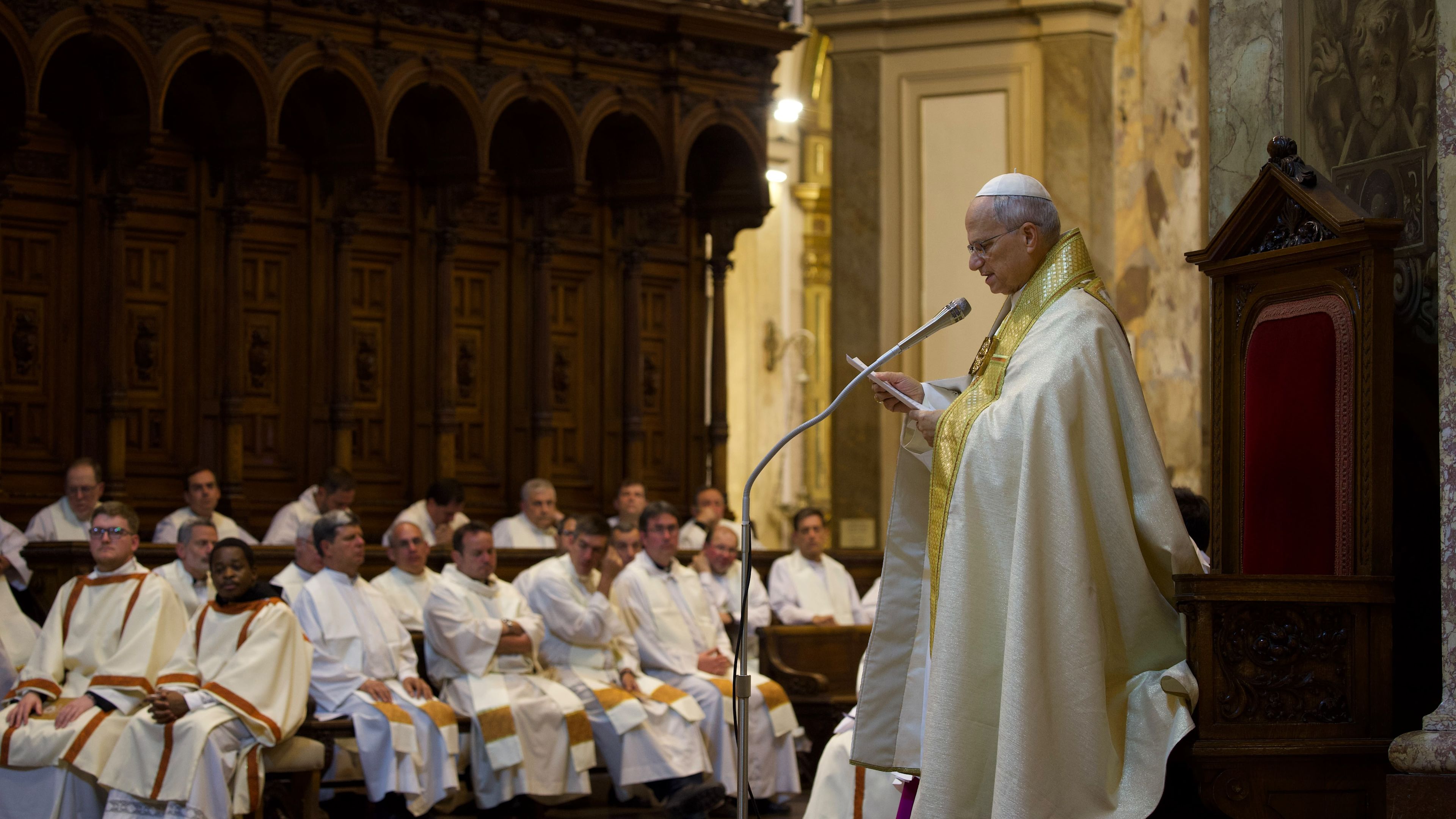
BUENOS AIRES, Argentina — Pope Leo XIV has made it clear since the start of his pontificate that he seeks to be a pope of unity. On Monday, Nov. 9, he brought that message to Argentina, in speeches on economic relations, interfaith dialogue and leadership of the Church itself.
Speaking to an audience at the Catholic University of Argentina that included business leaders, trade unionists and grass-roots social activists, the pope encouraged groups with apparently conflicting interests to join together in embracing the fundamental principles of Catholic Social Teaching.
Leo made his talk a mini-tutorial in the subject, offering brief definitions of the dignity of the human person, the common good, the universal destination of goods, solidarity and subsidiarity. By acting in accordance with these, he said, society could “build the civilization of love.”
The pope offered a concrete example of someone who lived by the principles in the Venerable Enrique Shaw, an Argentine businessman “who underwent a conversion after discovering the beauty of the Gospel as expressed in the Church’s Social Doctrine.”
Leo said the entrepreneur “understood that industry was not just a productive mechanism or a means of accumulating capital, but a true community of people called to grow together.”
Shaw died in 1962 and Pope Francis recognized his heroic virtues in 2021.
The pope also pointed to trade unions, workers’ associations, cooperatives and welfare organizations, whose “specific mission is to be instruments of solidarity and cohesion, channels of cooperation between workers and businesses.”
A little later the same afternoon, Leo addressed representatives of other Christian churches and other religions, proposing an understanding of “sincere prayer” that unites their different creeds. Such prayer, the pope said, gives voice to “religions as guardians of human dignity, religions as expressions of our freedom, and religions as places in which to cultivate hope.”
The pope’s last public event of the day was a vespers service with the Catholic bishops of Argentina. After surveying the geographic and cultural diversity of the country, Leo noted that Catholicism in the country is united by veneration of the Virgin Mary, though under different titles and devotions, including the Most Holy Virgin of the Miracle, Our Lady of the Valley, the Virgin of the Rosary, Mary of Itatí and Our Lady of Luján.
Leo is scheduled to celebrate Mass in front of the Basilica of Our Lady of Luján on Wednesday, his last day in Argentina.
The pope offered the biblical story of Joseph’s reunion with his father Jacob and his brothers, depicted in a relief on the facade of the cathedral where he was speaking, as a model of reconciliation for his listeners.
“Let us cultivate communion, welcoming our legitimate differences with charity and fostering fraternity, so that our unity may make Christ’s love visible and help many to encounter him,” the pope said.
Leo asked the bishops “to continue listening to one another and discerning together what the Holy Spirit is asking of you in the light of the word of God and the Magisterium of the Church.” He said they should do so in conjunction with their synodal teams, also present in the cathedral, since they were “fellow disciples of the one Teacher.”
Synodality, a signature initiative of Pope Francis that Leo has pledged to continue, seeks to involve the whole Church, including the laity, more fully in discernment and mission.
If you value the news and views Catholic World Report provides, please consider donating to support our efforts. Your contribution will help us continue to make CWR available to all readers worldwide for free, without a subscription. Thank you for your generosity!
Click here for more information on donating to CWR. Click here to sign up for our newsletter.

Leave a Reply