


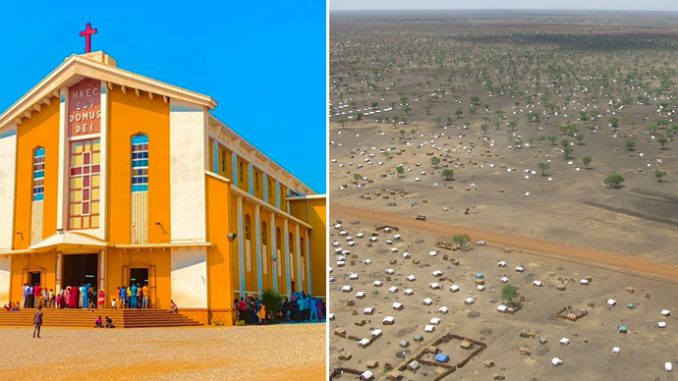
South Sudan is frequently defined by international headlines about conflict, displacement, and hunger. These crises have displaced over 2 million people within South Sudan itself, and forced 2,5 million others to seek refuge in neighboring countries, primarily Uganda, Sudan, Ethiopia, and Kenya.
Yet, following a recent visit to the embattled country, Fr. Andreas Frick, Director General of Misereor, the German Catholic Bishops’ Organization for Development Cooperation, offers a counter-narrative, describing the nation not just as a place of suffering, but as a “land of hope and solidarity.”
In an exclusive interview with CWR, Fr. Frick discusses the “unimaginable number of crises” facing the population, and emphasizes the profound resilience of those living in Protection of Civilians sites who, despite lacking basic necessities, refuse to give up.
Fr. Frick explores the intersection of spiritual and material support, explains why the global community must not look away, and shares how the strength of the South Sudanese people offers a vital lesson for Europe.
Following are excerpts of the conversation…
CWR: Fr. Frick, during your recent visit to Malakal, you described South Sudan as a “country of hope and solidarity” despite having visited 47 other nations. Given the ongoing violence and instability, what specifically did you witness that gave you this profound sense of hope amidst the suffering?
Fr. Andreas Frick: The people of South Sudan are affected by an unimaginable number of crises. Violent conflicts continue, climate change causes floods and droughts, and the war in neighboring Sudan has created additional challenges and demands great solidarity from the people. Despite this, during our visit, we saw people supporting one another, standing up for those who are most vulnerable, and continuing to work for better living conditions. Their courage not to give up, even under such difficult circumstances, is truly impressive. We in Europe can also learn from this resilience.
CWR: You acknowledged violence as one of the major challenges stifling the country’s progress. In your observation, how is this continued conflict specifically affecting the gains the country has made in critical sectors like education and agriculture?
Fr. Frick: In South Sudan, many people are forced to leave their homes and communities either to find safety or because floods and droughts make it impossible to sustain their livelihoods. As a result, education is interrupted, people often have to start over from nothing, and they must adapt to new circumstances, including learning new agricultural techniques.
CWR: The human cost of the South Sudanese crisis is often summarized in statistics. Can you paint a picture of the reality for the average family you met in the Malakal Protection of Civilians (POC) site? What are their daily struggles?
Fr. Frick: For people living in a PoC site, the most immediate concern is simply finding enough food. We were told that the minimal food assistance and small cash support they receive lasts for only about a week. After that, many people are left without support except for what they receive from the Church. They also face uncertainty about the future, including where and how they can rebuild their lives. Children are often unable to attend school, and basic prospects for the future need to be recreated. This is especially challenging for women who are caring for several children on their own. In addition, many displaced people have experienced trauma and would benefit from psychosocial support.
CWR: Archbishop Stephan Burger of Freiburg, who accompanied you during the visit, spoke of carrying the “faith, love, and hope” of the people back to Germany. What does it mean for a displaced person to be told that their suffering and resilience are “not forgotten” by the global community?
Fr. Frick: In Germany, we sometimes become so focused on our own challenges that we forget there are crises in other parts of the world that demand far more from people than we can imagine. It is important that we do not lose sight of these people in our daily lives and that we continue to support them. At the same time, it is important to recognize their strength and determination and learn from them. We can support people who are already working to improve their own lives, and we should continue to do so.
CWR: In a protracted crisis like South Sudan, where needs are overwhelming and constant, how do you measure success or provide meaningful relief that goes beyond just basic survival?
Fr. Frick: Beyond immediate survival and humanitarian assistance, it is important that people are able to regain control over their own future. We support people in creating opportunities for development and improving their lives independently, whether through agriculture, better education and vocational training, or helping mothers raise healthy children. These small improvements in people’s lives can contribute to a more positive future for the entire country.
CWR: You presented a candle to the community as a symbol of hope, linking its light to Christ. In the context of humanitarian work, how do you balance the spiritual support, the “hope”, with the tangible need for food, shelter, and protection?
Fr. Frick: We heard from all of our partners in South Sudan that their work is never only about improving people’s material conditions. For people living in such difficult situations, efforts to ensure physical survival are always connected to community, spirituality, and values, such as solidarity and peaceful coexistence. Church partners in particular are very aware of this and integrate both dimensions into their work.
CWR: You recently mentioned that the risen Lord will provide home, family, and protection. As the Director of Misereor, what are your plans to ensure that the international community does not look away while waiting for those miracles?
Fr. Frick: Misereor not only supports projects in many countries around the world, but also raises awareness of these challenges in Germany. We advocate for Germany to take responsibility for global issues such as climate change, inequality, poverty, and war, and to ensure that the interests of the most vulnerable people remain a priority. This is an explicit part of Misereor’s mission, which we pursue through advocacy work, public awareness campaigns, school programs, and cooperation with church communities.
We are therefore not waiting for a miracle from God; rather, together with God, we are working alongside our partners to help move the world in a better direction. We believe that God works through people. At the same time, this task is greater than our own strength, and we need God to connect us with many others who share the same commitment.
CWR: Looking at the next few years for South Sudan, what is your biggest fear, and conversely, your greatest prayer for the people of the world’s youngest nation?
Fr. Frick: During our visit, we saw that the coming months will be decisive for the future of South Sudan. Regardless of whether elections take place or not, we pray that the country finds a peaceful future and is able to use its enormous potential for the benefit of its people.
If you value the news and views Catholic World Report provides, please consider donating to support our efforts. Your contribution will help us continue to make CWR available to all readers worldwide for free, without a subscription. Thank you for your generosity!
Click here for more information on donating to CWR. Click here to sign up for our newsletter.

Leave a Reply