

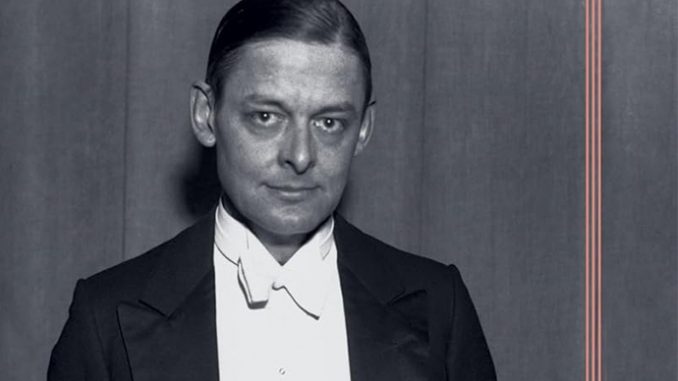
In her admirably updated and revised critical biography, T.S. Eliot: An Imperfect Life, Lyndall Gordon plunders the various works of her subject to show how suffused they are with the travails of the life, especially the life’s hunger for faith. One can see this hunger in something Eliot said of Pascal in an introduction to the Pensées:
Pascal offers much about which the modern world would do well to think. And indeed, because of his unique combination and balance of qualities, I know of no religious writer more pertinent to our time. The great mystics like St John of the Cross, are primarily for readers with a special determination of purpose; the devotional writers, such as St François de Sales, are primarily for those who already feel consciously desirous of the love of God: the great theologians are for those interested in theology. But I can think of no Christian writer, not Newman even, more to be commended than Pascal, to those who doubt, but who have the mind to conceive, and the sensibility to feel, the disorder, the futility, the meaninglessness, the mystery of life and suffering; and who can only find peace through satisfaction of the whole being.
There spoke the convert in Eliot. Nevertheless, by 1931, the year he composed the introduction, four years after his conversion, his eminently practical Christian faith might have enabled him to stare down doubt, but he would spend a lifetime tackling the “mystery of life and suffering.”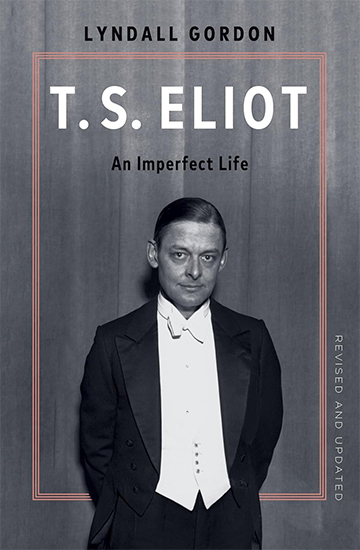
Gordon’s biography draws on a number of biographical studies of the poet critic that she began with Eliot’s Early Years (1977), resumed with Eliot’s New Life (1988) and rounded out in her most recent The Hyacinth Girl: T.S. Eliot’s Hidden Muse (2022), all of which were published to just acclaim, though there were a few quarters sworn to Eliot’s own misleading claims regarding the putative impersonality of art that had censorious things to say of the first book. No one saw as clearly as Gordon that the man whose work was so profoundly confessional in character took puckish delight in throwing his critics off the scent.
In all events, the critical biography before us now, in all its amplitude and panache, takes up the personal art of Eliot, and it is a book that everyone fond of the poet critic’s work will relish and prize.
It is true that several bungling reviewers had laudatory things to say about Robert Crawford’s uncritical biography. Yet their poor judgment and even poorer taste only accentuate the superiority of Gordon’s achievement. One of the few critics of any perspicuity in Eliot’s own time, Dame Helen Gardner gave Gordon generous assistance when she began what became her lifelong study of Eliot, and the older critic’s shrewdness can be seen in the work of her mentee. Apropos Gardner’s study of Four Quartets and Valerie Eliot’s facsimile edition of the original drafts of The Waste Land, for example, Gordon writes: “It is to be hoped that scholars of the future will follow their lead in discerning the simplicity at the heart of Eliot’s apparent difficulty.” About this “simplicity,” I shall have more to say anon.
Where Crawford treated Eliot as though he could be excavated from appointment diaries and only treated the poetry and criticism as incidental to the public man’s dutiful excursions, or, worse, expressions of what the biographer regarded as his subject’s unaccountably bizarre religious preoccupations, Gordon sees the work, as it must be seen, as continually interwoven with the life. As she says herself, “With Eliot writing was not an offshoot of the life; the life was an offshoot of the writing.” At the same time, she never loses sight of the fact that “Where the centre of interest lies in the inner life, we diverge from the schema of historical or political biography, where the centre of interest lies in public action. With writers we wish to know the sources of creativity, which may be unknowable or incommunicable, buried in the solitude of the artist’s life.” We certainly do not discover sources of the artist’s life in appointment diaries.
Moreover, from the very inception of her work on Eliot, Gordon has insisted on its unity, and this necessarily annoys those who wish to see two, irreconcilable Eliots: an atheist Eliot, who became the spokesman of post-war disillusionment, and an Anglo-Catholic Eliot, who chose to deviate from all the approved shibboleths of that disillusionment.
In this, she resembles another superb critical biographer, Douglas Lane Patey, whose 1998 critical biography of Evelyn Waugh disabused readers of the presumed lack of unity in the early and late work of the comic novelist. Instead of two Waughs, one godless and the other papist, Patey showed that there was only one continual convert, though the satirist of faithless lunacy in Decline and Fall (1928) did not have all the advantages of the convert in Sword of Honour (1965). Patey quotes a telltale letter that Waugh wrote his catechist Father D’Arcy in September 1930, while under instruction in Farm Street weeks before his conversion, which shows what a chasm he was crossing in leaving the unbelief of his age:
As I said when we first met, I realize that the Roman Catholic Church is the only genuine form of Christianity. Also that Christianity is the essential and formative constituent of western culture. In our conversations and in what I have read or heard since, I have been able to understand a great deal of the dogma and discipline, which seemed odd to me before. But the trouble is that I don’t feel Christian in the absolute sense. The question seems to me to be must I wait until I do feel Christian in the absolute sense… or can I become a Catholic when I am in such an incomplete state – and so get the benefit of the sacraments and receive faith afterwards?
As for Eliot, in 1927, the year of his conversion, he wrote an essay on the author of Les Fleurs du Mal (1857) that shows how crucial it was for him, as it had been for Waugh, to act in conformity with yearnings for conversion that set him radically apart from his contemporaries:
The important fact about Baudelaire is that he was essentially a Christian, born out of his time, and a classicist born out of his time. In his verse technique, he is nearer to Racine than to Mr. Symons; in his sensibility he is nearer to Dante and not without sympathy with Tertullian. But Baudelaire was not an aesthetic or political Christian; his tendency to ‘ritual’… springs from no attachment to the outward forms of Christianity, but from the instincts of a soul that is naturaliter Christian. And being the kind of Christian that he was, born when he was, he had to discover Christianity for himself. In this pursuit he was alone in the solitude which is only known to saints.
Reading these instructive passages from Waugh and Eliot, we can see how vital it was for both not only to experience but to write about the desolations of unbelief before searching out Christian belief as its only antidote. Hence, their pre-conversion work cannot be regarded as somehow irrelevant to their post-conversion work. On the contrary, it has to be seen as foundational to their conversion. One distinguishing virtue of Gordon’s biography is that she recognizes how the ubiquity of conversion animated all of her subject’s life and work. In a piece entitled “Christianity and Communism” (1932), Eliot wrote that “Towards any profound conviction one is borne gradually, perhaps insensibly, over a long period of time, by what Newman called ‘powerful concurrent reasons.’” At every turn, Gordon identifies and respects these reasons, along with what Eliot called their “unattended moments.”
In the same essay, Eliot anatomized the phenomenon–and the stakes–of unbelief with an unsparing precision:
To the baser minded, in the modern world, liberty…tends to be tantamount to mere license. The more intellectual experience more refined temptations… sometimes among the most gifted… who value so highly what seems to them intellectual liberty that they refuse to believe in anything. For that is a definite refusal. And in their own interest, being what they are, they are right; for to have passionate conviction about anything is like falling in love: it is not merely to risk being ridiculous (and such people are afraid of being ridiculous, though nothing makes a man more ridiculous than the fear of ridicule); it is to surrender oneself, to surrender liberty… The chief liberty of man… is the liberty to choose what master he shall serve. ‘Know ye not, that to whom ye yield yourselves servants to obey, his servants ye are to whom ye obey; whether of sin unto death, or of obedience unto righteousness?’”
Here we can see the prophetical caritas that drove Eliot’s best work. Like Newman, he acquired the authority he did by sharing with his contemporaries the indispensability of belief in a world bedeviled with unbelief.
II
Brimming with imagination, sympathy, and the sort of critical intelligence rarely on offer in the prurient shallows of literary biography, Gordon is a delight to read mostly because she is such a good reader herself. Like Eliot, who read Milton again and again before adjudging him “the greatest master in our language of freedom within form,” she often shares with her readers the cumulative findings of her readings of Eliot, which one will find nowhere in the dull, uncritical pages of Crawford. One example will suffice to show what I mean:
Dante, Eliot said, was the most ‘European’ of writers, and this was his own insistent image. This might appear a repudiation of America, but for Eliot the notion of the ‘European’ was not a matter of locale but a state of mind that overpassed frontiers. It actually had a native connotation which, we recall, he spelt out in his essay on Henry James: ‘It is the final perfection… of an American to become…a European – something which no European, no person of any European nationality, can become.’ The benefit of transplantation was to gain a sense of the uniformity of human nature… It was also to have a horizon beyond St Louis, Boston, or London. Wherever Eliot stood, part of him was not there – he had something in reserve. His self-imposed distance from home, his detachment, took on the authority of a Modernist position, but this was not an end in itself, because he was also detached in time. From that vantage-point he saw a biblical plot: the recurrent destruction of a corrupt society. His private horror – ‘the nightmare of evil’ – was like that of the prophets, for whom alone in their time, ‘history had meaning.’ His other model was Aeneas, whom he saw as the prototype of Christian pilgrim: his crossing from one culture to another had its real meaning as an act of obedience to the timeless gods. He is obedient to the destiny they impose. ‘For he is humbly, a man with a mission, and the mission is everything.’
Here, in a paragraph, Gordon gives her readers not only the trajectory of the life but of the work, their inextricability clearly set out in the primacy of the poet critic’s submission to providential destiny. One can go readily enough to reference books or Crawford for the appointment diary Eliot. Only Gordon gives us the convert and the artist.
Speaking of the artist, one should stress that one of the best critical aspects of Gordon’s book is the extent to which she shows how mixed a blessing the poet’s editors were, neither Pound with regard to The Waste Land, nor John Hayward with regard to Four Quartets having any sympathy for his religious life. Apropos The Waste Land, Gordon notes how Pound “blocked, at several points, Eliot’s impulse to exhibit the strength as well as sickness of a suffering soul.” Then, too, “He persuaded Eliot to omit his most penitential fragment, ‘Exequy’, in which a poet confesses having abused his gifts in order to court immediate fame and resolve to carry through the Dantean schema. Silly devotees admire what is fake and celebrate the poet with fireworks; but he is warmed by a ‘constant fire’ within, a purgatorial fire. Pound, who for years had helped Eliot to fame, could not see the reason for Eliot’s cry of ‘DOLOR.’” Most critics have been content to follow Eliot in praising Pound for being “il miglior fabbro:” Gordon rightly sees that there was a downside to the brash, ruthless cuts.
To give another example of Gordon’s critical chops, I should quote what she has to say of the composition of “Little Gidding” (1942):
Some time between the summer of 1941 and the summer of 1942, Eliot decided that greatness would come not through sublimity, as he had hoped, but through savage honesty. He was still consciously aiming at his highest reach as a poet, still walking shoulder to shoulder with the compound ghosts of the immortals, Yeats, Shelley and above all, Dante, whose verse form he still adopts. But in the drastic revision that Eliot undertook in August-September 1942, it was as though he recognized that he could not touch the ultimate heights of the Paradiso, so settled instead for searing confession.”
No better gloss can be given for that unforgettable passage in “Little Gidding,” in which the poet writes:
Since our concern was speech, and speech impelled us
To purify the dialect of the tribe
And urge the mind to forethought and afterthought
Let me disclose the gifts reserved for age
To set a crown upon your lifetime’s effort
First, the cold friction of expiring sense
Without enchantment, offering no promise
But bitter tastelessness of shadow fruit
As body and soul begin to fall asunder.
Second, the conscious impotence of rage
At human folly, and the laceration
Of laughter at what ceases to amuse.
And last, the rending pain of re-enactment
Of all that you have done, and been; the shame
Of motives late revealed, and the awareness
Of things ill done and done to others’ harm
Which once you took for exercise of virtue.
Then fools’ approval stings, and honour stains.
Apropos these searing lines, Gordon writes: “It took a grim moral courage to let go the visionary moments with their latent promise, and let judgment fall, with the utmost severity, on what he most wished to forget. We recall that Eliot confided in Virginia Woolf that what he feared above all was humiliation. But the reward of honesty was what is probably the greatest passage of poetry he ever wrote…” Readers can scan shelves and shelves of commentary on Eliot and find nothing as incisive as this from the good critic in Gordon.
III
If Eliot delighted in playing parts, whether the bowler-hatted banker or, later, the man of many committees, it was because he was adamant that the outer life must shield the all-important inner life. About this essential quality in her hero, Gordon is spot on:
His move from America to Europe gave him a peculiar detachment, a universal foreignness. He remained somehow alien to Englishmen and the Anglican Church, to everything with which he identified. He devised an anti-self, not like Yeats, to extend the self, but to guard it: the jokey clubman was a cover for the solitary; the mild gentlemanliness a cover for the extremist; the impersonality a cover for confession; the acquired European tradition for native roots.
One English friend, never deceived by the stage Brit in Eliot, once said to him, “You know there is this indestructible American strain in you,” to which he replied, without missing a beat, “Oh yes, there is. I’m glad you realized it. There is.”
For Gordon, even Eliot’s impeccably tailored suits–he had them cut by Stovel & Mahon in Old Burlington Street—were cover for “the agonized introspection” of this “son of the Puritans.” Yes, he could often be seen walking about Russell Square, where he transformed Faber & Faber as its most shrewd, adventuresome Director, but even there he was “stooped, lined and bowed by a sense of sin.”
Eliot’s sense of sin should be shared more widely with our own contemporaries: it would disabuse them of a good deal of cant. In the piece on Pascal quoted earlier, the poet has occasion to observe how “Heresies are never antiquated…” Why?
Because they forever assume new forms. For instance, the insistence upon good works and “service” which is preached from many quarters, or the simple faith that anyone who lives a good and useful life need have no “morbid” anxieties about salvation, is a form of Pelagianism. On the other hand, one sometimes hears enounced the view that it will make no real difference if all the traditional religious sanctions for moral behaviour break down, because those who are born and bred to be nice people will always prefer to behave nicely, and those who are not will behave otherwise in any case: and this is surely a form of predestination – for the hazard of being born a nice person or not is as uncertain as the gift of grace.
Those avid to turn even the Church of Rome into a humanitarian concern, with a more cheerful, permissive, ‘live and let live’ approach to the villainy of man will not be persuaded by such edifying mockery, but surely it is salutary for the rest of us.
IV
Good critical biographies do not grow on trees. Mention has already been made of Patey’s biography of Waugh; one might also cite Robert Baldick’s critical life of Joris-Karl Huysmans (1955); Walter Jackson Bate’s wonderful biography of Samuel Johnson (1977); Richard Holmes’s 2-volume life of Coleridge (1989, 1998); and Ian Ker’s magisterial life of Newman (1988; rev. 2009). Gordon’s book now takes its place in this distinguished company, especially since she gives Eliot’s religious life the center stage it requires.
In reviewing the second leg of Holmes’s life of Coleridge for Literary Review, Juliet Barker, who wrote an excellent biography of the Brontes, as well as splendid books on Agincourt and the Hundred Years War, confessed, after praising Holmes’s achievement: “it seems churlish to complain that the end of this book does not live up to its beginning,” but she found serious flaws:
From about the year 1818, and certainly for the last fourteen years of Coleridge’s life, there is a change of pace and tone which seems to reflect a disengagement with the subject. Holmes’s wonderful, leisurely, discursive prose gives way to a hurried summary of Coleridge’s last years – a few more lectures, a few more books… The reader is left feeling cheated and (which is a compliment to Holmes) wanting more. There is also a sense of omission: Coleridge’s Christianity, which had always been important but now became central to his life, is brushed aside…
One could never say this of Gordon’s Eliot. The last chapters of her book abound in critical insights. “Eliot was only superficially a man of his time,” she writes. “His affinities were with spokesmen for the perfect life in other centuries, the Catholic mystics of the Middle Ages and the American Puritans of the seventeenth century. He said in 1954 that he combined ‘a Catholic cast of mind, a Calvinist heritage, and a Puritanical temperament.’ His was not the cultural despair, the dead-end alienation of Modernity but the purposeful withdrawal of one who passed through his age as a hermit, refusing its debasement. Displaced, as it were, in time, he derided his contemporaries’ political solutions, their smug rationalism, their meaningless toys… Eliot saw the children of the twentieth century as aliens clutching cheap gods. Like a prophet, he denounced those who sat ‘in the sty of contentment.’”
Frank Kermode, one of the more notable of these misguided critics, who could never bring himself to see Eliot’s conversion–or Waugh’s, for that matter–as anything but reactionary, claimed, with a kind of triumphant sneer, that the “same neglect” that had fallen on the poet’s dramatic work also befell his call for a revived Christian culture, “for it is rarely invoked even on the extreme political right.” In contrast to Kermode, Gordon realizes that Eliot’s solicitude for the renewal of culture, rooted in the reality of Christianity, was the natural corollary of all his creative life and must continue to be invoked if the indefectible unity of the work is to be understood.
One last point. As a young man, the poet created an amusingly etiolate fellow who famously feared that the mermaids would not sing to him. Yet looking back on the twists and turns of his riverine life, we can see, as Gordon certainly sees, how irreplaceable good women were to him, both as poet and convert. His first wife, Vivien Haigh Wood, had made him a poet by immersing him in “the mystery of life and suffering” that brought “The Waste Land” (1922) into being. His other muse, Emily Hale, the Bostonian gentlewoman for whom he felt so much conflicted affection, had helped him to understand and express the spiritual yearning of “Ash Wednesday” (1930), “Marina” (1930), The Family Reunion (1939), and Four Quartets (1943). Mary Trevelyan, “a good sort,” as Gordon describes her, “hearty” and “backslapping,” with a quintessentially “English blend of sturdiness and humour,” befriended Eliot in wartime London when he needed befriending most. Finally, Valerie Fletcher gave him the marital love–the “leaping delight,” as he nicely called it—that had hitherto eluded him.
What all these women had in common was that they loved Eliot despite his flaws. They mustered that magnanimity, bred of compunctious fellow-feeling, which God enjoins all of us to exercise, and this is true of Gordon as well, who ends her book with an addendum to the poet’s catalogue of “things ill-done and done to other’s harm” that must inform any fair assessment of the man.
If full scale biography is unsuited to an understanding of Eliot’s life, this may be one reason why he forbade it. He made it clear that whatever is worth recording would not be found in wills and legal papers presided over by the lean solicitor, nor in well-intentioned recollections, the webs woven over the career by beneficent spiders. The single force of the career is contained in the awful daring of a moment’s surrender: By this and this only we have existed.’
This is the “condition of complete simplicity,” a condition “costing not less than everything,” to which Eliot refers in “Little Gidding.” Père de Caussade, SJ, wrote of the same condition in Self-Abandonment to Divine Providence (1733-40) when he spoke of “The history of that divine drama which consists in the life led by Jesus in holy souls… The holy souls are the paper, their sufferings and actions are the ink. The Holy Spirit, with the pen of his activity, writes in them a living gospel.” To see how longing for such a condition shaped everything T.S. Eliot ever wrote, we must read and reread the rich, revelatory, critical pages of Lyndall Gordon.
T.S. Eliot: An Imperfect Life
Lyndall Gordon
Hardcover. Originally 1998; revised and updated, 2026
W.W. Norton and Company. 658 pages. $45.
If you value the news and views Catholic World Report provides, please consider donating to support our efforts. Your contribution will help us continue to make CWR available to all readers worldwide for free, without a subscription. Thank you for your generosity!
Click here for more information on donating to CWR. Click here to sign up for our newsletter.

Great writing draws the plebeian to contemplate greater things. To the plateau on which our anguish finds its accord.
When l found out about his “casually cruel” treatment of his first wife, Vivian, his statue has diminished rather dramatically in my eyes.
Two tangoed. Vivienne suffered from many physical and mental vagaries. Temperamentally the couple was mismatched, and they received little or no support from her family. Eliot suffered as a result, and from that suffering he came to know, understood, and write “The Wasteland.”
Thanks for this essay, CWR and Mr. Short.
Mr. Short:
Thank you “seventy-times-seven” for your intriguing book review. I am magnetically drawn to the poetry of Eliot, and your appreciation of Gordon’s insight into Eliot is compelling.
I’m buying Gordon’s book…today.