

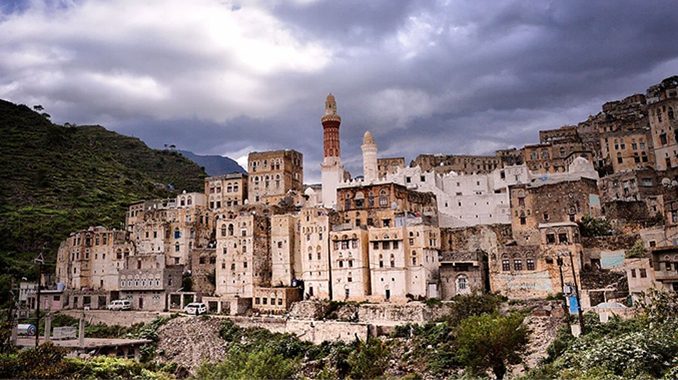
I was idling in my room at the Arabia Felix, drinking Orange Fanta and eyeing geckos on the wall, when a message came from the lobby. I’d been granted the meeting I was hoping for with Yahya Sayfallah.
This was a nom de guerre. ‘Sayfallah’ means ‘Allah’s sword,’ and it sounds as grandiose in today’s Arabic as it does in English. But it was appropriate, I thought, for someone who did public relations for the militant group known as the Houthis.
This was in Sanaa, Yemen’s capital, in a quiet interval some years ago, during the country’s civil conflicts in the spring of 2009. But amid Houthi missile attacks and drone strikes on Saudi oil tankers in the Red Sea in 2026, what I learned in my interviews back then may be worth knowing today for dealing with Yemeni Islamists—and with their patrons in Iran.
Our meeting was in a traditional mud-brick tower-house in Sanaa’s walled Old City. Yahya—young, intense, a fine speaker of Fusha (the elegant neoclassical Arabic rooted in the language of the Qur’an)—sat on a long couch surrounded by hangers-on and bodyguards. He was courteous, but by no means conciliatory. As soon as he learned I was from the States, he began reciting the Houthis’ slogan: “Allah is great. Death to America and Israel. May the Jews be cursed. Victory belongs to Islam.”
I couldn’t resist observing that this war-cry al-Mawt li-Amrika sounded a bit derivative, a copy of the Farsi Marg bar Amrika (“Death to America”) featured at regime rallies in Iran’s Islamic Republic. Did this mean the Houthis were underlings of the mullahs in Tehran?
His couch-mates glowered at my comment, but Yahya retained his calm. He said I needed to understand not only the Houthis but also their relations with Iran.
What he told me showed his familiarity with Islamic theology and history. The Houthis and the Iranian theocracy are both Shia but belong to different branches of the faith. Houthi militancy is rooted in Zaydi Shiism, which takes its name from an eighth-century descendant of the prophet Muhammad named Zayd ibn ‘Ali. Zayd was killed in the street fighting in the Iraqi city of Kufa during a revolt against the tyrannical Umayyad caliphate.
Ever since that time, Yahya said, Zayd’s heroic combat death highlights a key feature of the Zaydi tradition—muqawamah, active “resistance” to unjust overlords. Anyone who claims to be an imam or leader must be willing to fight openly against the reigning powers of this world, most notably the caliphal forces of the dominant Sunni Muslim majority. As scriptural justification, Zaydi leaders quote the Qur’an (chapter 4, verse 95), citing Allah’s preference for those who wage jihad over those who remain politically inactive. In the tenth century Zaydi rebels established an imamate that ruled much of Yemen until the mid-twentieth century. (Today, Zaydi Muslims constitute some 30% to 35% of the nation’s population and are concentrated especially in the northern regions of Yemen; the rest of Yemen largely adheres to the Sunni form of Islam.)
Iran’s rulers belong to a branch of Shiism—called the Ithna-‘Ashari or “Twelver”—that followed a different historical trajectory. From the seventh to the tenth century, a succession of twelve imams served as spiritual leaders of the Shias but generally refrained (with rare and politically unsuccessful exceptions) from open conflict with the caliphs. Twelver doctrine asserts that Allah has kept the twelfth imam alive and in concealment for centuries; he will return at a divinely chosen moment to restore justice to the world. Until then, Shias, with a long history as a persecuted minority, are to avoid confrontation and await the twelfth imam’s return as the Mahdi.
Things changed with the toppling of Iran’s shah in 1979. Ayatollah Rohallah Khomeini abandoned traditional Twelver quietism and instead favored a policy of “exporting the Iranian revolution.” He aspired to leadership of the entire ummah (the global community of Islam).
But how to achieve this? Arab-Persian rivalries were longstanding, as was Sunni antipathy for the Shia minority. This explains why Iran’s official designation post-revolution is “the Islamic Republic” and not, say, “the Shia Theocracy.” In pronouncements directed to Muslim audiences worldwide, the government downplays its sectarian identity.
But since 1979, Iran’s chief rival has been Saudi Arabia, home to the sacred cities of Mecca and Medina, and host to a Wahhabi Islamist ideology that has been rigorously anti-Shia for generations. In recent years, the Saudi government under Prince Muhammad bin Salman has downplayed Wahhabism’s longstanding sectarian bigotry, for the sake of projecting an image of religious tolerance. But the bias lingers, especially in the Saudi government’s readiness to suppress harshly any Shia political protests or collective activism.
Which brings us back to the Arabian peninsula, and the Saudis’ rivals across the border in Yemen. The Houthi movement takes its name from a Zaydi scholar named Badr al-Din al-Houthi and his son Husain, who in the early 1990s founded a group called “the Association of Believing Youth” to defend Zaydi identity against Saudi attempts to convert Zaydis to Wahhabism. Nowadays, the movement’s official name is “Ansar Allah” (“those who help bring about Allah’s victory”). But as Yahya pointed out to me, the group’s enemies prefer the designation “Houthis” or “Houthi rebels” to discredit the movement and make them sound like mere members of a personality cult.
I told him what Wahhabi evangelists in Sanaa had told me: the Houthis follow Iran’s lead so thoroughly that they’ve secretly converted to Twelver Shiism (thereby renouncing the Zaydi faith so closely linked to Yemen).
Yahya didn’t like hearing this kind of rumor. He admitted the Houthis admire Lebanon’s Hezbollah and Iran’s “Islamic revolution.” But, he said, “that doesn’t mean we’ve become Twelvers. The Iranians and the Twelvers are the ones who have been influenced by us, by the Zaydis.” By this, he meant that Zaydism’s centuries-long commitment to rebellion against tyranny was the source of Iran’s Khomeinist awakening and the root of the 1979 Islamic revolution. I interpreted this as a way of retrieving Zaydi dignity in the shadow of Iran’s present dominance of global Shiism.
Which brings us to the present. Worth noting are what I call the three pillars of Houthi governance in the regions of Yemen they control in the country’s ongoing civil war.
The first is an ongoing campaign of persecuting non-Muslim religious minorities as a matter of government policy. The U.S. Commission on International Religious Freedom notes that Houthi spokesmen repeatedly “incite hatred against vulnerable faith communities.” One of the sectarian movement’s leaders, ‘Abd al-Malik al-Houthi, claims that religious minorities “want to take away the sovereignty of Islam”. A 2026 Human Rights Watch report has documented a “campaign of arbitrary detention against Christians in Yemen,” in which those suspected of practicing Christianity are arrested in their homes or snatched from the street and subjected to harassment and prolonged imprisonment.
This is far worse than what I recall from my experience in Yemen. True, even then, no churches or other public places of non-Muslim worship were permitted in Sanaa (the nation’s capital); nor did the city tolerate the overt display of a cross to mark a meeting point for followers of Jesus. Nonetheless, I frequently attended clandestine “house church” gatherings.
Local Christians explained to me the unspoken rules that prevailed at that time: If you stay low-profile, worship indoors in unmarked private homes (safely away from the public eye), and—above all!—refrain from any attempt to proselytize, then your existence will be tolerated. Unsurprisingly, given the suspicion directed at non-Muslims, only a handful of people showed up for the worship services I joined—sometimes as few as three or four, but never more than 25 attendees.
Yet in the face of such ambient hostility, what I remember best is the intensity of prayer and the sense of companionship in Christ that prevailed at every gathering I attended. “Here, in a Muslim country,” one participant told me, “we don’t take our Christianity for granted. Here, with these small communities meeting ‘underground,’ the original spirit of Christianity can be revived.”
But those days seem largely gone. Now, amid the new resurgence of Houthi persecution, the bulk of the Christian community has fled either overseas or south to parts of the Arabian peninsula beyond Houthi control.
The second pillar of Houthi governance involves support for pan-Islamist causes. The most notable manifestation of this in recent years has been a series of long-range missile assaults on Israel in solidarity with Palestinian militant groups. Such support also extends to propaganda. Go to the online homepage of the “Yemen News Agency” (the Arabic-language mouthpiece of the Houthi government), and you’ll find a link labeled “You Are Not Alone: The National Campaign in Support of al-Aqsa.” (Al-Aqsa is a mosque on Jerusalem’s Temple Mount, which—together with Mecca and Medina—is among the foremost places of worship for Muslims worldwide, because of a belief that the prophet Muhammad underwent a mi‘raj—ascension to heaven—that began at that site in Jerusalem.) Click on the Aqsa link, and you’re led to an online celebration of the October 7 massacre of Israelis by Hamas terrorists in 2023. Public government-sponsored demonstrations in Sanaa feature placards and banners with rhyming slogans such as Amrika hiya al-shaytan, Isra’il hiya al-sartan. (“America is the devil; Israel is the cancer.”)
The third pillar is closely affiliated with the second: loyalty to the geopolitical agenda determined by Iran. For years, the Iranian Revolutionary Guard Corps has supplied weaponry to the Houthis; in exchange, they launch long-range strikes against northern Israel and (most recently) any Saudi shipping that tries to reach the Gulf of Aden via the Bab al-Mandab. The name means “Gate of Lamentation” in Arabic, so-called because this strait between Yemen and Africa is so treacherous to navigate. The Gate’s unpredictable crosscurrents, subsurface rocks, and rapidly shifting winds have caused many shipwrecks through the centuries.
Underlying such attacks on the Israelis and Saudis is a shared attempt at ideological deflection. The theocrats in both Tehran and Sanaa show support for Hamas and likeminded jihadists because the Palestinian issue retains traction in the Arab world today. But such support is meant to distract attention from the reality that no matter what they do to promote themselves as pan-Islamic, both the Houthis and the Iranian Revolutionary Guards remain hardcore Shias—and hence unpalatable to the Sunnis who make up the majority of Muslims worldwide.
What then might be done? In recent years, both the U.S. and Saudi Arabia have conducted repeated airstrikes against Houthi missile and drone launch sites, to little effect. A ground campaign involving infantry holds little appeal. Egyptian leader Gamel Abdel Nasser tried this in 1962, when he intervened in one of Yemen’s civil wars (there have been many!), hoping to expand Egyptian regional influence in the name of “pan-Arab unity.” He sent a massive expeditionary force to fight the Zaydis on their home ground in northern Yemen (the same territory controlled today by the Houthis).
The result: disaster. He didn’t understand the geography or the setting in which his troops would have to fight. (I’ve hiked the mountain highlands north of Sanaa, and I can testify: the terrain is rugged.) Over 15,000 Egyptians died in five years of fighting that yielded nothing, until the expeditionary force retreated ingloriously from Yemen in 1967, a campaign that at the time earned the title “Nasser’s Vietnam.”
But if there are few good military options in Yemen, other factors might be kept in mind.
First, the Houthis depend on Tehran for support, but—as noted above—they insist that when it comes to ideological predominance, they’re the true leaders, with the longest pedigree of resistance to the world’s tyrants and “satans.” The Houthis are proud and prickly, with a strong sense of independence. The Iranian-Houthi axis is one of convenience—and with the right leverage, just might be pried apart.
Second, Yemen’s Sunnis (who make up most of the country’s population) by and large loathe and mistrust the Houthis. This mistrust derives in part from the closeness of Houthi ties with Iran. This reality came out in a conversation I had with a Sunni mosque-leader in Sanaa. We discussed attempts by Iranian Muslim missionaries to convert Yemen’s Zaydis (including Zaydis politically aligned with the Houthis) to the Twelver-Shia denomination that predominates in Iran. I told this Sunni imam something I’d learned in my research: Iranian missionaries refer to the Yemenis who convert to Twelver Shiism as mustabsirun (“those who have become endowed with insight”). I asked him what he thought of this mustabsirun phenomenon.
He wasn’t happy with it. He told me he found this label of “newly insightful” both condescending and insulting to his fellow Yemeni Muslims.
Then he added that the Yemeni Zaydis and Houthis who adopt what he called “the Iranian form” of Shiism couldn’t possibly be sincere in their conversion. He insisted that such individuals were no more than pawns in a Tehran-based plot to take control of Yemen secretly. “The Iranians,” he concluded, “will use these converts as part of their conspiracy to rule our country from afar.”
What this imam told me reflects a sentiment I heard elsewhere: many Yemenis resent Iranian influence—another point worth keeping in mind in any dealings with the people of Yemen and the Houthi government.
The third point to consider: even many of the Zaydi Shias resent their Houthi overlords. Arab critics deride the government in Sanaa as dawlat al-khawf, “the regime of fear.” Zaydis under Houthi rule are heartily sick of the harm caused by the government’s insistence on pan-Islamist “resistance”: disease (notably cholera and malaria), widespread hunger and cities largely in ruins. What keeps the government in power is its readiness to use extreme brutality to suppress dissent among its own people (a trait the Houthis share with the theocracy in Tehran).
Which leads me to a suggestion. Perhaps it’s time for the Trump administration to restore funding and active support for Voice of America and other U.S. programs that once beamed Arabic-language broadcasts throughout the Middle East. Such programs might help foster changes that would come from within Yemen rather than be imposed exclusively by force from the outside.
“Gate of Lamentation,” these past few years, has struck me as a sadly apt name for Yemen, in general, given its long history of woe. But—with the right kind of assistance—someday the Houthi “regime of fear” may collapse under the weight of its own incompetence and crimes. Someday, it might even be possible to gather again with old friends in Sanaa and celebrate our love for Christ.
After all, as Jesus himself assures us in John’s Gospel (16:22), “So you have sorrow now, but I will see you again and your hearts will rejoice, and no one will take your joy from you.”
If you value the news and views Catholic World Report provides, please consider donating to support our efforts. Your contribution will help us continue to make CWR available to all readers worldwide for free, without a subscription. Thank you for your generosity!
Click here for more information on donating to CWR. Click here to sign up for our newsletter.

We read: “One of the sectarian movement’s leaders, ‘Abd al-Malik al-Houthi, claims that religious minorities ‘want to take away the sovereignty of Islam’.”
After the 1979 Iran Hostage Crisis, Ayatollah Rohallah Khomeini was asked if he might consider a constitution. Said he: “I already have a constitution, it’s the Qur’an.”
Today the monologue continues….But who even needs a nuclear weapon when you can use Hormuz and now the Bab-el-Mandeb (entrance to the Red Sea) to hold the whole world hostage as an asymmetrical minority?
Thank you for this enlightening article and you excellent book The Crucifix on Mecca’s Front Porch. All Christians should read it and be instructed on very important issues. It is also available on kindle.
Have you read Sword and Scimitar: Fourteen Centuries of War between Islam and the West or Defenders of the West: The Christian Heroes Who Stood against Islam or The Two Swords of Christ: Five Centuries of War between Islam and the Fighting Monks of Christendom? They show that following Christ did not mean for Christians to become doormats and wimps and let evil ones trample on or worse on our wives, children, neighbors, church or country.
—Here is a list that I have posted before:
—Don John of Austria and his fellow soldiers at Lepanto (where the Christian war alliance, the Holy League, put together by Pope Saint Pius V, made it possible for the present Pope to still have a Vatican), Godfrey of Bouillon, Skanderbeg, King Saint Louis IX of France, King Saint Ferdinand III of Castile, El Cid, King Richard the Lionheart of England, John Hunyadi, Vlad Tepes, the monk Knights Hospitaller, the monk Knights Templar, and so many other Christian heroes who still had THE ANCIENT GREEK VIRTUE OF ARETE (EXCELLENCE, VIRTUE, AS WARRIORS IN THEIR CASE) and who through these virtues of courageous war-making effectiveness—Arete—BY DEFENDING CHRISTIANITY ACHIEVED THE ANCIENT GREEK VIRTUE OF KLEOS—RENOWN, GLORY—AND TIME—RESPECT, SOCIAL WORTH–BECAUSE WE STILL REMEMBER THEM AND HONOR THEM AS GREAT CHRISTIAN HEROES—WHO SHOWED THAT FOLLOWING CHRIST DOES NOT MEAN BECOMING A DOORMAT AND A WIMP AND LETTING ENEMIES TRAMPLE AND WORSE ON ONE’S WI, CHILDREN, FAMILY, CHURCHES, NATION, NEIGHBORS, FRIENDS, RELIGION AND CULTURE.
—For King Saint Ferdinand III of Castile see
SAINT FERDINAND III OF CASTILE: WARRIOR KING AND CATHOLIC SAINT
https://www.tfp.org/king-saint-ferdinand-iii-and-his-conquests-for-christ/
—For the famous Don John of Austria and the other famous heroes of Lepanto read G.K. CHESTERTON’S FAMOUS AND GLORIOUS POEM LEPANTO
https://www.poetryfoundation.org/poems/47917/lepanto
—For many others famous and glorious Christian heroes READ THIS BOOK WHICH HAS ACHIEVED FAME—KLEOS– as a No. 1 Best Seller at amazon
DEFENDERS OF THE WEST: THE CHRISTIAN HEROES WHO STOOD AGAINST ISLAM
https://www.amazon.com/Defenders-West-Christian-Heroes-Against/dp/1642938203#averageCustomerReviewsAnchor
—And I forgot to list the very learned and courageous Bishop Jeronimo of Valencia, who fought on horseback sword in hand alongside the Cid to protect his flock, his church, and his land against the Islamic enemies. He was a phenomenal fighter with his sword on horseback; cut off many many heads of the Moors. And he offered absolution to all the Spaniards who died fighting. What a bishop and priest and man!
—See this short excellent article with beautiful photographs of statues and other memories still existisng in Spain:
A Fighting Bishop Joins El Cid in Valencia
https://nobility.org/2023/01/a-fighting-bishop-joins-el-cid-in-valencia/
https://www.catholicworldreport.com/2026/08/07/interview-with-bishop-gerard-battersby/?unapproved=561136&moderation-hash=31ad0412adb783708e35fa89a4971aaf#comment-561136
I also forgot the great Catholic King of Poland, Jan III Sobieski, the formidable hero who saved Christianity at the big battle of the Siege of Vienna, when the city was about to fall on September 11, by showing up sword in hand with his Winged Hussars, and crushing the Muslim Turks, on September 12, 1683.
—And I also forgot the greatest Christian warrior of them all!: the Aposotle Saint James the Great (Santiago el Mayor, as the Spaniards call him). No wonder Jesus called him and his brother John “Sons of Thunder”!
—He is the Patron Saint of Spain. He helped the Christians in their centuries-long fight to reconquer their land from the Muslim conquerors. He was decisive at the crucial battle of Navas de Tolosa (16 july 1212), when he rode his white horse, sword in hand, cutting Muslim heads right and left leading the Christian fighters.
—The battle cry of the Christians in their Reconquest of the land became Santiago y Cierra, Espana! (Saint James and close ranks, Spain!).
—After this battle, the Church named this battle The Triumph of the Holy Cross, as a cross was seen on the sky during the battle.
— The Church of Spain celebrated this date in its calendar for many years. But after the “reforms” of Vatican II (of course…) it was removed from the Catholic calendar.
—See this great short beautifully illustrated article
July 16 – Catholic Spain’s fate in the balance at the battle of Las Navas de Tolosa
July 16, 2026
https://nobility.org/2026/07/las-navas-de-tolosa-battle/
Yes, the Church’s history is full of great fighting hero saints. Not one of them should be looked at as embodying the pagan idea of virtue. That was just secular; personal or communal glory – makes no difference. I know liberalism has its wimp expression which is common. The Enlightenment has also mass produced violently “virtuous” humans: the Americans dying for the Enlightenment against obscurantism in the Spanish American War, French Revolutionary armies, Hitlerian armies, Stalinist armies. Funnily enough, all of them idolised the heroic violence of pagan antiquity. Catholicism annihilated that pagan world.
A long list…three more Points and a Takeaway:
FIRST, at least at the interpersonal level, and about the tragic mystery of what it is to be brokenly human, we have this from a Western Crusader, Oliverius Scholasticus, a returning member of a defeated Frankish army:
“Who could doubt that such goodness, friendship and charity came from God. Men whose parents, sons and daughters, brothers and sisters had died in agony at our hands, whose lands we took, whom we drove naked from their homes, revived us with their own food when we were dying of hunger, and showered us with kindness even while we were in their power” (Friedrich Heer, “The Medieval World,” Mentor Books, 1963, p. 144).
And, recalling the First and only successful Crusade (of eight in nearly three centuries), when the triumphant West killed everyone in Jerusalem, including the Jews who were herded into the temple and burned alive…
SECOND, Original Sin is a terrible and profound evil, twisting all of history—both personal and global— into the abyss. The Father of Lies (John 8:44).
At the doctrinal level, Islam’s presupposition is to claim to be restoring a PRE-HUMAN condition of Original Purity (“fitrah”: a bit like Rousseau’s noble savage before taken down by civilization?). The “uncreated” and even self-contradictory Qur’an substituted for (!) the incarnate Jesus Christ—who in revealing the love of the Father also reveals (!) Man to himself (Gaudium et Spes, n. 22). With the terrifying meaning of sin, but then the healing of interior conversion, repentance, forgiveness and Redemption. Rather than Islam’s simplistic and superficial cycle of simply forgetting and then remembering the Sharia rule book.
THIRD, while “Magnifica Humanitas” (MH) takes on the different and POST-HUMAN crisis associated with AI (Technocracy on steroids), it also appeals briefly to innate “fraternity” (the universal natural law?) as a thread between Christian anthropology and “faith” versus escapist Islamic “belief”—with its jihadist mindset.
“In rejecting the mindset of violence, interreligious dialogue plays a decisive role, because at the heart of the great spiritual paths lies a message of peace. Whereas those who use the name of God to legitimize terrorism, violence or war betray his true nature, for to fight in the name of religion means attacking religion itself. The ‘spirit of Assisi,’ evoked by Saint John Paul II and carried forward by Pope Francis — for example, through his dialogue with the Grand Imam of Al-Azhar — shows that believers can draw upon the most authentic sources of their particular spiritual traditions [Benedict placed hope not in convergence, but in parts of the Wisdom traditions], where there is no room for ‘sanctified hatred’” (MH, n. 223).
TAKEAWAY: A path awaiting attention from the new inter-dicastery commission to track the future of AI, plus (?) this part of Magnifica Humanitas—that is, the contradictions between Babel and Jerusalem, AND Mecca—in A.D. 624 Muslim prayer turned away (!) from Jerusalem and toward Mecca (the quibla).
If it hadn’t been for the brave, faithful Christian Crusaders driving Islam out of Spain and other occupied parts of Europe, the whole of Europe including the British Isles would now be under strict Sharia Law. As an English Catholic I will always be grateful to those brave Christian men and their leaders (civil and religious) for the fact that I can freely practice my Catholic Faith today.
And yet, the worst terrorist attacks against the shell of the Christian West have been perpetrated by militants from the Sunni tradition, citizens of countries that are officially our allies…
It sounds as if Islam is going through their crusades, 100 years war, reformation and “troubles “ as Christians did some centuries past. Let them fight and let God sort it out.
Islam has a 14 century record. it is consistent and this time or recent times are not some anamoly. In addition, the Crusades were a delayed and ineffective reaction to repeated Islamic incursions.
But but but there were some good Muslims who were nice to Christian soldiers who had fought and killed them and their families during those evil crusades; and there were some good National Socialists (“Nazis”) who were nice to non-National Socialists though the non-National Socialists were bombing the hell out of their cities in WWII; and there were many nice Communists who…and so on and on.
—So we must not be islamophobic or naziphobic or communistphobic, but as good Christians learn to live together and realize we are all humans and creatures of God, etc. etc.
—No wonder Lenin called those goody goody naïve people who helped the Communists in many ways “simpleton fellow travelers” ((попутчики). The simpleton fellow travelers are in force today regarding both Communism and the religion of peace.
Your allusion is to my comment above? I said nothing about phobias.
The expression attributed to Lenin and Stalin is “useful idiots.”
“Thank you for sharing.”
allah is no god. Jihadists are barbaric. The West insures its own demise by importing barbarians.
Lenin did refer to the naïve goody goody non Communist both non-Christian and Christian westerners as “simpletons” or “fellow travelers” (попутчики).
It amazes me that some Catholics persist with the idea that Islam is just another path to God. Just announced tonight here in Ireland that RCC baptisms have declined by 30% in the past decade. MSM are positively drooling with delight. Do they have no instinct for survival or are they merely stupid?
The number of Baptisms is not a measure of survival. That is a very capitalistic and corrupted view of Christianity.
Even for you, that’s incoherent.
It’s funny, right before I read this article I saw a baby gecko scurry across my living room floor. Night geckos are a feature here, too.
It’s so sad. Yemen looks like an amazing place to visit and the little I know about people from Yemen is that they are extremely hospitable. What a shame Yemen isn’t more of a travel destination.
While variations of Islam are determined to obliterate Christianity, Judaism et Al non Islamists, the will of mostly nominal Christians to resist domination diminishes with loss of faith and secularist accommodation.
Perhaps there’s hope in conversion to the more rational, more committed faith of the early Church, whose virile practice remains in the unadulterated Gospel proclamation, the witness of the early fathers.
As the entire world continues to devolve into chaos Christ’s light increasingly radiates.
“Variations of Islam”? The wishful thinking and lack of or denial of actual history and coming to grips with reality continues apace, even among good Catholics who should know better but do not.
In Islam, there are 2 primary “branches” that are not distinct variations, just like Franciscans and Dominicans are not distinct variations of the One Catholicism so as to make Catholicism not one in its core beliefs across the board but many. The 2 primary branches of Islam are Sunni and Shia, and unknown to most people who desperately want there to be different flavors of Islam so they can blame some and not others for the violence that is supported by and taught by all of Islam, the Sunni and Shia groups share at least 90% of the same beliefs, and where they differ does not impact any of the overall teachings and practices of Islam. The same holds true for even lesser groups all under Islam. There is one and only one overall Islam.
This being so, it is Islam, not any pretend variation, that is determined to smash or subdue all non-Islamic religions in the ongoing and unceasing obligation imposed upon all Muslims to engage in one form of jihad or another, but all in support of eventually establishing a worldwide caliphate dominating all under barbaric sharia law, or another worldwide Islamic establishment dominating all, also under barbaric sharia law.
For all those who continue to view Islam with Pollyannish eyes because they know some really, really nice Muslims, and they also desperately want there to be different forms of Islam wherein one or more of the forms are peaceful and reject violence even though that is impossible in Islam, this goes beyond wishful thinking and falls into being along the lines of the gullible and intentionally blind and negligent Neville Chamberlain in his bromance with Herr Hitler.
But there is a cure for this extreme naivete afflicting anyone who continues to obtusely believe that Islam is actually a religion of peace. It comes in the form of many objective sources that provide the unvarnished reality of what Islam itself presents as its core beliefs and practices and goals, and these are readily available throughout the internet, in bookstores, in libraries, and so on for much needed enlightenment. One book in particular is very helpful because it illustrates the absurdity of believing and promoting a fantasy that does not exist in reality. It is scholar Dr. Stephen M. Kirby’s “The Lure of Fantasy Islam: Exposing the Myths and Myth Makers” (2017) that simply provides the truth.
If you are among those who do not fear but instead embrace the truth even if it compels you to give up harmful fantasies, I hope you will pick up a copy of Dr. Kirby’s book, read it conscientiously, and perhaps recommend it to all others you may know who also continue to labor under the delusion that Islam is a religion of peace despite it never having been so throughout its 14 centuries of existence.
“The lives of the saints and heroes of Catholic history are not relics of the past — they are models for the present. In an age that celebrates mediocrity and avoids sacrifice, these men and women stand as proof that heroic virtue is possible, that faith can move armies, and that the Church has always raised up champions in her darkest hours.
From the Crusader knights who defended the Holy Land to the martyrs who gave their lives for the Faith, from the great doctors of the Church to the humble souls canonized for their hidden holiness — their stories inspire, instruct, and challenge us to aim higher.”
https://www.tfp.org/category/saints-and-catholic-heroes/
Using both Christian and Muslim primary sources (he is fluent in Arabic) historian Raymond Ibrahim provides a detailed account of the sufferings of Christian soldiers during the First Crusade primarily in his book Sword and Scimitar: Fourteen Centuries of War between Islam and the West (2018), with additional context in Defenders of the West (2022) and various articles on his website.
—Key Accounts of Suffering
Ibrahim focuses on the extreme physical and psychological hardships endured by the Crusaders to contextualize their later actions as reactions to prolonged trauma and defensive necessity:
• The Siege of Antioch (1097–1098): Ibrahim describes this as a period of “emaciation” and “starvation more bitter than death.” He details how Crusaders were reduced to eating dogs, rats, thistles, and even the leaves of fig trees. He cites chroniclers to illustrate that many died of pestilence and thirst, and that the survivors were psychologically broken by the sight of Turkish forces throwing the heads of captured Christian allies over the walls.
• The Battle of Dorylaeum (1097): He highlights this as the first major clash where Western knights experienced the “Muslim way of war.” Ibrahim recounts how the Crusaders were surrounded and subjected to relentless arrow fire under the scorching July sun, suffering from severe dehydration and heat exhaustion while trapped in their heavy armor. He notes the death of thousands of commoners and the sheer desperation of the knightly class before relief arrived.
The March to Jerusalem: Ibrahim emphasizes that by the time the Crusaders reached the outskirts of Jerusalem, they were exhausted, starving, and dying of thirst. He frequently mentions the incident at Maarat al-Numan, where starvation drove some Crusaders to eating flesh from the Muslims dead.
Narrative Purpose
—In these accounts, Ibrahim EXPLICITLY LINKS THE CRUSADERS’ SUFFERING TO THE PRIOR MASSACRES OF CHRISTIANS IN ANATOLIA AND ARMENIA. He argues that the Crusaders’ memory of their own “starvations” and the sight of their coreligionists’ heads being used as projectiles by the Muslims fueled their rage upon finally breaching Jerusalem, framing the final conquest not as unprovoked aggression but as the culmination of a desperate, traumatic struggle for survival against an enemy he describes as employing systematic terror and scorched-earth tactics. “
—MOREOVER, MANY DECADES BEFORE THE FIRST CRUSADE, MUSLIMS HAD DESTROYED THE HOLY SEPULCHER COMPLEX. This Christian holy complex was built under Saint Helen’s guidance and ordered by Emperor Saint Constantine the Great and consecrated in 335 A.D. The complex was much larger than the present Church of the Holy Sepulcher.
The complex was razed to the ground by Muslims between October 18 and September of 1009. THIS CREATED A FUROR IN EUROPE AND WAS A MAJOR FACTOR IN THE EVENTUAL ORGANIZING OF THE FIRST CRUSADE (launched on November 27, 1095, when Pope Urban II called for it at the Council of Clermont PARTLY IN RESPONSE TO THE REQUEST FOR HELP FROM THE GREK ROMAN EMPEROR WHOSE CHRISTIAN DOMAIN WAS BEING OVERHWELMED BY THE MUSLIM TURKS).
—BTW, THE JEWISH POPULATION OF JERUSALEM SUPPORTED THE MUSLIM CONQUEST LOGISTICALLY AND MILITARY AND WITH INTELLIGENCE AND GUIDANCE. Thus it got its revenge from the years of prohibitions and restrictions from the Christian authorities. It cheered the triumph of Islam over the Christians.
—And BTW there were no Christians (those still living there in dhimmi status) left in the city when it was reconquered. Muslims had expelled them all when the crusade started.
—The battle for Jerusalem was horrendous. That the Christians won was yet another miracle in the First Crusade. So when the Crusaders entered, their rage fell upon the Muslim and Jewish population.
—BUT NO, “THE CRUSADERS DID NOT KILL EVERYONE IN JERUSALEM DURING THE FIRST CRUSADE in 1099, but they massacred many among of the city’s Muslim and Jewish population.
• Survivors: A significant number of inhabitants survived through ransom, expulsion, or sanctuary. Those who could pay were allowed to leave, while others sought refuge in the Tower of David (which negotiated a ransom) or specific buildings under the protection of Crusader leaders like Tancred and Count Raymond.
• Death Toll Estimates: Contemporary and modern estimates vary widely due to biased sources. Muslim sources often cite figures as high as 70,000, which historians consider an exaggeration given the city’s total population of roughly 30,000. More moderate estimates suggest 3,000 to 10,000 deaths, with some survivors remaining as slaves or hostages for years. “
• Understanding the historical context—including the suffering of Crusaders, prior conflicts and massacres of Christians, and the nuanced realities of the Jerusalem siege—provides a more balanced perspective beyond simplified narratives.”
And one of te great achievements of the CC and also the Orthodox Church has been their assimilation of the best of Greco-Roman civilization. The virtue of the pursuit of excellence, Arete, and the virtues of social respect and so on, were not obliterated by Christianity. On the contrary, they were assimilated and incorporated now under the aegis (a Greek word…) of the Gospel.
“Several key studies explore how THE CATHOLIC AND ORTHODOX CHURCHES ASSIMILATED GRECO-ROMAN CULTURAL VALUES, PARTICULARLY REGARDING ARISTOCRATIC ETHICS, PHILOSOPHY, AND SCIENTIFIC THOUGHT. The heroes and saints of the CC exemplify these virtues and made possible their successful defense of Christianity in battle, politics, social life, and personal development. Ask Saint Thomas Aquinas!
For the Catholic Church, a notable study is “THE ROLE OF GRECO-CHRISTIANITY IN PRESERVING ANCIENT ARISTOCRATIC CULTURAL VALUES” (published in Procedia – Social and Behavioral Sciences, 2014).
THIS RESEARCH ARGUES THAT CHRISTIANITY SURVIVED AS THE CULTURAL HEIRESS OF GRECO-ROMAN CIVILIZATION, with Church leaders assimilating key components of the aristocracy’s worldview. The study highlights how the primitive Christian doctrine of equality was adapted to fit the values and interests of the nobility, promoting a moral hierarchy that valued cultural literacy and excellence similar to ancient Greek and Roman culture.
For the Orthodox Church, “Science and Orthodox Christianity: An Overview” (published in The Journal of Religion, 2013) examines the assimilation of scientific ideas and ancient philosophical texts. It notes that Byzantine scholars judged discursive reasoning and scientific knowledge to be a necessary intermediary stage for human accomplishment, aiming for likeness to God. The study also discusses the impact of Neoplatonism on Byzantine scientific thought, with figures like Synesius embodying the reconciliation of Greek wisdom with Christianity, influencing later humanist scholars.
Other relevant works include:
• “Byzantine Rome and the Greek Popes” by Andrew J. Ekonomou (2007), WHICH EXPLORES THE EASTERN INFLUENCES ON ROME AND THE PAPACY FROM 590-752 AD.
• “Science and Eastern Orthodoxy” by Nikolai Sidorkin (2011), which surveys the history of science in Byzantium, the Ottoman Empire, and the Greek state.
• “The Historical Development of Greek Orthodoxy” by Demetrios Constantelos, which discusses the harmonious relations between Christianity and the Graeco-Roman civilization and the integration of rational elements into Orthodox theology.”
Thank you Oscar!
I wonder if Western man, confronted with the violent aggressions of nazism and marxism, spent much time analyzing the core philosophies of each while looking down the barrels of the guns they wielded. We seem to have this fascination with Islam as if there was anything substantive to their lunacy.
Come on deacon, where’s our curiosity about at least the beginning? Can we imagine a singular god (monotheism) who is NOT relational or Triune? And yet, still infinitely transcendent above history…
Four Considerations, and a Summary:
FIRST, consider the BUTTERFLY EFFECT: one “prophet” out of 125,000 others earlier in Arabia, all for the blinking of an eye. Consider this one’s intuition about oneness as the alternative to 360 tribal deities in Mecca. He is scandalized by the theological fractiousness of the Christian Byzantine Empire and concludes that relational (Triune) Christianity is just another package of polytheism…he still views the Triune One through (pagan-ish) compound eyes—as another pagan “triad” (Father, Son, and Mary, as reported in the Qur’an).
SECOND, consider the historical interlude that Byzantium and Persia have exhausted each other in warfare, and that Arabia is now a power vacuum enabling the consolidation of the tribes into a desert whirlwind. Capable of progressively sucking peripheral tribes into one movement. And yet, fossilized as if time does not exist, believing itself to be restoring an Original Purity uncontaminated by history (or the gravitational complication of Original Sin). Such that the internal struggles of the soul—JIHAD—can be aimed outward through external jihad/conquest. Real peace exists at the end or outside of “history” when all are members of the umma.
THIRD, consider such an alternative universe (!) where there is no “alarming” (BENEDICT’s term) INCARNATION and, therefore, where any human coherence of Faith & Reason means a separate “autonomy” from Allah and therefore is blasphemy. Consider, here, the sitting ducks in the West who have replaced Triune Christianity with the autonomous “lunacy” of radical Secularism…. What did Ratzinger/ Benedict write about St. Paul’s “providential” (!) crossing over into Greek Macedonia?
“If one investigates this concept more closely, however, one encounters something unexpected that—as far as I can tell—is glossed over in almost all the pertinent studies. The Church Fathers found the seeds of the Word, not in the religions of the world, but rather in philosophy [!], that is, in the process of critical reason directed against the (pagan) religions, in the history of progressive reason, and not in the history of religion [!]” (“On the Way to Jesus Christ”, Ignatius, 2005, p. 72).
FOURTH, consider that ST. AUGUSTINE foresaw much, (a) when in the early 5th-century he warned of the scandal caused (as later in Arabia) by internal Church heresies (think Byzantium); (b) when he observed alternative universes—“fantastica fornicatio”—the prostitution of the mind to its own fantasies; and (c) when he then marveled at the needle’s eye Self-disclosure(!) of the infinitely divine nature into fallen human history:
“Yet, when the question is asked (of the Trinity), What three, human language labors altogether under great poverty of speech. The answer, however, is given, three ‘persons,’ NOT that it might be (completely) spoken, but that it might not be left {wholly) UNSPOKEN” (“On the Trinity,” in Philip Schaff (ed.), “Nicene and Post-Nicene Fathers of the Christian Church,” Wm. B. Eerdmans Publishing Co., 1887/1998, Book V, Ch. 9, CAPS added).
SUMMARY: “Wholly unspoken”(!) as in Muhammad’s substantively pre-Christian 7th-century Arabia, and equally as in our substantively post-Christian 21st-century radical Secularism? Until his 53rd year, Muhammad was simply a monotheistic (and monogamous!) street preacher in pagan Mecca. The wealthy trinket salesmen saw the danger to their livelihood. Thus, threats and the Flight to Medina in A.D. 622. The war clouds take over and the rest is history.
And yet, curiously, this from the still-carnal eyes of Muhammad, probably only two years before his death in A.D. 632: “If the Merciful had a son, I would be the first to adore him (Q 43:81).”
Even for you, that’s incoherent.
Error.
Ignore.