

 By
By As it was already circulating on the internet, the Vatican decided to go public with a 2024 letter to the German bishops reiterating that blessings for same-sex couples could not be formalized.
The Vatican released a letter May 4 but dated November 2024 in which the Dicastery for the Doctrine of the Faith (DDF) categorically rejected a proposal from the German episcopate to introduce ritualized blessings for couples in same-sex unions and irregular situations, warning that such blessings could be interpreted as the legitimization of unions incompatible with Church doctrine.
The letter is signed by the prefect of the dicastery, Cardinal Víctor Manuel Fernández, and addressed to Stephan Ackermann, bishop of Trier, and through him to the entire German episcopate.
In the letter, dated Nov. 18, 2024, Rome issued a categorical rejection of a text proposing the implementation of blessings with a prescribed ritual form.
The DDF in the letter responds to a “vademecum” (an authoritative handbook or reference guide) drafted by the German episcopate in October 2024 as a guide for priests. Written in German and Italian, it was intended to serve as a practical aid for “Blessings for Couples Who Love Each Other” and was presented as an application of the declaration Fiducia Supplicans to the “pastoral reality” in Germany.
The background: Fiducia Supplicans
In 2023, the DDF published the document Fiducia Supplicans, which opened the possibility of blessing couples “in irregular situations” or of the same sex, without equating them to marriage. The text specified that such blessings could not be performed with a precise ritual nor with signs characteristic of a wedding.
The Church in Africa subsequently expressed its unanimous rejection of the document and requested clarifications from Pope Francis. Major Archbishop Sviatoslav Shevchuk, the leader of the Ukrainian Greek Catholic Church, said the document did not apply to the Eastern Catholic Churches.
In the November 2024 letter, which it has published on its website, the DDF recalled that Fiducia Supplicans clearly establishes that the “Church does not have the power to confer its liturgical blessing when this, in any way, might offer a form of moral legitimation to a union that purports to be a marriage or to an extramarital sexual practice,” nor to those who claim “the legitimation of their own status.”
In light of this, Fernández’s letter notes that the German “vademecum” “speaks of a union and of an ‘official regulation’ on the part of pastors of couples who love one another outside of marriage” and even of an “acclamation,” a “gesture normally prescribed in the marriage rite.” In this regard, the Vatican states that such an act legitimizes “the status of such couples, in a manner contrary to what was affirmed by Fiducia Supplicans.”
Why the Vatican is publishing it now
The November 2024 letter began circulating widely on the internet this week, causing confusion as it was presented as if it were a recent pronouncement.
“The Holy Father stated on the return flight from Africa that the Holy See had already sent a response regarding this matter to the German bishops, and many were asking where that response was or what it said. For that reason, we decided to make it public,” Fernández explained in a statement to ACI Prensa, the Spanish-language sister service of EWTN News.
The Holy See ‘does not agree’
During his return flight to Rome following an 11-day tour of Africa, Pope Leo XIV stated to journalists on April 23 that the Holy See “does not agree with the formal blessing of homosexual couples.”
The pontiff was responding to a question from a journalist regarding a directive issued by German Cardinal Reinhard Marx, archbishop of Munich and Freising, who had urged priests and pastoral workers to offer blessings in a uniform manner to same-sex couples or to divorced and remarried individuals within his archdiocese.
Before responding directly, Leo XIV emphasized that “the unity or division of the Church should not revolve around sexual matters” and lamented the tendency to reduce Christian morality solely to that area. “In reality, I believe there are much greater and more important issues, such as justice, the equality, freedom of men and women, freedom of religion, that would all take priority before that particular issue,” he stated.
Nevertheless, the pope noted that “the Holy See has already addressed the German bishops and has made it clear that it does not agree with the formal blessing of same-sex couples.”
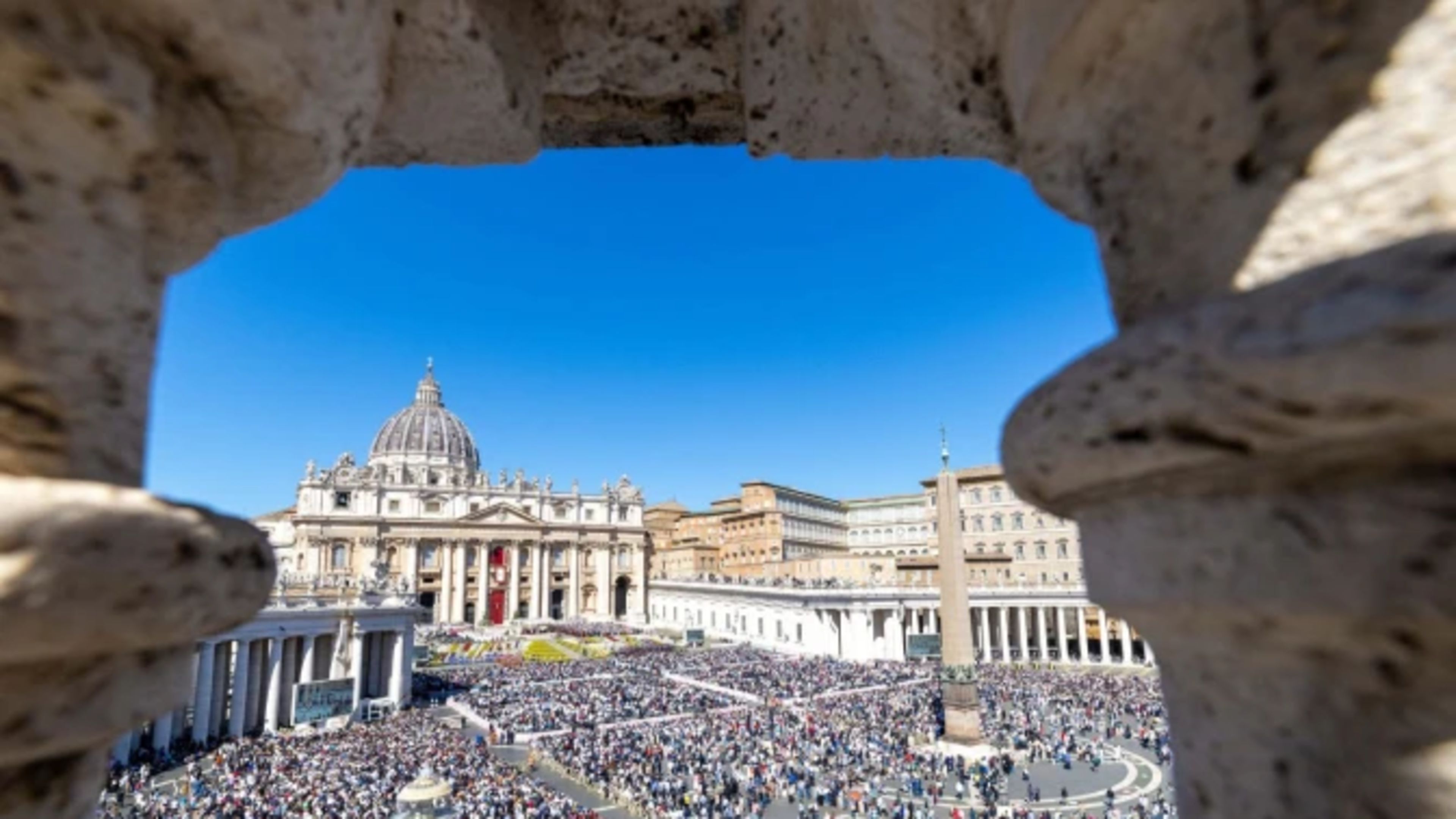
“When a priest gives the blessing at the end of Mass, or when the pope gives a blessing at the end of a great celebration, like the one we had today, there are blessings for all people,” he noted, recalling the famous expression of his predecessor, Francis: “Tutti, tutti, tutti” (“everyone, everyone, everyone”).
Going beyond this, Leo XIV warned, “can cause more disunity than unity.” “Everyone is invited to follow Jesus, and everyone is invited to seek conversion in their own lives,” he explained.
This story was first published by ACI Prensa, the Spanish-language sister service of EWTN News. It has been translated and adapted by EWTN News English.
If you value the news and views Catholic World Report provides, please consider donating to support our efforts. Your contribution will help us continue to make CWR available to all readers worldwide for free, without a subscription. Thank you for your generosity!
Click here for more information on donating to CWR. Click here to sign up for our newsletter.

Publishing a letter issued previously is in no way adequate governance of the Catholic Church. The Vatican ought to be ashamed.
We read: “In the November 2024 letter, which it has published on its website, the DDF recalled that Fiducia Supplicans clearly establishes that the ‘Church does not have the power to confer its liturgical blessing [!] when this, in any way, might offer a form of moral legitimation to a union that purports to be a marriage or to an extramarital sexual practice,’ nor to those who claim ‘the legitimation of their own status’.”
Fine, but where’s the needed retraction of the halfway-house of “non-liturgical” [!] blessing of irregular pairings as “couples”?
How is it, exactly, that by Fernandez’s obscure harmonizing, we devolved away from the clarity (clarity, what’s that?) of Cardinal Erdo at the Synod on the Family (2015): “‘There are absolutely no grounds for considering homosexual unions to be in any way similar or even remotely analogous to God’s plan for marriage and family’”? https://www.catholicnewsagency.com/news/32772/full-text-of-cardinal-erdos-introductory-report-for-the-synod-on-the-family
Ok, I’ll play along. If “formal” blessings are not permitted, does that mean that “informal” blessings could be? Fr. James Martin, SCH seems to think that it’s perfectly acceptable to bless same sex relationships based on his interpretation of Francis’ teachings. What about that?
Agreement is a word applied between equal authorities, whereas in this instance we have the supreme authority of the Church speaking with the German bishops as if he is simply one among equals.
We can be reasonably assured the Germans are in consequence going to insist on their end of the bargain – in context of an acknowledgement of their equanimity with the Roman pontiff. But this is a vital issue deserving of clear doctrinal ratification. Although what we have is a prime display of papal authority amounting to zero. So, your Holiness, what else is new?
Indeed.
“A separation, or even an opposition [!], is thus established in some cases between the teaching of the precept, which is valid and general, and the norm of the individual conscience, which would in fact make the final decision [no longer a ‘moral judgment’!] about what is good and what is evil. On this basis, an attempt is made to legitimize so-called ‘pastoral’ solutions contrary to the teaching of the Magisterium, and to justify a ‘creative’ hermeneutic according to which the moral conscience is in no way obliged, in every case, by a particular negative precept [thou shalt not!]” (Veritatis Splendor, n. 56).
And, “This is the first time, in fact, that the MAGISTERIUM of the Church [caps added] has set forth in detail the fundamental elements of this [‘moral’] teaching, and presented the principles for the pastoral discernment necessary in practical and cultural situations which are complex and even crucial” (n. 115).
And, as for possible extravagance, “The Church is no way [!] the author or the arbiter of this [‘moral’] norm” (n. 95).
Veritatis Splendor, so great a moral compass for the Church has been muffled by hierarchy since 2013, understandably due to their absence of moral character. You do well to frequently quote pertinent passages for the benefit of all.
Thank you.
Veritatis Splendor restores moral character. About moral absolutes, this too: “Jesus himself reaffirms that these prohibitions allow no exceptions: ‘If you wish to enter into life, keep the commandments….You shall not murder. You shall not commit adultery, You shall not steal, You shall not bear false witness'(Mt 19:17-18).”
Three points:
FIRST, something to watch prayerfully will be how the Church navigates both a world of collapsed morality in the West and the second alternative universe of Islam—by fostering the needed “fraternity” with individual Muslims (as persons), but without blurring “interreligious dialogue” as if the religion of Islam is now a branch of Christian “ecumenism”….
SECOND, Islam, which in the Qur’an celebrates the “Law of Moses” while not listing the prohibitive commandments; which does not believe in either free will or then original sin; which therefore replaces the redemptive the salvific Jesus Christ as the “Word made flesh” with the substitute and “uncreated” Qur’an as “the word made book”; which therefore replaces Mary as Theotokos with Muhammad as the messenger, and in the same stroke erases the Holy Spirit by rendering Christ as a sort of John the Baptist (foretelling not the coming of the Paraclete, but the coming of Muhammad).
THIRD, and, at the philosophical level: Islam which replaces the non-demonstrable first principle of non-contradiction with the non-principle of inside-the-bubble consensus (ijma and ijtihad) and “abrogation”—abrupt abrogation which resembles so very much the Western slow-motion drift into equally pragmatic process theology. Der Synodale Weg?
SUMMARY: Without the gift of divinely ordained and baked-in moral absolutes from a relational (Triune) God who is Father, the resulting vacuum is easily filled with ahistorical and apocalyptic 7th-century jihadism. Possibly modernized in Shi’ite Iran with endgame nuclear weapons?
So, individual words matter as the Church discerns an astute path of “fraternity” (yes!)—to truly encounter agnostic Secularists and fideistic Muslims, both—without seeming to split the difference into a blended/intercultural block party.