


 By
By 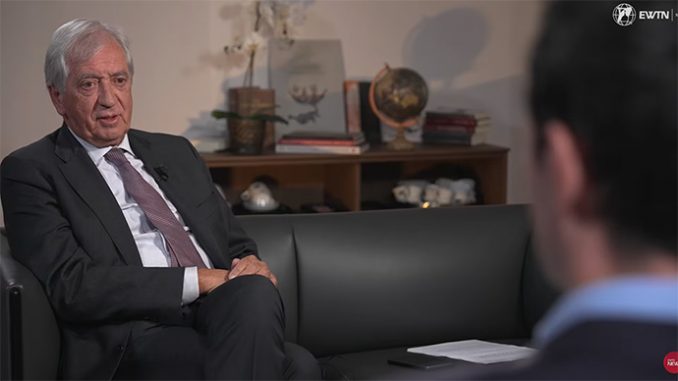
Former Vatican auditor general Libero Milone revealed details about the work he oversaw with the Vatican finances with the late Cardinal George Pell, including financial irregularities and unaccounted-for sums of money.
“We need to be sure, and I say this as a Catholic and as an accountant, that we are informed correctly about the state of the Vatican finances,” Milone said. “Because if the Vatican finances are sound, it means that our Church will continue. If the Vatican finances are not sound, it’s going to have problems.”
Milone sat down with EWTN News correspondent Colm Flynn for an exclusive interview about his case against the Vatican alleging unfair dismissal, loss of earnings, and reputational damage. The case has been dismissed, and he is filing his final appeal.
For decades, the Vatican has struggled with transparency and accountability in its finances. To address this, Pope Francis appointed Pell to head the Secretariat for the Economy and named Milone as the Vatican’s first auditor general.
Before coming to the Vatican, Milone was a top financial auditor who spent more than 30 years at Deloitte in Italy and in the U.S. as well as a number of other firms.
His job at the Vatican was to examine the Church’s balance sheets and bring order to its financial operations. But after two years Milone suddenly resigned, which he has said he was forced to do after uncovering financial irregularities.
Milone took legal action alleging that Cardinal Angelo Becciu pressured him to quit after he began finding evidence of fraud. The Vatican dismissed his complaint, arguing that even if Becciu did force his resignation, he acted in a personal capacity, not as an official of the Secretariat of State.
The Vatican has said that Milone “failed in the agreement to keep confidential the reasons for his resignation from office.”
“When they delivered the decree of the crimes that I committed, the document said that they had a document …. which proved they had carried out seven months of investigation on me and included all the details of whatever crimes I’d committed,” Milone said.
“This happened in June of 2017. Eight years and some months have gone by, and we have asked for this document many, many times and we’ve never been given it. So I don’t have any element to know what exactly I’m accused of,” he said.
“My impression is, I’ve never seen it because maybe it doesn’t include anything, because had it included something real, I would have been confronted with it,” he said.
Milone appealed, but the decision was upheld. He has launched a final appeal.
The Vatican did not comment upon EWTN News’ request, which Milone says is because “they’re very embarrassed.”
“They’re very embarrassed what two individuals did within the Vatican from an institutional standpoint, and they don’t have the answer,” he said. “So they try to shy away from the issue without commenting on it, which is what happened in the legal case.”
Financial irregularities
Since his dismissal, Milone has spoken with a number of journalists about the matter and irregulatires he uncovered. He spoke with one who was investigating an issue regarding payment systems for the Administration of the Patrimony of the Apostolic See (APSA).
APSA “is the major dicastery of the Vatican, responsible for the management of its assets,” Milone said. “It’s like a treasury, and it’s also sort of a banking institution, although it’s not a direct bank because it operates through banks in other countries to operate its financial activities.”
“When this journalist did his investigation and came up with an analysis … he contacted me and he said he had found out that the payment system in APSA was possibly able to make payments by losing track of the receiver,” Milone said.
The issue was that someone could make a money transfer and then change the direction where the money was going after it had left the account, and it wouldn’t show up on the initial records.
The journalist asked if it was true. “So I told the journalist, ‘What you found out is correct, full stop.’ So I only mentioned it once, saying there was a problem with the swift payment issues. And I confirmed the investigation. How could I not confirm? I couldn’t lie.”
“In my two years in the Vatican, I reported 15 issues to the money laundering authority AIF, and to the promoter [of] justice to investigate. Because my statute said if there are issues which are in conflict of the law, you have to report to these authorities,” he said.
“AIF, 14 times, replied to me that we had misunderstood and one time they didn’t reply. And the promoter of justice never replied to any of them. So what’s the point in highlighting issues which need to be investigated if nobody looks into them?”
Milone has also spoken out about “an odd transfer” of 2.5 million euros sent to a hospital to build a ward. The money was sent, but there is no ward.
“We examined all the documentation, all the transactions, and we found that 2.5 million had been paid over to … the hospital over a period of time in equal transactions, 10 transactions of 250,000, I think. And it had gone into the bank account. The ward had not been built. But the money also left the bank account” of the hospital.
“And that was reported to the promoter of justice in the Vatican,” he said. “I just did my job. My job was to review, report, and then get on with the next thing. My job was not of a judicial nature.”
Next steps with Pope Leo
In an interview with Crux, Pope Leo XIV has said the claims of a financial crisis at the Vatican have been exaggerated, noting that the Holy See actually recorded a surplus of 60 million euros in 2024.
He even said he wasn’t “losing any sleep” over the issue of finances at the Vatican. In response, Milone said: “I was very worried that the pope would not be properly informed of the situation in the Vatican because there were too many, let me use the word, skeletons in cupboards that needed to be preserved. And therefore it would be very difficult to understand the issues at hand.”
“The financial situation may be better than he expected,” Milone said. “I don’t know what’s happened between 2017, when I left, and today, except from reading in the newspapers. But I also know as an experienced accountant that some of the issues there would have been very difficult to remove in a very short period of time.”
“Now, the fact that the consolidated financial statements are not being disclosed, to me, is an indication that there is a problem,” he said.
Milone said he would like to meet with Pope Leo “to give him my understanding of some of the challenges that the Vatican faces in moving forward and becoming sound from an economical standpoint.”
As Milone’s case moves forward, if the next appeal is rejected “that would be technically the end of the line in the Vatican,” he said.
“I’m an optimistic person. I believe that in any case, if there’s a justice system, the justice system has to be properly followed by. And I believe that at the end of the day, if there is truth in the documents and the documents are read properly and understood properly, I will be on the right side of the decision,” Milone said.
If you value the news and views Catholic World Report provides, please consider donating to support our efforts. Your contribution will help us continue to make CWR available to all readers worldwide for free, without a subscription. Thank you for your generosity!
Click here for more information on donating to CWR. Click here to sign up for our newsletter.

The only recourse is to insure that no money goes to the Vatican until and unless an independent audit of their finances is done.
“The Vatican,” meaning all elite inhabitants of the Vatican State, including the Pontiff Leo XIV and his right-hand-man Eminence Parolin and their financial administrators, are justifiably to be judged frauds, unless and until the day that they do 2 things:
A. Vindicate Libero Milone, and publicly attest to his good character; and
B. Submit to a publicized financial audit performed by 3 separate publicly-trusted 3rd parties .
Ten years ago, the Vatican contracted a global audit firm (Price Waterhouse Coopers) to conduct an audit. The arrangement was terminated after a few months, after Cardinal Pell was undercut by Abp. Becciu. Becciu was named a Cardinal by Francis. Pell was pursued by his native Australian authorities until acquitted, Becciu was tried and convicted and as a part of his conviction, renounced his Cardinal privileges. Despite that, he attempted to participate in the 2025 conclave.
Remember too, that the dispute over PWC’s role involved the supremacy of Milone as Auditor General.
One thing you learn as a fundamental aspect of auditing is that prior to accepting an engagement, you need to conduct acceptance procedures-essentially a preliminary review of a prospective client, to assure that the integrity of management.
At this point, I doubt any of the “Big Four” (and due to the size and scope of this audit, it would likely require an auditor with global reach) would be eager to begin the work necessary to accept the Vatican as a new client, because the history doesn’t suggest integrity and there would be a serious question about client retention.
If the enemies for reliable financial disclosure wanted to surround Vatican finances with a toxic moat to prevent any independent inquiry and disclosure, they likely succeeded.
With all the twists and turns of the long-running Vatican financial saga, I had forgotten about APSA contracting with PWC, and the fallout that ensued. To refresh my memory, I found two articles by Phil Lawler, one in 2016 and 2017, the first about the termination of an APSA contract with PWC, and the second about the resumption of the contract in 2017 (or maybe it was a new contract). Lawler’s articles reminded me of even more things that happened, going back to the Vatileaks scandal.
Yes, it’s hard to imagine why any of the major accounting firms would want to get involved with the Vatican, especially after seeing what has happened to Libero Milone’s career. He had already retired from Deloitte and was working for his own consulting firm when he was brought on by Cardinal Pell. In the interview, he said that one of the reasons he wanted to get involved was that, as a Catholic, he wanted to get involved in improving the financial situation of the Church. May his efforts eventually pay off, however long it takes.
If they have a new contract, it’s for advisory services, not audit.
I seem to recall they were brought back as advisors only.