

 By
By At the German Embassy to the Holy See, scholars honored Benedict XVI’s vision for Europe including the late pontiff’s warning that Europe cannot survive without its Christian roots.
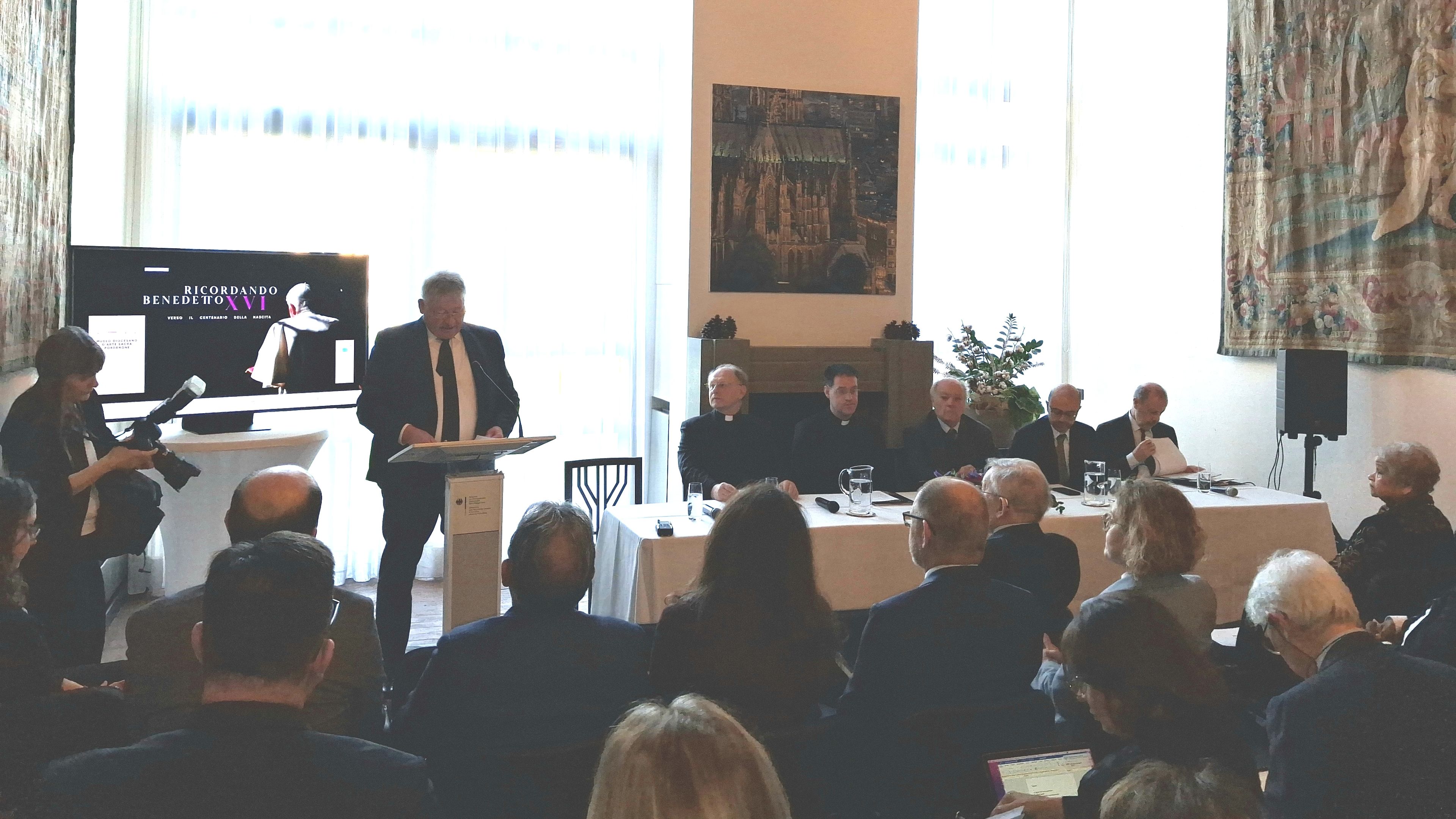
ROME — Just days after four of Europe’s most senior bishops called on the continent to “rediscover its soul,” scholars gathered at the German Embassy to the Holy See on Feb. 17 to honor the man who spent his entire career making that very argument: Joseph Ratzinger.
Benedict XVI — as a theologian, as prefect of the Congregation for the Doctrine of the Faith, and as the 265th pope — never stopped insisting that Europe could not survive as a mere economic and political project without its Christian foundations.
In a landmark 2005 lecture at Subiaco, delivered the day before St. John Paul II died, then-Cardinal Ratzinger warned that what offends people of other religions is “not the mention of God” in Europe’s founding documents but rather “the attempt to build the human community absolutely without God.”
That message was echoed on Feb. 13 when the presidents of the French, Italian, German, and Polish bishops’ conferences issued a joint appeal urging Europe to recover its spiritual identity in a world they described as “torn and polarized.” The bishops invoked the EU’s Catholic founding fathers — Robert Schuman, Konrad Adenauer, and Alcide De Gasperi — and warned that Europe “cannot be reduced to an economic and financial market” without betraying their vision.”
“And he was never fed up with it,” said Giovanni Maria Vian, a historian and the former editor-in-chief of the Vatican newspaper L’Osservatore Romano, describing Ratzinger’s decades-long engagement with Europe’s crisis of identity at the conference organized ahead of the 100th anniversary of his birth on April 16, 2027.
‘Christianity helped to bring all of them together’
The event, titled “Ricordando Benedetto XVI” (“Remembering Benedict XVI”), also served as the Rome presentation for a forthcoming exhibition dedicated to the late pope at the Diocesan Museum of Sacred Art in the Italian city of Pordenone, running from Feb. 21 to April 12.
“One of the greatest examples was that Cardinal Ratzinger brought the ancient Holy Inquisition” — referring to what is now the Dicastery for the Doctrine of the Faith — “as a Roman institution to the whole world,” Vian told EWTN News, describing Ratzinger’s impact in and beyond Europe.
Vian said that after Benedict XVI resigned in 2013, he visited the pope emeritus and found that Ratzinger “followed everything” from Church affairs to global politics and was “curious and attentive” also to the secular world.
Father Mariusz Kuciński, director of the Ratzinger Study Centre in Bydgoszcz, Poland, told EWTN News that the relevance of the late pope is evident in the continued volume of books being reprinted and new institutes being established across Germany, Europe, and other parts of the world.
“Ratzinger truly fought a battle” both intellectually and in the form of “strong pastoral action, to help Europe regain its nature,” Kuciński said.
“It is not that Europe is perfectly Christian, because it never was,” the priest said, but Ratzinger struggled for the continent to “reclaim its Christian roots.”
According to Kuciński, Ratzinger understood that Europe was built on the Ten Commandments, Greek philosophy, and Roman law. When those three foundations are separated, “nothing remains,” the priest warned, stressing that “Christianity helped to bring all of them together.”
“In our difficult era, we need a clear and concrete teaching” just like Benedict’s, Kuciński said.
A ‘creative minority’
Ratzinger’s concern for Europe spanned his entire career and produced some of his most memorable interventions, such as a constant call for Catholics to be a “creative minority.”
In his 2004 book “Without Roots,” co-authored with Marcello Pera, then-president of the Italian Senate, the Bavarian cardinal argued that “Europe is not a continent that can be comprehended neatly in geographical terms; rather it is a cultural and historical concept.”
Ratzinger warned of a “self-hatred in the Western world that is strange and that can be considered pathological; yes, the West is making a praiseworthy attempt to be completely open to understanding foreign values, but it no longer loves itself.”
“In order to survive, Europe needs a new — and certainly a critical and humble — acceptance of itself, that is, if it wants to survive.”
In his lecture at the convent of St. Scholastica in Subiaco, Italy, the theologian famously connected this warning with “a proposal to the secularists.”
“The attempt, carried to the extreme, to manage human affairs disdaining God completely leads us increasingly to the edge of the abyss, to man’s ever-greater isolation from reality.”
The late pope called on Europe, and the West more broadly, to “reverse the axiom of the Enlightenment and say: Even one who does not succeed in finding the way of accepting God, should, nevertheless, seek to live and to direct his life ‘veluti si Deus daretur,’ as if God existed.”
If you value the news and views Catholic World Report provides, please consider donating to support our efforts. Your contribution will help us continue to make CWR available to all readers worldwide for free, without a subscription. Thank you for your generosity!
Click here for more information on donating to CWR. Click here to sign up for our newsletter.
Leave a Reply