

 By
By At the German Embassy to the Holy See, scholars honored Benedict XVI’s vision for Europe including the late pontiff’s warning that Europe cannot survive without its Christian roots.
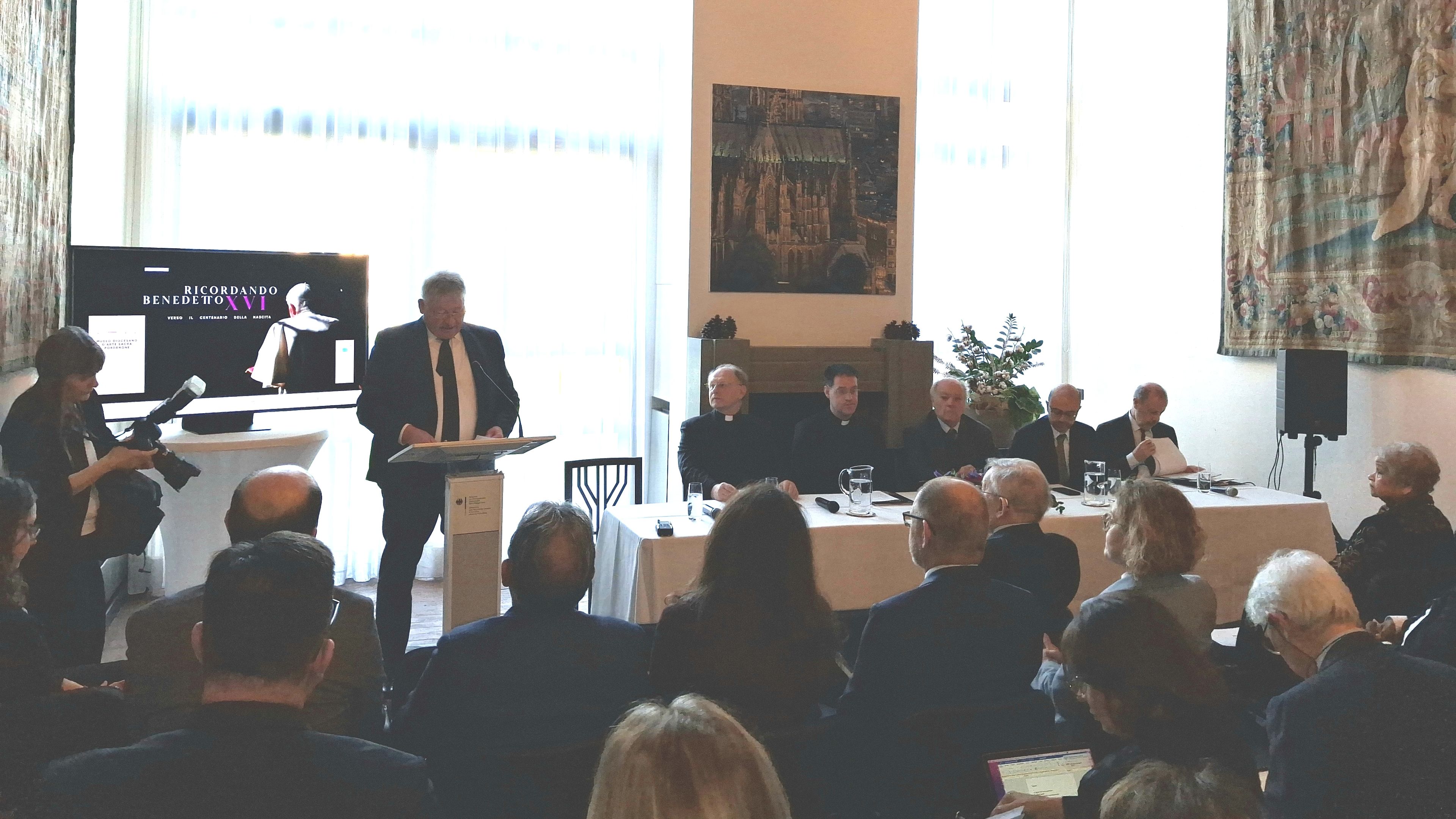
ROME — Just days after four of Europe’s most senior bishops called on the continent to “rediscover its soul,” scholars gathered at the German Embassy to the Holy See on Feb. 17 to honor the man who spent his entire career making that very argument: Joseph Ratzinger.
Benedict XVI — as a theologian, as prefect of the Congregation for the Doctrine of the Faith, and as the 265th pope — never stopped insisting that Europe could not survive as a mere economic and political project without its Christian foundations.
In a landmark 2005 lecture at Subiaco, delivered the day before St. John Paul II died, then-Cardinal Ratzinger warned that what offends people of other religions is “not the mention of God” in Europe’s founding documents but rather “the attempt to build the human community absolutely without God.”
That message was echoed on Feb. 13 when the presidents of the French, Italian, German, and Polish bishops’ conferences issued a joint appeal urging Europe to recover its spiritual identity in a world they described as “torn and polarized.” The bishops invoked the EU’s Catholic founding fathers — Robert Schuman, Konrad Adenauer, and Alcide De Gasperi — and warned that Europe “cannot be reduced to an economic and financial market” without betraying their vision.”
“And he was never fed up with it,” said Giovanni Maria Vian, a historian and the former editor-in-chief of the Vatican newspaper L’Osservatore Romano, describing Ratzinger’s decades-long engagement with Europe’s crisis of identity at the conference organized ahead of the 100th anniversary of his birth on April 16, 2027.
‘Christianity helped to bring all of them together’
The event, titled “Ricordando Benedetto XVI” (“Remembering Benedict XVI”), also served as the Rome presentation for a forthcoming exhibition dedicated to the late pope at the Diocesan Museum of Sacred Art in the Italian city of Pordenone, running from Feb. 21 to April 12.
“One of the greatest examples was that Cardinal Ratzinger brought the ancient Holy Inquisition” — referring to what is now the Dicastery for the Doctrine of the Faith — “as a Roman institution to the whole world,” Vian told EWTN News, describing Ratzinger’s impact in and beyond Europe.
Vian said that after Benedict XVI resigned in 2013, he visited the pope emeritus and found that Ratzinger “followed everything” from Church affairs to global politics and was “curious and attentive” also to the secular world.
Father Mariusz Kuciński, director of the Ratzinger Study Centre in Bydgoszcz, Poland, told EWTN News that the relevance of the late pope is evident in the continued volume of books being reprinted and new institutes being established across Germany, Europe, and other parts of the world.
“Ratzinger truly fought a battle” both intellectually and in the form of “strong pastoral action, to help Europe regain its nature,” Kuciński said.
“It is not that Europe is perfectly Christian, because it never was,” the priest said, but Ratzinger struggled for the continent to “reclaim its Christian roots.”
According to Kuciński, Ratzinger understood that Europe was built on the Ten Commandments, Greek philosophy, and Roman law. When those three foundations are separated, “nothing remains,” the priest warned, stressing that “Christianity helped to bring all of them together.”
“In our difficult era, we need a clear and concrete teaching” just like Benedict’s, Kuciński said.
A ‘creative minority’
Ratzinger’s concern for Europe spanned his entire career and produced some of his most memorable interventions, such as a constant call for Catholics to be a “creative minority.”
In his 2004 book “Without Roots,” co-authored with Marcello Pera, then-president of the Italian Senate, the Bavarian cardinal argued that “Europe is not a continent that can be comprehended neatly in geographical terms; rather it is a cultural and historical concept.”
Ratzinger warned of a “self-hatred in the Western world that is strange and that can be considered pathological; yes, the West is making a praiseworthy attempt to be completely open to understanding foreign values, but it no longer loves itself.”
“In order to survive, Europe needs a new — and certainly a critical and humble — acceptance of itself, that is, if it wants to survive.”
In his lecture at the convent of St. Scholastica in Subiaco, Italy, the theologian famously connected this warning with “a proposal to the secularists.”
“The attempt, carried to the extreme, to manage human affairs disdaining God completely leads us increasingly to the edge of the abyss, to man’s ever-greater isolation from reality.”
The late pope called on Europe, and the West more broadly, to “reverse the axiom of the Enlightenment and say: Even one who does not succeed in finding the way of accepting God, should, nevertheless, seek to live and to direct his life ‘veluti si Deus daretur,’ as if God existed.”
If you value the news and views Catholic World Report provides, please consider donating to support our efforts. Your contribution will help us continue to make CWR available to all readers worldwide for free, without a subscription. Thank you for your generosity!
Click here for more information on donating to CWR. Click here to sign up for our newsletter.
Reconversion of Europe was close to his heart. Renowned theologian, the late Joseph Ratzinger, who became Pope Benedict XVI served the Church with vision, dedication, and passion.
Ratzinger’s vision is not merely academic, but existential…
How, then, not only to “reverse the axiom [axis?] of the Enlightenment,” but also the global trajectory? The pied piper Francis Bacon (1521-1626) did our and future generations no favors by placing “nature on the rack” to reveal her secrets for our control— as in the notion that human faults and perversity can be outrun by simply/simplistically giving equal access to the industrialized Consumer Culture across the entire globe.
Encouraged to notice Kuciński’s remark that “In our difficult era, we need a clear and concrete teaching,” and to also recall that only a few weeks ago Pope Leo XIV posed this exact challenge to (Cardinal Fernandez’s) Dicastery for the Doctrine of the Faith. This is more and deeper than dancing in ambiguity between constructed “polarities”.
“Ratzinger warned of a ‘self-hatred in the Western world that is strange and that can be considered pathological'” (Petrík).
Pathological. Extreme. To act in an inordinate way. Uncontrolled ‘feelings’. I’ve wondered why that was so, as this dynamic became evident in Europe, its foreign and political outlook.
Was it the excesses of the War, the unspeakable brutality, the engagement of both sides in mass murder? A loss of faith in the divine good? That was the apparent basis for someone dear to me, when a bright life soured, when relished ideals disassembled, happiness a futile mirage.
For Europe, the center of Christian culture, evil sources had to be in play. Self hatred recognizes our sin, the egregious failures, and fails to forgive them. This seems to have occurred collectively in the European psyche. We develop a hatred for the forms of behavior, the rituals expected of us.
Whatever we may think of Angela Merkel, her policy of open borders was perhaps more than a reaction to communism and the Wall, a pathological pretext for empathy that was actually self destructive. Her mentor Helmut Kohl warned her.
Then came Francis and the religiosity of borderless Europe, open to the teeming impoverished from South and East. If Europe learned to hate itself this became mass suicide. Will Leo XIV save her? He alone possesses remedy.
But then there’s Timothy Schmalz’ Homeless Jesus, and Angels Unawares sitting before St Peter’s Basilica. And it was Pope Leo who said the migrant is Jesus knocking on the door!
The pathology of self-hatred…
Instead of rogue aspects of intellectualized “modernity,” we might wonder about not only a European pathology but also overlaid, synergistic (!) or symbiotic (!) and serpentine (!) pathologies (sins?) reported in Genesis and later exposed in Humanae Vitae?
Two Points, plus a long but revealing Quote, and a Summary…
FIRST, about the historic role of individual personalities— while it seems that Hitler’s pathological attempt to cleanse Europe of Jewry is likely not connected to the speculation that his own blood was remotely part Jewish, what else might have been stirring, too, at least in his erroneous (?) self-perceptions? https://jewishvirtuallibrary.org/was-hitler-jewish
SECOND, within part of Islam as an expansive world religion, members of the jihadist network clearly know that killing of innocents is immoral, but are they are experiencing a pathological “desire to escape reality or transform it along the lines of a second reality more congenial to the “‘pneumopathological’ [!] terrorist imagination”? The italicized [‘’] term applies to a spiritual sickness rather than any psychological disorder or more rational thought process at least calculated to achieve justice, if by whatever means. They know what they are doing; “They are not psychopaths [!] who cannot distinguish good and evil or innocence and guilt” (Barry Cooper, “Jihadists’ and the War on Terrorism,” The Intercollegiate Review, Spring 2007).
And, THIRD, from the perspective of human nature and the perennial Catholic Church, what about interior spirituality and the vocational meaning of embattled and betrayed celibacy?
“Some Fathers off the Church, such as John Chrysostom, Gregory of Nyssa and Maximus the Confessor, through that if Adam had not sinned there would have been no marriage, with the sexual procreation that is now its distinguishing feature, because in the way in which it is no exercised, human sexuality is the fruit of original sin. HOWEVER, from a more biblical and less Platonic perspective it must be said that rather the reverse is true [!]: that, had there been no sin there would have been no virginity, because there would have been no need to question marriage and sexuality and subject them to judgment.
“Poverty, chastity and obedience are not a renunciation—or worse, a condemnation—of a created ‘good’, but a rejection of the ‘evil’ that has come to overlay that good. Therefore, they are, by definition, a proclamation of the original goodness of created things. They are a way of imitating the Word of God Who, by taking flesh, took on all that belongs to human nature, but did not take on sin (cf. Heb 4:15)” (Raniero Cantalamessa, OFM and long-time preacher of the Papal Household, “Virginity: A Positive Approach to Celibacy for the Sake of the Kingdom of Heaven,” Alba House, 1995).
SUMMARY: Again, what about the self-hatreds of “synergistic (!) or symbiotic (!) and primordially “serpentine” (!) pathologies? What do we really mean by the superficially sociological and economic term: “structural sin”?
Small wonder that mechanistic, therapeutic and pathological Secular-ISM compartmentalizes interior religion as only a “private” domain. And we’re told borders don’t matter!
A reasonable objection to the pious thoughts of Saints John Chrysostom et Al that the transmission of human life is a form of punishment for original sin is, in all reverence to the Saints, preposterous. Because God would then have designed male and female man and woman in his divine image only to deform it due to sin.
We are morally indebted to assume he created us, as is, due to his own free will not because of our human imperfection.
What appears more likely is that original sin was related to human sexuality, although not in the natural act itself, rather due to a perversion of the act, the original sin, that violated natural law and God’s admonition. That perversion of the act, related to Mankind’s most common and aggravated sin, is suggested by Edith Stein, and renders greater reasoned coherence to the fall from grace.