


 By
By 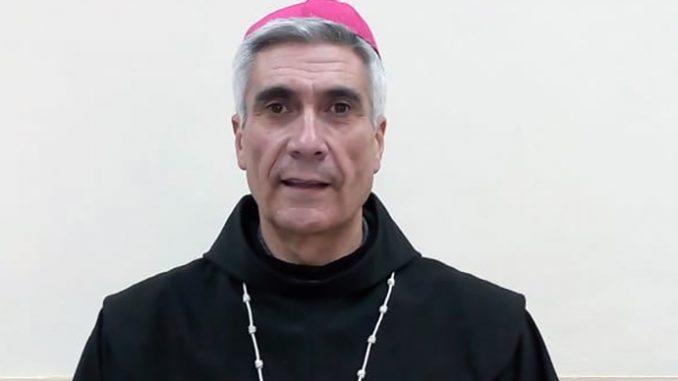
The archbishop of Corrientes, Argentina, José Adolfo Larregain, confirmed that the marriage between two transgender persons, which took place in January in the archdiocese, has been annulled because it did not meet the requirements established by the Code of Canon Law and generated confusion among the faithful.
The ceremony was performed on Jan. 28 at Our Lady of Pompeii Parish between two transgender persons, one biologically male and the other biologically female, who legally changed their names and genders on their national identity documents under Argentina’s gender identity law.
On Feb. 8, the Archdiocese of Corrientes issued a statement announcing that it would apply the corresponding “canonical disciplinary measures.”
In that context, Larregain explained to ACI Prensa, the Spanish-language sister service of EWTN News, that the annulment of the sacrament had already been promulgated and explained that the decree “specifically considers that the Church, by virtue of safeguarding the sacraments entrusted by Christ, establishes through the Code of Canon Law and Church discipline the essential conditions for the validity and licitness of the sacrament of marriage, and that the omission of such requirements prevents this aforementioned celebration from being considered sacramental.”
The prelate pointed out that the marriage lacks canonical validity and that its public nature “generated confusion among the faithful.”
The annulment was based on two reasons, Larregain explained, noting that “every sacrament is constituted by matter and form. In this case, the sacrament of marriage consists of the contracting parties and the marital exchange of consent. Here, the matter and the form are absent. Why? First, for ontological reasons, and second, for phenomenological reasons. The ontological aspect relates to what is; the phenomenological aspect, to what is seen or what is shown.”
“Here there is a contradiction, a dissonance between the ontological and the phenomenological. And so, for that reason, it is declared null ipso facto. What does that mean? It is null at that very moment, because it does not effect the sacrament; that is, there is no sacrament as such,” he emphasized.
Based on these facts, and by virtue of his ordinary authority, the bishop “acts ex officio to safeguard the good of souls, the juridical order of the Church, and the correct understanding of the sacraments,” he added.
Thus, the promulgated decree “simply formally declares what happens ipso facto, precisely because it does not have a sacramental character nor meet the conditions required by the Code of Canon Law.”
Larregain also considered it very important “to take into account sacramental theology when celebrating the sacraments and their correct administration.” To this end, he also highlighted the importance of the provisions in the 2023 declaration Fiducia Supplicans, a document from the Dicastery for the Doctrine of the Faith on the pastoral meaning of blessings.
“It clearly specifies these situations so that there is no confusion regarding the administration of sacraments,” he pointed out.
Regarding the disciplinary aspect, the archbishop clarified, “action was taken in accordance with the law,” so “this process is now concluded,” he stated.
This story was first published by ACI Prensa, the Spanish-language sister service of EWTN News. It has been translated and adapted by EWTN News English.
If you value the news and views Catholic World Report provides, please consider donating to support our efforts. Your contribution will help us continue to make CWR available to all readers worldwide for free, without a subscription. Thank you for your generosity!
Click here for more information on donating to CWR. Click here to sign up for our newsletter.
Most people don’t understand words like ontological and phenomenological.
Try a man is a man and a woman is a woman.
The rest is fraud.
Let’s be fair here. There was a man, and there was a woman. (I grant the man was pretending to be a woman, and the woman a man, but still.) And I would assume they were consenting.
Now, could they consummate the marriage? No clue. If they had surgery, I’m guessing no, not really.
Finally, a bishop who acts like a bishop.
A bishop who believes ALL that tl the Catholic Church teaches.
A bishop who is unafraid to speak the Truth.
A bishop who doesn’t acquiesce to the secular pagan culture.
What we need now in the Catholic Church for preparation/examination PRIOR TO an attempt a Sacramental Marriage is a question similar to this: “Were you at birth assigned a sex that you later attempted to change legally i.e. were you born male and attempted to legally change your sex to female? And, if so, did you secure medical intervention to make this change?” If so, this disqualifies one for a Sacramental Marriage.
It was appropriate and necessary to dissolve this union which did not meet sacramental requirements. I wish more Roman Catholic Bishops would stand up for the faith as it has been taught for centuries.
“The ontological aspect relates to what is; the phenomenological aspect, to what is seen or what is shown.”
Can someone explain this to me? Nothing in this article is clear. Exactly why was the marriage declared null other than the obvious.
Ontology is the study of what a thing is. In this case, a man is a man no matter how he presents himself – and a woman is a woman for the same reasons. Phenomenology has to do with what is experienced. What the Archbishop seems to be saying is saying is if a woman is presenting herself as groom and the man is presenting himself as bride, what they say within the context of the celebration of Holy Matrimony isn’t true. “I take you to be my wife,” for example, would be objectively (ontologically) untrue. And that’s before even broaching the question about openness to life and acceptance of children (which is also promised within Holy Matrimony) based on whatever sorts of medicinal or surgical interventions may be involved. All this to say, what is happening or promised does not match what is. That’s why nullity applies.
This is a similar sort of analysis that’s performed to declare a nullification of any other marriage when an annulment is sought. It’s not so much a looking for fault as it is attempting to discover what would have precluded Sacramental Marriage from occurring based on Canon Law.
Inadequate matter. Sacramental marriage requires one biological male and one biological female. Proper sex is the essential and necessary matter.
Elizabeth,
I agree that the article did not provide sufficient information to determine why the bishop acted as he did. Nevertheless, I strongly suspect that the reasons for the bishop’s action was that the biological man no longer looked like a man and had a male sex organ which did not properly function. Therefore, at the very least, the marriage could not be consummated.
The archbishop is precise and judicious in basing the declaration of nullity on sacramental theology.
In a less deep sense, we might also appeal simply to the innate and universal natural law, but this has become vulnerable ground in our now Aztec world where fetal infanticide is routine. Still, we can appreciate what even Cardinal Radcliffe once said about the oxymoron “gay marriage”:
“The Catholic Church does not oppose gay marriage. It considers it to be impossible [!]… Marriage is founded on the glorious fact of sexual difference and its potential fertility. Without this, there would be no life on this planet, no evolution, no human beings, no future. Marriage takes all sorts of forms, from the alliance of clans through bride exchange to modern romantic love. We have come to see that it implies the equal love and dignity of man and woman. But everywhere and always, it remains founded on the union in difference of male and female. Through ceremonies and sacrament this is given a deeper meaning, which for Christians includes the union of God and humanity in Christ.”
Elizabeth Henson (6:46 a.m) – Yep. There is a place for high falutin’ language but most folks operate on a more basic level (and sometimes see more clearly because of it).
What a joke.
You can’t declare something null that never had even the slightest possibility of existence. When a normal man and woman are married there is the possibility that a marriage exists so it can be declared null.
The bishop means well but needs to think things through because this is farcical.
I disagree. That’s how I used to think about Psalm 100:3 — “It is He who has made us, and not we ourselves.” Surely that is obvious? Surely no one is fool enough to think that he has literally bootstrapped himself into existence?
No child is that foolish, but I came to learn that some adults are. If, as I suspect, we are in “Three Days of Darkness” that are more literally “Three Decades of Intellectual and Spiritual Blindness”, it would go a long way towards explaining why so many adults are today that foolish.
JSB: Nothing funny about it. People are acting as God by tampering with the Divine order of creation. This confusion is exactly where the sin of pride takes us.
Once there is a public ceremony and an exchange of vows, with witnesses and guests, there is presumption of validity in the public square. It is actually quite necessary under these circumstances to make it absolutely clear this was invalid and if the Bishop did nothing he would be negligent in his duties.
Now, the priest or deacon that witnessed this is either easily tricked, ignorant or defiant.
He didn’t “declare it null” in the sense that “there was a marriage but now I’m dissolving that marriage.” He declared it null in the sense of pointing out that there was never a marriage in the first place. And it needed to be done in case anybody had any doubt about it.