


Western culture is fading because its western roots are eroding. This failing culture has reached its lowest point in the emerging culture of death, which is antithetical to what John Paul II calls the culture of life in the 1995 encyclical Evangelium Vitae. There are four specific roots of the culture of death: individual autonomy; a debased notion of freedom detached from objective truth; the eclipse of the sense of God and, in consequence, of the human person; and the darkening of human conscience, indeed, moral blindness, resulting in a confusion between good and evil in the individual and in society.
The above quote is from Eduardo Echeverria’s Redeeming Sex: The Battle for the Body, a detailed exposition that meticulously examines the four roots of the culture of death and provides the needed doctrinal, theological, philosophical, anthropological, and spiritual correctives. It is a theological tour de force as Echeverria leaves barely a stone unturned in his examination of what has gone wrong, what it means to be human, and the significance of the body to the person.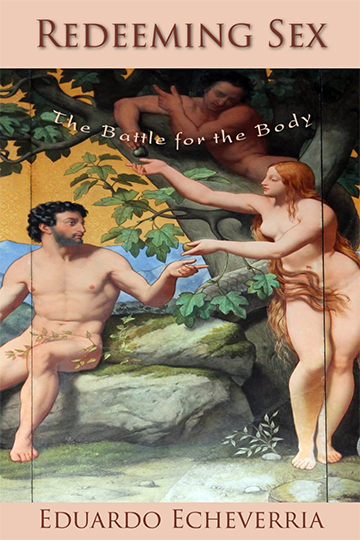
Disputing modern Neo-Calvinist falsehoods
Echeverria’s work is comprehensive. He is not just addressing the “battle for the body” but laying the foundation upon which a proper appreciation for the body may be reached—thus several pages are devoted to anthropology, natural law, epistemology, hermeneutics, and the relation between nature and grace because a proper appreciation for the Church’s sexual moral doctrines requires a proper understanding of the foundations upon which those doctrines rest.
Having studied at the Free University of Amsterdam, Echeverria dedicates several pages to a commentary and critique of Neo-Calvinist thinkers, including Herman Dooyeweerd, Abraham Kuyber, G. C. Berkouwer, and Herman Ridderbos—names unfamiliar to most American Catholics. Nonetheless, the ideas expressed by such authors are especially pertinent. The book focuses in particular on Ad de Bruijne, Professor of Christian Ethics and Spirituality at the Theological University Kampen in the Netherlands.
De Bruijne articulates a very radical, one can even say odd, view of sexual morality. He claims that Christian sexual ethics have evolved even among those he characterizes as “orthodox”—as many believers have accommodated sexual morality to the culture. He insists that the Christian view of sexual morality is “no longer about procreation and the ordering of one’s sexual desires to the goods of human sexuality; rather engaging in sex acts is a matter of physical needs, indeed a private matter that renders such acts an instrument of pleasure, or about individual realization.”
Of course, one wonders in what sense such Christians may be considered “orthodox”—but we should note that many high-profile Catholic theologians paved the way for such unorthodoxy in their dissent from Humanae Vitae, such as Richard McCormick, S.J., Karl Rahner, S.J., Bernard Haring, Daniel McGuire, and Charles Curran, to name just a few. But De Bruijne goes even further in his peculiar argument that the sexual revolution—while recognizing its “break with Christian tradition”—nonetheless “in some respects is also the positive legacy of that tradition.” Where is he getting this? Christianity affirms the goodness of the individual and “sex’s intrinsic goodness rather than merely an instrumental good for the sake of procreation.” Echeverria addresses these claims to show how far some theologians will go to justify the overthrow of sexual morality based on natural law and Divine Revelation, and to emphasize what the Church is up against in fighting the “battle for the body.”
Echeverria’s primary partner in presenting counter-arguments to the heterodox Dutch Reform thinkers is the Dutch prelate Willem Jacobus Cardinal Eijk, currently the Metropolitan Archbishop of Utrecht. One of the pleasures of reading Echeverria’s book is to be introduced to this clear-headed, articulate Cardinal, who explains the problem with basing morality on proportionalism—that school of morality that rejects moral absolutes and instead argues that ontic evil may be directly chosen if there is a proportionate good.
Rooted in the thought and theology of St. Pope John Paul II
Chapter Two is focused on anthropology, with particular emphasis on the body/soul relationship. Here, Echeverria rightly relies on John Paul II’s theology of the body. Dissent from Catholic moral doctrines concerning the meaning of sex is largely based on neo-gnosticism that treats the body as insignificant to personhood. In this dualist system, the body is reduced to mere functionality, or is simply a kind of costume separate from the true person identified with the spirit, mind, or soul.
Throughout this book, Echeverria draws upon the writings of Saint John Paul II, in particular Man and Woman He Created Them—A Theology of the Body, Love and Responsibility, Person and Act, and the encyclical Veritatis Splendor, which corrected current problems in Catholic moral theology. We see that the body is not something we possess—rather, the body is the person.
One of the strongest sections of the book is Echeverria’s treatment of natural law in continued response to De Bruijne’s defense of homosexuality. Coupled with a defense of natural law’s basis for morality, the moral teaching of the Church is illuminated by going back to the beginning, as Jesus Himself based His teaching on marriage and human sexuality by citing the first two chapters of Genesis.
There is also an important discussion about and a clear explanation of the difference between what is called “the law of gradualism” versus “the gradualism of the law”—a distinction that can be difficult to understand. The gradualism of the law recognizes that there is a distinction between where the person is at the moment (perhaps caught in sinful habits) and the advancements that person can and hopefully will make in the moral life without “falsifying the standard of good and evil in order to adapt it to particular circumstances.”
But many who do not accept Church teaching on sexual morality pose a “gradualness of the law.” According to this precept, a person can justify their immoral acts, a self-justification that the person is doing the best that he can, and given the situation, is the only moral standard he is obliged to meet.” In other words, the objective moral standard is only an ideal, not a moral obligation.
Addressing faulty presuppositions
The third chapter, titled “Culture Wars, the Sexual Revolution, Ethics, Hermeneutics,” focuses on contraception, homosexuality, and artificial reproduction. There is special attention given to the meaning of marriage and procreation, drawing again on the insights of John Paul II, in particular his book Love and Responsibility, published in 1960. Echeverria lays out four presuppositions that need to be considered in understanding and discussing sexual ethics.
They are: 1) “there is a distinctive sexual ethics, rather than just a general ethics, governing interpersonal relationships … The question here that needs attention is: what is the proper end of our sexual powers and their relationship to marriage?” 2) “…one of the reasons why a distinctive sexual ethic is denied by many is that there is no room, in their view, of a moral law grounded in human nature, willed by God.” 3) “… a key to understanding Catholic sexual ethics is the truth that the human person is a bodily being. This view rejects a dualistic view of the human person…”. 4) “… a rehabilitation of the ‘culture of person’ is necessary because the objective good of the person constitutes the essential core of all human culture.”
Echeverria’s work includes an extensive comparison between the theology of John Paul II and the sexual ethics of feminist theologian Margaret Farley as presented in her book Just Love: A Framework for Christian Sexual Ethics. In 2012, Farley was the subject of a Vatican investigation of her book in which the Congregation for the Doctrine of the Faith under Cardinal Gerhard Ludwig Müller stated Farley’s book “affirms positions that are in direct contradiction with Catholic teaching in the field of sexual morality” and “is not in conformity with the teaching of the Church.” The CDF further decreed that her book “cannot be used as a valid expression of Catholic teaching, either in counseling and formation, or in ecumenical and interreligious dialogue.” Her ethics contradicts “all offences against chastity in the Catechism of the Catholic Church. Rejecting natural law, Farley locates morality in “contemporary experience” and what she calls a “responsible relational” position according to norms that govern relationships as such—i.e. consent, honesty, lack of exploitation, and so on.
Furthermore, Farley believes that “human sexuality, embodiment, doesn’t essentially consist of sexual differentiation.” Echeverria stands effectively on the theological shoulders of John Paul II as the Saint beautifully explains that being male and female is necessary for a true communion of persons—the highest expression of such communion is realized in the sacrament of marriage. And, according to John Paul II, “Natural law points to the need for penetration into … ontic structures and the need to understand natures, i.e., the essence of things, essences which enter into the object of human action.”
When reading Echeverria’s numerous arguments against De Bruijne, I wondered if he would also address the controversial priest James Martin, S.J. Indeed, the last section of his book is devoted to Martin and may be regarded as the book’s climax in the battle for the body. This is one of the few places where one finds a full commentary on how Martin’s heterodox defense of homosexuality and the “LGBTQ” lifestyle contradicts the teachings of the Church as expressed in Martin’s book, Building a Bridge: How the Catholic Church and the LGBT Community Can Enter into a Relationship of Respect, Compassion, and Sensitivity.
For anyone wanting to understand Martin’s arguments and position and how they cannot be squared with Catholic moral teachings, Echeverria provides an excellent exposition. Much discussion here is focused on Martin’s complaint about how the Catechism of the Catholic Church (art. 2358), states that the homosexual orientation itself is “objectively disordered.” Martin’s main objection is that such characterization causes a person with same-sex attraction to “feel hurt” and “shows a lack of respect.” Echeverria responds to Martin’s pro-gay arguments with recourse to John Paul II, Benedict XVI, the teachings of St. Paul, Christian anthropology, the Magisterial authority of the Church, and the meaning of marriage according to natural law and divine revelation.
Conclusion
There is one shortcoming in Echeverria’s treatment of homosexuality. He states that Scripture’s condemnation of homosexuality “pertains not only to outward acts but also to the inward desires and inclinations constitutive of the condition itself.” He does not make a sufficient distinction that those desires are not condemned unless the agent wills them and approves them—and certainly not until the person with same-sex attraction acts upon them.
Moreover, one must take into account the level of freedom involved in persons with same-sex attraction being able to resist giving in to those desires and actions when evaluating such persons’ level of culpability. Nonetheless, Echeverria rightly shows that the Catechism identifies homosexuality as “intrinsically disordered” because the orientation disposes the person to commit disordered acts, contrary to the God-designed meaning of what it means to be embodied as a man or woman.
In this present moment, when our society and culture are dominated by a refusal to embrace objective reality on something so foundational to human existence as the human body, Echeverria’s book, rooted in the author’s love for Christ and His Church, offers a sophisticated, thoroughly researched, and scholarly rebuttal.
• Related at CWR: “The Triumph of the Therapeutic Mentality” (June 6, 2024) and “Call to Conversion and Holiness” (June 9, 2024), a two-part response to James Martin, SJ, on experience, respect, morality, and authority, by Eduardo Echeverria.
Redeeming Sex: The Battle for the Body
By Eduardo Echeverria
En Route Books and Media, 2025
Paperback, 565 pages
If you value the news and views Catholic World Report provides, please consider donating to support our efforts. Your contribution will help us continue to make CWR available to all readers worldwide for free, without a subscription. Thank you for your generosity!
Click here for more information on donating to CWR. Click here to sign up for our newsletter.

Echeverria’s book is a long-overdue synthesis, connecting the dots between broad cultural collapse and domination of the most intimate and creative moments of interpersonal respect. A comment and a quote:
COMMENT, we have “Humanae Vitae” with the seamless insights of St. John Paul II’s fleshed-out reflections in the “Theology of the Body,” and as more doctrinally broadened in “Veritatis Splendor”. And, beyond the West, the same estrangement from gifted reality (the “original sin” of deepest mutual disrespect/self-betrayal) also manifests itself at the core of Islam—a natural religion which in the Qur’an repeatedly reveres the “Law of Moses” (the Commandments), but which also dismisses original sin and any explicit mention of the six prohibitive commandments—as also under the “gradualist” theology and crisis of the West.
QUOTE, cross-culturally, a speaker of ten languages and reader of twenty, turned on the lights: “In the early and less disrupted 1990s an aging European intellectual and aristocrat appeared as a conspicuous [and only Western] guest at a large meeting of Islamic scholars in Muscat, Oman. Without advance notice it was asked of the Austrian [intellectual, author, world traveler] Erik von Kuehnelt-Leddihn what he actually thought was the source of the crisis of Islam.
“During its ancient glory the Islamic world had been so superior to the West in so many ways—in philosophy as evidenced by the transmittal through Moorish Spain of Aristotle to twelfth-century Paris, and in medicine, astronomy, and mathematics. Why, he was asked, had the Muslim world been so eclipsed in recent centuries? Erik could have pointed to the heaviness of Islam itself and what Bernard Lewis identifies as its “arrogance” toward intercultural learning, or to social and economic and political reasons such as the loss of plunder income, and to the aversion for discoverable laws of nature and science, or simply to the competing rise of the West and the naval and military inferiority of the Ottoman Empire. He could have confirmed Bernard Lewis’ summary view that the lack of basic personal freedoms explains all.
“At possible personal risk and almost as a summary of a most complex subject, this guest ventured one distilled sentence for the passing of the golden age of Islam: ‘IT IS BECAUSE YOU DO NOT RESPECT YOUR WOMEN’,” (from Beaulieu, “Beyond Secularism and Jihad: A Triangular Inquiry into the Mosque, the Manger & Modernity,” University Press of America, 2012).
Have only skimmed this article so far. Will get back to it.
Did read the accompanying Olson article from the past and the source article from the Ex Atheist. 2013. Really, we are slow learners.
Ah, yes, James Martin, SJ, the bridge builder — or as his late fellow Jesuit Fr. Paul Mankowski denominated him, Pontifex Minimus.
Not Dolor Natibus Maximus?
Good article, to which I have one small quibble.
“He does not make a sufficient distinction that those desires are not condemned unless the agent wills them and approves them—and certainly not until the person with same-sex attraction acts upon them.”
Mrs. Miller makes this sentence confusing by use of “certainly”. Not sure how the sentence as constructed makes full sense. What does she mean by “act upon them”? One can lust in the heart, that is an internal action which is sin, and a serious one, according to Jesus Himself. One can also sin by omission as well as commission., i.e. accept one’s inclination as one’s “nature” instead of seeking counsel or taking external and internal actions to discipline one’s inclination even in thought. One would certainly it seems to me be obliged not to socialize in circles where such sins would be approved. That would include staying far away from the writings of Father Martin. (-:
I think this whole area may reveal some of both the legalism and the psychologization through which the Latin rite looks at this matter, and results in the current bending over backwards to use nice soft words concerning the inclination to sodomy, as even the author does here. We do not do this to anywhere the same extent with other sins do we, with adultery, with murder, with grand theft? Why the special status for homosexual sins? Do we concern ourselves with “level of freedom” so much for adultery? A healthy look at how the Eastern church addresses the passions might provide some differing perspectives without challenging the basic western mode of thought and move the discussion away from the graininess of where sin begins to where helpful spiritual actions occur. Some Eastern liturgies, for instance, speak of “voluntary and involuntary sins”. The western line of thought, focused exclusively on the will, seems to deny the existence of the latter. St. Maximus the Confessor, for one, might beg to differ. It is the heart the needs to be circumcised, not just the actions. The homosexually inclined might do better with a hair shirt than with continued psychologization. One cannot reason with a demon.
“There is one shortcoming in Echeverria’s treatment of homosexuality. He states that Scripture’s condemnation of homosexuality pertains not only to outward acts but also to the inward desires and inclinations constitutive of the condition itself” (Migliorini).
Although, as Migliorini indicates Echeverria does not adequately distinguish between the same sex attraction and acting it out, there is at least the assent of the will [which she addresses] in forming a sexual predilection for the same sex. That may not be in some instances since there are, as Aquinas said, accidents of nature.
There are persons with same sex attraction who live exemplary, holy lives in which the attraction may not be explained. Effeminacy, strictly as a form of behavior gives an indication of acquired sexual attraction and its culpability as it was widely condemned in the Hebrew scriptures and by the early Church Apostles and Fathers.
It comes down to the capability of the human intellect and freedom of will capable of transforming the natural appetites and redirecting them away from their natural due end.
We are all given different crosses to bear and sane sex attraction may be one for some.
Sane attraction? I think that’s the regular variety but sometimes it can bring crosses, too.
🙂
(I make typos frequently myself. )
Akin to the ‘situational ethics’ of the phenomenologists, Satan is ever attempting to corrupt our thinking in regard to the 6th and 9th commandments. Slippery serpentine semantics are our Achilles heal and have led and continue to lead good people into making exceptions to their case. We deceive ourselves. What ever happened to the time honored mortification of the flesh? Properly understood, doing ‘hard things’ and avoiding a soft life and situations that lull us are difficult but have an important place in mastering temptations of the flesh. Instead we have been bullied into adopting zeitgeist psychology (Freudian and otherwise) as our only savior with its attendant psychotropics. Time for us to reintroduce sound mortification techniques to wrestle back our moral base…and our sanity.
Sometimes we make it too complicated: it’s wrong because HE says so. Just read the Gospels!
But there are reasons why he says so, and to simply say, “He said it, that’s all you need to know,” can very easily slip into the sort of voluntarism found in Islam and some Protestantism. This is why John Paul II, in Veritatis Splendor, was very careful to talk about “participated theonomy” over against “heteronomy,” stating:
Of course, it’s sometimes the case that we don’t fully understand the reasons for particular commands/laws, and we still need to obey them, as we trust God wills what is good for us. But some of the comments here don’t appear to fully acknowledge that the logos of the moral law means it can be pondered and studied, albeit with humility and love.
Carl: don’t get me wrong. I do appreciate those who give themselves studying and explaining these things, but at the end of the day, all is based on His simple teachings. Perhaps the simple must become complicated before it is understood and accepted.
This just came across my feed. Sound advice is an understatement..from a Saint and doctor of the Church.
“St. Catherine of Siena’s Struggle and Tips to Overcome Lust”
St. Catherine of Siena overcame lust by learning to accept suffering and embrace the bitter as sweet. Catherine reported experiencing strong temptations during her mystical period, some sexual in nature, that alarmed her deeply. She prayed and struggled with these demons for days and yet they did not leave her.
Vivid images filled her mind as devils pestered her continually. She responded by incessant prayer and penancies such as fasting, vigils and scourging her body. The apparent absence of Christ compounded her struggles.
She wondered where God was and why he did not dispel them. Jesus seemed to have vanished. She weakened in the struggle, but in the last moment she remembered to accept the bitter as sweet and to embrace the suffering which these horrific experiences brought her.
Finally, she learned to laugh at the devil and he was gone. After several days of struggle, a ray of the Holy Spirit entered her soul as she returned from church. Her thoughts reminded her of what she originally hoped to receive, namely the virtue of fortitude.
She marveled that her endurance of strong temptations was the very means by which she acquired fortitude. She subsequently fought more earnestly to repel the demons that afflicted her. When a devil came to tempt her once more, she said she was willing to endure all pains.
In view of her boldness, the devil fled and her temptations against chastity ceased. In view of her victory, Jesus visited her to bestow rich blessings on her soul. She complained to him, Lord, where were you when my heart was so tormented? Jesus responded, I was in the center of your heart.
Catherine wondered how it could be as impure thoughts engulfed her mind. Jesus asked if the thoughts gave her pleasure or pain. She told him that the thoughts caused her pain and sadness.
Jesus then explained to her that it was because he was in her heart that these thoughts were painful and not pleasurable. He told her that he defended her throughout the ordeal. Saint Catherine taught us that God is often closest to us when we think he is furthest away.
She believed that God uses the unavoidable realities of the world, the flesh, and even the devil as means to propel us to union with him if we grow in determination to resist them. The very attacks intended to defeat us in fact become the means to victory if we apply the wisdom of the saint in dealing with them. By her example, Saint Catherine offers three helpful lessons for the tempted.
Remember God’s presence, live austerely such as by fasting from excessive food, and finally, blessings will come after the storm, so be patient.”