


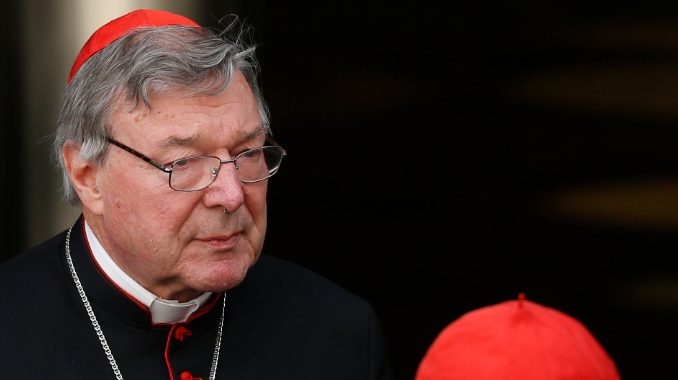
On January 10, 2023, George Pell, cardinal-priest of the Catholic Church and former archbishop of Sydney and Melbourne, died suddenly the day after undergoing hip surgery. He was eighty-one years old.
It may seem unusual for a cardinal to have enemies, but it is indisputable that George Pell did. Secular news coverage of his career, both before and after his death, was peppered with reminders to the public that he was one of those most terrible of all things: an orthodox, conservative Catholic priest.
But why did these self-appointed enemies, both inside and outside the Church, hate him so much?
George Pell was born in Ballarat, Victoria, Australia, in 1941. His father was a non-attending member of the Church of England and a former heavyweight boxing champion, while his mother was a staunch Catholic who made sure her three children went to Mass every Sunday and prayed the Rosary at home. For most of George’s youth, his parents ran a hotel. A former classmate remembered watching George serve drinks to workers in the hotel’s pub on Saturdays.
George was educated at Catholic schools and earned a reputation for being both an excellent student and athlete. By the time he was eighteen years old, he had decided to become a medical doctor, while also signing a contract to play professionally for the Australian Football League.
But then, “a small cloud,”1 a repeated feeling of dissatisfaction, propelled him through the door of his school’s chaplain. Although the chaplain had already thought to himself that George had the makings of a priest, George himself was not so certain. George’s father was disappointed that he wanted to turn his back on an athletic career, but he told George to make his own decision.
George chose to enter seminary, where he quickly demonstrated his leadership abilities. Some of his classmates found him to be overly aggressive, particularly on the soccer field, which was hardly surprising for a trained athlete. But the seminary staff knew what to do with a natural leader who commanded respect and had a sharp mind: send him to complete his studies at the Pontifical Urban University in Rome.
George was ordained a priest at St. Peter’s Basilica, received a Licentiate of Sacred Theology in Rome, and earned a Doctor of Philosophy degree in Church history at Oxford. Perhaps to teach the smart young priest some humility, he was first sent to serve as an assistant priest at a church in a remote area, where no one was impressed with (or perhaps even knew about) his multiple degrees. But he fit right in. For the next twenty years, he served as a parish priest, earned a Master of Education degree, directed institutes of Catholic education, edited the diocesan newspaper, and served as a seminary rector.
All of this occurred during the 1970s and 1980s in Australia, when traditional Catholic devotions and moral teachings were mostly “out”, while liturgical experimentation and situation ethics were very “in”. That did not keep George from telling people what the Church believed.
When George, as rector, tried to restore some simple devotional practices to his seminary, such as seminarians praying the Rosary together and attending Mass more often than merely on Sundays, the response from his staff was so hostile that one would have thought he was proposing martyrdom. He also incurred the wrath of liberal Catholics through his frequent articles in support of traditional Catholic morality.
As an intellectual, George was more of a historian than a theologian. As a homilist, he was perfectly willing to tackle hard subjects, even reminding college students at a youth Mass about the high rate of chlamydia in Australia2 to make his point that lust is not love. Interestingly, he often included poetry in his homilies, demonstrating his own personal love of literature.
But the most noticeable characteristic of his sermons, speeches, and writings was his willingness to speak bluntly about matters of faith and morals, though without rancor. That habit didn’t change when he became archbishop of Melbourne in 1996, archbishop of Sydney in 2001, and a cardinal in 2003.
Sadly, most reporting about George Pell’s service as an archbishop focuses not on his many accomplishments for his archdioceses, but on the issue of sexual abuse. While there is a distressingly high number of Australian priests who have been credibly accused of sexually abusing minors—as is the case in every part of the world affected by the Sexual Revolution—there is no evidence that Pell should be considered one of them.
In 1996, six years before the sexual abuse crisis in the “long Lent” of 2002 in the US, Archbishop Pell established the “Melbourne Protocol” to respond to claims of child sexual abuse in his archdiocese. If the practices he established are not considered exhaustive by today’s standards, it must be remembered that he was the first twentieth-century bishop in the entire world willing to tackle the problem.
It is also alleged that young Father Pell was complicit because he served in the same parish as Gerald Ridsdale, an Australian priest who was ultimately convicted of multiple counts of child sexual abuse and was laicized. As an auxiliary bishop, Pell even showed up in court to support Ridsdale on one occasion, but he apparently did so only out of obedience to his archbishop.3 Since there is no evidence that Pell ever knew about Ridsdale’s behavior during the twelve months that they served in the same community, it is reasonable to assume that Pell was just one of many people who were fooled by the man. After all, anyone who can get away with abusing at least sixty-five children must be very good at deceiving people. Ridsdale died in 2025 at the age of ninety while still in prison.
For all the above reasons, multiple groups of people had an axe to grind with Cardinal George Pell. His willingness to confront child sexual abuse cases within the Church in Australia made him a lightning rod for criticism, while other bishops tended to look the other way. The media had created a public perception that he was buddies with a convicted pedophile priest. His willingness to stand up for Catholic moral teaching, even refusing Communion to homosexual activists who made a point of their beliefs during Mass, led to angry protests.
With the help of the Australian press, Pell became the public scapegoat for any and all crimes committed by Catholic priests and bishops in the country.
And then came the year 2014, when Pell’s obedience to the pope led to even greater persecution.
(Editor’s note: Read Part 2 of this essay here.)
Endnotes:
1 Tess Livingstone, George Cardinal Pell: Pax Invictis (San Francisco: Ignatius Press, 2024), 83.
2 George Pell, Test Everything: Hold Fast to What is Good (San Francisco: Ignatius Press, 2015), 299.
3 Tess Livingstone, George Cardinal Pell: Pax Invictis (San Francisco: Ignatius Press, 2024), 312.
If you value the news and views Catholic World Report provides, please consider donating to support our efforts. Your contribution will help us continue to make CWR available to all readers worldwide for free, without a subscription. Thank you for your generosity!
Click here for more information on donating to CWR. Click here to sign up for our newsletter.

I have read some of Cardinal Pell’s writings, which of found both inspirational and of excellent spiritual value. We need more priests that emulate his service to God and to the Church.
His courage always impressed me and wish that more bishops and cardinals had his spine.
Thank you for this article and the next. I have long admired the late Cdl. Pell for his spirituality, leadership, and virtual martyrdom. I had wished he became the pope. Imagine what great photo opps he would make, being good-looking and the tallest among cardinals! I was so sad for his passing, but I’m sure Our Lord Jesus will give him his reward. Thanks again and God bless you.
Well said, Margarita. Without a doubt our beloved Cardinal George Pell was deservedly a Prince of the Church. He excelled in all attributes of a prince.
Beautiful piece. Can’t wait for part 2. I am one of Cardinal Pell’s biggest fans!