


Jan 8, 2026 / 10:52 am (CNA).
ROME — Some cardinals and faithful who have a devotion to the traditional Roman rite have expressed concern that the liturgy appears to be sidelined in the extraordinary consistory currently underway at the Vatican after the cardinals voted to give priority to other issues on the agenda.
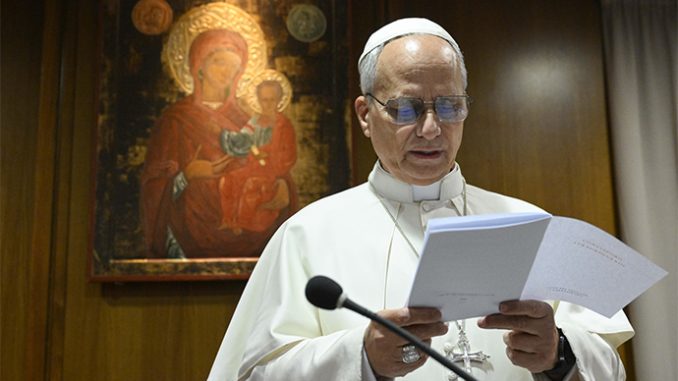
In his opening address to the consistory yesterday, Pope Leo XIV reaffirmed to the cardinal participants that they will have the opportunity to “engage in a communal reflection” on four themes already preannounced to be on the meeting’s agenda.
Those topics, he said, were Pope Francis’ 2013 apostolic exhortation Evangelii Gaudium, “that is, the mission of the Church in today’s world”; Praedicate Evangelium, the late pope’s apostolic constitution reforming the Roman Curia; the Synod and synodality “as both an instrument and a style of cooperation”; and the liturgy, “the source and summit of the Christian life.”
But Leo added that “due to time constraints, and in order to encourage a genuinely in-depth analysis, only two of them will be discussed specifically.”
The cardinals were then asked to make clear which two of the four they would want to be specifically debated and, according to Vatican spokesman Matteo Bruni, “a large majority” decided the topics would be “evangelization and the Church’s missionary activity drawn from rereading Evangelii Gaudium,” and “the Synod and synodality.”
Bruni told reporters at a press briefing Wednesday evening that the 170 cardinals taking part were divided into 20 groups, which were then divided into two blocks. Eleven groups consisted of cardinals in Rome including curial cardinals and those who have concluded their service and are no longer electors. The remaining nine groups were cardinal electors of local Churches (archbishops and bishops of dioceses), cardinal electors who are nuncios and cardinal electors who have concluded their service but remain electors due to being under the age of 80.
Bruni said that “for reasons of time,” the cardinal secretaries of the second block had the job of reporting back the decision of the cardinals. “They had three minutes to explain the work done within the groups and the reasons that led to the choice of the two themes.”
The Holy Father had made clear in his opening address that it was his preference to hear back from the second block as he does not usually receive advice from those cardinals. “It is naturally easier for me to seek counsel from those who work in the Curia and live in Rome,” he said.
But the decision not to make the liturgy a key theme was disappointing to some cardinals and traditional faithful.
The liturgy has long been a particularly sensitive issue, and especially to traditional-minded Catholics following recent sweeping restrictions on the older form of the Latin rite during Pope Francis’ pontificate. These faithful experienced the restrictions not as a mere disciplinary change but as a judgment on their fidelity, spirituality, and ecclesial belonging, which many have described as deeply wounding and divisive.
The popular Italian traditional website “Messa in Latino“ wrote Jan. 7 that it had contacted some anonymous but important cardinals who all said they were “discouraged and disappointed” about the relegation of the liturgy as a discussion topic.
In comments to the National Catholic Register, CNA’s sister news partner, on Jan. 8, the website’s editor Luigi Casalini asked: “To whom did the pope delegate this choice, and according to what criteria were these cardinals of the nine local Churches selected in order to remove — in effect — two topics?” He also wondered “why cardinals sensitive to the issue” appear to have “made no attempt to lobby” for the liturgy to be included as a core topic of discussion, “even before the consistory.”
The consistory, he added, “appears to be in perfect continuity with the synods and the thought of Francis” — a reference to how recent synods were silent on the traditional liturgy.
Speaking to journalists on Wednesday, Bruni tried to offer some reassurance. “The other two themes will still be addressed in some way, because mission does not exclude the liturgy,” he said. “On the contrary, in many ways it does not mean exclusion. It means that they will still be addressed within the others or in some other way.”
He added: “As the pope said and as he noted in both his opening and closing speeches [on Wednesday], the themes cannot be separated from each other, because in mission and evangelization there is liturgy.”
Casalini said he was looking ahead to the two free discussions today to see “whether the topic of the liturgy will be taken up again.”
This story was first published by the National Catholic Register, CNA’s sister news partner, and has been adapted by CNA.
If you value the news and views Catholic World Report provides, please consider donating to support our efforts. Your contribution will help us continue to make CWR available to all readers worldwide for free, without a subscription. Thank you for your generosity!
Click here for more information on donating to CWR. Click here to sign up for our newsletter.


It is not in Pope Leo’s interests to allow a public discussion of the TLM (even if it is a hugely fake public discussion) because anything public would threatens his private usage of TLM and “traditional attributes” as a tool for having “trads” to back up his credibility as “a tradition-friendly Pope”. And, as long as he does that, he keeps “trads” from criticizing his other other deeds which blow that image away. For many months he kept ignoring the banishing of TLM around the world while throwing the same TLM as a bone to trads (most notably, TLM celebrated at St Peter’s in Vatican; wearing parts of traditional Pope’s garb was also noticed). It is not logical; one who is truly “a peace maker” would issue a decree which regulates the situation with TLM. But I repeat, his control of contrary camps would suffer so he does not do that.
I find it comical (and telling) that, while making a discussion of “synodality” a focus, PL chose to ignore the Liturgy. Liturgy is the nucleus of the true synodality because it was created by “people of God”, as their way of worship which was slowly crystallized. There is nothing more “synodal”, in the authentic sense of those words, than a liturgical rite or better to say, liturgical rites (including TLM) in their variety. All I can say is “the emperor is naked”.
The consistory produced no documents, as far as I have heard, so I don’t think it would be particularly public. However, there were side conversations regarding the liturgy.
Pope Benedict XVI waited 2 years before issuing SP. I think we can wait at least that long before judging Leo as anti-trad.
The Cardinals barely know each other, due to Francis ending the consistories through his reign. Liturgy is a controversial, important, and difficult topic. Synodality is not, except for some controversy on whether we ought to bother with a Synod on it, that’s already finished anyway.
Given that we’ll probably have Leo around for quite a while regardless of what we do, I think waiting another year, having finally cleared all of the Francis scheduling and writing off the docket, to see what he does before judging makes sense. That’ll give him the same amount of time that Benedict took.
Howdy Anna,
I don’t know that I’m ready to assume that Pope Leo is acting in such a calculated way as a means of keeping the “trads” at bay. I think his opening address from his pontificate lays out precisely his MO – unity. The fact that the liturgy was on the docket for discussion (amidst all the other concerns afflicting the Church) means it’s on his radar. And Pope Leo’s comment that “the themes cannot be separated from each other” seems to indicate that despite the vote to focus on synod and synodality and evangelization from the cardinals (two areas that do sorely need focus), he intends to address liturgy as well.
Pope Leo did inherent a Church with lots of internal divides and I’m grateful that he’s being intentional about not changing too much too quickly so as to reduce the papal office to a partisan position. I’m still in the wait-and-see camp for how these concerns are addressed over the course of the next several years. And I’m hopeful that he’s going to at least turn the car around (perhaps slowly) in a thoughtful and maybe even quiet manner.
It doesn’t seem to me that he’s ignoring anything. We can disagree on that opinion; but we’ll definitely see one way or the other. I think we’ll need to give it some time to be sure.
Peace,
James
inherit – pardon the typo. 🙂
Of course this group of Cardinals would select those two items for detailed discussion, especially synod and syodality. The intention of too many Cardinals, Bishops and now two Popes in a row is to throw the Church, its sacred doctrine, tradition and the magisterium to the wolves that are those who want to change it all and become un-Catholic. Shame
It is getting more and more obvious that the Vatican is very anti-Catholic, and it is losing credibility with the faithful (those who still care and pay attention).
The cardinals were then asked to make clear which two of the four they would want to be specifically debated and, according to Vatican spokesman Matteo Bruni, “a large majority” decided the topics would be “evangelization and the Church’s missionary activity drawn from rereading Evangelii Gaudium,” and “the Synod and synodality.”
Left you their own devices the Cardinals will always pick the least contentious topics to discuss. It’s up to Leo to decide with or without them where he chooses to legislate.
^to
Malice is defined as the choosing of the “lesser good”. Res ipsa loquitor.
The TLM is obsolete. It is no longer the lex orandi of the Roman Rite. Traditionis Custodes has clarified as much, and that is from the magisterium. I favor abolishing permission for the TLM’s celebration. Yes, that includes revoking the constitutions for the TLM societies such as FSSP, etc.
Why continue celebrating an older form of the Mass that the Roman Church has replaced and moved past? It makes no sense.
Things that are sacred don’t wear out or have time limits, Mr. Sebastian. The Church is catholic & universal with diverse rites & liturgies. There’s no competition going on between those. Or at least there shouldn’t be.
The church has neither removed, moved past nor replaced the Mass in any form.
By your ‘logic’ we ought not celebrate Christmas, Good Friday, or the Resurrection for that matter, as their historical origins are long gone.