


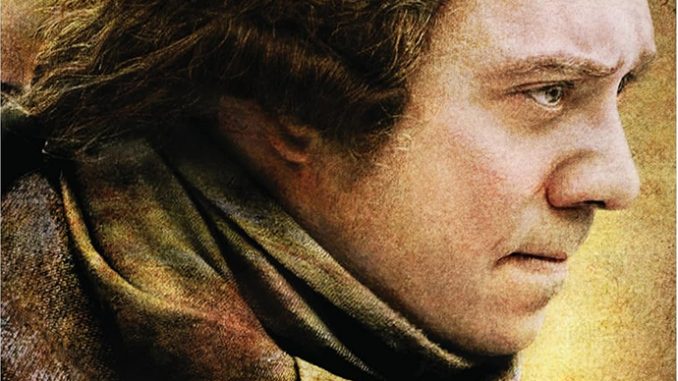
Having recently lamented in this space that book reading is on life support in these United States, I find myself in the awkward position of recommending a made-for-television series as good preparation for the nation’s 250th birthday, which will soon be upon us.
In fact, though, if you’re going to do just one thing over the next six months to recollect what a marvel the birth of this country was—not to mention its survival into adolescence—you can’t do better than watching, or rewatching, the HBO miniseries, “John Adams,” based on David McCullough’s eponymous (and wonderful) book.
Directed by Tom Hooper, who won the Academy Award for “The King’s Speech,” “John Adams” has to rank with the best television series ever made.
The visuals are stunning, from the pre-revolutionary and revolutionary Boston through the foppish Paris of Louis XVI to the nascent, muddy Washington, D.C., and, at the end, Quincy, Massachusetts, and Monticello, Virginia, as Adams and Thomas Jefferson die on the same day: the 50th anniversary of the Declaration of Independence.
The acting is superb. Paul Giamatti’s Adams captures the complex personality of one of the greatest, if typically least regarded, of the Founders: a farmer, lawyer, diplomat, and politician, irascible at one moment, lovable in the next, always honest, sometimes too unyieldingly so. Laura Linney is brilliant as Abigail Adams, her husband’s “dearest friend,” and a woman of high intelligence and valor. In Stephen Dillane’s Jefferson, we meet the principal author of the Declaration in his various and sometimes contradictory personae as Virginia aristocrat, searching intellectual, cagey politician, and irresponsibly abstract theorizer about the French Revolution.
The Adams-Jefferson relationship is in many ways the fulcrum of the series, as the two men grow into friendship, achieve a close collaboration, become bitter political enemies, and are finally reconciled through a series of letters in which each tries to explain himself to the other.
Then there are the magnificent set-piece scenes. The tension is palpable as the Second Continental Congress takes its final vote on the resolution declaring that “these colonies are, and of a right ought to be, free and independent states,” each delegate knowing that he risks being hanged for treason. Then there is John Adams’ initially fraught, but ultimately triumphant, meeting with King George III as the newly independent United States’ first diplomatic representative to the old mother country, the two men finding within themselves the nobility to recognize the decency in the other. And any patriot will feel an urge to stand and salute as George Washington takes the oath of office as president.
The high drama of June-July 1776, movingly staged by director Hooper and intensified by Rob Lane and Joseph Vitarelli’s marvelous score, raises an old question with contemporary relevance: How could so diverse a group of men, divided by regional prejudices, religious sectarianism, social conventions, and personal histories, agree on so momentous and dangerous a step as declaring their independence from what was then, and would long remain, the world’s greatest empire?
Perhaps it was because, amidst their many differences, they shared the essential rudiments of a common moral culture.
They had all read the King James Bible, and whatever their divergent (and in certain instances, rather bizarre) theological views, they believed that the hand of Providence somehow guided history, and that the task of upright men was to follow that guidance, whatever the cost. Many of them shared a common legal sensibility, having been formed intellectually by Blackstone’s Commentaries on the Laws of England. Shakespeare had forged for them a common, elegant tongue, whose rhythms could be deployed to great persuasive effect.
And, whether rich or poor, they understood how gentlemen behave, and they refused to act the cad. As we watch those men watching each other while the vote for independence is taken, we’re reminded that this country at its founding shared a baseline moral code that proved sufficient to bind it together and sustain it through a difficult war for independence — and beyond.
And if we ask ourselves why there is no one of the stature of the least of those Founders in high public office today, “John Adams” suggests an answer: because our public moral culture has been eroded by assertive individualism and crass utilitarianism to the point where the mortar capable of binding together a republic that is e pluribus unum — one from many — has largely dissolved, leaving vulgarity to reign in its place.
Catholicism’s public task in this semiquincentennial year is to draw the nation’s attention to that, and to teach, with clarity and compassion, the timeless truths that were declared self-evident, and proved liberating, 250 years ago.
(George Weigel’s column ‘The Catholic Difference’ is syndicated by the Denver Catholic, the official publication of the Archdiocese of Denver.)
If you value the news and views Catholic World Report provides, please consider donating to support our efforts. Your contribution will help us continue to make CWR available to all readers worldwide for free, without a subscription. Thank you for your generosity!
Click here for more information on donating to CWR. Click here to sign up for our newsletter.

Weigel writes: “And if we ask ourselves why there is no one of the stature of the least of those Founders in high public office today, “John Adams” suggests an answer: because our public moral culture has been eroded by assertive individualism and crass utilitarianism to the point where the mortar capable of binding together a republic that is e pluribus unum — one from many — has largely dissolved, leaving vulgarity to reign in its place.”
How can any country be said to evince “public moral culture” when in over 50 years it approves of the murder of 75 million of its own most vulnerable and defenseless?
How can any country be said to evince “public moral culture” when 50%+ of those who pledge to commit themselves to another for life to another wind up violating their promise?
How can any country be said to evince “public moral culture” when the majority of children of minor age in this country grow up without their own biological father living in the home?
How can any country be said to evince “public moral culture” when Catholic clergy in the USA have sexually abused minors in vast numbers?
Is “individualism” just a synonym for crass selfishness and sin?
Good points. I think the term “individualism” is used a bit too broadly here. What exactly does it mean? Individualism is not necessarily or automatically a bad thing. I’m not sure that all of the ills of our culture can be subsumed under the term.
Mr. Weigel criticizes individualism, not individuality.
Thanks George: your last paragraph says it all.