


What is Protestantism?
It seems a straightforward thing to answer. Protestantism is the affirmation of Scripture as the ultimate, unparalleled authority of Christian faith and practice. Protestantism is the “five solae” of the sixteenth-century Reformation: Sola Scriptura, Solus Christus, Sola Gratia, Sola Fide, and Soli Deo Gloria. And Protestantism is not Catholic (or, as many Protestants insist, Roman Catholic, claiming that the Church is not really universal, since it excludes Protestants and the Eastern Orthodox).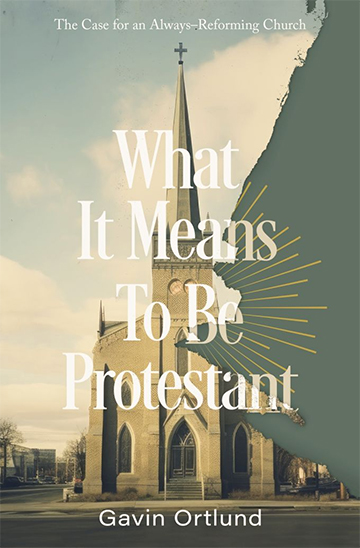
Which Protestantism?
Yet many Protestants—typically of a traditionalist, confessionalist variety—believe a significant number of those raised in various traditions do not understand Protestantism. This, they assert, explains why many are becoming Catholic or Orthodox. It’s also what Protestant theologian and apologist Gavin Ortlund argues in his recent book, What It Means To Be Protestant: The Case for an Always-Reforming Church. “They leave Protestantism for other traditions without an authentic grasp of what Protestantism really is (and often without fully looking into the other traditions,” he writes in the introduction. “We must distinguish between particular contemporary expressions of Protestantism versus Protestantism as such,” he urges elsewhere.
Yet what is “Protestantism as such”?
At least in What It Means To Be Protestant, the answer more or less includes the definitions I’ve cited above. Certainly, many self-identifying Protestants across a variety of Protestant communions would probably agree with much of that—but not all, and possibly not even a majority. According to Pew, about one-third of self-identifying Protestants affirm either sola fide or sola scriptura but not both, and another third do not believe in either doctrine. Perhaps Ortlund would protest, saying such persons are precisely the problem, and do not get to define what Protestantism truly is. But, then, who does?
It’s a problem that has beguiled Protestantism since the earliest decades of the Protestant Reformation. Martin Luther, of course, sparked the theological (and, in time, ecclesial) movement with his protests against the late-medieval Catholic Church. Many across Europe aligned themselves with Luther, though that alignment was by no means total or monolithic—indeed, disagreements abounded, including on the very question of what defined the true Reformation. Some, such as Lutherans, Calvinists, and Anglicans, often referred to as magisterial Protestants because they enjoyed state support, flourished. Others, such as Thomas Müntzer, Andreas Karlstadt, the Zwickau prophets, the Hutterites, and the Mennonites—often termed the radical Reformers—were either suppressed or pushed to the fringes of Europe.
In time, the various magisterial Protestant churches issued the kinds of doctrinal confessions that Ortlund and other Protestant apologists appeal to as representative of “authentic Protestantism”: the Westminster Confession of Faith of English Calvinists, the “Three Forms of Unity” of Dutch Calvinists, the Thirty-Nine Articles of Anglicans, and the Augsburg Confession of Lutherans. Yet all of those confessional documents necessarily excluded other self-identifying Protestants who disagreed with them, “dissenters” often labeled heretics. Many Calvinists, for example, such as seventeenth-century Reformed English theologian John Owen, viewed Arminianism as a manifestation of the Pelagian heresy and in opposition to sola fide.
The very nature of Protestantism, with its historic emphasis on the individual Christian reading his Bible and protesting against a corrupt Catholic Church filled with “doctrinal accretions,” means that there is, by default, no way of adjudicating different assertions of what is “Protestantism as such.” Appeals to Scripture or church history help little, given there is no agreed-upon arbiter within Protestantism regarding disputes over what the Bible means or which theologians or confessional documents are authoritative, besides recourse to the Bible itself.
What we’re left with, then, is typically a presentation of Protestantism that is merely contra the Catholic Church. And that is certainly the case with Ortlund’s book, which argues that “Protestantism is the most catholic and the most biblical of all the major streams of Christianity.”
Which mere Christianity?
Ortlund’s “too catholic to be Catholic” mantra—popularized by such Protestant thinkers as Peter Leithart, Kenneth Collins, and Jerry Walls—is intended to mean that the Catholic Church is exclusive in various ways that are not actually catholic in the universal sense.
For example, so they argue, the Church demands its adherents hold to a wide variety of doctrines that have little if any biblical support; it refuses to recognize various aspects of Protestantism as legitimate, such as ordination, and will not allow Protestants to receive the Eucharist at Mass. Protestantism, in contrast, is said to be more accepting of other ecclesial traditions and allows for a diversity of religious belief and practice. “Protestantism has a superior orientation toward catholicity than its rivals because it lacks their institutional exclusivism,” writes Ortlund. “Protestantism offers the most promising pathways by which to cultivate and pursue catholicity.”
Such thinking is premised on a specific definition of “catholic” that presumes a certain ad hoc “mere Christianity” that supposedly Protestants, Catholics, and others share. But who decides what encompasses that “mere Christianity”? The one making the definition, of course. Thus, all those whose beliefs fall outside that definition (as defined by Ortlund or whoever) are necessarily excluded.
This hints at a second problem: the “too catholic to be Catholic” argument, despite presenting itself as somehow more inclusive, cannot help but also be exclusive according to someone’s terms.
Third, on what grounds is inclusivity even an appropriate category for determining what is the best Christian tradition?
Fourth, if Christ established a visible, institutional Church to which Christians are expected to submit, then “too catholic to be Catholic” amounts to nothing but question-begging. If Christ did establish such an institution, and if the Catholic Church is that very institution, then a self-identifying Christian is not being more universal by refusing to submit to it. He is being a heretic or a schismatic.
Problems with history and authority
The “Protestantism is the most biblical” argument also has its share of issues. Ortlund claims that the Catholic position “has had the overall practical effect of placing the church over Scripture,” and that “the church is ultimately untethered from accountability to the inspired Word of God.” While it’s true that the Catholic position holds that the magisterial church has a God-given authority to interpret Scripture, it is misleading to claim that the Protestant position, in contrast, holds that Scripture is acting as the supreme authority. In truth, in the Protestant paradigm, it is the individual self-identifying Christian who is effectively “over Scripture” by deciding what it means. Authoritative interpretation is inescapable — the question is who has it, and on what grounds.
Unsurprisingly, Ortlund thinks the evidence for an ecclesial institution such as the Catholic Church wielding interpretive authority is weak, as he articulates in chapters critiquing the papacy and apostolic succession. He claims there is no precedent for an infallible institution in the Old or New Testaments, nor in the early Church. Underlying this argumentation is the unproven premise that unless there is a proximate, if not identical correlation between Holy Scripture and the early Church on the nature of religious authority—or any doctrine, for that matter—and what the Catholic Church teaches today, then the Catholic Church’s position must necessarily be an accretion, rather than a development. The concept of development, which of course takes time, must thus be written.
This makes the passage of time do a lot of the rhetorical work in Ortlund’s argumentation. “Testimony from a century after the fact is obviously more liable to err than the evidence of the testimony from the time in question,” he writes when discussing certain patristic sources. He dismisses magisterial infallibility and Mary’s Assumption in large part because several centuries pass before there are explicit articulations of these doctrines. Similarly, in refuting the veneration of images, he argues: “The relevant point right now is that the seventh ecumenical council took place in 787, which is farther from the apostles than we are from the Reformation.”
Yet Ortlund’s use of time is inconsistent and arbitrary. Ortlund seems to have no problem with chronological distance when it comes to events described in the Old Testament, many of which happened many centuries before they were recorded. Moreover, Ortlund gives no objective criteria to judge what is an acceptable amount of distance between events and when they are described in writing.
One might just as well claim that the distance between the Gospels and the life of Christ—at least 30 to 50 years—should undermine our trust in those documents. Or consider the chronological distance when it comes to doctrinal formulation that Ortlund affirms. It took the Church three centuries to formulate a doctrine of the Trinity at Nicea, and 650 years to hammer out the major specifics of the Christological doctrines.
Further weaknesses
An alternative (i.e., Catholic) approach proposes that it is possible for there to be principles that remain constant across salvation history, even if the manifestation and texture of those principles adjust and develop over time.
To cite an example that presumably many Protestants concede, there are significant adjustments regarding the nature and extent of religious authority within the biblical narrative. We move from the patriarchs to Moses and his successor Joshua; from the Judges to prophets to simultaneously divinely anointed kings who write Scripture; to more prophets, to the scribes and Pharisees who do not write Scripture but sit on the “chair of Moses” (Matt 23:2); and to Jesus and then to the Apostles. All are complex, unprecedented developments in salvation history that do not follow an easily discernible progression.
We need a principled reason to discount the possibility that such developments occur even after the closure of the biblical canon. Especially since there were probably decades of ecclesial history before a single New Testament book was written and widely circulated, and centuries before any ecclesial body offered a determination on the contents of the New Testament canon. Simply put, the Church was founded and grew without a universally accepted biblical canon. In the Catholic paradigm, this is a story of apostolic authority and Holy Tradition, which included a slowly growing consensus over which books enjoyed apostolic approbation. If we are willing to at least entertain this type of development as possible, issues such as, say, the Assumption, can be explained: Marian devotion appears very early in Church history, and over time that devotion describes Mary as full of grace, without sin, ever virgin, and, eventually, assumed into heaven. Many of these descriptions are found in the writings of those who claimed apostolic authority.
Ortlund dismisses apostolic succession by an appeal to authority, saying it is “rejected virtually everywhere in the scholarship” and opposed to “the mainstream scholarly view.” This is more than a little ironic, given that the “mainstream scholarly view” on a wide variety of issues related to biblical scholarship, such as the historicity of the biblical texts, also repudiates beliefs held dear by Protestants such as Ortlund.
Moreover, one can find evidence of apostolic succession as early as the writings of the first-century St. Clement I, second-century St. Hegesippus, and St. Irenaeus of Lyons, and third-century Tertullian and St. Cyprian. Ortlund claims that affirmations of apostolic succession in St. Irenaeus and Tertullian are suspect because they “functioned in a highly polemical context,” as if Christian history has ever not been “highly polemical.”
A highly contested and evolving question
Speaking of the “scholarly view,” Ortlund has a tendency to cite Catholic scholars whose opinions on various subjects undermine Catholic teaching. Thus, readers are favorably introduced to Hans Küng—a theologian who was barred from teaching as a Catholic theologian in the 1970s after denying the doctrine of papal infallibility—on the subject of justification. Ortlund summons Johann Döllinger to his side, who is another Catholic theologian excommunicated for rejecting papal infallibility. Further, Eamon Duffy is trotted out for his skepticism regarding Mary’s Assumption.
I suppose this is intended to achieve a certain rhetorical effect, but it is, in fact, deeply misleading. Why not cite the arguments of the many Catholic scholars who have written defending the Catholic view on justification, papal infallibility, or the Marian dogmas? For someone who, in his book’s conclusion, urges readers to “engage the best of each tradition”—which one would presume would include the best defenses of each tradition—these are curious decisions, to say the least.
Finally, as much as Ortlund (like many Protestants) argues that there is no means of determining what in the Catholic paradigm constitutes authentic magisterial teaching, his entire work implicitly acknowledges that many things about Catholic teaching are seemingly clear-cut and easily identifiable as decidedly Catholic doctrine. In truth, the Church has on many occasions explained the nature and extent of magisterial teaching, including at Vatican I, Vatican II, the 1983 Code of Canon Law, Ad Tuendam Fidem, and several documents issued by the Congregation for the Doctrine of Faith in 1983 and 1990.
The same cannot be said of Protestantism, as I’ve argued here and in my book The Obscurity of Scripture. Since the Reformation, “what it means to be Protestant” has been a highly contested and evolving question, both within and outside self-identifying Protestant communities.
Pace Ortlund, little seems to unite Protestants besides a general opposition—if not antipathy driven by inconsistent and invalid argumentation—towards the Catholic Church.
What It Means to Be Protestant: The Case for an Always-Reforming Church
By Gavin Ortlund
Zondervan, 2024
Paperback, 284 pages
If you value the news and views Catholic World Report provides, please consider donating to support our efforts. Your contribution will help us continue to make CWR available to all readers worldwide for free, without a subscription. Thank you for your generosity!
Click here for more information on donating to CWR. Click here to sign up for our newsletter.

As a Catholic, I am grateful to ex-Protestants like Casey Chalk, Gavin Ashenden and John Boersma for helping me understand Protestantism and thereby better understand Catholicism.
John Boersma a Catholic? When did that happen?
Two different Dr. Boersmas, I think. The reference here is probably to this Dr. Boersma.
My guess is it’s a typo for John Bergsma.
Yes, that’s likely the case. There is a John Boersma who teaches at Christendom, but is focused on political philosophy, so…
Oops. Forgot Fr. Dwight Longenecker.
Yeah, I don’t trust former Protestants. 😉
I am not personally aware of faithful Catholics taking every opportunity to bash Protestants. However, not infrequently do Protestants denigrate Catholics with names like “Mary worshippers”, worshippers of idols, etc. All you need to do is take a look at those Jack Chick slurs.
BTW, we want our churches and cathedrals returned in Great Britain and reparation for the destruction of monasteries and confiscation of Catholic property.
I mentioned to a former boss, a staunch Baptist through his wife, that “at least you guys read the Bible.” He then/later replied the Knights drink too much, so how much should you try to compliment? His attitude was one reason I eventually left that job.
One of our local Assemblies member questioned our Catholic school principal whether the Catholic church was even Christian, and he had to remind her of the connection to Peter in Rome.
But in years past Catholics sure did bash!
Never as much as contemporary liberal Catholics bash the Catholic faith.
Physically bash as well as verbally. And it worked the same way with Catholics getting bashed by Protestants. It’s been a mutual effort over the centuries.
Yes, they thought Catholic ways would overtake the country; they eventually noticed the success of their schools and hospitals as well as the general well being of their populations and parishes. There was long running discrimination though. In our area we weren’t even allowed to ride the school bus into town to attend the Catholic school, until some of the leaders finally put their foot down with the public school board. One parent tells of the packed vehicles and routes getting the students in from the far reaches of this rural, hilly county. Good grief.
Really? I am over 70 years old, went to Catholic schools through grade 12. NEVER as a child did I hear in my home, school, church or neighborhood friends anything which was anti-Protestant. Our neighborhood was of the blue collar variety where people certainly did not hold back on their opinions. I will admit to the neighborhood being heavily Catholic, but still, not exclusively.
However, recently in this computer age I have been on any variety of web sites open to public comments being posted, with a few sites having to do with religious topics. I have seen the occasional Catholic bashing remark made. Usually as a prelude to attacking Mary or Catholic belief on the saints.
Some years ago, I had occasion to need to speak with a co-worker(A), who was concluding a personal conversation with another co-worker(B).
I caught the end of it and the salient part. B was explaining to A that he had a friend in the hospital-apparently the hospitalized man was seriously ill- and B was explaining to A that he was getting a bunch of his “Christian” friends together to “lay hands” on the patient, because “he’s an old Catholic, so he’s not saved”.
So much for working out your salvation in fear and trembling as mentioned Philippians.2:12. I’ve never quite understood using the extra-Biblical “accepting Jesus Christ as your personal Lord and savior”. as a curious fusion of a get out of jail free card and Christian Shahada.
I was once posed that question with a tone of judgmentalism that often accompanies it, so I thought I’m ending this hear and now. My initial response was “No, don’t need to” followed by a pause just long enough for me to see astonishment, followed by befuddlement. The second part was “I never doubted it”.
Not all, but a significant number of Protestants see themselves as judge and jury of unrepentant Papists, freely imputing culpability for various sins of their imagination-Bibliophobia, idolatry, etc-while they think their own sins are forgiven by reciting a phrase or having some sort of emotional epiphany or intellectual assent.
We call them “separated brothers and sisters”, they condemn us to hell.
And I’ve had many similar existences-including being told ‘you aren’t really Christian” as if Christianity started 10/31/1517.
Been asked that question about having a personal relationship with Christ many times. The response I wish I’d had: “I consume His actual Body & Blood every Mass…it doesn’t get more personal than that!”
It seems like it will be a struggle until the end. He said his burden is light though.
At funerals many times we sing “the strife is o’er, the battle done, the victory of life is won!”
I actually don’t like that response, mainly because it avoids the question the Protestants ought to be asking (but probably isn’t, since they probably don’t know what they mean by it).
I might go with “I believe Jesus is a Person, and I have a relationship with Him. So yeah, personal relationship, check. Admittedly, the devil also believes He is a person and has a relationship with Him, his just isn’t a very good one.”
Other responses include: “Can you give an example of a relationship that is personal, and a relationship that is not personal, with someone who isn’t Jesus?” and then continue the inquisition until they cry uncle.
Or “Catholics consider Saints to be examples of people who have the best relationships with Jesus, and this invariably comes with them suffering greatly for Him, and being willing to die rather than commit even a small sin, due to their great love for Him. Is that what you mean by “personal relationship”, and if so, do you have one?
The problem with using the Eucharist as a counter is that there are Catholics whose consumption of the Eucharist is more sacrilege than love. Even if the Protestant did accept the Real Presence, they would be silly to accept your reception of Him as evidence of a good relationship with Him – similar to how it would be silly to accept a spouse’s claims of weekly intercourse as evidence of a strong marriage. Both are something that can occur only on the physical level.
While reading your comment it made me think of the “We are many parts. we are all one body” hymn. (made me chuckle as the only response I could come up with)
In all fairness, per John, 6, 54-60 (New Catholic Edition, apprx 1964 version): Jesus therefore said to them, “Amen, amen I say to you, unless you eat of the flesh of the Son of Man and drink his blood, you shall not have life within you. He who eats my flesh and drinks my blood has life everlasting and I will raise him up on the last day. For my flesh is food indeed and my blood is drink indeed. He who eats my flesh, and drinks my blood, abides in me and I in him. As the living Father has sent me and as I live because of the Father, so he who eats me, he also shall live because of me. This is the bread that has come down from heaven; not as your fathers ate manna, and died. He who eats this bread shall live forever.” These things he said when teaching in the synagogue at Capharnaum.
I believe Leah’s standard response is validated by the sentence with “abides” in it?
@Amanda: All good points! But the subtext is the questioner knows i’m catholic (my crucifix gives me away) & is under the impression that Catholics have to talk to our priests to talk to God, or we pray to the saints & the Blessed Mother because we can’t pray to Our Lord directly (!).
This was in the South & frequently it was either Baptists or nondenominational / evangelicals asking.
So it’s kind of a loaded question from them, knowing their utter ignorance about the Church.
B was mistaken on his laying of the hands being only applicable to those who are “saved” yet keep right on sinning like the deplorable Catholics.
Jesus never charged for his miracles and freely counseled the woman he knew had been married many times at her decisions. Blessed be His name!
The question is again which vein within the spectrum of Catholic ideologies is the author addressing from the traditional foundation of St Thomas Aquinas, the moderate realism of the Scholastic, the beautiful though speculative writing of Duns Scotus, the teaching of Catholic Liberation Theologies culminating in the modern Church that for the most parts spans the spectrum of Protestant teachings and ideologies. Should St Thomas listen to the same homilies and teaching of my liberal sentimentalist priest he may agree with some of the musings while holding the priest accountable for not sharing the Truth sincerely nor completely. Then the moral authority of the Church has been compromised over the last decade in numerous ways accommodating the vices within the Church.
A Church constantly in reformation markedly fits Catholicism since 2013. Some would argue since V2. Reformation then as legitimate within Catholicism requires a Ratzingerian hermeneutic of continuity, whereas Protestantism has made radical, discontinuous changes as underlined by Casey Chalk.
Another weakness is the Protestant claim of Sola Scriptura. How do they reconcile:
John 14:12 “I have many more things to say to you, but you cannot bear them at the present time”. John 14: 25 “All this I have spoken while still with you. 26 But the Advocate, the Holy Spirit, whom the Father will send in my name, will teach you all things and will remind you of everything I have said to you”.
These scriptural passages support Apostolic tradition, much of which was revealed after the ascension. There are commonalities within all Christian bodies. What then is Protestant if not what Chalk argues, is their insistence on not being Catholic? But that infers, or at least suggests Catholic legitimacy.
I would think a better word to describe Catholicism since 2013 is a state of obvious “DEformation” rather than “reformation”.
The irony is that for all of the time when Benedict was known as Ratzinger and “God’s Rottweiler”, he was apparently Spock to John Paul’s Kirk.
Capable of command, but uncomfortable with it, more adept and at ease at scholarly support.
This disposition was evident when a certain Cardinal Archbishop from South America decided to criticize the Regensberg address. A more command inclined individual would have ended that public insubordination and dissuaded imitators by burying him far away from the possibility of becoming the next Pope. And for those that think that’s not merciful, a reminder how Francis treated his opponents.
I have never been in my eighties; nor do I have no idea what sort of dispiriting exhaustion or frustration is caused by day after day, dealing with McCarrick and Mahoney level corruption or the mess that is the German Episcopacy. I also never witnessed the private indignities and infirmities of John Pau in his declining years.
Still, Benedict survived until three years ago, and had he hung on a little longer, we’d have avoided the South American Antinomian virus, and what increasingly looks like the Beta strain in Leo (Francis 2.0?).
Unfortunately, George Neumayr also is gone; it would have been interesting to have read his accounts of the present Pontiff.
Cardinal Giacomo Biffi had a close relationship with Benedict XVI, both interested in Soloviev’s writings on the Antichrist, Benedict inviting Biffi to preach the 2007 Lenten retreat in which he discussed Soloviev. Biffi distinguished between the actual Second Vatican Council and a ‘media council’ or virtual council, a concept Benedict also popularized. Biffi also alleges the St Gallen Group, initiated by Cardinal Mario Martini Milan Archbishop, had pressured Benedict to resign, which Benedict XVI denied citing health issues, fatigue.
The then Cardinal Jorge Bergoglio was a protege of Cardinal Martini, an avowed progressive who created the concept of a continuous Synodal Church intended to modernize Catholicism. When Bergoglio was elected Martini was ecstatic. As we well know Bergoglio was inimical to Benedict attested to by Benedict’s secretary Archbishop Georg Gänswein in his recent book.
We cannot allege any reference to the Antichrist in this scenario, except for the influence of the Spirit of Antichrist, the darkness that seems at work within the Church.
“ A Church constantly in reformation markedly fits Catholicism since 2013.”
I’d say on a local or global level (micro and macro) the Church has had various “reforms” since the passing of St. John the Apostle. Also, IMO the reforms of the Western Church after Trent was far more significant, necessary, and positive than either V1 or V3..
Protestants come in many flavors. You have the Anglicans, who my freshman religion teacher Brother Lawrence referred to as “Junior Varsity Catholics” and you have snake handling Evangelicals in Appalachia who are borderline psychotic. Plus many denominations in between. I am more comfortable with Anglicans than Baptists because they seem vaguely Catholic.
I think that the origins of Lutherans and Anglicans are more political than theological. They were rebelling against a rather corrupt Vatican. The Vatican has been cleaned up (no more Cardinals who are the illegitimate sons of Popes), but we are still separated. Perhaps the Anglicans can be brought back into the fold, but not the Baptists.
We used to live not too far from a Pentecostal snake handling church. The pastor in every other way seemed normal.
It’s one example of the extremes Christians can balance between. At least the snake handlers believe in something & take that passage of scripture seriously. Perhaps taking it literally though isn’t a safe practice.
On the other hand we knew someone who could pick up a rattlesnake without being bitten. I watched that once as a child. You just never know.
At least the snake handlers believe in something & take that passage of scripture seriously.
There’s a difference between believing in “something” and believing in anything.
That’s the problem with adhering to one passage to the exclusion of others. Another passage tells us “not to put the Lord thy God to the test”. Intentional physical imperilment is not a sign of fidelity or faith-it’s succumbing to the very temptation the Devil used on the Lord.
Why not just get in a cage with a tiger or jump in shark infested waters? Or throw oneself from a height upon rocks-I mean if you are going to sin, “sin boldly” as Luther taught, right?
Well, people sometimes do the best they can with the level of understanding they possess. Minus the teaching authority of the Church, we might be doing something similar.
I’m sorry but you aren’t fishing a pearl out of this septic tank.
Our separated brethren may be separated in ways we find peculiar but they are still our brothers and sisters in Christ.
There but for the Grace of God and the teaching authority of the Church…
Faith in a promise that you have taken out of context so that it no longer resembles what God meant isn’t really Faith, it’s called “mistaking imagination for reality”. Yes, that’s exactly what we’d be doing without the Church. No, that does not make it admirable.
Rattlesnakes are not among the most aggressive snakes, and Appalachian fundamentalists are not the only people who can pick them up mostly without being bitten. Texans do it for fun (because of course), and there’s a long tradition in Asia of charming serpents.
We went to an annual rattlesnake roundup some years ago. It was amazing to see how huge rattlesnakes can get.
I think those events are less popular today because they figured out it’s not the best thing for the environment. Rattlers aren’t everyone’s favorite critter but they play role in controlling rodent populations, etc.
My former boss was a “high church” Episcopalian and would explain his tradition as “Catholic light”, blissfully unaware that it’s a binary proposition.
Anglicanism originated in the King’s desire to get a divorce. Is that what you mean by “political”?
Yes. The Pope refused Henry because Catherine of Aragon was the aunt of the Holy Roman Emperor. Politics.
Politics & connections both, I imagine.
That’s patently ridiculous.
Henry was a detestable portion of excrement. He was an intemperate mass murderer, a spendthrift and a thief (raping the monasteries was one way of concealing his fiscal incontinence) a glutton whose weight ballooned from an estimated 170 or so pounds based on various assessments including coronation garments to an estimated 400 by his death, and there are accounts that his legs were so necrotic from diabetes that people were sickened in his presence and his slow organ failure caused the build up of internal gasses that exploded his corpse prior to interment. His physicians drank his urine to try to determine the cause of his many ills.
The great irony? While Henry was awarded “Fidei Defensor” for his likely ghostwritten by St. Thomas More defense of Seven Sacraments-who he would later murder-made divorce a habit along with his apparent rampant infidelity-he joined forces with Luther (he mass murdered Lutherans as well as Catholics) in debasing marriage. Luther proposed marriage to be a civil arrangement outside the bounds of the Church-and Henry, when it was was no longer convenient to think of marriage as a Sacrament made it a civil arrangement to be entered into for “light and transient” reasons and to be exited in the same manner.
I’d call Henry a pig, but pigs have always served a useful purpose.
Henry was awful, but curiously, popular with his subjects at the time. Monarchs are usually not Mother Theresa and often pretty bad. Some of the Renaissance Popes were not much better. Pope Alexander,the Borgia Pope made his illegitimate son a Cardinal. Pope Julius III had a teenage boy for a mistress. Things were bad all around.
Henry VIII decided it would be politics his way.
Politics certainly motivated Rome’s procrastination in responding to The King’s Great Matter. The Church hoped that Catherine would die or Henry would tire of Anne and thus the problem would solve itself. Alas, no. But Henry didn’t have a rightful case in canon law, just an implacable determination to have his own way.
Henry’s Anglicanism was in schism, a situation that could have been resolved after Anne and Catherine were dead, but by that time the monasteries had been confiscated and there was no going back. The real break, which invalidated Anglican ordinations, came in the reign of Henry’s Calvinist-leaning son, Edward. It’s interesting that every single nexus point (ex: who is born, who dies, etc.) goes against the Catholic cause, even into the reign of the Stuart dynasty.
Just to throw in a little more in the way of politics: the Tudor claim to the throne came through Edward III’s third son, John of Gaunt, Duke of Lancaster. Specifically through the line of one of his illegitimate children, the Beauforts; later legitimized but barred from the throne.
Ignoring the other line (the Yorkists), and sticking only with John of Gaunt: his legitimate daughter by Constance of Castle (his second wife), whose name was Catherine, married Henry III of Castile. Their son was John II of Castile. His daughter was Isabella of Spain (of Isabella and Ferdinand who financed Christopher Columbus fame). One of their daughters was Catherine of Aragon. And no illegitimacy in her descent from John of Gaunt, so her claim to the throne of England was actually better than Henry VIII’s. As indeed were those of her sisters and their children. And the descendents of John of Gaunt’s daughters; Philippa, who married the King of Portugal; and Elizabeth, who married several times and had numerous offspring (assuming any of the descendents were alive by the 1500’s; I didn’t do that much research!)
“because Catherine of Aragon was the aunt of the Holy Roman Emperor. Politics.”
Among other, and more important reasons. Henry wasn’t just asking the pope to give him an annulment any way any how, but the king’s essential argument was that no pope could grant a man a dispensation to marry his brother’s widow because (Henry argued) such marriages were “against the Law of God.” Since the biblical foundations of Henry’s argument were slender and since popes had been granting dispensations allowing such marriages fir a long time Henry’s argument was never going to fly.
You had the tradition of Leverite marriage though when a brother died childless.
Quite slender. Depending on which version of the Old Testament Law you look at, marrying your brother’s widow might be required, forbidden, or optional. That points rather clearly to its being a matter for the Church to decide, and not to a fundamental moral principle.
to Amanda’s comment below/above that might be taking up your cross
(for sure) if you had to marry your brother’s widow!
might be if the roles were reversed as well though! in this day and age who is the bread winner?
Casey is right. But I argue this way:
1. Jesus says he is the Truth
2. And he calls the Devil the Father of Lies.
3. Jesus is also the Bridegroom, and the Church is the Bride.
4. To protect his Bride from the Enemy, Jesus sent the Holy Spirit of Truth on Pentecost to lead the Church, led by the apostles and their successors, into *all* the truth.
5. If he didn’t do all that (all in the NT) he’s not God.
6. Protestants have to claim that Jesus left us orphans until the printing press.
7. They have to claim that the Church Jesus established got many seriously important things wrong for centuries.
8. But if Scripture is true, which Protestants believe, then the Church Jesus established could not have erred.
❤️👍🎶
The reality of Catholic Tradition is as sacramental incorporation into the very Mystical Body of Christ…
Ortlund’s inclusive self-image–sola Scriptura “too catholic to be Catholic”–this invites more comparisons…
The inclusive self-image of the Islamic “umma” is a pre-Christian (not chronologically) sola Scriptura “congregational theocracy” of equality.
The inclusive self-image of Secular-ism is as a post-Christian/Positivist Scriptura of identity-politics or a congregational democracy.
Paraphrasing Flannery O’Connor: “that which does not (!) rise must converge”.
“Scholarly succession”, or, “interpretation succession”, as a problem, quite convoluted implicit assertion, which also goes to the “pastoral” methods and “denominational” settlements/configuring – as shown by Chalk -:
‘ This makes the passage of time do a lot of the rhetorical work in Ortlund’s argumentation. “Testimony from a century after the fact is obviously more liable to err than the evidence of the testimony from the time in question,” he writes when discussing certain patristic sources. …..
Yet Ortlund’s use of time is inconsistent and arbitrary. Ortlund seems to have no problem with chronological distance when it comes to events described in the Old Testament, many of which happened many centuries before they were recorded. Moreover, Ortlund gives no objective criteria to judge what is an acceptable amount of distance between events and when they are described in writing.
…..
Ortlund dismisses apostolic succession by an appeal to authority, saying it is “rejected virtually everywhere in the scholarship” and opposed to “the mainstream scholarly view.” This is more than a little ironic, given that the “mainstream scholarly view” on a wide variety of issues related to biblical scholarship, such as the historicity of the biblical texts, also repudiates beliefs held dear by Protestants such as Ortlund. ‘
“Protestantism is the affirmation of Scripture as the ultimate, unparalleled authority of Christian faith and practice.”
Except while it is true that Scripture is the inerrant, inspired and unchanging Word of God, its readers are not nearly as inspired as they imagine or inerrant. Even before the last few decades, there were wild disagreements among claimed adherents of Sola Scriptura over such topics as eschatology and soteriology. Luther himself couldn’t find agreement with Zwingli and supposedly said at the end of his life that there were more doctrines than heads.
Worse is the mindless memorization for the purpose of Scriptural cherry picking. Luther was here an originator also coined “Sola Fide” and diminished works of faith. Yet in the Book of James 2:14, it says “What shall it profit, my brethren, if a man say he hath faith, but hath not works? Shall faith be able to save him?”. Luther’s reaction? The Book of James is an “epistle of straw”.
Today modern Protestants cheerfully accept things, such as homosexual pseudonogamy, female clergy and episcopies that would have caused Luther, Calvin or any other of the “reformers” to brand them heretics and blasphemers. Few if any sense these novelties are damning distortions and discontinuities.
Nor are hands of Catholics free of the “show me in the Bible” exegetical selective interpretation. There are those on both sides of the Tiber (usually Bishops with their hand in the public treasury) that will point to the accounts of Christ saying “render unto Caesar” as an implicit injunction that people should cheerfully remit whatever is demanded of them-no matter how oppressive in amount, complexity, volume or differential treatment is the tax code. They imply an “unenumerated penumbrae” subtext that whatever Caesar wants, and when and how he wants it is inarguable – forgetting the punctuating phrase is “but render unto God” and part of what is God’s is justice.
Finally, this slogan has never been adhered to by Protestants. “Scripture Alone” implies Scripture is sufficient. Yet they produce an inordinate number of commentaries and concordances, and some treat Luther’s writings (I kind of chuckled at the indiscretion that was his letter to his “wife” apologizing for his impotence), especially works such “Bondage of the Will” and “Table Talk” as Christian hadiths. This despite Luther’s lament about the “multitude of books”. Perhaps it’s not surprising that Luther commissioned a printing of the Koran in 1543, despite the clear injunction of Scripture not to have any other Gospel.
Luther wasn’t a reformer; he was a deformer. Had he arrived decades before Gutenberg, instead of decades after, this idea would have been a dead letter.
Casey Chalk’s article makes me ask: what is Vatican Two-ism? Consider that Protestants claim to follow the Bible, but reject entire books of the Bible and the entire history of how the Church decided what the nature and contents of the Bible are. The ism’s are always the problem. The Bible isn’t the problem. Vatican II is not the problem. In fact, ironically while decrying faithful Catholics who like the TLM for supposedly rejecting Vatican II, “Vatican II Catholics” reject Vatican II daily in their profession of faith and in their very lives. The issue is those Catholics who obsess over it as though it’s the only council, or perhaps the council that undid all the others. We’ll call adherents of Vatican II-ism “Vatican II Catholics”. “Vatican II Catholics” are distinct from Catholics in a way similar to how “Old Catholics” are outside the Church whereas Catholics are not despite their both using the word Catholic in their names, claiming that old tyme religion. Consider that the vast majority of “Vatican II Catholics” reject Vatican II on abortion: “Therefore from the moment of its conception life must be guarded with the greatest care while abortion and infanticide are unspeakable crimes” (Gaudium et Spes 51.3). “Vatican II Catholics” reject Vatican II on Mary as Co-Redemptrix: “After this manner the Blessed Virgin advanced in her pilgrimage of faith, and faithfully persevered in her union with her Son unto the cross, where she stood, in keeping with the divine plan,(294) grieving exceedingly with her only begotten Son, uniting herself with a maternal heart with His sacrifice, and lovingly consenting to the immolation of this Victim which she herself had brought forth” (Lumen Gentium 58). “Vatican II Catholics” reject Vatican II on liturgy and the Eucharist as sacrifice: “Nevertheless the liturgy is the summit toward which the activity of the Church is directed; at the same time it is the font from which all her power flows. For the aim and object of apostolic works is that all who are made sons of God by faith and baptism should come together to praise God in the midst of His Church, to take part in the sacrifice, and to eat the Lord’s supper.” “Vatican II Catholics” reject Vatican II on salvation from the Catholic Church alone as Christ’s Bride: “This is the one Church of Christ which in the Creed is professed as one, holy, catholic and apostolic, (12*) which our Saviour, after His Resurrection, commissioned Peter to shepherd,(74) and him and the other apostles to extend and direct with authority,(75) which He erected for all ages as ‘the pillar and mainstay of the truth’.(76) This Church constituted and organized in the world as a society, subsists in the Catholic Church, which is governed by the successor of Peter and by the Bishops in communion with him” (Lumen Gentium 8.2). “Vatican II Catholics” reject Vatican II on worshiping in Latin and singing Gregorian chant: “1. Particular law remaining in force, the use of the Latin language is to be preserved in the Latin rites” (Sacrosanctum Concilium 36); “The Church acknowledges Gregorian chant as specially suited to the Roman liturgy: therefore, other things being equal, it should be given pride of place in liturgical services” (Sacrosanctum Concilium 116). “Vatican II Catholics” reject Vatican II on praying vespers as a parish on Sundays: “Pastors of souls should see to it that the chief hours, especially Vespers, are celebrated in common in church on Sundays and the more solemn feasts. And the laity, too, are encouraged to recite the divine office, either with the priests, or among themselves, or even individually” (Sacrosanctum Concilium 100). “Vatican II Catholics” reject Vatican II and Canon Law on the requirement for clerics to pray the Divine Office in Latin and for clerics to know Latin before being ordained: “In accordance with the centuries-old tradition of the Latin rite, the Latin language is to be retained by clerics in the divine office. But in individual cases the ordinary has the power of granting the use of a vernacular translation to those clerics for whom the use of Latin constitutes a grave obstacle to their praying the office properly” (Sacrosanctum Concilium 101) & “The Charter of Priestly Formation is to provide that the students are not only taught their native language accurately, but are also well versed in Latin, and have a suitable knowledge of other languages which would appear to be necessary or useful for their formation or for the exercise of their pastoral ministry” (CIC 249).
Could you repeat that?
Bearing in mind the distinction of “Vatican II Catholics”–between what Pope Benedict XVI identified as the “real” Council of the Documents vs the “virtual” Council of the media.
Peter, I’m saying the documents shouldn’t be ignored in the discussion or rants I’ve seen the last several years but especially the last couple months where some self righteous commentators denigrate TLM Mass goers as rejecting Vatican II while not bothering to acknowledge that the vast majority of Catholics poll as being ok with abortion, gay marriage, divorce and remarriage and other nonnegotiables, some of which as I outlined above are teachings of Vatican II, eg abortion. The trend is to shame the TLM community as heretics or schismatics while ignoring that most Catholics reject the faith and morals of Catholicism. Few people are heard voicing their concerns that most Catholics don’t think going to Mass each Sunday is important or that most Catholics don’t think it’s grave evil to murder children. But heaven forbid someone goes to the TLM and says aloud: I don’t think this TLM needed a completely new calendar or cycle of readings. It’s ok to murder babies and never go to Mass, but if you say aloud that maybe the TLM didn’t need reform, you’re either a heretic or schismatic. Huh?! Yes, Ratzinger-Benedict twenty years ago this past week reminded us of the false council of the media, harkening to a hermeneutic of continuity and reform. Wonderful. A future saint, indeed. But Vatican II has some ideological acolytes that treat the Council as something it’s not, turning it into an ism, hence my term “Vatican II Catholics” — people who don’t really have the faith because they reject the council’s key teachings on faith and morals all the while touting themselves as faithful and able to judge and condemn ordinary Catholics who believe what was taught prior to Vatican II and worship the way the Council Fathers prayed at Vatican II before the reform. It’s like science vs scientism. Scientists are great and science is great, but scientism is a heresy. Our faith is in Christ — not documents or a strange interpretation or implementation of documents, especially if those interpretations and implementations contradict the council documents. : )
I was reading in the Sept 2nd Epoch Times edition, an article titled “Why Can’t Teens Get Jobs? The author, Jeffrey A. Tucker, recounted his job at age 12, was working for an organ repair company. He cleaned pipe organs in churches and loved it (he later figured out he was hired because of his youth and size (small & skinny.) He and his boss would have to take breaks if services started while the cleaning was underway but he mentioned he “saw his first Catholic Mass, which I found magical and mystifying.” I imagine this was the TLM of old.
A former pastor, RIP, had worked at a pipe organ manufacturing business before he became Catholic. Thank you for sharing your comments. That may have been Father’s first experience also. I hadn’t thought about that. It wouldn’t have been the TLM but a Mass nonetheless.
Jamie: with all due respect, I think that it is unfair to broad brush some people as being “Vatican II Catholics. There are many people who “cherry pick “ doctrines , but they are by no means all the same. Vatican II has been interpreted in many different ways by many people, but they can’t be lumped together- they are by no means homogeneous. I have a feeling that after every major church council there was a similar phenomenon of a multitude of interpretations. It is only human nature to try to interpret something in a way that justifies our own views or prejudices.
I’m not sure we actually disagree. I’m just saying that it’s annoying to read people online condemning the TLM community for “shockingly” “rejecting” Vatican II when it’s easy to see from polls that most Catholics in America are ok with abortion, same sex marriage, divorce and remarriage, female diaconate and priesthood, etc etc yet some of these are explicitly against Vatican II. We don’t see these same online “shocked” commenters revealing how sad they feel to witness the vast majority of Catholics reject Vatican II. It’s such a let down to see so many Catholics up in arms about whether the one year or three year cycle of readings is a litmus test for fidelity but murdering babies isn’t important for determining whether someone is a Catholic in good standing. I’m calling out the online crowd for their fake shock. It’s like virtue signaling.
Personally, I like to go back to the moment Jesus made Peter the “Rock” and gave him the keys to the Kingdom of Heaven.
One Rock, one set of Keys.
Protestants, regardless of the denominational differences, still have Jesus standing at the corner of 5th & Main, handing out keys.
I’m starting to wonder how many run-of-the-mill Protestants actually read the Bible, apart from certain cherry-picked verses/books.
I guess you would need to define what ” run of the mill” Protestant means today.
It used to describe Christians very familiar with sacred scripture. Things change, but that’s still going to be the case for many practicing Protestants.
On a signaled railroad, engineers and conductors are confronted with an array of signals that tell them how to operate, today typically a vertical array of lights displaying a combination of one to three green yellow or red lights displayed along the right of way, although in faster applications (> 79mph) signals are displayed continuously in the cab. (Yes, I’m going somewhere with this).
This produces an aspect- the name describing the appearance. For example, a green light displayed over a red light is “clear” and all aspect have an accompanying indication-which is the operating direction meant to be conveyed. Clear = Proceed not exceeding Normal speed.
There are rules that govern reading the signals. For example, signals are read top to bottom and “if it’s not all red, it’s not red at all” (red can be a placeholder) and a flashing light is more permissive that one continuously illuminated.
There are a myriad of aspects with a confusing array of names, including Medium Approach, Approach Medium and Medium Approach Medium. It takes time, training and experience to master these rules as well as the rest of the rules that govern the movement of trains. Normal speed for example is defined outside the signal rules; and different rule books do have minor differences in their signal rules.
Sola Scriptura assumes Bible verses are signal aspects, but ones that can be applied by anyone, without training and experience by merely memorizing verses/aspects without regard to the indications and knowledge of the interpretive rules. That’s a little like thinking you can sit down with a book of rules, memorize the aspects and be good to go as the engineer of a crack passenger train.
The entire foundation of private interpretation of Scripture is based on the doctrine of the perspicuity (clarity) of Scripture, i.e. the Bible is clear and understandable and that the Bible itself can be properly interpreted in a normal, literal sense-but that’s not something stated in Scripture-it’s extrabiblical and there refutes “Sola Scriptura’.
So where does it come from? It actually emanates from the Westminster Confession of 1646, convened over 100 years after Luther and Tudor to resolve the then already flourishing religious strife. It is “Bondo” on a rusted out car.
They carry it to church every week, anyway, from what I’ve seen and for what that counts.
Few. Much of the Bible thumping reputation that Protestants have is due to the minority that study on their own and prep for apologetics against Catholics, and then carry it out aggressively. If Catholics were to prep for apologetics against Protestants and start talking to run-of-the-mill Protestants, you’d find some without basic Scriptural literacy, and most without basic responses. And of course, all of them have the serious handicap of trying to defend things that aren’t true, from a book that is true.
I’ve been to Protestant Bible studies and spent a great deal of time with Mennonite and other Protestant friends. They sincerely loved reading and studying scripture and not just for the sake of arguing with Catholics.
There are some that love to bash us, in our area the assemblies were doing it on a not infrequent basis; many of these member people were former Catholics, but one lifetime Catholic I know of had her Catholic funeral, as she attended Sat mass then went there on Sundays (to the assembly). I’m not sure how a parent with a baptized Catholic minor can switch to a Protestant religion, as that is a clear violation of their baptismal promise to raise the child in the Catholic faith. (I can’t remember if that promise goes beyond high school?)
There are many hard hearted people out there, which is unfortunate.
Pretty much the only Protestants I’ve met who had an axe to grind were ex-Catholics. Just my personal experience.
What it means to be Protestant. It is easy to answer. It is summed up as “Jesus on your terms.”
Not even remotely true.
Even for those that want Jesus on Jesus’ terms, Protestants cannot find Him except on their own terms, because they acknowledge no Church that is reliably right where they are wrong. They are trapped in themselves.
Really? So my love for Jesus Christ as a Protestant was a sham? The countless hours that I spent worshipping Him, reading and studying Scripture, following Christ’s commandments, etc., were nonsense? You need to give the Triune God a bit more credit. As does “Lumen Gentium” in stating:
That certainly described me as a young Fundamentalist and, later, Evangelical Protestant. As indicated by your comments here and below, I don’t think you really know or understand Protestantism as well as you think you do. There is a wide and even wild range of views and beliefs among Protestants, and some of them are certainly far more Catholic than others (I’d say that some are more Catholic than many Catholics.)
So, far instance, some Protestants have a robust and catholic understanding of the Church that is, while flawed and lacking, hardly anti-Church. While some of the beliefs of my Fundamentalist youth (especially re: soteriology and eschatology) were quite lacking, my beliefs as an Evangelical (having attended a Bible college for two years, etc) were very orthodox. Echoing what Dr. Scott Hahn said many years ago, I believe that while I had to reject many aspects of Fundamentalism (see my first book, Will Catholics Be “Left Behind”?), becoming Catholic was very much a completion and fulfillment of my Evangelical beliefs. In other words, as LG teaches, there is a certain spectrum of relationship between Protestantism and the Church Church; it’s not a 0-to-a-100 type of thing.
Carl, I’d bet That’s not what Amanda meant. As for me I’ll never judge the state of any individual’s soul. Since I’m married to a convert, I’m not particularly inclined to extend my institutional judgments to individuals, we are “quantum”, we might know their position, but we don’t know their velocity.
I know a lot of good and decent Protestants, many of whom have deep prayer lives, reverence for God and concern for others. One of my best friends is a disaffected ELCA Lutheran who was recently attending Episcopal services, until he had a fill of wok and reads Patristic writings-but just can’t consider crossing the Tiber.
Another was a Lutheran who migrated between Wisconsin Evangelical and Missouri Synod and once confessed he’d be far more comfortable at any Catholic Mass than an ELCA service-his phone and social media went “dark” in recent months, I suspect his serious health issues finally got him. Both men are/were spirited, bone fide debaters and if my friend has passed, I hope and pray God gave him some way of entry to eternal life.
However, as an institutional premise, all of Protestantism starts with the premise the Catholic Church was irredeemably corrupt and that the “reformers” resolved that corruption-with no mention of the endless fracturing and irresolvable quandaries that has created. They won’t admit Protestantism’s inherent frailty gave life to Seventh Day Adventism for example.
The problem with that premise is that “Protestantism” isn’t itself incorrupt, homogeneous or invariant and it produces some telling paradoxes.
Recently, Tucker Carlson, a nominal Episcopalian exclaimed his gratitude for Luther’s emergence and that he rid the world of Indulgences. It’s as if he’s unaware that Henry Tudor persecuted Lutherans and that Luther’s complaint was against the sale of indulgences or that there was a Council of Trent, or that indulgences still exist.
Even more paradoxical is that since 1980, More and St. John Fisher were added as “martyrs of the reformation” to the Church of England’s calendar of “Saints and Heroes of the Christian Church”. I don’t know Anglicans remain in the community established by the very person that martyred them-and for their opposition to his contumacy. “Put not your trust in Princes” comes to mind.
And then there’s Luther’s original paradox. He believed in “total depravity” but was indignant when he found it and intolerant of it, despite his doctrine of Sola Fide, once quipping, even if only hyperbolically, “sin and sin boldly”.
Thank you for mentioning Dr. Scott Hahn. He is wonderful, as are his many books supporting Catholic belief. His book describing his awakening to Catholicism, called “Rome Sweet Home”, is a short but wonderful and uplifting read. I enjoy seeing him on Youtube in various interviews. A video version of his conversion story, with him speaking at what appears to be a Catholic College, is also available online and is worth the few minutes to watch.
As for you Carl, so glad you decided to join us!
Handing out the Keys of the Kingdom at a street corner’s a different thing, but I think we’re more likely to find Protestants handing out Bible tracts there & sharing the Good News.
We knew a lovely lady from a little fundamentalist church & she always carried Christian tracts with her to leave in washrooms, under windshield wipers, in returned library books, etc. I’ve noticed that Mennonite stores have those at the checkout area.
I think that if you look at the percentage of Protestants who attend service weekly, who also evangelize regularly, vs. the percentage of Catholics who attend service weekly, who also evangelize regularly, the Catholics will win handily.
There are about 3 times as many Protestants in the US as Catholics. Less than a third of those Catholics actually attend Mass weekly, vs just under half of Protestants. Comes out to 30% of the US are attending Protestants, vs. about 5% of the US being Mass attending Catholics. But if you look around at the evangelization, US Catholic evangelism is worldwide. There are religious orders dedicated to it, priests and laity online with popular channels (Bible in a Year ranked #1) and multiple lay groups dedicated to evangelization (Legion of Mary, Opus Dei, St. Paul Street Evangelization, etc.).
I think I could name well over a dozen people at my parish who engage in evangelisation regularly, including a little old lady who gives out holy cards and literature, and a young person who witnesses to gender confused coworkers.
Thing is, in a parish that waters down the Faith and minimizes the importance of personal devotion, reverent liturgy, and a moral life, the people won’t have much to share, unless they find a support system for their Faith outside the parish. We’re not meant to be loners, but to have the support of our fellow Catholics and spiritual fathers. A person who is secure in his/her parish family is far more likely to risk ostracism in secular society in order to share the Faith.
Evangelization may vary Amanda, on the part of the US one lives in.
I live in an area with a lot of parishes, and have been a member of several for multiple years each. It varies enormously by parish, even in the same locality, even within lay groups dedicated to evangelization.
It doesn’t really make sense for it to vary based on locality. Unless you’re a desert hermit 100 miles from the next human being, there are people to evangelize. Even if the area is completely Catholic, there’s a lot of Catholics that need evangelization, and we have cars and the internet. The question isn’t where you are, it’s whether you have the resources and support and prayer life you need.
It’s partly about the culture where one lives I think. But certainly evangelization’s a good thing & should be practiced everywhere.
There was a Barney Miller episode where the arrested is dressed as a priest and is providing Bibles on the street “for a donation.” Miller asks him to the effect “Which parish or church are you affiliated with Father..?” and the “priest” responds after a moment, “The Church of the street.”
Correction – Dr. John Bergsma (See Matt Fradd – Pints With Aquinas).
Sorry.
My comment wondering how many Protestants actually read the Bible was prompted by a comment by Gavin Ashenden that many Muslims, like many Catholics (or maybe it was Christians), don’t know their own religion.
The ex-Protestants I’ve mentioned, Chalk, Ashenden, Bergsma and Longenecker, obviously know their Bible and their religion and that’s why their conversion is so significant, IMO.
I have heard that many Protestant Scripture scholars who do not convert wind up adopting more Catholic positions and may be refraining largely for fear of losing their jobs, reputations, and friends. An honest and knowledgeable approach to Scripture can be expected to lead to Catholicism, it’s our book after all.
The implication meant by the allusion of Jesus Standing at the corner of 5th & Main handing out keys to this day has to do with Martin Luther and subsequent protestants believing that the Catholic Church is a failed institution, for whatever their reasons.
If the Catholic Church failed after Jesus commissioned Peter as the first pope and the apostles as the first bishops all founded on the Rock of Peter against which hell itself will not prevail implies:
1) Jesus’ attempt to establish His Church on earth failed
2) Peter and the apostles failed
3) hell did prevail over the Church
4) if Jesus failed, He must not be the Messiah He presented Himself to be.
So, ML & his bunch decide that they can successfully accomplish what Jesus Himself failed to do, i.e., re-establish the right and proper “Christian” faith on earth.
They start off by reorganizing sacred scripture, taking out parts with which they don’t agree, do away with the sacraments, especially confession & Holy Mass (transubstantiation), drop veneration of the saints and our Blessed Mother, etc.
ML sees himself as the “new” pope of the newly-reformed whatever one can call the mutilated skeleton of the Catholic Faith, but looks nothing like the design and construct Jesus gave the Apostles.
The boat built by the first Protestants quickly exploded into a thousand splinters because no two individuals could agree on even the basics of this manmade effort.
Over the next few centuries, those splinters split further into toothpicks until there were over 30,000 different recorded variations of the protestant faith. Hence the need for Jesus to keep handing out new sets of keys to the kingdom.
The painful lessons learned at the expense of religious wars, persecutions, slanders and terrorism, all in the name of Jesus, is that imperfect mortal men and women can never build, much less create perfection.
Now, in our present time, we can only watch as apostasy from anything and everything “Christian” leads masses of confused souls away from God.
You hit the nail on the head. The Catholic Church is founded by Jesus Christ, while all Protestant churches are founded by men. Furthermore, the Reformation denies over 1,500 years of teaching of the true presence of Christ in the Holy Eucharist. Note that Jesus also proclaimed Peter as the beginning of an authority that would be passed on with the words “I give to you the keys of the kingdom. Whatever you bind on earth shall be bound in heaven and whatever you loosed on earth shall be loosed in heaven.” Keys are referred to in the Old Testament as a sign of authority as handed on by the Priminister of Isreal.
What unites many Protestants is the fact they see a Catholic Church more obsessed with immigration and gay affirmation than with salvation. Does the pope even believe people need to worry about their salvation? Or read their Bible? Or buck the culture? Or is he more concerned about wearing vestments and being known as a White Sox fan? That may sound unfair, but the biggest thing keeping Protestants in Protestantism is the clerical culture that seems way to similar toto the ECUSA than to a Catholic Church. Until the Church changes its ways, I’d argue Protestantism, or the best expressions of it, remain God’s corrective while his people and his Church refuse to step up.
Joe, if your only knowledge of the Catholic faith comes solely from what you gather from the media, which is what your description implies, you are judging unfairly.
The media, i.e., the worldly, have no love for anything Godly, particularly the Catholic Church.
I challenge you to purchase a copy of the Catechism of the Catholic Church and read it front to back before passing judgement on her teachings and her fidelity to everything Jesus taught and commanded us to do.
You misread me. I affirm the Catholic Church’s teachings, but lament the leadership’s current tendency to soft pedal those teachings. It’s that simple. https://www.peterkreeft.com/audio/03_ecumenism/ecumenism_transcription.htm
Hey, Joe M.,
Thanx for your armchair diagnostics.
But, as for “God’s corrective,” consider the possibility that at the Council of Trent the earlier Catholic corrective was to re-establish the apostolic succession and to state clearly what the Church teaches and what it doesn’t.
Was communio slightly damaged by the need to respond in this way? Yes…About which, or about the “ecclesial assembly”–as including those sacramentally baptized but as also distinguished from the included and sacramentally ordained, decades ago Pope Benedict XVI used this term when he reflected on the loss of the ecclesial assembly—or communio. The restoration of the sacramentally ordained priest as more than a congregational or even a seeming “cult-minister” (his words), but as a bearer of sacramentality through Holy Orders, also led to an unfortunate separation of the laity from the clergy—the loss of communio—”the problem of the laity, which arose at this time and still haunts us today” (“Successio Apostolica,” as Chapter 2 in Ratzinger, “Principles of Catholic Theology,” Ignatius, 1982/Ignatius 1987).
The challenge for Christ’s Church, which predates Protestantism by fifteen centuries and which wrote the Bible, not handled well in the past decade, is, both, to heal the communio (bungled in much of the recent “synodality”) without now damaging the distinct sacrament of Holy Orders as conferred by Christ (e.g, Matthew’s Gospel). A sacramental role differing in kind as well as degree from the vocation of the laity.
Protestant critics, as well as most Catholics, would do well to study Vatican II’s two constitutions on the Church (Lumen Gentium) and on the Church in the Modern World (Gaudium et Spes). We can agree about the White Sox, but disagree about vestments versus designer jeans which are even more expensive.
A work in progress…
What unites many Protestants is the fact they see a Catholic Church more obsessed with immigration and gay affirmation than with salvation.
So, too much like Episcopalians, Lutherans, Methodists?
If you think Ortlund represents those groups, you really don’t get it.
I second the motion (Paul Ravasage above, 10:31 a.m.) to read (or listen to) the Catechism of the Catholic Church. Only takes a year.
Mr. Rasavage – I see I’ve mucked up your name again. Sorry.
David Deavel above (2:08 p.m.) – not a typo. Brain malfunction. Confusion between two Dutch names. (Ironic if you saw my own Dutch-sounding name. Probably over-confidence on my part).
“Thou art Peter and upon this rock I will build MY CHURCH and the gates of hell shall not prevail against it.” Words of Jesus Christ. Thus, the Catholic Church is founded by Jesus Christ, while all other faiths are founded by men. The abandonment of the Holy Eucharist as the true presence of Christ, as taught for over 1500 years and handed down from Jesus Christ himself, is totally unacceptable.
Add Joshua Charles to my earlier list of ex-Protestant converts who obviously know and love their Bible and Christianity (like Hahn and Olson, of course).
I’m starting to wonder how the average Protestant is taking these “defections”, assuming they are aware of them.
Well, speak of the devil!
Dr. John Bergsma, CWR, Jan.2.