


Thanks partly to the obvious insanity of the left, especially under the Biden administration, what I once called the “Antichrist Right” back in 2010 has become surprisingly mainstream. Young people—especially young men—are far more open to iconoclastic influencers like “the Bronze Age Pervert” than anyone could have imagined just fifteen years ago.
This past June, Rod Dreher called attention to the phenomenon by publishing an essay entitled “The Radical Right Is Coming for Your Sons,” lamenting the ascendance of a post-Christian identitarian movement, which has “adapted the same harsh identity-politics categories that the woke left uses, and employ them to shape their own thinking and rhetoric.”
Dreher is right to be concerned, although it seems to me that he misses something. More on that shortly.
First, it is worth adding that—if anything — Dreher understates the problematic strains that exist within the identitarian right, strains that are often hidden among very cogent and accurate critiques of advanced liberal modernity. For instance, the late French scholar Guillaume Faye (1949-2019) made very astute remarks about the incoherence of multiculturalism, the folly of mass immigration, the absurdity of denying the differences between the sexes, and so on.
At the same time, in Faye’s writing, we also find a celebration of genetic engineering, robots, cybernetics, and bio-manipulation as ways to demolish naïve Christian notions about the dignity of human life. At one point, he denounces the concept of love itself as a “pathological and emphatic form of solidarity leading to failure and, paradoxically, hate and massacres.” Upon inspection, then, the radical right’s neo-pagan element calls to mind not Sophocles, Leonidas, or Virgil, but power-fixated, transgressive intellectuals like Michel Foucault.
The problem with identitarianism is not that it addresses identity, but that it does so to the exclusion of faith, hope, and charity. That the neopagan right makes good points regarding issues such as border control and effeminacy gives us no more reason to embrace identitarianism than the fact that Communists have made good points about the exploitation of labor should lead us to embrace Marxism. At root, both Marxism and neopaganism entail a rejection of God, which ultimately means also rejecting man.
At the same time, there is no reason to poke holes in the neopagan right without first acknowledging the deep problem in Christian culture, which has allowed for neopaganism to emerge from the fringes. Pace Faye, the problem with Christian culture today stems not from an excess of love, but from its absence. In many cases, Catholic youth have long been bombarded by their own pastors with the message that archetypally masculine expressions of love—loyalty, valor, competitiveness, paternalism, honor—are at best irrelevant and at worst incompatible with the Faith, two millennia of Christian tradition and teaching to the contrary notwithstanding. Naturally, then, many such youths have turned away from the Church and toward Homeric values. (Or rather, toward Homeric values as interpreted by Nietzsche as interpreted by various online influencers.)
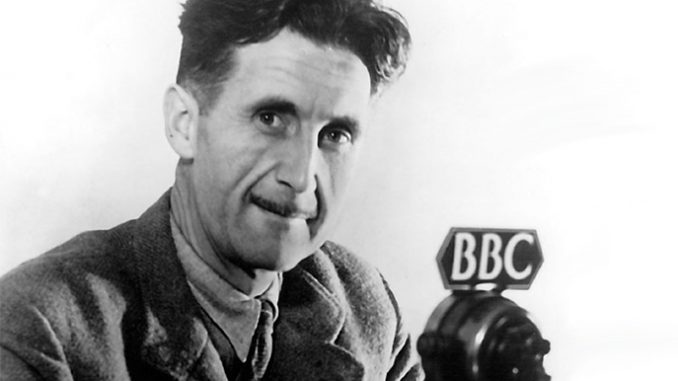
Although no Christian himself, George Orwell (1903-50) seems to me to have uttered the very last word regarding the neopagan temptation. And he did so by considering neopaganism in its most extreme expression. Instead of merely pointing and deploring, what Dreher and anyone else concerned about the radical right ought to do is consider Orwell’s perceptive review of Mein Kampf.
For Orwell, the key mystery was the book’s influence, its popularity. How could so many otherwise thoughtful Germans have fallen for the “monstrous vision” of “a horrible brainless empire in which, essentially, nothing ever happens except the training of young men for war and the endless breeding of fresh cannon-fodder”? Germans were neither unusually stupid nor uniquely evil, so what happened?
For Orwell, the mischief lay in Germany’s Weimar Republic, which in turn represented a West that had become morally and spiritually exhausted at least ever since World War I. “Nearly all western thought since the last war,” he reflected,
certainly all ‘progressive’ thought, has assumed tacitly that human beings desire nothing beyond ease, security and avoidance of pain. In such a view of life there is no room, for instance, for patriotism and the military virtues. The Socialist who finds his children playing with soldiers is usually upset, but he is never able to think of a substitute for the tin soldiers; tin pacifists somehow won’t do. Hitler, because in his own joyless mind he feels it with exceptional strength, knows that human beings don’t only want comfort, safety, short working-hours, hygiene, birth-control and, in general, common sense; they also, at least intermittently, want struggle and self-sacrifice, not to mention drums, flags and loyalty- parades.
Arguably, then, Orwell’s argument is even more relevant now than it was in the twentieth century: “Whereas Socialism, and even capitalism in a more grudging way,” he noted, “have said to people ‘I offer you a good time,’ Hitler has said to them ‘I offer you struggle, danger and death,’ and as a result a whole nation flings itself at his feet.”
It should be obvious that I bring up Orwell’s remarks not to indulge in an argumentum ad Hitlerum against the “woke right,” or MAGA, or any other movement. Rather, the point is that any society that mistakes entertainment and comfort as the end goal of human existence will fall before a society that appeals, in however distorted a fashion, to deeper ideals of courage and self-sacrifice.
Yes, there are abhorrent factions within the radical right, and we must identify them as such. At the same time, it is not hard to see why so many red-blooded young Americans find so much of American Christian rhetoric uninspiring and unimpressive. Niceness really is a virtue, but it is not the highest one, nor the only one.
In any event, the Catholic Faith begat chivalry, repelled Islamic invasion during the Middle Ages, sponsored the great voyages of discovery, and fostered the incredible achievements of modern science. No one acquainted with Catholic heritage need take lessons from Nietzsche about what it means to be a man. A complete and Christian vision of the good life recognizes the daring, strength, initiative, and creativity associated with “master morality,” right alongside the mercy and kindness of “slave morality.”
The defeat of heresy lies not in embracing the opposite heresy, but in recovering the whole truth about man’s nature and destiny.
If you value the news and views Catholic World Report provides, please consider donating to support our efforts. Your contribution will help us continue to make CWR available to all readers worldwide for free, without a subscription. Thank you for your generosity!
Click here for more information on donating to CWR. Click here to sign up for our newsletter.

Great article!
Ditto
Mr. Salyer uses many words to make his point “the point is that any society that mistakes entertainment and comfort as the end goal of human existence will fall before a society that appeals,to deeper ideals of courage and self-sacrifice”. However he forgets to add the Word of God to deeper ideals of courage and self sacrifice.
Virtue is often found at the center fulcrum between the extremes.
A comforting fiction. No, truth is an absolute extreme on the spectrum betreen submission to God and the infinite varieties of self-worship.
Provide one example.
Balance is found for sure. Christians always walk a tightrope between opposing tensions. When either side slackens we fall.