


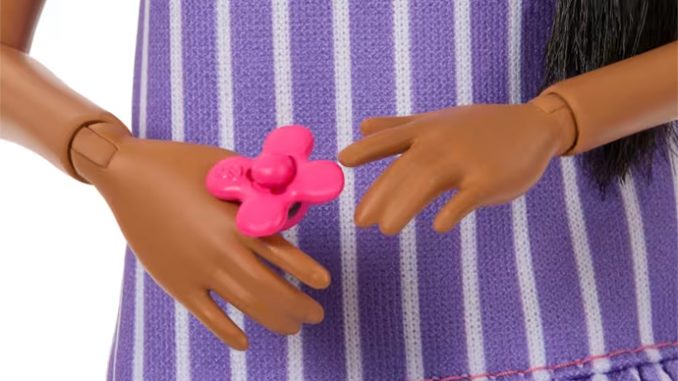
In April 2023, Mattel began selling a new Barbie that had the features of a young woman with Down syndrome. At the time, I thought this was a great step forward for little girls who could see in a plastic playmate features they shared.
The doll was received enthusiastically, raved about in the media, and sold quickly. I wrote an article sharing my enthusiasm and received several media requests for interviews to discuss my reaction. As the father of five daughters who all cherished their Barbie time as they were growing up, and as the father of a younger son born with Down syndrome, I thought the addition of this Barbie to their Fashionista Line was a good move.
Now Mattel has released an autistic Barbie, and I am not so eager to enthusiastically support this one. I did a little searching online and discovered that my ambivalence is shared by others.
Is it because autism seems so highly politicized right now, with Secretary Kennedy vowing to turn over all stones until a cause is discovered? We know the reported incidence of autism in the U.S. has skyrocketed at an alarming rate. In 2000, the CDC reported that the condition was shared by only about 1 in 150 eight-year-olds. But the most recent data tells us that the incidence has increased to a stunning 1 in 31. You would have to be in some form of denial not to be concerned about what factors in our environment could be causing that.
Maybe our shared ambivalence is because many people with autism do not have identifiable features like people with Down syndrome. Or maybe it is because this doll is not representative of the full spectrum of a condition that is characterized by a wide range of affectation. If you’re really going to represent autism, then you have to represent level 3 autistics, too. They have substantial support needs and may require specialized help to keep them from injuring themselves or others.
Even families with autistics are divided over how autism should be represented in the culture because of the wide variation in how it is expressed in individual persons. But the real problem many people have with the Barbie brand is that it has always been stereotypical of an idealized beauty—well, some people’s ideal, anyway.
A doll can only represent visual differences, and the differences Mattel chose to work with in this doll are her accessories, but that’s not really different from other Barbies. Rather than Dr. Barbie’s stethoscope and scrubs, Autistic Barbie comes with a communication device, noise-cancelling headphones, and a fidget spinner. There are also some subtly noticeable physical representations built into her articulated elbows and wrists, a slightly averted gaze so she doesn’t have to make direct eye contact, and a loose-fitting dress to indicate sensory sensitivities. Most people would probably never notice.
Perhaps the difference in attitudes between this release and Down syndrome Barbie in 2023 is timing. In April 2023, we were just coming out of the acute phase of the COVID-19 pandemic and still reeling from the experience. We were eager to grab hold of any available feel-good moment, and Down syndrome Barbie provided one. January 2026 is a very different time. We see our country and a world in crisis, and maybe a new Barbie doll—especially one that does not represent the full spectrum of the condition—has landed at the wrong time.
This seems allegorically like a trite, first-world dodge from reality. Remember the saying that Nero fiddled while Rome burned. We are pretty good at that, too, but I do not think many people are in a fiddling good mood right now.
I sympathize with parents who may be looking at this new doll and asking why Mattel would perpetuate an idealized stereotype of a high-functioning autistic woman while they struggle to get through every day, supporting an adult child they deeply love who is severely impaired by autism. I encourage you to read my friend Maria Maffucci’s reflection about how much her 31-year-old son struggles, while she hopes that a “mother’s love is enough to truly comfort and reassure her child.”
A cute little plastic thing in pretty clothes wearing noise-cancelling headphones does not quite fit Maria’s, and so many others’, reality.
I’m sorry to throw a wet blanket on this one. I’m sincerely happy for anyone who finds joy in this doll, and for all the little girls who feel like they now have a companion to play with who is just like them. I know there can be comfort in that. Let’s just not forget that Barbie has never represented reality, and I don’t think she was ever supposed to.
Her primary purpose is to be a plaything, and not a device to convey a profound and troubling social reality. I suppose we should just let her be what she is and not grant her more importance than that.
If you value the news and views Catholic World Report provides, please consider donating to support our efforts. Your contribution will help us continue to make CWR available to all readers worldwide for free, without a subscription. Thank you for your generosity!
Click here for more information on donating to CWR. Click here to sign up for our newsletter.

Maybe the proceeds from the sales of the dolls goes to research for autism? That would be a good thing then.
Waiting for the ANTIFA Minneapolis Barbie. Purple-haired, scowl on its face with the mouth frozen open in a scream. Accessories include rocks, molotov cocktail and same sex “friend”.
Needs to come with the Barbie attack SUV.
Or a Barbie Subaru.
🙂
That’s an unfortunate association for me, although I won’t be confused with an alphabet woman from Vermont with a flat top and a closet full of Mackinaw shirts.
I’m on my fourth, if you count the Misses’.
Reliable, sure footed, good on gas. A few quirks, but decent wheels.
I helped my son buy a used Subaru several years ago. But they have acquired that association for some reason
Apparel to include a ski mask, rugged terrain parka, combat boots. Accessories and accoutrements? A whistle or drum and a “NO ICE” sign or placard with stick which fits nicely into her white-skinned hand.
Map of Minneapolis.
After the reform of ICE, masks were disallowed. When ANTIFA Barbie saw Ken, unmasked Ken, for a brief moment she hesitated, lost in reverie, all of the vitriol suspended. Removed briefly from the chaos. She knew that Ken had joined the Marines but had lost track of him. And here he was, an ICE agent. They never agreed on politics. The breakup was inevitable. But to see him… to see him now. Oh, the conflicted emotions! The sweet surprise but the bitter confirmation that reuniting was impossible.
I wonder how much the widening of the definition of autism plays into the data?
Not to be cynical because serious autism & mental illness are real challenges but it seems everyone who goes to a mental health professional these days either comes out with an autism/”autism spectrum ” diagnosis or bipolar.
I’m waiting for the ADHD Barbie.
The increasing number of children with a diagnosis is a concern. As parent to a special ed child, I think cynicism is justified. School districts receive on average a doubling of state funds for educating special ed students. School districts test and assess and so diagnose (in addition to doctors and psychologists outside the district). Some students labeled ‘autistic’ differ slightly and some show no actual apparent difference from ‘typically developing’ peers.
My elementary school pictures from the late 1960s show an average of 35 children in one classroom with one teacher. All sorts of children were in those classrooms. Some were quite gifted. Others today would be branded with a diagnosis which carried increased state funding to their school. Many children diagnosed today are on medication for ADHD, autism, mild mental retardation, or behavior issues.
In the 1960s and ’70s, all children (except the seriously physically or mentally handicapped) were lumped together in one large classroom with one teacher. That teacher had no aides, assistants, or supplementary resources. The state did not supply extra financial support because of disabled students. Students received no individualized or specialized instruction.
Teachers themselves, from their own pocket money, often supplied snacks, pencils, or Kleenex to kids in poverty. Some kids informed their parents, and some parents sent extra sandwiches or fruit to poor kids through their child’s lunch bag. What a wonderful lesson in charitable almsgiving to us schoolchildren. My family had little, but my good Christian mother was generous with what she had.
Testing of students in public schools in the ’60s and ’70s revealed scores consistently high compared to test scores of students today. And let’s not get started on the grade of morality!
Too many of the mostly female teachers fail to understand boys are naturally less compliant and more kinetic than girls. As this interferes with the imposition of classroom order, boys are viewed by the teachers as having behavioral issues. There are plenty of anecdotal accounts of teachers suggesting children see a behavioral provider so they could diagnosed as ADD/ADHD, as if the professional would merely make the teacher’s estimate official.
Pubmed offers this:
Overdiagnosis of Attention-Deficit/Hyperactivity Disorder in Children and Adolescents
A Systematic Scoping Review
Luise Kazda 1,✉, Katy Bell 1, Rae Thomas 2, Kevin McGeechan 1, Rebecca Sims 2, Alexandra Barratt 1
Author information
Article notes
Copyright and License information
PMCID: PMC8042533 PMID: 33843998
This systematic scoping review evaluates the multidecade pattern of diagnosis in attention-deficit/hyperactivity disorder in young people using a framework for identifying overdiagnosis for noncancer conditions.
Key Points
Question
Is attention-deficit/hyperactivity disorder (ADHD) overdiagnosed in children and adolescents?
Findings
In this systematic scoping review of 334 published studies in children and adolescents, convincing evidence was found that ADHD is overdiagnosed in children and adolescents. For individuals with milder symptoms in particular, the harms associated with an ADHD diagnosis may often outweigh the benefits.
PubMed has this offering about overdiagnosis
Absolutely right.
There is no question that diagnosing 533% more children as being autistic (2000 to 2020?) is much more a function of ‘syndrome redefinition’ than it is an actual recognition of some sort of massive ‘plague’ which has been visited upon unsuspecting American youth.
Heck, I’d guess most of us reading this have any number of autistic ‘tells’ according to the seemingly endless list of symptoms…thus the cocktail party throwaway: “I’m probably on the spectrum because going to cocktail parties exhausts me!’
Once everyone is seen as being — in some ways — ‘autistic’ then no one is autistic, including, sadly, the .6% of individuals who really are autistic and were so diagnosed 25 years ago…..and who deserve the special assistance they require to function even at a minimum level in society.
So nobody’s going to comment on Mattel’s 2020 offering of a ghoulish Dia De Muertos Barbie?
I suspect we, with good intention, misunderstand the meaning and nature of ‘beauty’ and how the beautiful is represented in Art, be it the statue of ‘David’… the roles played by Errol Flynn, Catherine Deneuve, Brad Pitt, Liz Taylor… the amazing interiors shown in Architectural Digest….or even the lowly Barbie.
We don’t watch golden-haired Brad cavort in ‘Once Upon a Time in Hollywood’ because he looks like us. We don’t identify with Cary in ‘North by Northwest’ because, ‘Gosh, that could be me!’. Instead, we find ourselves riveted by the actors/actresses who play-pretend so well exactly because they DON’T look like us and they are not ‘Me’ (with all our own, self-recognized weaknesses, deficiencies, foibles, & flaws) We watch them because they are transcendently, archetypically beautiful/handsome and their characters almost always good, right & true. They are Ideals. They are how we would like to be, how we would like to see ourselves. And the actor/character therefore becomes, in a very real sense, our aspirational dream…NOT because we want plastic surgeons to make us look like John Wayne, but because we want to be as brave as ‘the Duke’, as cool as Cary Grant, as self-confident as Pitt (as he stands midstream and hunts the golden trout).
So too with Barbie….and all other dolls & imaged toys that have ever been.
Sure they’re plastic, fantastic, unreal creations with microscopic waists, and piles of shimmering, chiffon-like hair. Sure, their eyes sparkle (made with polished glass & crystal resin) and their play homes are pink palaces of indulgence and high-glamour. Of course they are. They’re dolls! They’re art designed for kid-consumption & playing pleasure. They’re designed, as all/most toys are designed to encourage and enable imagination and engagement. Boys play (or played) with GI Joe not because they aspired to be green plastic soldiers but because they wanted to be fearless warrior leaders, capable of conquering armies of ‘bad guys’.
So no, the – again, well-intentioned – urge to create more ‘realistically / identifiable’ Barbies (complete with certain ‘approved’ flaws & genetic malformations) is and always has been a mistake. To indulge this pained, exceedingly adult/parental need to idealize what is not ideal is to lose track of what toys, and aspirational dreams are all about. [It also, on a somewhat more minor note, is rather cruel in its particular idealizations, focused as they are only upon a very specific set of publicly recognized and ‘celebrated’ differences. We don’t have obese Barbie…we don’t have plain Barbie or Severely Acned Barbie…we don’t have Barbie with cerebral palsy, or Barbie with epilepsy – none of those very human problems have the same kind of embraced ‘difference’ that Down Syndrome Barbie has.]
But even if Mattel went entirely bonkers and created a whole stable full of Barbies suffering from any number of diseases and congenital anomalies, that effort would miss entirely the point that ideals (no matter how unreal) exist not to drive an obsessive & envious jealousy…not to make all us real (and flawed) human beings feel bad about ourselves…but to help us dream and to encourage us to aspire. And children, no matter who they are or how they may be challenged (as my own daughter is and always will be challenged) deserve the chance to dream.