Vatican City, Jul 13, 2017 / 11:56 am (CNA/EWTN News).- An analysis piece published Thursday in La Civilta Cattolica, discusses what it calls a “surprising” and unfortunate alliance between conservative Catholics and evangelicals in the U.S. on issues such as immigration – suggesting the two are in direct opposition to Pope Francis’ message of mercy.
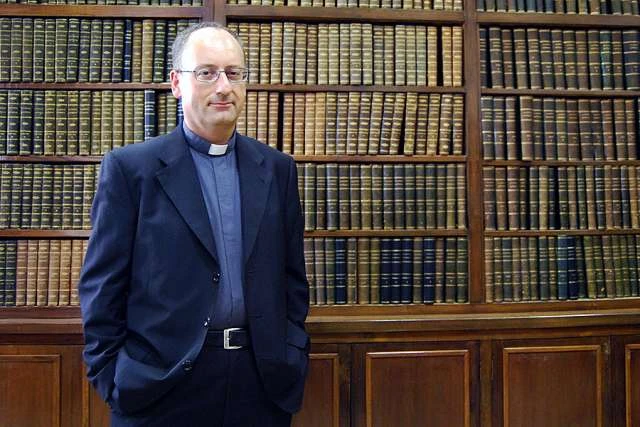
The article, published online July 13, is co-authored by Fr. Antonio Spadaro, editor in chief of the Jesuit publication, and Marcelo Figueroa, a Presbyterian pastor who is editor in chief of the Argentine edition of L’Osservatore Romano, the Vatican’s newspaper.
Both men are regarded as confidantes of Pope Francis. La Civilta Cattolica is also seen as a mouthpiece of sorts for the Holy See, as its text is revised and approved by the Vatican Secretariat of State before it is published.
Fr. Spadaro and Figueroa start from the US motto, In God We Trust, saying that for some this “is a simple declaration of faith,” but for others it is “the synthesis of a problematic fusion between religion and state, faith and politics, religious values and economy.”
The authors hold that in recent decades American politics have been shaped by “religion, political Manichaeism and a cult of the apocalypse.”
They cite President George W. Bush’s speaking of the “axis of evil” and the US’ duty to “free the world from evil” as an example of what they call “a Manichaean language that divides reality between absolute Good and absolute Evil.”
Fr. Spadaro and Figueroa trace these to the evangelical-fundamentalist movement which becan in the early 20th century, and tie them to the consideration of the US as “a nation blessed by God.”
“They do not hesitate to base the economic growth of the country on a literal adherence to the Bible,” they write. “Over more recent years this current of thought has been fed by the stigmatization of enemies who are often ‘demonized.’”
Fundamentalism has developed an exegesis which decontextualizes the Old Testament without being “guided by the incisive look, full of love, of Jesus in the Gospels,” they write, adding that “within this narrative, whatever pushes toward conflict is not off limits.”
“Another interesting aspect is the relationship with creation of these religious groups that are composed mainly of whites from the deep American South,” Fr. Spadaro and Figueroa state. “There is a sort of ‘anesthetic’ with regard to ecological disasters and problems generated by climate change. They profess ‘dominionism’ and consider ecologists as people who are against the Christian faith.”
Ecological problems are regarded by fundamentalists as signs of the apocalypse, they write, which “confirm their non-allegorical understanding of the final figures of the Book of Revelation and their apocalyptic hope in a ‘new heaven and a new earth.’”
The authors find a prophetic formula to this worldview, characterizing it as charged to “fight the threats to American Christian values and prepare for the imminent justice of an Armageddon, a final showdown between Good and Evil, between God and Satan.”
They also cite Rousas Rushdoony, a 20th century Protestant pastor, in this regard, and note his influence on Steve Bannon, who is chief strategist in the Trump administration.
Rushdoony supports, they say, the subjection of public norms to religious morals and a “theocratic necessity” which “submit(s) the state to the Bible with a logic that is no different from the one that inspires Islamic fundamentalism.”
Fr. Spadaro and Figueroa then treat of the prosperity gospel and the rhetoric of religious liberty, first citing Norman Vincent Peale, another 20th century Protestant pastor. Peale authored The Power of Positive Thinking and was close to President Donald Trump, as well as Richard Nixon and Ronald Reagan.
In the section treating of the prosperity gospel, they also speak about “a particular form of proclamation of the defense of ‘religious liberty.’”
“The erosion of religious liberty is clearly a grave threat within a spreading secularism,” they write. “But we must avoid its defense coming in the fundamentalist terms of a ‘religion in total freedom,’ perceived as a direct virtual challenge to the secularity of the state.”
Next, the authors describe what they call a “fundamentalist ecumenism” developing between evangelical fundamentalists and “Catholic Integralists”, who they say are “brought together by the same desire for religious influence in the political sphere.”
They note that some Catholics “express themselves in ways that until recently were unknown in their tradition and using tones much closer to Evangelicals … Both Evangelical and Catholic Integralists condemn traditional ecumenism and yet promote an ecumenism of conflict that unites them in the nostalgic dream of a theocratic type of state.”
For Fr. Spadaro and Figueroa “the most dangerous prospect for this strange ecumenism is attributable to its xenophobic and Islamophobic vision that wants walls and purifying deportations.”
They describe this as a paradoxical “ecumenism of hate” which contrasts with Pope Francis’ “ecumenism that moves under the urge of inclusion, peace, encounter and bridges. This presence of opposing ecumenisms – and their contrasting perceptions of the faith and visions of the world where religions have irreconcilable roles – is perhaps the least known and most dramatic aspect of the spread of Integralist fundamentalism.”
“Here we can understand why the pontiff is so committed to working against ‘walls’ and any kind of ‘war of religion.’”
In the article, Fr. Spadaro and Figueroa argue that “(t)he religious element should never be confused with the political one.”
“Confusing spiritual power with temporal power means subjecting one to the other…There is a need to flee the temptation to project divinity on political power that then uses it for its own ends,” they say.
As an example, they point to the “shocking rhetoric” of Church Militant, a website formerly known as Real Catholic TV, which changed its name to in 2012 after being told by the Archdiocese of Detroit that it did not have permission to describe itself as “Catholic.”
Church Militant and its founder Michael Vorris are known for their controversial positions. Vorris has claimed on one of his programs that only faithful Catholics should be allowed to vote. In 2011, Vorris was banned from speaking at any facility owned by the Diocese of Scranton, Penn.
Fr. Spadaro and Figueroa noted that the group portrayed the U.S. elections as a “spiritual war,” creating “a close analogy between Donald Trump and Emperor Constantine, and between Hilary Clinton and Diocletian.” By suggesting that Trump’s victory could be attributed to the prayers of Americans, Church Militant portrayed “a divine election,” they said.
“This warlike and militant approach seems most attractive and evocative to a certain public, especially given that the victory of Constantine – it was presumed impossible for him to beat Maxentius and the Roman establishment.”
A truly Christian theopolitical plan would be eschatological, they said.
“And this is why the diplomacy of the Holy See wants to establish direct and fluid relations with the superpowers, without entering into pre-constituted networks of alliances and influence.”
In contrast, Fr. Spadaro and Figueroa say, Pope Francis “radically rejects the idea of activating a Kingdom of God on earth as was at the basis of the Holy Roman Empire and similar political and institutional forms, including at the level of a ‘party’.”
They also warn that fear of chaos and a breakdown of order is what “underlies the persuasive temptation for a spurious alliance between politics and religious fundamentalism.”
Political success becomes assured by “exaggerating disorder” and “agitating the souls of the people by painting worrying scenarios beyond any realism,” they say. At this point, religion becomes “a guarantor of order.”
Pope Francis, however, is fighting against “the manipulation of this season of anxiety and insecurity,” they say. The Pope “gives no theological-political legitimacy to terrorists, avoiding any reduction of Islam to Islamic terrorism. Nor does he give it to those who postulate and want a ‘holy war’ or to build barrier-fences crowned with barbed wire.”
“(T)he Christian roots of a people are never to be understood in an ethnic way,” Fr. Spadaro and Figueroa say. “Triumphalist, arrogant and vindictive ethnicism is actually the opposite of Christianity.”
 […]
[…]






About appealing to “fraternity beyond the Christian world” and “an authentic understanding of God as Father,” this relationship and concept and word (!) does not show up in the “uncreated” Qur’an which dismisses the Triune One and the Incarnation as polytheism. How to dialogue with those who live in an alternative universe?
Peter, perhaps the Pope could follow in the footsteps of St.Francis of when he engaged in dialogue with Muslim leaders in Egypt in 1219. Francis approached them as fellow humans and respected their fidelity to their beliefs. His humility and willingness to engage in friendly dialogue so impressed them that they entertains him and granted him safe passage back to the Crusaders who were engaged in combat against them. Francis respected their piety, however misplaced, and used it as an example for his brothers. There is an old saying that says: there is not a human alive that we can’t learn from; and I think this is very true. The Pope has a unique opportunity to live Christ before and with leaders of other religions, and I think it is right for him to do so. You can dialogue with out compromising your own beliefs, and you can respect the integrity of those you disagree with.
Of course, I agree one on one, nevertheless Islam—as a religion—is the negation of Christianity. Arianism on steroids.
James Connor: Sentimentality is comforting, but When has “dialogue” ever occurred across billions of people?
Good points, Mr. Connor. Thank you.
You pose the existential question that has yet to be answered. State-sponsored radical Islam is the greatest threat to world peace.
“You pose the existential question that has yet to be answered. State-sponsored radical Islam is the greatest threat to world peace.”
Perhaps, but the greatest threat to our Salvation, is The Sin Against The Holy Ghost , due to a hardened heart at the moment of our death, that in denying The Unity Of The Holy Ghost, Who Is The Spirit Of Perfect Divine Eternal Love Between The Father And His Only Begotten Son, Jesus The Christ, denies The Divinity Of The Most Holy Blessed Trinity, while denying The Source Of God’s Gift Of Grace And Mercy , Salvational Love.
“Do not let your Hearts be hardened!”
“Penance, Penance, Penance” At the heart of Liberty Is Christ, “4For it is impossible for those who were once illuminated, have tasted also the heavenly gift and were made partakers of the Holy Ghost, 5Have moreover tasted the good word of God and the powers of the world to come…”, to not believe that Christ’s Sacrifice On The Cross will lead us to Salvation, but we must desire forgiveness for our sins, and accept Salvational Love, God’s Gift Of Grace And Mercy; believe in The Power And The Glory Of Salvation Love, and rejoice in the fact that No Greater Love Is There Than This, To Desire Salvation For One’s Beloved.
“Hail The Cross, Our Only Hope.”
“Blessed are they who are Called to The Marriage Supper Of The Lamb.”
“For where your treasure is there will your heart be also.”
“Behold your Mother.” – Christ On The Cross
Dear Blessed Mother Mary, Mirror of Justice And Destroyer Of All Heresy, Who Through Your Fiat, Affirmed The Filioque, and thus the fact that There Is Only One Son Of God, One Word Of God Made Flesh, One Lamb Of God Who Can Taketh Away The Sins Of The World, Our Only Savior, Jesus The Christ, thus there can only be, One Spirit Of Perfect Divine Eternal Complementary Love Between The Father And His Only Begotten Son, Jesus The Christ, Who Must Proceed From Both The Father And His Only Begotten Son, Jesus The Christ, In The Ordered Communion Of Perfect Divine Eternal Complementary Love, The Most Holy And Undivided Blessed Trinity (Filioque), hear our Prayer that your Immaculate Heart Will Triumph soon for the sake of Christ, His Church, all who will come to believe, and all our beloved prodigal sons and daughters, who, hopefully, will return to The One Body Of Christ, which exists From The Father, Through, With, And In His Only Son, Jesus The Christ, In The Unity Of The Holy Ghost (Filioque) Amen.
Our Lady Of Fatima, Blessed Mother Mary , Full Of Grace , Please Intercede For Us🙏✝️💕🌹
The Jews don’t believe in the Trinity either.
This is true. Muslims, Christians,and Jews worship the God of Abraham but we each have different understandings of Him.
Because of their monotheistic religion, Muslims and Jews have a lot more in common with each other than with Catholics.
Not “because they are ‘monotheistic'” but, instead, this:
“The responses of the Old Testament and a fortiori of Islam (which remains essentially in the enclosure of the religion of Israel) are incapable of giving a satisfactory answer to the question of why Yahweh, why Allah, created a world of which he did not have need in order to be God. Only the fact is affirmed in the two religions, not the why. The Christian response is contained in these two fundamental dogmas: that of the Trinity and that of the Incarnation” (Hans Urs von Balthasar).
We believe in one God , too. Three persons in One God
We’re all monotheists. Different understandings about Him though.
Of course, but except for a few radicals they and we do accept and respect each other. We have each had a type of renewal. Islam has yet to have a renewal. Studying history and monitoring how certain Islamic countries continue to govern ought to help us be realistic. Reading the Koran might help also! Our Pope is correct and possibly prophetic.
It is important to note that Division is not of The Holy Ghost, thus it is what divides other religious denominations from Christ’s One, Holy, Catholic, And Apostolic Church, In The Unity Of The Holy Ghost, The Spirit Of Perfect Divine Eternal Love Between The Father And His Only Begotten Son, Jesus The Christ, Who Must Proceed From Both The Father And His Only Begotten Son, Jesus The Christ, In The Ordered Communion Of Perfect Divine Eternal Love, The Most Holy Blessed Trinity, that keeps various religious denominations from being in communion with The One Body Of Christ, In The Unity Of The Ghost, Christ’s One, Holy, Catholic And Apostolic Church.
The Fact That The Holy Spirit Must Proceed From Both The Father And His Only Begotten Son, Jesus The Christ, dues not imply The Holy Ghost “is in a subordinate position to The Father And The Son”.
Perfect Divine Eternal Love Does Not Divide, It Multiplies, as in The Miracle Of The Loaves And Fishes.
The Filioque is a Dogma Of The Catholic Faith that affirms The Divinity Of The Holy Ghost.
“Quoting the creed, he underlined the proclamation of Christ as “consubstantial with the Father,” describing it as “a profound bond already uniting all Christians.” Citing St. Augustine, he added: “Although we Christians are many, in the one Christ we are one.”
Quoting The Creed while acknowledging The Holy Ghost, The Spirit Of Perfect Complementary Divine Eternal Love Between The Father And His Only Begotten Son, Jesus The Christ Proceeds From Both The Father And His Only Begotten Son, Jesus The Christ, underlines the proclamation of Christ as “consubstantial with the Father,”
Yes, the filioque has divided us for centuries. It is not such a small thing, although to outsiders it seems so. (Ask your Protestant friends and they won’t even be aware of the difference, or at least mine aren’t.) Pray for the peace of Jerusalem.
As events, whether by chance or the fates would have it, Byzantine emperor Patriarch Constantine XI Palaiologos was in consultation for unity with Rome when Ottoman sultan Mehmed II moved his siege artillery in range of Constantinople. Constantine considered making the momentous decision to unite when Mehmed’s artillery crumbled the great city’s walls. All was lost.
The Vatican had prepared to send a fleet though time had run out. When Genoese captain Giovanni Giustiniani Longo had arrived earlier with a brigade of Genoese and Greek mercenaries, the emperor placed him in command of the city’s defense. Outnumbered, outgunned they fought well, joined by Venetians who had several ships in harbor. The good was that Italians and Greeks fought and died together, despite the 1182 massacre of the Latins in that city, the 1204 sack by French and Venetian crusaders – to save the central city of Orthodoxy.
Ottoman Islam would spread into Europe on the verge of conquest when defeated at Lepanto under the patronage of the Blessed Virgin and similarly at the gates of Vienna. Might it again be the growing, ominous threat of Islam, the scourge of moral disorder due to indifference reasons for uniting in the name of Christ under Our Lady’s patronage?
About being “outnumbered and outgunned” at the FALL of COBSTANTINOPLE: Between one hundred and three hundred thousand Muslims moved against a much smaller remaining force of only seven thousand defenders. The historian JOHN JULIUS NORWICH captures this moment:
“By now, too, the omens had begun. On 22 May there was a lunar eclipse; a day or two later, as the holiest icon of the Virgin was being carried through the streets in one last appeal for her intercession, it slipped from its platform. A few hundred yards further on, a violent thunderstorm caused the whole procession to be abandoned. The next morning the city was shrouded in fog, unheard-of at the end of May; the same night the dome of Santa Sophia was suffused with an unearthly red glow that crept slowly up from the base to the summit and then went out. The past phenomenon was also seen by the Turks in Galata; Mehmet himself was greatly disturbed, and was reassured only after his astrologers had interpreted it as a sign that the building would soon be illuminated by the True Faith. For the Byzantines, the meaning was clear: the Spirit of God itself had deserted their city” (“A Short History of Bizantium,”1997).
And, about the SCOURGE of CHRISTIAN DISUNITY:
The Muslim siege in 1453 was aided by a 27-foot-long brass canon built by a German (!) engineer…
And, it’s possible Constantinople could even have held if it had not been sacked and permanently weakened over two centuries earlier in 1204 by the Fourth Crusade (!).
And later, about the divisive Reformation, the Augustinian monk Luther might not have been below the radar in 1517, had not the Emperor and the Pope both been distracted by Muslim advances from the east following disaster of 1453 (and preceding the successful Battle of Vienna in 1683).
That trip is another step towards building One Global Church.
The One, Catholic Church already exists. So…the one global church has been around a while.
Should we not desire union with the Orthodox churches?
“Should we not desire union with the Orthodox churches?”
We should desire that The Orthodox Churches that are not in communion with Christ’s One, Holy, Catholic, And Apostolic Church, desire to return to The One Body Of Christ , which exists “Through Him, With Him, And IIn Him, Oh God Almighty Father, In The Unity Of The Holy Ghost”, affirming both The Filioque and The Papacy Of His One, Holy, Catholic, And Apostolic Church , That Christ Himself Has Founded For The Salvation Of Souls.
You mean one catholic and universal Church the way it used to be before the Great Schism?
Isn’t that what we should hope for?
John 17:22. “ that you may be one as we are one…” given as a witness to the world.
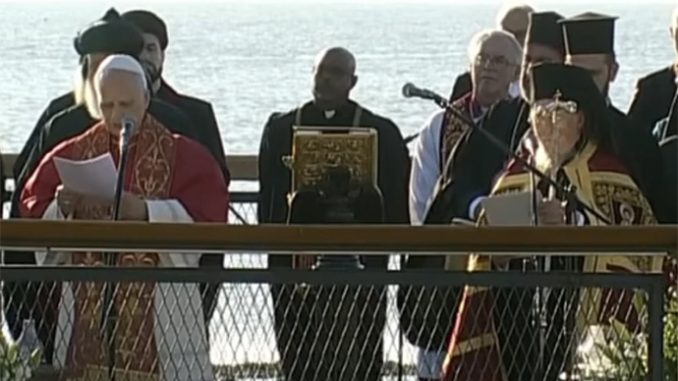
Although we missed a golden opportunity for unification with Greek Orthodox, Byzantine emperor Patriarch Constantine XI Palaiologos willing at the last, lost minute, last night viewed Leo XIV attend the very solemn, deeply reverential Mass offered by Ecumenical Patriarch Bartholomew 1 of Constantinople eastern Orthodox Church. Deep. Beautifully solemn.
Captured was a profound insight into the granite like immobility of the Greek Orthodox, if not in the integrity of doctrine: the filioque clause, Christological deficiency, divorce; rather in their ownership as the primary recipients of Paul’s mission to convert the gentiles. It was from their tradition that we have the Septuagint, the Koine Greek Gospels, the majority of Church fathers, the theological masters of Alexandria Athanasius and Cyril. The locales of the early councils Nicaea the first. A fierce attitude, Let no other Christian Church claim dominance.
Last night Patriarch Bartholomew I revealed an entirely different posture with Leo XIV. Smiling, leading by hand, showing warm respect. Perhaps more than Athenagoras showed Paul VI. Pope Leo gave a talk, almost a Francis I replica musing on care for our environment, creation, without mentioning in any form the precious value of the creation of Man, his present day moral disfigurement, the slaughter of human life in the womb.
Nevertheless Leo addressed the required effort to settle differences amicably for sake of unity. It all seems hopeful. Although this observer is not convinced whether differences will be correctly resolved or simply disregarded. The result a fine friendship in place of real unity. Still there’s hope.
How many of the sixteen (or so) of the Orthodox Churches fully in communion with one another attended the events for the Nicea anniversary? Does anyone know? I have been looking for a list and have gathered that at least three Churches were not in attendance, the Patriarchates of Antioch, Jerusalem and (unsurprisingly) Russia. The answer could shed light n how much widespread interest in unification presently exists across the Orthodox world, outside of the Churches directly connected to the Ecumenical Patriarch. And that, in turn, could help clarify what the prospects are for achieving more unity in the near future.