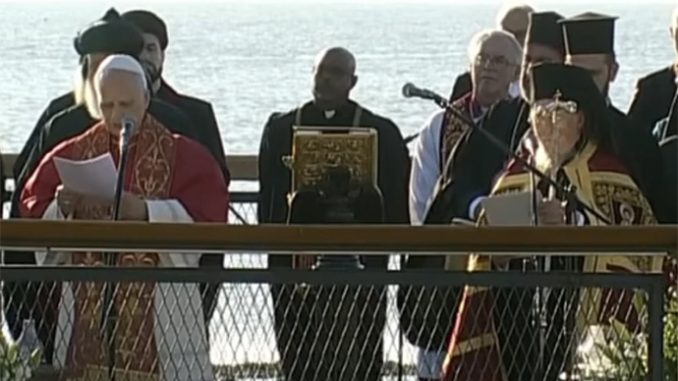
Pope Leo XIV and Ecumenical Patriarch Bartholomew I of Constantinople at an ecumenical event marking the 1,700th anniversary of Nicene Creed, in Iznik, Turkey, on November 28th, 2025. (Screenshot: Vatican Media)
Iznik, Turkey, Nov 28, 2025 / 08:05 am (CNA).
Pope Leo XIV commemorated the 1700th anniversary of the First Council of Nicaea on Friday in the Turkish city historically known as the birthplace of the Nicene Creed, calling Christians to overcome “the scandal of divisions” and to renew their commitment to unity.
The pope spoke during an ecumenical prayer service held at the archaeological site of the ancient Basilica of Saint Neophytos on the shore of Lake Iznik, southeast of Istanbul. The gathering marked one of the most symbolic moments of his apostolic visit to Turkey, which has focused heavily on ecumenical and interreligious outreach.
“We are all invited to overcome the scandal of divisions,” he said, urging Christians to nurture “the desire for unity for which the Lord Jesus prayed and gave his life.”
Pope Leo and Ecumenical Patriarch Bartholomew I, considered first among equals among Eastern Orthodox bishops, were welcomed by two senior Orthodox bishops before proceeding to a platform beside the submerged ruins of the basilica. The two leaders stood before icons of Christ and of the council and lit candles together.
Iznik, formerly Nicaea, is located about 130 kilometers southeast of Istanbul. The remains of an early Christian basilica dedicated to Saint Neophytos, a young martyr killed in 303 during the persecutions of Diocletian, were first identified in 2014 after aerial photographs revealed the outline of a submerged church. The basilica collapsed during an earthquake in 740, and its ruins are now visible from the lakeshore.
In his homily, Leo said the anniversary was “a precious opportunity to ask ourselves who Jesus Christ is in the lives of men and women today, and who he is for each one of us personally.” He cautioned against reducing Christ to “a kind of charismatic leader or superman,” recalling Arius’ denial of Christ’s divinity and the council’s defense of the full humanity and full divinity of Jesus.
“If God did not become man, how can mortal creatures participate in his immortal life?” the pope asked, emphasizing what was at stake in the fourth-century debate.
Leo said the Nicene confession of faith remains a foundation for unity among Christians worldwide. Quoting the creed, he underlined the proclamation of Christ as “consubstantial with the Father,” describing it as “a profound bond already uniting all Christians.” Citing St. Augustine, he added: “Although we Christians are many, in the one Christ we are one.”
A reconciled Christianity, he continued, can “bear credible witness to the Gospel” and offer “a proclamation of hope for all.”
The pope also extended his appeal for fraternity beyond the Christian world, insisting that authentic recognition of God as Father requires honoring all people as brothers and sisters. He warned against using religion “to justify war, violence, or any form of fundamentalism or fanaticism,” and called instead for “fraternal encounter, dialogue, and cooperation.”
Pope Leo’s schedule in Turkey includes a series of ecumenical events, among them the signing of a joint declaration with Patriarch Bartholomew I on Nov. 29 at the Patriarchal Palace. His trip also carries an interreligious dimension. Earlier on Friday he met the Chief Rabbi of Turkey, discussing the visit as a sign of peace and support for all religious communities. On Saturday, Nov. 29, he will visit the Sultan Ahmed Mosque.
If you value the news and views Catholic World Report provides, please consider donating to support our efforts. Your contribution will help us continue to make CWR available to all readers worldwide for free, without a subscription. Thank you for your generosity!
Click here for more information on donating to CWR. Click here to sign up for our newsletter.
Bishop Thomas Zinkula, who has led the Diocese of Davenport, Iowa since 2017, was named the next archbishop of the Archdiocese of Dubuque, Iowa, on July 26, 2023. / Diocese of Davenport.
Vatican City, Jul 26, 2023 / 05:51 am (CNA).
Pope Francis… […]
Altar of the Chair in St. Peter’s Basilica, where Bernini’s gorgeous bronze monument to the Chair of Peter acts as a massive
bronze reliquary for the historic wooden chair. / Credit: Vatican Media
Vatican City, Nov 9, 2024 / 06:00 am (CNA).
For the first time in over a century, the historic Chair of St. Peter, a wooden throne symbolizing the pope’s magisterial authority, has been removed from its gilded bronze reliquary in St. Peter’s Basilica to be displayed for public veneration.
Pilgrims and visitors can now behold this storied relic directly in front of the basilica’s main altar, just above the tomb of St. Peter, where it will remain on display until Dec. 8, the solemnity of the Immaculate Conception.
The last major public viewing of the chair occurred in 1867, when Pope Pius IX exposed the Chair of Peter for the veneration of the faithful for 12 days on the 1,800th anniversary of the martyrdoms of St. Peter and St. Paul, according to Pietro Zander, head of the Necropolis and Artistic Heritage Section of the Vatican.
It was the first time that the centuries-old wooden throne had been exhibited to the public since 1666 when it was first encased within Gian Lorenzo Bernini’s monumental bronze sculpture under the stained-glass Dove of the Holy Spirit window at the basilica’s apse.
The historic wooden Chair of St. Peter as it is currently on display in St. Peter’s Basilica. Credit: Courtney Mares/CNA
Formally known as the Cathedra Sancti Petri Apostoli, or more simply as Cathedra Petri, the chair has held a revered place in Catholic tradition over the centuries, representing papal authority from St. Peter to the present.
“The chair is meant to be understood as the teacher’s ‘cathedra,’” art historian Elizabeth Lev told CNA. “It symbolizes the pope’s duty to hand down the teaching of Christ from generation to generation.”
“It’s antiquity [ninth century] speaks to a papacy that has endured through the ages — from St. Peter who governed a church on the run trying to evangelize with the might of the Roman Empire trying to shut him down, to the establishment of the Catholic Church and its setting down of roots in the Eternal City, to our 266th successor of St. Peter, Pope Francis,” she explained.
Pope Francis venerates the Chair of St. Peter at the end of the closing Mass of the Synod on Synodality on Oct. 27, 2024, the first day the chair was displayed for public veneration. Credit: Vatican Media
A storied history
The wooden chair itself is steeped in history. According to the Vatican, the wooden seat was likely given by the Holy Roman Emperor Charles the Bald to Pope John VIII in A.D. 875 for the emperor’s Christmas coronation in the old St. Peter’s Basilica. A depiction of the emperor appears on the crossbeam of the chair, and its ivory panels illustrate the labors of Hercules along with other scenes from Greek mythology.
The informational sign near the chair in St. Peter’s Basilica informs visitors that “shortly after the year 1000, the Cathedra Petri began to be venerated as a relic of the seat used by the apostle Peter when he preached the Gospel first in Antioch and then in Rome.”
The Fabric of St. Peter, the organization responsible for the basilica’s upkeep, maintains that “it cannot be ruled out that this ninth-century imperial seat may have later incorporated the panel depicting the labors of Hercules, which perhaps originally belonged to an earlier and more ancient papal seat.”
Before returning the chair to its place within Bernini’s monumental reliquary, Vatican experts will conduct a series of diagnostic tests with the Vatican Museums’ Cabinet of Scientific Research. The ancient seat was last removed and studied from 1969 to 1974 under Pope Paul VI but was not shown to the public.
Closer details can be seen of the historic relic of the Chair of St. Peter. For the first time in over a century, the wooden throne symbolizing the pope’s magisterial authority has been removed from its gilded bronze reliquary in St. Peter’s Basilica to be displayed for public veneration. Credit: Daniel Ibanez
The recent restoration of Bernini’s works in the basilica, funded by the Knights of Columbus in preparation for the Catholic Church’s 2025 Jubilee Year, made it possible for the chair to be moved from the bronze sculpture in August.
Pope Francis got a sneak peak of the relic in early October and a photo of the moment — showing him sitting in a wheelchair before the Chair of St. Peter — quickly went viral. Afterward, the pope requested that the relic be displayed for public veneration.
Francis ultimately decided that the Chair of St. Peter — a symbol of the Church’s unity under the instruction of Christ — would be unveiled for the public at the closing Mass for the Synod on Synodality.
“Pope Francis has been exceptionally generous to the faithful about displaying relics,” Lev said. “He brought out the bones of St. Peter shortly after his election, he had the Shroud of Turin on view in 2015, and now he has taken the Chair of Peter out for veneration in the basilica.”
“In our virtual age, where much confusion reigns between what is real and what is not, Pope Francis has encouraged us to come face to face with these ancient witnesses of our faith and our traditions.”
Pope Francis venerates the Chair of St. Peter at the end of the closing Mass of the Synod on Synodality on Oct. 27, 2024, in Rome. Credit: Vatican Media
Feast of the Chair of St. Peter
The Feast of the Chair of St. Peter, celebrated each year on Feb. 22, dates back to the fourth century. St. Jerome (A.D. 347–420) spoke of his respect for the “Chair of Peter,” writing in a letter: “I follow no leader save Christ, so I enter into communion with … the Chair of Peter, for this I know is the rock upon which the Church is built.”
As Pope Benedict XVI explained in a 2006 catechesis: “‘Cathedra’ literally means the established seat of the bishop, placed in the mother church of a diocese, which for this reason is known as a ‘cathedral.”
“It is the symbol of the bishop’s authority and in particular, of his ‘magisterium,’ that is, the evangelical teaching which, as a successor of the apostles, he is called to safeguard and to transmit to the Christian community,” he said.
When a bishop takes possession of the particular Church that has been entrusted to him, he sits on the cathedra, Benedict explained: “From this seat, as teacher and pastor, he will guide the journey of the faithful in faith, hope, and charity.”
“The Church’s first ‘seat’ was the upper room, and it is likely that a special place was reserved for Simon Peter in that room where Mary, mother of Jesus, also prayed with the disciples,” he added.
Benedict XVI described Peter’s ministry as a journey from Jerusalem to Antioch, where he served as bishop, and ultimately to Rome. He noted that the See of Rome, where Peter ultimately “ended his race at the service of the Gospel with martyrdom,” became recognized as the seat of his successors, with the cathedra representing the mission entrusted to Peter by Christ.
“So it is that the See of Rome, which had received the greatest of honors, also has the honor that Christ entrusted to Peter of being at the service of all the particular Churches for the edification and unity of the entire people of God,” he said.
The Altar of the Chair in St. Peter’s Basilica, where Bernini’s bronze monument to the Chair of Peter acts as a massive bronze reliquary for the historic wooden chair. Credit: Vatican Media
Bernini’s Baroque masterpiece
Bernini’s monumental reliquary for the chair, commissioned by Pope Alexander VII and completed in 1666, is one of the most iconic artworks in St. Peter’s Basilica. Bernini encased the wooden relic within a bronze-gilded throne, dramatically raised and crowned by a stained-glass depiction of the Holy Spirit, symbolized as a dove, surrounded by sculpted angels.
The bronze throne is supported by massive statues of four doctors of the Church — two from the West, St. Augustine and St. Ambrose, and two from the East, St. John Chrysostom and St. Athanasius — symbolizing the unity of the Church through the ages, bringing together the teachings of both the Latin and Greek Church Fathers. And at the top of the throne, cherubs hold up a papal tiara and keys symbolizing papal authority.
On the chair itself, there are three gold bas-reliefs representing the Gospel episodes of the consignment of the keys (Matthew 16:19), “feed my sheep” (John 21:17), and the washing of the feet (John 13:1-17).
The ongoing restoration of Bernini’s monument at the Altar of the Chair, along with the recently finished restoration of the baldacchino, is significant not only in light of the 2025 Jubilee Year but also the upcoming 400th anniversary of the consecration of the current St. Peter’s Basilica in 2026.
“Celebrating the ‘Chair’ of Peter,” Benedict XVI said, “means attributing a strong spiritual significance to it and recognizing it as a privileged sign of the love of God, the eternal Good Shepherd, who wanted to gather his whole Church and lead her on the path of salvation.”
Apparently, metal detectors are only a problem when installed by Jews. […]
25 Comments
About appealing to “fraternity beyond the Christian world” and “an authentic understanding of God as Father,” this relationship and concept and word (!) does not show up in the “uncreated” Qur’an which dismisses the Triune One and the Incarnation as polytheism. How to dialogue with those who live in an alternative universe?
Peter, perhaps the Pope could follow in the footsteps of St.Francis of when he engaged in dialogue with Muslim leaders in Egypt in 1219. Francis approached them as fellow humans and respected their fidelity to their beliefs. His humility and willingness to engage in friendly dialogue so impressed them that they entertains him and granted him safe passage back to the Crusaders who were engaged in combat against them. Francis respected their piety, however misplaced, and used it as an example for his brothers. There is an old saying that says: there is not a human alive that we can’t learn from; and I think this is very true. The Pope has a unique opportunity to live Christ before and with leaders of other religions, and I think it is right for him to do so. You can dialogue with out compromising your own beliefs, and you can respect the integrity of those you disagree with.
“You pose the existential question that has yet to be answered. State-sponsored radical Islam is the greatest threat to world peace.”
Perhaps, but the greatest threat to our Salvation, is The Sin Against The Holy Ghost , due to a hardened heart at the moment of our death, that in denying The Unity Of The Holy Ghost, Who Is The Spirit Of Perfect Divine Eternal Love Between The Father And His Only Begotten Son, Jesus The Christ, denies The Divinity Of The Most Holy Blessed Trinity, while denying The Source Of God’s Gift Of Grace And Mercy , Salvational Love.
“Do not let your Hearts be hardened!”
“Penance, Penance, Penance” At the heart of Liberty Is Christ, “4For it is impossible for those who were once illuminated, have tasted also the heavenly gift and were made partakers of the Holy Ghost, 5Have moreover tasted the good word of God and the powers of the world to come…”, to not believe that Christ’s Sacrifice On The Cross will lead us to Salvation, but we must desire forgiveness for our sins, and accept Salvational Love, God’s Gift Of Grace And Mercy; believe in The Power And The Glory Of Salvation Love, and rejoice in the fact that No Greater Love Is There Than This, To Desire Salvation For One’s Beloved.
“Hail The Cross, Our Only Hope.”
“Blessed are they who are Called to The Marriage Supper Of The Lamb.”
“For where your treasure is there will your heart be also.”
“Behold your Mother.” – Christ On The Cross
Dear Blessed Mother Mary, Mirror of Justice And Destroyer Of All Heresy, Who Through Your Fiat, Affirmed The Filioque, and thus the fact that There Is Only One Son Of God, One Word Of God Made Flesh, One Lamb Of God Who Can Taketh Away The Sins Of The World, Our Only Savior, Jesus The Christ, thus there can only be, One Spirit Of Perfect Divine Eternal Complementary Love Between The Father And His Only Begotten Son, Jesus The Christ, Who Must Proceed From Both The Father And His Only Begotten Son, Jesus The Christ, In The Ordered Communion Of Perfect Divine Eternal Complementary Love, The Most Holy And Undivided Blessed Trinity (Filioque), hear our Prayer that your Immaculate Heart Will Triumph soon for the sake of Christ, His Church, all who will come to believe, and all our beloved prodigal sons and daughters, who, hopefully, will return to The One Body Of Christ, which exists From The Father, Through, With, And In His Only Son, Jesus The Christ, In The Unity Of The Holy Ghost (Filioque) Amen.
Our Lady Of Fatima, Blessed Mother Mary , Full Of Grace , Please Intercede For Us🙏✝️💕🌹
Not “because they are ‘monotheistic'” but, instead, this:
“The responses of the Old Testament and a fortiori of Islam (which remains essentially in the enclosure of the religion of Israel) are incapable of giving a satisfactory answer to the question of why Yahweh, why Allah, created a world of which he did not have need in order to be God. Only the fact is affirmed in the two religions, not the why. The Christian response is contained in these two fundamental dogmas: that of the Trinity and that of the Incarnation” (Hans Urs von Balthasar).
We believe in one God , too. Three persons in One God
We’re all monotheists. Different understandings about Him though.
Of course, but except for a few radicals they and we do accept and respect each other. We have each had a type of renewal. Islam has yet to have a renewal. Studying history and monitoring how certain Islamic countries continue to govern ought to help us be realistic. Reading the Koran might help also! Our Pope is correct and possibly prophetic.
It is important to note that Division is not of The Holy Ghost, thus it is what divides other religious denominations from Christ’s One, Holy, Catholic, And Apostolic Church, In The Unity Of The Holy Ghost, The Spirit Of Perfect Divine Eternal Love Between The Father And His Only Begotten Son, Jesus The Christ, Who Must Proceed From Both The Father And His Only Begotten Son, Jesus The Christ, In The Ordered Communion Of Perfect Divine Eternal Love, The Most Holy Blessed Trinity, that keeps various religious denominations from being in communion with The One Body Of Christ, In The Unity Of The Ghost, Christ’s One, Holy, Catholic And Apostolic Church.
The Fact That The Holy Spirit Must Proceed From Both The Father And His Only Begotten Son, Jesus The Christ, dues not imply The Holy Ghost “is in a subordinate position to The Father And The Son”.
Perfect Divine Eternal Love Does Not Divide, It Multiplies, as in The Miracle Of The Loaves And Fishes.
The Filioque is a Dogma Of The Catholic Faith that affirms The Divinity Of The Holy Ghost.
“Quoting the creed, he underlined the proclamation of Christ as “consubstantial with the Father,” describing it as “a profound bond already uniting all Christians.” Citing St. Augustine, he added: “Although we Christians are many, in the one Christ we are one.”
Quoting The Creed while acknowledging The Holy Ghost, The Spirit Of Perfect Complementary Divine Eternal Love Between The Father And His Only Begotten Son, Jesus The Christ Proceeds From Both The Father And His Only Begotten Son, Jesus The Christ, underlines the proclamation of Christ as “consubstantial with the Father,”
Yes, the filioque has divided us for centuries. It is not such a small thing, although to outsiders it seems so. (Ask your Protestant friends and they won’t even be aware of the difference, or at least mine aren’t.) Pray for the peace of Jerusalem.
As events, whether by chance or the fates would have it, Byzantine emperor Patriarch Constantine XI Palaiologos was in consultation for unity with Rome when Ottoman sultan Mehmed II moved his siege artillery in range of Constantinople. Constantine considered making the momentous decision to unite when Mehmed’s artillery crumbled the great city’s walls. All was lost.
The Vatican had prepared to send a fleet though time had run out. When Genoese captain Giovanni Giustiniani Longo had arrived earlier with a brigade of Genoese and Greek mercenaries, the emperor placed him in command of the city’s defense. Outnumbered, outgunned they fought well, joined by Venetians who had several ships in harbor. The good was that Italians and Greeks fought and died together, despite the 1182 massacre of the Latins in that city, the 1204 sack by French and Venetian crusaders – to save the central city of Orthodoxy.
Ottoman Islam would spread into Europe on the verge of conquest when defeated at Lepanto under the patronage of the Blessed Virgin and similarly at the gates of Vienna. Might it again be the growing, ominous threat of Islam, the scourge of moral disorder due to indifference reasons for uniting in the name of Christ under Our Lady’s patronage?
About being “outnumbered and outgunned” at the FALL of COBSTANTINOPLE: Between one hundred and three hundred thousand Muslims moved against a much smaller remaining force of only seven thousand defenders. The historian JOHN JULIUS NORWICH captures this moment:
“By now, too, the omens had begun. On 22 May there was a lunar eclipse; a day or two later, as the holiest icon of the Virgin was being carried through the streets in one last appeal for her intercession, it slipped from its platform. A few hundred yards further on, a violent thunderstorm caused the whole procession to be abandoned. The next morning the city was shrouded in fog, unheard-of at the end of May; the same night the dome of Santa Sophia was suffused with an unearthly red glow that crept slowly up from the base to the summit and then went out. The past phenomenon was also seen by the Turks in Galata; Mehmet himself was greatly disturbed, and was reassured only after his astrologers had interpreted it as a sign that the building would soon be illuminated by the True Faith. For the Byzantines, the meaning was clear: the Spirit of God itself had deserted their city” (“A Short History of Bizantium,”1997).
And, about the SCOURGE of CHRISTIAN DISUNITY:
The Muslim siege in 1453 was aided by a 27-foot-long brass canon built by a German (!) engineer…
And, it’s possible Constantinople could even have held if it had not been sacked and permanently weakened over two centuries earlier in 1204 by the Fourth Crusade (!).
And later, about the divisive Reformation, the Augustinian monk Luther might not have been below the radar in 1517, had not the Emperor and the Pope both been distracted by Muslim advances from the east following disaster of 1453 (and preceding the successful Battle of Vienna in 1683).
“Should we not desire union with the Orthodox churches?”
We should desire that The Orthodox Churches that are not in communion with Christ’s One, Holy, Catholic, And Apostolic Church, desire to return to The One Body Of Christ , which exists “Through Him, With Him, And IIn Him, Oh God Almighty Father, In The Unity Of The Holy Ghost”, affirming both The Filioque and The Papacy Of His One, Holy, Catholic, And Apostolic Church , That Christ Himself Has Founded For The Salvation Of Souls.
Although we missed a golden opportunity for unification with Greek Orthodox, Byzantine emperor Patriarch Constantine XI Palaiologos willing at the last, lost minute, last night viewed Leo XIV attend the very solemn, deeply reverential Mass offered by Ecumenical Patriarch Bartholomew 1 of Constantinople eastern Orthodox Church. Deep. Beautifully solemn.
Captured was a profound insight into the granite like immobility of the Greek Orthodox, if not in the integrity of doctrine: the filioque clause, Christological deficiency, divorce; rather in their ownership as the primary recipients of Paul’s mission to convert the gentiles. It was from their tradition that we have the Septuagint, the Koine Greek Gospels, the majority of Church fathers, the theological masters of Alexandria Athanasius and Cyril. The locales of the early councils Nicaea the first. A fierce attitude, Let no other Christian Church claim dominance.
Last night Patriarch Bartholomew I revealed an entirely different posture with Leo XIV. Smiling, leading by hand, showing warm respect. Perhaps more than Athenagoras showed Paul VI. Pope Leo gave a talk, almost a Francis I replica musing on care for our environment, creation, without mentioning in any form the precious value of the creation of Man, his present day moral disfigurement, the slaughter of human life in the womb.
Nevertheless Leo addressed the required effort to settle differences amicably for sake of unity. It all seems hopeful. Although this observer is not convinced whether differences will be correctly resolved or simply disregarded. The result a fine friendship in place of real unity. Still there’s hope.
How many of the sixteen (or so) of the Orthodox Churches fully in communion with one another attended the events for the Nicea anniversary? Does anyone know? I have been looking for a list and have gathered that at least three Churches were not in attendance, the Patriarchates of Antioch, Jerusalem and (unsurprisingly) Russia. The answer could shed light n how much widespread interest in unification presently exists across the Orthodox world, outside of the Churches directly connected to the Ecumenical Patriarch. And that, in turn, could help clarify what the prospects are for achieving more unity in the near future.








About appealing to “fraternity beyond the Christian world” and “an authentic understanding of God as Father,” this relationship and concept and word (!) does not show up in the “uncreated” Qur’an which dismisses the Triune One and the Incarnation as polytheism. How to dialogue with those who live in an alternative universe?
Peter, perhaps the Pope could follow in the footsteps of St.Francis of when he engaged in dialogue with Muslim leaders in Egypt in 1219. Francis approached them as fellow humans and respected their fidelity to their beliefs. His humility and willingness to engage in friendly dialogue so impressed them that they entertains him and granted him safe passage back to the Crusaders who were engaged in combat against them. Francis respected their piety, however misplaced, and used it as an example for his brothers. There is an old saying that says: there is not a human alive that we can’t learn from; and I think this is very true. The Pope has a unique opportunity to live Christ before and with leaders of other religions, and I think it is right for him to do so. You can dialogue with out compromising your own beliefs, and you can respect the integrity of those you disagree with.
Of course, I agree one on one, nevertheless Islam—as a religion—is the negation of Christianity. Arianism on steroids.
James Connor: Sentimentality is comforting, but When has “dialogue” ever occurred across billions of people?
Good points, Mr. Connor. Thank you.
You pose the existential question that has yet to be answered. State-sponsored radical Islam is the greatest threat to world peace.
“You pose the existential question that has yet to be answered. State-sponsored radical Islam is the greatest threat to world peace.”
Perhaps, but the greatest threat to our Salvation, is The Sin Against The Holy Ghost , due to a hardened heart at the moment of our death, that in denying The Unity Of The Holy Ghost, Who Is The Spirit Of Perfect Divine Eternal Love Between The Father And His Only Begotten Son, Jesus The Christ, denies The Divinity Of The Most Holy Blessed Trinity, while denying The Source Of God’s Gift Of Grace And Mercy , Salvational Love.
“Do not let your Hearts be hardened!”
“Penance, Penance, Penance” At the heart of Liberty Is Christ, “4For it is impossible for those who were once illuminated, have tasted also the heavenly gift and were made partakers of the Holy Ghost, 5Have moreover tasted the good word of God and the powers of the world to come…”, to not believe that Christ’s Sacrifice On The Cross will lead us to Salvation, but we must desire forgiveness for our sins, and accept Salvational Love, God’s Gift Of Grace And Mercy; believe in The Power And The Glory Of Salvation Love, and rejoice in the fact that No Greater Love Is There Than This, To Desire Salvation For One’s Beloved.
“Hail The Cross, Our Only Hope.”
“Blessed are they who are Called to The Marriage Supper Of The Lamb.”
“For where your treasure is there will your heart be also.”
“Behold your Mother.” – Christ On The Cross
Dear Blessed Mother Mary, Mirror of Justice And Destroyer Of All Heresy, Who Through Your Fiat, Affirmed The Filioque, and thus the fact that There Is Only One Son Of God, One Word Of God Made Flesh, One Lamb Of God Who Can Taketh Away The Sins Of The World, Our Only Savior, Jesus The Christ, thus there can only be, One Spirit Of Perfect Divine Eternal Complementary Love Between The Father And His Only Begotten Son, Jesus The Christ, Who Must Proceed From Both The Father And His Only Begotten Son, Jesus The Christ, In The Ordered Communion Of Perfect Divine Eternal Complementary Love, The Most Holy And Undivided Blessed Trinity (Filioque), hear our Prayer that your Immaculate Heart Will Triumph soon for the sake of Christ, His Church, all who will come to believe, and all our beloved prodigal sons and daughters, who, hopefully, will return to The One Body Of Christ, which exists From The Father, Through, With, And In His Only Son, Jesus The Christ, In The Unity Of The Holy Ghost (Filioque) Amen.
Our Lady Of Fatima, Blessed Mother Mary , Full Of Grace , Please Intercede For Us🙏✝️💕🌹
The Jews don’t believe in the Trinity either.
This is true. Muslims, Christians,and Jews worship the God of Abraham but we each have different understandings of Him.
Because of their monotheistic religion, Muslims and Jews have a lot more in common with each other than with Catholics.
Not “because they are ‘monotheistic'” but, instead, this:
“The responses of the Old Testament and a fortiori of Islam (which remains essentially in the enclosure of the religion of Israel) are incapable of giving a satisfactory answer to the question of why Yahweh, why Allah, created a world of which he did not have need in order to be God. Only the fact is affirmed in the two religions, not the why. The Christian response is contained in these two fundamental dogmas: that of the Trinity and that of the Incarnation” (Hans Urs von Balthasar).
We believe in one God , too. Three persons in One God
We’re all monotheists. Different understandings about Him though.
Of course, but except for a few radicals they and we do accept and respect each other. We have each had a type of renewal. Islam has yet to have a renewal. Studying history and monitoring how certain Islamic countries continue to govern ought to help us be realistic. Reading the Koran might help also! Our Pope is correct and possibly prophetic.
It is important to note that Division is not of The Holy Ghost, thus it is what divides other religious denominations from Christ’s One, Holy, Catholic, And Apostolic Church, In The Unity Of The Holy Ghost, The Spirit Of Perfect Divine Eternal Love Between The Father And His Only Begotten Son, Jesus The Christ, Who Must Proceed From Both The Father And His Only Begotten Son, Jesus The Christ, In The Ordered Communion Of Perfect Divine Eternal Love, The Most Holy Blessed Trinity, that keeps various religious denominations from being in communion with The One Body Of Christ, In The Unity Of The Ghost, Christ’s One, Holy, Catholic And Apostolic Church.
The Fact That The Holy Spirit Must Proceed From Both The Father And His Only Begotten Son, Jesus The Christ, dues not imply The Holy Ghost “is in a subordinate position to The Father And The Son”.
Perfect Divine Eternal Love Does Not Divide, It Multiplies, as in The Miracle Of The Loaves And Fishes.
The Filioque is a Dogma Of The Catholic Faith that affirms The Divinity Of The Holy Ghost.
“Quoting the creed, he underlined the proclamation of Christ as “consubstantial with the Father,” describing it as “a profound bond already uniting all Christians.” Citing St. Augustine, he added: “Although we Christians are many, in the one Christ we are one.”
Quoting The Creed while acknowledging The Holy Ghost, The Spirit Of Perfect Complementary Divine Eternal Love Between The Father And His Only Begotten Son, Jesus The Christ Proceeds From Both The Father And His Only Begotten Son, Jesus The Christ, underlines the proclamation of Christ as “consubstantial with the Father,”
Yes, the filioque has divided us for centuries. It is not such a small thing, although to outsiders it seems so. (Ask your Protestant friends and they won’t even be aware of the difference, or at least mine aren’t.) Pray for the peace of Jerusalem.
As events, whether by chance or the fates would have it, Byzantine emperor Patriarch Constantine XI Palaiologos was in consultation for unity with Rome when Ottoman sultan Mehmed II moved his siege artillery in range of Constantinople. Constantine considered making the momentous decision to unite when Mehmed’s artillery crumbled the great city’s walls. All was lost.
The Vatican had prepared to send a fleet though time had run out. When Genoese captain Giovanni Giustiniani Longo had arrived earlier with a brigade of Genoese and Greek mercenaries, the emperor placed him in command of the city’s defense. Outnumbered, outgunned they fought well, joined by Venetians who had several ships in harbor. The good was that Italians and Greeks fought and died together, despite the 1182 massacre of the Latins in that city, the 1204 sack by French and Venetian crusaders – to save the central city of Orthodoxy.
Ottoman Islam would spread into Europe on the verge of conquest when defeated at Lepanto under the patronage of the Blessed Virgin and similarly at the gates of Vienna. Might it again be the growing, ominous threat of Islam, the scourge of moral disorder due to indifference reasons for uniting in the name of Christ under Our Lady’s patronage?
About being “outnumbered and outgunned” at the FALL of COBSTANTINOPLE: Between one hundred and three hundred thousand Muslims moved against a much smaller remaining force of only seven thousand defenders. The historian JOHN JULIUS NORWICH captures this moment:
“By now, too, the omens had begun. On 22 May there was a lunar eclipse; a day or two later, as the holiest icon of the Virgin was being carried through the streets in one last appeal for her intercession, it slipped from its platform. A few hundred yards further on, a violent thunderstorm caused the whole procession to be abandoned. The next morning the city was shrouded in fog, unheard-of at the end of May; the same night the dome of Santa Sophia was suffused with an unearthly red glow that crept slowly up from the base to the summit and then went out. The past phenomenon was also seen by the Turks in Galata; Mehmet himself was greatly disturbed, and was reassured only after his astrologers had interpreted it as a sign that the building would soon be illuminated by the True Faith. For the Byzantines, the meaning was clear: the Spirit of God itself had deserted their city” (“A Short History of Bizantium,”1997).
And, about the SCOURGE of CHRISTIAN DISUNITY:
The Muslim siege in 1453 was aided by a 27-foot-long brass canon built by a German (!) engineer…
And, it’s possible Constantinople could even have held if it had not been sacked and permanently weakened over two centuries earlier in 1204 by the Fourth Crusade (!).
And later, about the divisive Reformation, the Augustinian monk Luther might not have been below the radar in 1517, had not the Emperor and the Pope both been distracted by Muslim advances from the east following disaster of 1453 (and preceding the successful Battle of Vienna in 1683).
That trip is another step towards building One Global Church.
The One, Catholic Church already exists. So…the one global church has been around a while.
Should we not desire union with the Orthodox churches?
“Should we not desire union with the Orthodox churches?”
We should desire that The Orthodox Churches that are not in communion with Christ’s One, Holy, Catholic, And Apostolic Church, desire to return to The One Body Of Christ , which exists “Through Him, With Him, And IIn Him, Oh God Almighty Father, In The Unity Of The Holy Ghost”, affirming both The Filioque and The Papacy Of His One, Holy, Catholic, And Apostolic Church , That Christ Himself Has Founded For The Salvation Of Souls.
You mean one catholic and universal Church the way it used to be before the Great Schism?
Isn’t that what we should hope for?
John 17:22. “ that you may be one as we are one…” given as a witness to the world.
Although we missed a golden opportunity for unification with Greek Orthodox, Byzantine emperor Patriarch Constantine XI Palaiologos willing at the last, lost minute, last night viewed Leo XIV attend the very solemn, deeply reverential Mass offered by Ecumenical Patriarch Bartholomew 1 of Constantinople eastern Orthodox Church. Deep. Beautifully solemn.
Captured was a profound insight into the granite like immobility of the Greek Orthodox, if not in the integrity of doctrine: the filioque clause, Christological deficiency, divorce; rather in their ownership as the primary recipients of Paul’s mission to convert the gentiles. It was from their tradition that we have the Septuagint, the Koine Greek Gospels, the majority of Church fathers, the theological masters of Alexandria Athanasius and Cyril. The locales of the early councils Nicaea the first. A fierce attitude, Let no other Christian Church claim dominance.
Last night Patriarch Bartholomew I revealed an entirely different posture with Leo XIV. Smiling, leading by hand, showing warm respect. Perhaps more than Athenagoras showed Paul VI. Pope Leo gave a talk, almost a Francis I replica musing on care for our environment, creation, without mentioning in any form the precious value of the creation of Man, his present day moral disfigurement, the slaughter of human life in the womb.
Nevertheless Leo addressed the required effort to settle differences amicably for sake of unity. It all seems hopeful. Although this observer is not convinced whether differences will be correctly resolved or simply disregarded. The result a fine friendship in place of real unity. Still there’s hope.
How many of the sixteen (or so) of the Orthodox Churches fully in communion with one another attended the events for the Nicea anniversary? Does anyone know? I have been looking for a list and have gathered that at least three Churches were not in attendance, the Patriarchates of Antioch, Jerusalem and (unsurprisingly) Russia. The answer could shed light n how much widespread interest in unification presently exists across the Orthodox world, outside of the Churches directly connected to the Ecumenical Patriarch. And that, in turn, could help clarify what the prospects are for achieving more unity in the near future.