


Does Saint Patrick pray for Ireland and the Irish from Heaven? Does Saint Frances Cabrini still care about the difficulties faced by residents of Italy, her native country, or by the citizens of America, where she became a naturalized citizen?
The saints, of course, have already entered “into the glory of Christ and into the joy of the Trinitarian life,”1 as it says in the Catechism of the Catholic Church. But the Catechism also reminds us that “the blessed continue joyfully to fulfill God’s will in relation to other men and to all creation.”2 The men, women, and children who have received the beatific vision of God do not become amnesiacs, forgetting about their loved ones, their friends, and their native countries when they enter Heaven. By God’s grace, they pray for us.
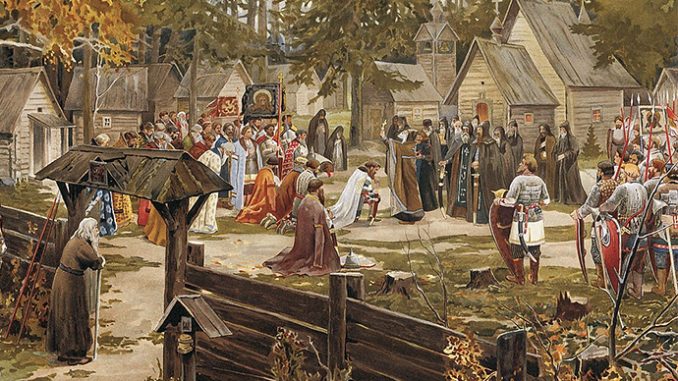
The saints of Russia pray for Russians, too, but Westerners’ knowledge of Russian history tends to be sketchy. A review of the lives of some holy Russians can help us to understand the history of Christianity in Russia itself.
According to some traditions, the Apostle Saint Andrew spread the Gospel in the modern countries of Greece and Turkey before he traveled to Ukraine. Whether Saint Andrew erected a cross in the city of Kiev, as is traditionally believed, is debatable, but missionaries certainly began to evangelize the pagan Slavic peoples by the ninth century. Most famously, Cyril and Methodius (recognized as saints by the Catholic Church) were sent by Patriarch Photius I of Constantinople (recognized as a saint by the Eastern Orthodox Church). They and other missionaries gradually converted people to Christianity throughout Great Moravia, a region also including portions of modern Austria, Croatia, Czech Republic, Hungary, Poland, Romania, Serbia, Slovakia, Slovenia, and Ukraine.
Saints Cyril and Methodius died in the late ninth century, and Saint Olga (879-969), princess of Kiev, became a Christian about a century later. Unfortunately, her conversion—and the pressure she exerted on her citizens to do likewise—did not lead to widespread conversions.
But King Vladimir the Great of Kiev (c. 958-1015), also a saint, chose baptism in 988, for reasons that were both spiritual and political. He decided to allow missionaries from Byzantine Constantinople to enter his kingdom and married a Byzantine princess. He also built churches and destroyed pagan monuments.
Following the Great East-West Schism of 1054, the peoples of Western Europe generally followed Rome, while the people of Russia, among others, retained their ties to Constantinople. The importance of the Church in Russia increased when Constantinople (and the Byzantine Empire) fell apart in 1453. The Russian Orthodox Church thus (according to some) began to see itself as the “Third Rome,” that is, the imperial successor to both the Roman empire and the Byzantine empire. The resulting tension over the status of the Russian Orthodox Church with respect to the status of the Catholic Church has created problems for centuries.
At present, both the Russian Orthodox Church and the Catholic Church have their own canonization processes and lists of saints. When the day finally comes for reunion between these “two lungs” of the Church3—and may that day come soon, by God’s grace—then we can worry about reconciling our liturgical calendars (and many other things).
In the meantime, the Catholic Church took a step toward acknowledging the holiness of medieval Russian Christians when it added two Russian saints to its liturgical calendar in 1940: Abbot Saint Sergius of Radonezh (1314-1392) and Bishop Saint Stephen of Perm (d. 1396). Blessed Leonid Feodorov (1879-1935), the exarch of Eastern Catholics in Russia, was also added to the Catholic calendar in 2001.
While followers of Jesus Christ may be divided in this world, they are not divided in the next. Any monks and abbots, nuns and abbesses, bishops and patriarchs, children and adults, martyrs and missionaries from Russia who enjoy the beatific vision are surely praying for the Russian people from Heaven. Since it is estimated that Communism caused the deaths of twenty million Russians4 during the seven decades of Communist rule, it is reasonable to assume that some—perhaps many—of that incomprehensibly large number died as martyrs because of their faith in Jesus Christ.
After all, although the Orthodox Churches are separated from the Catholic Church, the Catechism of the Catholic Church reminds us that our communion with those churches “is so profound ‘that it lacks little to attain the fullness that would permit a common celebration of the Lord’s Eucharist.’”5
The exact number of Russian Orthodox saints and martyrs under Communism is a matter for that Church to settle. But we Catholics have some idea of the number of Russian Catholic martyrs. In 2002, the Conference of Catholic Bishops for the Russian Federation collected the biographies of 1,800 heroic and holy Catholic clergy and laity. These men, women, and children suffered under Communist repression in the USSR during the period of 1918 to 1953. The bishops declared sixteen of those inspirational Russian Catholics to be Servants of God.
One of those sixteen, Anna Ivanovna Abrikosova (1882-1936), was born into a noble family in Moscow. Well-educated and highly intelligent, she married a cousin, Vladimir Vladimirovich Abrikosov. After a period of searching, both decided to leave the Russian Orthodox Church and enter the Catholic Church. Vladimir became a priest, while Anna became a Dominican tertiary and took the name of Mother Catherine of Siena. Vladimir and Anna, who loved each other deeply, then chose to live as brother and sister. As the Communists increased their persecution of Christians in Russia, Fr. Vladimir was expelled, while Mother Catherine refused to leave her spiritual daughters and was imprisoned. Her loving, Christlike witness continued to inspire her sisters, as well as other prisoners (including prostitutes and thieves), and she probably died in solitary confinement after undergoing surgery for breast cancer in 1936. Details about her life can be found here, and biographies of all sixteen Russian Servants of God can be found here and here.
While we can be grateful that the brutality of Communist rule has ended in Russia, the situation of the Russian people today is hardly idyllic. That’s why we Western Christians should join the Russian saints in Heaven as they pray for the Russian people—and for more than just an end to the war in Ukraine. After all, for seventy-two years, Catholics all over the world prayed the rosary not for the conquest of Russia but for the conversion of Russia to the Immaculate Heart of Mary.
Our Blessed Mother, the Lady of Fatima, the Mother of God—she is loved by many titles—would remind us that we all need to pray and do penance for our personal sins, as well as the sins of our nation, and she would surely want us to keep praying for the Russian people. In the end, there is only one true empire worth joining: the Kingdom of God.
Endnotes:
1 Catechism of the Catholic Church, no. 1721.
2 CCC, no. 1029.
4 Stéphane Courtois et al, The Black Book of Communism: Crimes, Terror, Repression (Cambridge, Massachusetts: Harvard University Press, 1999), 4.
5 CCC, no. 838, quoting a discourse by Pope Paul VI, December 14, 1975. See CCC, nos. 832-848 for more detail on this thorny issue.
If you value the news and views Catholic World Report provides, please consider donating to support our efforts. Your contribution will help us continue to make CWR available to all readers worldwide for free, without a subscription. Thank you for your generosity!
Click here for more information on donating to CWR. Click here to sign up for our newsletter.

Ms. Beutner’s columns are always informative and generally excellent and this one is no exception.
Since she mentions the continued need to pray for the conversion of Russia to the Immaculate Heart of Mary, can we agree that Franics’ attempted consecration in 2022 failed? I remember being at the early morning Mass before work on March 25 of that year. Much to the consternation of the celebrating priest, I could not bring myself to read the prayer composed for the occasion with its “common home” verbiage. The ongoing carnage in the Ukraine, more than three and a half years later, strongly suggests it was ineffective.
Thank you for this informative, kind, and timely article. An Orthodox friend of mine made some comments to me about the subject, which I pass on along with some of mine.
—Constantinople did not just “fall”. It was conquered and (literally) raped by the Turkish followers of the religion of peace led by Sultan Muhammad II. Today Turkey celebrates this date as a glorious event every year. For a short and enlightening historical account see historian R. Ibrahim’s article:
https://www.raymondibrahim.com/2023/05/29/today-in-history-muslim-turks-sack-christian-constantinople/
—Russia does not need to be converted. It is today the most Christian country, with a larger percentage of the population practicing Christianity than any other country more than the US or Europe. The Fatima words on the conversion of Russia referred to the fall of Communism and the return to the Christian faith. It did not have to do with the conversion of Russia to Roman Catholicism despite what the CC argues.
—This return to the Christian faith is nothing short of miraculous give the Communist persecution of it for about seven decades.
—In contrast, whereas the CC in the US, for example, (not to mention Europe!) keeps losing adherents according to the Pew research (a huge loss only lessened by the addition of illegal immigrants—which some unfriendly critics see as one of the reasons for the CC to protect illegal immigrants in addition to the money that Catholic charities get to do this), the Russian Orthodox Church keeps growing. Its churches are full. As of 2015, Pew calculated that 25 million had left the CC in the US.
Broadly correct. I will add that the prosecution of believers was unprecedented. They were tortured, murdered or sent to the labour camps (where most died). A quote:
“The Bolshevik Revolution of 1917 brought to power men who hated God and Christianity in all its forms. Lenin, who would end up being embalmed and put on display like a dead pope after his premature passing, once called the idea of God an “unutterable vileness.” The Russian Orthodox Church, as the chief repository of tradition and culture in Holy Mother Russia, had to be extinguished in order for the godless Soviet Union to rise from the ashes. The revolutionaries got to work as soon as they could—over 12,000 clergy were murdered outright–shot, beaten to death, hanged or drowned—and a secret 1930 police report put the number of Orthodox clergy who had died in prison camps at 42,800.”
It is important for me, personally, that my Church at that time did not mind risking to be prosecuted:
“Patriarch Tikhon pushed back, declaring the Bolsheviks anathema: “Recover your senses, madmen. Bring an end to your bloody strife. You are not merely committing the deeds of Satan, which are condemning you to Gehenna in the next world, and leave a dreadful curse upon your descendants in the present one.”
Who can now say those words?
As for now, it is not rosy at all. Yes, people go to the churches but I do not think more than US Catholics. The situation within the country is objectively dreadful. We are losing thousands of our men, including young, in a pointless war. It is a demographic catastrophe. I see it as deliberate extermination of two Slavic people.
Thank you, Anna, for the details of the horrific persecutions suffered by the Russian Orthodox Church under the Communists. See the link that Otis provides to the prophecy of Fr. Pio regarding Russia.
–Thank you for sharing this Otis, of which I was unaware. Padre Pio prophesied that Russia would be actually an example to the world. I quote about the Padre Pio prophecy:
“I shared these reflections on Padre Pio’s prophecy. The idea that Russia might one day serve as a faith leader—teaching others, including the United States, through her swift and profound conversion—was met with skepticism, even resistance. Yet, as history has shown, revolutions of thought and spirit often come from where we least expect them.”
–Padre Pio’s prophecy confirms the miraculous nature of the conversion of Russia to Christianity after the many decades of atheist and criminal Marxism-Leninism, or “real socialism” as it also used to call itself. It connects too with one of the Fatima prophecies, namely the (re-)conversion of Russia. It did happen! BTW, the devotion to the Virgin Mary, the Mother of God, the Theotokos in Russia is today as at least as strong if not stronger as the devotion to the Virgin Mary, the Mother of God, is in the Catholic world.
–The Russia-Ukraine war is a tragedy at so many levels. But the war has antecedents that the Western media and politicians omit.
–After the fall of the USSR (Union of Soviet Socialist Republics) Gorbachev and the Western leaders reached an agreement that the former East European Communist states that were allied to the USSR would be neutral. But the West violated the agreement and one after another these former allies of the USSR became part of NATO–the military alliance the West had organized to combat the USSR!
–Though there was no more USSR, and the new regime in Russia was not communist, and did not have therefore an ideology bent on subverting the world and turning it socialist, NATO remained! It was now pointed against Russia, no longer vs the USSR! The new Russia felt betrayed. Putin was part of the intelligence apparatus or Russia, as he had been of the intelligence apparatus of the USSR. He was very aware of what the West had done. And he did not forget it.
–But Urkaine did not join the now anti-Russia NATO. It had a democratically elected government that was at least neutral. Then in 2014 a coup d’etat, probably engineered by our all wise CIA, toppled the regime and installed an anti-Russian one. In response, Russia drew a line on the sand: no NATO right next to it.
–A parallel would be if say, China, got Mexico or Canada to join its military alliance. The US would not tolerate that. Remember what happened when Cuba got USSR military bases with missiles. The US threatened war, sent ships toward Cuba, and the USSR withdrew its missiles.
–Then the new Ukrainian government began an anti-Russia campaign. Eastern Ukraine had a majority Russian population. But that population was now even forbidden to teach Russian in the schools. All sorts of other forms of oppression were instituted. Russian Orthodox Churches were closed. Priests were arrested. Etc.
–That is when Putin decided to go to war. He was not going to tolerate either NATO next to that part of Russia, or what was happening to the Russian minorities in Ukraine. The pro-NATO president of Ukraine has even cancelled elections (not even Licoln cancelled elections during the US War of Secession, or “Civil War,” though he did cancel habeas corpus). Ukraine is one of the most if not the most corrupt country in the world. Zelensk’s approval ratings, after the most recent corruption scandal, is now about 20%. I have read theories that one main reason for the West hatred of present-day Russia, a hatred that did not exist even against Communist Russia, is partly based on the fact that Russia is now a thorough going Christian country, with no tolerance for the sort of things that are now taking over the West…
I (Russian) am skeptical about this prophecy and about “prophecies” of this kind in general, i.e. those which speak of a messianic rise of a nation full of virtue etc. Listening to them has no spiritual benefit; also, we are now in the realm of apocalyptic forces which employ people regardless their nationality (I mentioned it in another comment, natural and unnatural evil). I think we will do far better if we stick to what Our Lord said about the time before His second coming.
Well, I’m convinced! The Blessed Virgin Mary said Russia needs to be converted, but your anonymous friend says otherwise, and of course he would know better!
Seriously, there is no country on earth that does not need conversion — and I do not make an exception for Vatican City. I also have an anonymous Orthodox friend, but this friend was working in Russia when he witnessed a murder from the local mafia. He testified to what he saw, which is why he had to be evacuated with some urgency and can never return. That, however, is not what disappointed him most about what he saw in Russia. It was the son shamelessly punching his own mother in the kidneys. It was the frequency with which Russian priests found it necessary to preach about how husbands should not beat their wives. It is a good thing when men in positions of power have to make a show of being Christian, but, really, Putin kissing icons is no more convincing than Clinton making a show of carrying his Bible to church. It is not enough to attend Mass or the Divine Liturgy; there must always be a conversion to greater holiness, and Russia certainly needs that as much as any country.
Praiseworthy historical accounts. Thanks.
Nobody prays for Russia.
They’re bad people who interfere in others’ elections and are run by an autocrat who came to power through foreign interference in a color revolution after a career showing a talent for playing a piano without fingers or toes and starring in homoerotic leather videos.
Now he parades around in an olive drab t-shirt to feign military engagement and is willing to conscript the old, people with disabilities, dispatch opponents to the front line, ban churches and remain in power by cancelling elections and is currently in yet another self-dealing scandal.
“We’re killing the right people”
-Chickenhawk Lindsey Graham (ze/zir)
Support democracy! Be a Russophobe!
/sarcasm tag off
Thanks, Dawn. Keep them coming! 😇
Yes, please.
“After all, for seventy-two years, Catholics all over the world prayed the rosary not for the conquest of Russia but for the conversion of Russia to the Immaculate Heart of Mary.”
Consecration is (relatively) easy. Conversion is much harder, and much more important. We should still be praying for conversion … but, really, for the conversion of the whole world.
“but, really, for the conversion of the whole world.”
Yes, you are right here. While I highly regard the prophecy of Fatima, I really do not understand this “conversion of Russia” being said now. In the past it made some sense, re: 1917. However, Russia is a Christian country. We do not need to be converted; we converted earlier than many other countries. But, if we speak of “a conversion of the whole world” then yes because Putin’s Russia is a reverse side of the West. Both are killing people and destroying morals but in different ways. Putin’s ways are a bit “better” because they are more natural, more primitive. He does not murder for “your own good” as the proponents of euthanasia say. He murders more brutally and obviously and personally I prefer this. However, it is one thing in essence, the process of emptying the world of meaning.
See the reference to Padre Pio below. Russia has, it appears, a special and important vocation. Vocations need not be “fair”, and they do not derive from pre-existing worthiness, as was made very clear by the call of Abraham, Isaac, Jacob, Moses, and David, among others; the Apostles are also good examples. It appears that Russia is called to do some great good, which is much more than abstaining from great evil. To do this will require conversion.
See also https://www.patheos.com/blogs/mysticpost/2016/01/23/padre-pio-russia-will-teach-the-united-states-a-lesson-in-conversion/.