



Rome, Italy, Nov 9, 2025 / 06:40 am
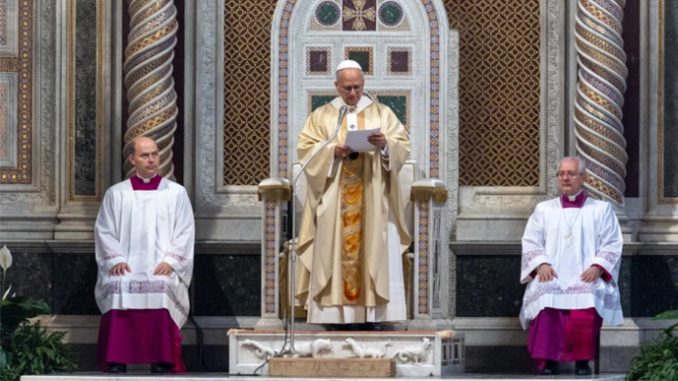
At the Basilica of St. John Lateran on Sunday, Pope Leo XIV urged Christians to build the Church on “solid foundations” rooted in Christ rather than on “worldly criteria” that demand immediate results and overlook the value of patience and humility.
Celebrating Mass for the solemnity of the Dedication of the Lateran Basilica — the cathedral of the bishop of Rome and the oldest church in the city — the pope reflected in his homily on the meaning of this feast and on the Church as a living temple built of “living stones.”
“The millennial history of the Church teaches us that with God’s help, a true community of faith can only be built with humility and patience,” he said. “Such a community is capable of spreading charity, promoting mission, proclaiming, celebrating and serving the Apostolic Magisterium of which this temple is the first seat.”
The pope drew on the image of the basilica’s physical foundations to speak about the spiritual foundations of the Church. “If the builders had not dug deep enough to find a solid base on which to construct the rest, the entire building would have collapsed long ago,” he said. “As laborers in the living Church, we too must first dig deep within ourselves and around ourselves before we can build impressive structures. We must remove any unstable material that would prevent us from reaching the solid rock of Christ.”
Citing Saint Paul’s words that “no one can lay any foundation other than the one that has been laid; that foundation is Jesus Christ,” the pope encouraged Christians to “constantly return to Jesus and his Gospel and be docile to the action of the Holy Spirit,” warning against “overloading a building with heavy structures whose foundations are too weak to support.”
Pope Leo XIV also cautioned against haste and superficiality in serving God’s kingdom. “Let us dig deep, unhindered by worldly criteria, which too often demand immediate results and disregard the wisdom of waiting,” he said.
Reflecting on the Gospel story of Zacchaeus, the pope said that when Jesus calls believers to take part in God’s great project, “he transforms us by skillfully shaping us according to his plans for salvation.” The image of a “construction site,” he added, captures “the concrete, tangible efforts of our communities as they grow every day, sharing their charisms under the guidance of their pastors.”
Acknowledging that the Church’s current journey — particularly in the context of the Synod — requires perseverance, he urged the faithful not to be discouraged. “Let us not allow fatigue to prevent us from recognizing and celebrating this good, so that we may nourish and renew our enthusiasm,” he said. “After all, it is through charity in action that the face of our Church is shaped, making it ever clearer to all that she is a ‘mother,’ the ‘mother of all Churches,’ or even a ‘mom,’ as Saint John Paul II said when speaking to children on this very feast day.”
Turning to the liturgy, the pope said it is “the summit toward which the activity of the Church is directed… the source from which all its power flows.” He called for particular care for the liturgy at the See of Peter, so that it “can serve as an example for the whole people of God.”
“It must comply with the established norms, be attentive to the different sensibilities of those participating and keep with the principle of wise inculturation,” he said. At the same time, it should remain “faithful to the solemn sobriety typical of the Roman tradition,” ensuring that “the simple beauty of the rites expresses the value of worship for the harmonious growth of the whole Body of the Lord.”
“I hope that those who approach the altar of Rome’s Cathedral go away filled with the grace that the Lord wishes to flood the world,” Pope Leo XIV concluded.
This story was first published by ACI Prensa, CNA’s Spanish-language news partner. It has been translated and adapted by CNA.
If you value the news and views Catholic World Report provides, please consider donating to support our efforts. Your contribution will help us continue to make CWR available to all readers worldwide for free, without a subscription. Thank you for your generosity!
Click here for more information on donating to CWR. Click here to sign up for our newsletter.

Bíblia Católica Online
Luke 13:26 states:
“Then you will begin saying, ‘We ate and drank in Your presence, and You taught in our streets.’”
This verse reflects the theme of repentance & the urgency of faith, emphasizing that mere familiarity with Jesus does not guarantee salvation.
It serves as a warning that many may claim to have been part of Jesus’ ministry but will ultimately perish unless they repent.”
A cognate insight from the lowliest lay Catholic to the multitude of our splendid clergy:
“A lack of common resolve to obey & courageously teach obedience to the 10 Commandments as completed by our LORD Jesus Christ
Blocks many clergy from individual and collective infilling by The Holy Spirit of GOD
Funding a general clerical deficiency in real Holy Spirit-graced Holy Trinitarian vitality
That fosters confusion and disillusionment in a high percentage of lay Catholics”
As Jesus teaches us;
as our Most Blessed Mother Mary teaches us;
as Saint Joseph teaches us:
“BEFORE ALL ELSE – OBEY GOD’S COMMANDMENTS!”
Catholicism is a culture, the same yesterday today and tomorrow.
“Inculturation” is not a Catholic principle – it is an alien ideological notion that blends the old with the new.
Catholicism – on the contrary – is a religion of conversion From the old To the new. Traditional Catholicism is the same the World Over. One Tongue. One Mass. One Lord.
To the contrary, inculturation is a relatively new word, coined in the early 1970s, to fescribe something the Church has always done in various different ways throughout her history. You should read all the many uses of the word and descriptions of its mea ing and content found in the magisterium of St. John Paul II. Its application requires prudence and wisdom but it is not something to be afraid of. While it is true, as it is of any good thing, that a reckless or careless or imprudent or immature application can cause damage and misunderstanding, so too can the failure to consider and apply it, as can its neglect.
With genuine humility and patience as priceless building blocks, the Apostles and early disciples of Jesus went about spreading the Good News of spiritual wellness.
They weren’t promoting man-made climate doom, then? They were concerned rather with the salvation of souls than building New World Order?
A most welcome Paradigm UNshift…the process of synodality not replacing the structure of the Church.
Ratzinger said it this way:
“…without a view of the mystery of the Church that is also ‘supernatural’ and not only ‘sociological.’ christology itself loses its reference to the divine in favor of a purely human structure, and ultimately it amounts to a purely human project: the Gospel becomes the ‘Jesus-project,’ the social-liberation project or other merely historical, immanent projects that can still seem religious in appearance, but which are atheistic in substance” (The Ratzinger Report, 1985, p. 46).
This is not to imply that some versions of synodality are totally flawed, only that bishops serving “primarily as facilitators” is a crippled way of “walking together.” too much of an eclipse of the Son. More from Ratzinger:
“But the Church of Christ is not a party, not an association, not a club. Her deep and permanent structure [!] is not ‘democratic’ but ‘sacramental,’ consequently ‘hierarchical’ [as in the ‘hierarchical communion’ clarified in Lumen Gentium].”
Of the bishops as successors of the apostles, G.K. Chesterton said it this way:
“Those runners gather impetus as they run. Ages afterwards they still speak as if something had just happened. They have not lost the speed and momentum of messengers; they have hardly lost, as it were, the wild eyes of witnesses [….] We might sometimes fancy that the Church grows younger as the world grows old” (The Everlasting Man).
Some vintage Pope Benedict XVI is illuminating –
Pope Benedict XVI emphasized The Holy Spirit’s vital role in the life of the Church & individual believers, highlighting The Holy Spirit’s Presence in prayer, mission, & our Christian identity.
Presence in Prayer: In his catechesis, Saint Pope Benedict XVI reflected on how The Holy Spirit assists believers in their prayer life. He noted that true prayer is a gift from The Holy Spirit, who intercedes for us and helps us express our deepest needs to God. He quoted Saint Paul, stating: “The Holy Spirit helps us in our weakness” (Romans 8:26), emphasizing that prayer is not merely our action but a response to The Holy Spirit’s presence within us.
Role in Christian Identity: Saint Pope Benedict taught that The Holy Spirit dwells within Christians, shaping our identity & enabling us to live as children of God. He referenced Galatians 4:6, where it states that God has sent The Holy Spirit of His Son into our hearts, allowing us to call God “Father.” This relationship underscores the transformative power of The Holy Spirit in the life of every true believer.
Mission of the Church: Saint Pope Benedict XVI highlighted that The Holy Spirit is essential for The Church’s mission. He stated that the effectiveness of missionary work relies not only on human efforts but on the action of The Holy Spirit. He encouraged Christians to be humble and to rely on God’s grace, which is made manifest through The Holy Spirit’s actions in our lives.
Joy and Love: The Pope also spoke about the joy that The Holy Spirit brings to believers. He described joy as a gift that encompasses all other gifts and is essential for authentic communication & community within the Church. The Holy Spirit fosters love among believers, enabling us to share the joy of The Gospel with others.
Spiritual Warfare: In his teachings, Pope Benedict XVI acknowledged the ongoing battle between The Holy Spirit & the spirit of the age (Zeitgeist). He emphasized the importance of adhering to traditional Church teachings and The Truth of the Gospel, which The Holy Spirit helps us preserve. This battle is not just external but occurs within each individual Catholic, as they obey The Holy Spirit or chose to obey the influences of the world.
Through these teachings, Saint Pope Benedict XVI sought to deepen the understanding of The Holy Spirit’s role in the life of The Church and the personal lives of Catholics, encouraging a reliance on The Holy Spirit for guidance, strength, and transformation.
This saintly papal exhortation on the life & work of The Holy Spirit in us reminds us of Jesus’ teaching reported in John 14: vv 23-26:
“If anyone loves Me they will keep My Word, & My Father will love them,
and We shall come to them & make Our Home with them.”
“Those who do not love Me do not keep My Words.
And My Word is not My Own; it is The Word of The One who sent Me.”
“I have said these things to you while still with you;
but The Advocate, The Holy Spirit, Whom The Father will send in My Name,
will teach you everything & remind you of all I have said to you.”
How then will we followers of our LORD Jesus Christ assess the presence of the Divine, powerful, life-changing Holy Spirit of GOD in our lives . . ?
Saint Paul tells us that The Holy Spirit brings love, joy, peace, patience, kindness, goodness, trustfulness, gentleness, & self-control. This contrasts with unspirtual human nature, with its self-indulgent passions & desires that prevent a person from belonging to Jesus Christ. We are to crucify our self-indulgence, so that The Holy Spirit, The Spirit of Truth, becomes our life and the director of our discipleship under Christ. (Galatians 5:16-26)
Without The Holy Spirit alive inside us and flourishing among us, even our most strenuous efforts to build on the solid foundation of Christ will fail.
We can not change the perennial teaching of the Church which itself is mandated by Christ.
The fruits of the Spirit are love, tranquil, benignity, goodness, modesty, continency, chastity. Faithfulness. Long-suffering.
Of the human virtues, the four cardinal virtues are well known by which the subordinate virtues are brought to a right and true tenor and activity, respect for others, understanding, simplicity, sociability, friendship, patriotism, honesty.
It is out of keeping with both Church teaching and human virtue to advocate for fraternity as a necessity of survival.
It is possible to have relationships of trust without having to be fraternal at the same time. It is possible to have concord without fraternal adhering and without hatred.
Formal bonds, or, formal commitments, have their just places. Not to be downplayed.
Where is the “necessary emphasis” and “encapsulation” on fraternity coming from that also has to be broadcast and channeled through the Pope; it should be examined better.
You have to condition what you are saying, I think. Fraternity means different things to different folk and situations but you have to preach the Christian message in its completeness.
https://www.ncregister.com/cna/pope-leo-xiv-fraternity-is-one-of-the-great-challenges-for-contemporary-humanity
“We can not change the perennial teaching of the Church which itself is mandated by Christ.”
It’s amazing how many, including many in the hierarchy seem to watch to become disciples of the world, rather than make disciples of the world.
The point in the perennial teaching of the Church, had been raised by Cardinal Burke early on in the Francis Pontificate; by which to hold discipline against upheaval.
Thanks to EG, TPR, & MCN:
In regard to obeying the ‘perrenial teaching of The Church’, we would be sinfully disobeying our GOD if we don’t always contectualize that common proposition with Matthew 23:10 –
“Nor must you allow yorselves to be called teachers, for you have only One Teacher, The Christ.”
The role of The Holy Spirit is made plain by John 16:13-15 –
“The Holy Spirit of truth will lead you to complete truth, since He will not be speaking as from Himself but will say only what He has learnt; & He will tell you of the things to come.
He will glorify Me (Jesus), since all He tells you will be taken from what is Mine. Everything The Father has is Mine; that is why I said: ‘All He tells you will be taken from what is Mine.'”
Just like The Holy Spirit: The Body of Christ (The Church & her officers) have no teaching authority that is independent from the teachings of her eternal Head, King Jesus Christ; for these teachings are those of The Eternal All-Powerful Father, GOD above all, Who is ever to be universally worshipped & adored.
In truth: this is an easy yoke and a lite burden.
In religiosity, how come we take on so many irksome yokes and keep on burdening ourselves with unbearably heavy baggage?
To hear & to receive power to comprehend & to obey the eternal teaching of our One & Only Divine King, we must (as individual Catholics & as The Church) be intimate with and in submission to The
Holy Spirit of GOD. Truly, a pure joy.
As Saint Paul exhorts the Thessalonians: “Never try to suppress The Holy Spirit or treat the gift of prophesy with contempt: think before you do anything – hold on to what is good & avoid every form of evil.”
Ever seeking to lovingly hear & obey King Jesus Christ; blessings from marty