



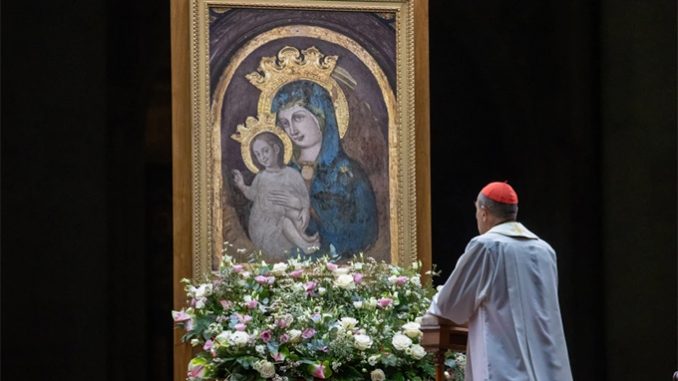
Vatican City, Nov 4, 2025 / 05:25 am (CNA).
The Vatican’s doctrinal office said Tuesday the titles of “Co-Redemptrix” and “Mediatrix” are not appropriate ways to describe Mary’s participation in salvation.
In “Mater Populi Fidelis” (“The Mother of the Faithful People of God”), the Dicastery for the Doctrine of the Faith (DDF) said when an expression requires frequent explanation to maintain the correct meaning, it becomes unhelpful.
“In this case, the expression ‘Co-redemptrix’ does not help extol Mary as the first and foremost collaborator in the work of Redemption and grace, for it carries the risk of eclipsing the exclusive role of Jesus Christ,” according to the doctrinal note, released Nov. 4.
Pope Leo XIV approved the document — signed by DDF prefect Cardinal Víctor Manuel Fernández — on Oct. 7.
Mary’s contribution to human salvation, specifically the title of “Co-Redemptrix” (“Co-Redeemer”) has been a point of theological debate for decades — with proponents calling for Mary’s role in redemption to be declared a dogma but critics saying it exaggerates her importance and could damage efforts for unity with other Christian denominations.
In a preface to the note, Fernández wrote that the document responds to questions the dicastery received in recent decades about Marian devotion and certain Marian titles, and clarifies which are acceptable.
“There are some Marian reflection groups, publications, new devotions, and even requests for Marian dogmas that do not share the same characteristics as popular devotion,” the cardinal wrote, adding that some Marian devotions, expressed “intensely through social media,” can sow confusion among Catholics.
“This text also aims to deepen the proper foundations of Marian devotion by specifying Mary’s place in her relationship with believers in light of the Mystery of Christ as the sole Mediator and Redeemer. This entails a profound fidelity to Catholic identity while also requiring a particular ecumenical effort,” Fernández wrote.
In addition to “Co-Redemptrix,” the document also addressed at length the Marian title “Mediatrix” or “Mediatrix of All Graces,” analyzing related Church teaching on Mary’s role as intercessor.
The DDF concluded that, “some titles, such as ‘Mediatrix of All Graces,’ have limits that do not favor a correct understanding of Mary’s unique place.”
The dicastery encouraged the use of other expressions for Mary, specifically titles referring to her motherhood, including “Mother of God” and “Mother of the Faithful People of God.”
“She is the Mother who gave the world the Author of Redemption and of Grace, who stood firm at the foot of the cross (cf. John 19:25), suffering alongside her Son and offering the pain of her maternal heart pierced by the sword (cf. Luke 2:35),” the document said. “From the Incarnation to the cross and the Resurrection, she was united to Christ in a way that is unique and that far surpasses any other believer.”
Emphasizing that Mary was saved by her Son, Jesus Christ, “in a particular and anticipatory way,” the document explained that “Mary’s incomparable greatness lies in what she has received and in her trusting readiness to allow herself to be overtaken by the Spirit.”
It warned that, “when we strive to attribute active roles to her that are parallel to those of Christ, we move away from the incomparable beauty that is uniquely hers.”
If you value the news and views Catholic World Report provides, please consider donating to support our efforts. Your contribution will help us continue to make CWR available to all readers worldwide for free, without a subscription. Thank you for your generosity!
Click here for more information on donating to CWR. Click here to sign up for our newsletter.


And we’re shocked that a pornographic publishing prelate would instruct us about the Virgin Mothers role….. Is Leo becoming Francis lite? Pray God no!
This appears to be another attempt at satisfying the desire for Catholics to become Protestant… Very sad
In his letter to Pusey on the Blessed Virgin Mary, Newman wrote:
“She has a place in the economy of grace; she co-operated in our redemption by her faith and obedience; she continues to intercede for the faithful, and thus is our advocate and mediatrix.”
“Mediatrix” and “co-redemption” was rubbished by Tucho this same week Newman was made a Doctor of the Church by ppLeoXIV.
Is this Newman letter – from the Pope’s new Doctor of the Church – now forbidden teaching by the DDF just days later?
Which are we to believe is speaking truth?
“She has acquired by grace what Jesus has by nature; that is to say, she is the Mediatrix of all graces, because she is the Mother of God; if the Son is the one Mediator by nature, the Mother is the Mediatrix by grace. She it was who gave Him His human nature, and with it the instrument of our redemption. She co-operated in our redemption by her faith and obedience. She continues to intercede for the faithful; she is our Advocate and Mediatrix; through her we receive the graces which flow from the Passion of her Son.”
Cardinal John Henry Newman letter to Pusey
“Through these, he has bestowed on us the precious and very great promises, so that through them you may come to share in the divine nature, after escaping from the corruption that is in the world because of evil desire.” 2 Peter 1 (RSV-CE)
This “sharing in the divine nature” is called theosis. (https://www.catholic.com/magazine/online-edition/a-word-that-every-catholic-needs-to-know) Is it something that might be misunderstood? Of course! The cure for that, though, is careful, clear teaching.
Good point, and certainly St Maximillian Kolbe’s devotion to her as mediatrix deserves to be addressed in making these points as well.
I might be concerned about that if I believed that Cardinal Fernandez was the main author, or that this “Doctrinal Note” reflected his original thoughts and interpretation of the Virgin Mary’s role. But now that I am in the process of reading this heavily footnoted, slow-movimg document, I doubt he wrote more than the “Presentation” at the beginning. So no worries there.
Actually, what I have read so far does not have much shock value, although I know that people who are strongly in favor of the designations “co-redemptrix” and “mediatrix of grace” will disagree–probably strenously– with the conclusions. After reading two lengthy footnotes with statements and explanations by then Cardinal Ratzinger, I will (like MarkM) defer to his position of not supporting use of these two titles associated with Mary.
This will take a while for me to get through … I look forward to expert analysis and commentary.
“I doubt he wrote more than the “Presentation” at the beginning. So no worries there.”
Just one worry! The doublespeak: “This entails a profound fidelity to Catholic identity while also requiring a particular ecumenical effort.”
The “ecumenical effort” is denying Catholic Truth?!
That sentence comes from the Presentation, which is directly credited to Fernandez. So yes, he definitely wrote that part. Now that I have read about 3/4 of the document, my impression is that it was put together by a committee, and I strongly doubt that Fernandez did that research or found the nearly two hundred citations on his own. That’s what I was thinking about in my post. I also feel that the “spiral” approach to presenting the material that he refers to in the Presentation worked out too well.
However, if you find that statement alarming, and you feel that need to raise an alarm about it, then … okay. Here’s the paragraph in which the sentence appears:
“While clarifying in what sense certain titles and expressions referring to Mary are acceptable or not, this text also aims to deepen the proper foundations of Marian devotion by specifying Mary’s place in her relationship with believers in light of the Mystery of Christ as the sole Mediator and Redeemer. This entails a profound fidelity to Catholic identity while also requiring a particular ecumenical effort.”.
In context, the sentence doesn’t come across as doublespeak to me, although taken out of context, it might.
What do you think it means? Can you explain so that I can better understand where you are coming from?
Oops, I meant to say that the “spiral approach” to presenting the material DIDN’T work out too well.
Father j: well the Catholic Faithful will continue to refer to Mary as Co-Redemptrix and Mediator regardless of what the Vatican says. Let’s see what they do then.
Diogenes: So you limit the “faithful “ solely to your camp?
There are no “camps” in the Church. But there is a difference between Catholics who value their faith and Catholics who treat it as a mere vestigial family association and subject to secular judgements of it being even worth their time.
Certainly he has not the authority to make such a proclamation.
Today’s Vatican appears to constantly avoid considering the evil effects of any act of redefining the faith and how the whole world will perceive their actions. But this is what secular progressives do.
Anti-Catholic bigots everywhere have an image of a “backward” Church incrementally overcoming their antiquated notions and gradually adopting to modern times because they’re too stupid to do so immediately.
This is more red meat for the haters.
This is well above my pay grade and training.
So, I will defer to Cnd Ratzinger’s position.
Why defer to Cardinal Ratzinger’s position as opposed to St. John Paul II’s position? Was Pope John Paul wrong on that issue? If he was wrong on that, what else was he wrong about? Or is the present group of Vatican officials wrong?
And John Paul was not the only pope to use the term. Pope St. Pius X used it and granted an indulgence to a prayer which included the term “Co-redemptrix.” It was in the Raccolta, which is approved by Vatican officials. Why are those popes wrong but the present one right?
From Vatican News: Saint John Paul II referred to Mary as ‘Co-redemptrix’ on at least seven occasions, particularly relating this title to the salvific value of our sufferings when they are offered together with the sufferings of Christ, to whom Mary is united especially at the Cross.”
Very inaccurate headline – the document actually approves the title of Mediatrix as long as it is understood in a certain way.
Indeed!
Four supporting points:
FIRST, we might also remember that untouched are the paired Sacred Heart of Jesus and the Immaculate Heart of Mary, on the Miraculous Medal given to the Church through Catherine Laboure.
SECOND, and, the direct incorporation of Mary into the Church by the Second Vatican Council, in Lumen Gentium, Sections II, III, and IV. The term “Mediatrix” is included with “Advocate, Auxiliatrix, Adjutrix,” but with the qualifier: The Council applies to the Blessed Virgin the title of Mediatrix, and carefully explainss this so as to remove any impression that it could detract from the uniqueness and sufficiency of Christ’s position as Mediator (cf. 1 Tim 2:5), already referred to in Chap. 1 (Art. 8) [of Lumen Gentium].
THIRD, others, above, have already referred to Cardinal Newman–now a Doctor of the Church. His meditations on Mary are extensive, dating to even prior to his conversion from Protestantism: See “Mary: The Virgin Mary in the Life and Writings of John Henry Newman,” edited with an introduction and notes by Philip Boyce, William B. Eerdman’s, 2001, 439 delightful pages. (Newman’s “Development of Christian Doctrine” is also strongly positioned as the lens through which to evaluate any doctrinal and pastoral adventurism in a range of subjects.)
FOURTH, on the really big screen, educational dialogue (surely not banned “proselytization”) with Muslims might be a bit easier, since the Qur’an misunderstands the Triune One as more of a pagan triad consisting of the Father, the Son…and Mary. After fourteen centuries (!) the now 1.8 billion Muslims need to be disabused of this perplexed Islamic scholarship.
Islam replaces Christ with the Qur’an, and then cancels the Holy Spirit altogether—since the prophet Christ is foretelling the coming of the prophet Muhammad, rather than the Paraclete. Back in the fifth Century, St. Augustine (Leo XIV is Augustinian) already foresaw this problem as raised by divisions within the Christian family: “All who want to live piously in Christ Jesus…realize how many would-be converts are driven into perplexed hesitancy because of heretical dissention” (City of God, XVIII, ch. 51).
SUMMARY: Better to even lose the word and retain the content, than the other way around. Especially when all 21st-century Christians are called to deal with novelties inserted into a polyglot and resurgent natural religion–pre-Christian in content– dating from 7th-century Arabia.
As a girl growing up in Catholic schools in the 60’s and 70’s, I NEVER heard the term, “Co-Redemptrix” used for Mary. Left the church for some number of years and then returned to hear this term being thrown around. To be honest I found it somewhat shocking. Like all Catholic I have a great deal of respect for Mary and her role as mother of Jesus. Calling her a “Co-redemptrix” however seems a bridge too far, and is a title which is apt to cause confusion and problems, in my opinion.
I have not been a fan of Pope Leo to this point. However if he is the one trying to bring things back into line, I think that is good and I have no problem with that.
“Like all Catholic I have a great deal of respect for Mary and her role as mother of Jesus.”
Catholics honour Mary because God honoured her first. This is why Catholics call her the Mother of God, not some mere respect as her earthly role as Jesus’s mother.
Once again our beautiful and holy Catholic faith is being compromised and watered down to accommodate those outside the church.
Yes, it IS a “bridge too far” or whatever way you want to describe it. There has been a movement in the Catholic church for some time to basically worship Mary even though it’s not described as such.
I’m hoping the Vatican’s note today signifies that they are ready to address this heresy.
“There has been a movement in the Catholic church for some time to basically worship Mary even though it’s not described as such.”
Where do you see the slightest specific evidence of this Protestant slander in reality?
I am a cradle Catholic, and this is possibly the best thing to come out of the Vatican in my lifetime!
There are many Catholics walking down the path to Marian idolatry. Some have arrived at the destination already, and others are on the way. But it wasn’t always so: In the Catechism of Trent, there half a page devoted to Mary. In the most recent Catechism, there is one full page just for the INDEX of Mary references.
You don’t have to be a Protestant to see that many, many Catholics have confused honoring Mary with something else which approaches breaking the first Commandment. I’ve actually been in classrooms where Catholic (students) said they actually thought we were SUPPOSED to worship Mary. Ask yourself, why did they get that impression?
I hope this “note” from the Vatican is the first step in correcting this problem, and God bless the clerics who had the vision address this issue.
Fred,
Can you cite one prominent Catholic Influencer or cleric who advocates worship of the blessed Virgin as an idol?
I do not know one.
As many Saints have said: it is actually impossible to love Mary enough… in other words to love her as her Son did.
True Devotion always stems from imitation of Christ’s love for his Mother.
Ave Maria!
I’ve actually been in classrooms where Catholic (students) said they actually thought we were SUPPOSED to worship Mary. Ask yourself, why did they get that impression?
Because they listened to Catholics so convinced of their superiority to pious Catholics that they are quite willing to align themselves with Protestant ignorance and repeat their slanders as real, even to small children.
I appreciate yours and Joseph’s restraint when replying to me. You guys are far nicer than I will ever be.
Here’s my point, and in a way, it’s very nuanced: No Catholic comes out and says, “Hey, I believe we should worship Mary.” I’ve only heard one priest who actually did that.
A lot of Catholics, though, have slipped from honoring Mary into things properly reserved for God. You don’t have to be a Prot to see it, although you may not notice it if you are never challenged on it the way Catholics (like me) in Prot areas are on a regular basis! I’m probably the first (devout) Catholic you’ve ever heard say that, although you are free to question my piety, Ed. 🙂
We can tell ourselves, as Catholics, that we never break the first commandment and never sin because, well, we are good Catholics! But we are just as capable of falling into error as any other human.
So I believe the time has come to question all the Marion devotions and honors and venerations, etc. We should ask ourselves, “Are we really worshipping Mary as a lesser deity?” “Are we placing too much of an emphasis on her instead of giving it fully to God & Jesus?” And, even if we think we are perfect in that regard, “Are other people around us falling into sin by giving to Mary what properly belongs to God?”
It is not for nothing the authors of the Vatican “note” included the phrase “when we strive to attribute active roles to her that are parallel to those of Christ…”
They included that phrase because they see Catholics doing just that! I know, because I see the same thing!
I know some people’s feelings are hurt, but I say this to make the Church better – not more Prot.
Well when you cross that bridge it’ll be all your fault and when you are unable to return that’ll be all your fault as well. I’m not losing any step.
Try not to be swayed by the arrogant presumptions of some minor authors of VII documents.
The sin of pride is a two way street. It can affect the thought of the pious, “Thank you Lord, that I am not like other men.” But it can easily affect the thought of prelates who become elitists rather than teachers of God given truth, similar to our socio/political elitist class, where Ivy League graduates in academia and government fail to realize they are not more intelligent than the citizens they patronize.
The Catholic faith is in freefall. And it is not because the pious have become stupid and insensitive. When an article of faith seems to be difficult, it is meant by God to be a difficult challenge to our preferred vanities. Confronting Catholics, who never made efforts to honestly adopt the faith, is as necessary as confronting the false ideas of anti-Catholic hatred.
And this is why this document is, typical of today’s Vatican, short-sighted.
Flapdoodle and balderdash.
“We should ask ourselves, “Are we really worshipping Mary as a lesser deity?”
No, we’re not. If you’re falling into that error (doubtful; you sound as if you say, “Hey, Jesus, love you, but your mom is just sort of okay”) then stop.
“Are we placing too much of an emphasis on her instead of giving it fully to God & Jesus?”
No, we’re not.
“And, even if we think we are perfect in that regard, “Are other people around us falling into sin by giving to Mary what properly belongs to God?”””
Or are other people falling into sin by not honoring Mary, who is blessed among women, whose soul magnifies the Lord, whom all generations shall call blessed? Or are people not taking responsibility for learning their Faith and blaming others for their failings?
Dear Heaven, I so wish that we had someone of the caliber of Rafael Cardinal Merry del Val at the head of the Holy Office.
Typical catholic veneration of Mary falls well behind the Orthodox and Eastern Catholics, who have stuck to their traditions a bit more tightly.
If you think like a modern American Protestant, praise, songs, flowers and kneeling are all it takes to make you think of worship. It seeps into the minds of cradle Catholics too, since it’s the atmosphere. But that’s not worship, that’s just honor. I’ll be concerned about Catholics worshipping Mary when they say she’s God, or that she has virtue independent of God, or offer Mass TO her, rather than in her honor.
Some methodology: “when an expression requires frequent explanation to maintain the correct meaning, it becomes unhelpful.” Are “transubstantiation” and “consubstantial” next on the chopping block?
Brilliant observation Mr. Flynn. The Vatican’s pornographer in chief actually takes himself seriously as a theologian, and a theologian who surfs the waves of watering down the faith for backwardists.
‘ In the Tract for the Mass Salve Sancta Parens, the Church sings, “Rejoice, O Virgin Mary, thou alone hast destroyed all heresies.” From this, Pope St. Pius X invoked her as “Destroyer of Heresies” in Pascendi. And again, it was in the context of St. Dominic’s war against heresy that the Holy Rosary, Mary’s psalter, was revealed. ‘
https://onepeterfive.com/heretics-hate-mary/
What’s the Vatican going to do when the Catholic Faithful continue to refer to the Blessed Virgin Mary as Co-Redemptrix? Excommunicate everyone?
Interestingly, Mediatrix is specifically used to describe Mary in Lumen Gentium. Can the DDF override a Dogmatic Constitution from an Ecumenical Council?
And once again, Our Lady gets shafted….
some musings:
John Paul II used the phrase “co-redeemer” seven times.
If Jesus is the Redeemer and man is redeemed, Mary the Woman must be the Co-Redeemer (Co-Redemptrix). Otherwise Christ the Redeemer is but the Body-less Head – there are no Redeemed body members, only a Redeemer Head – what an unholy monstrosity! Nor is Jesus the NewAdam and Mary the NewEve. They are not ‘Woman-Mother and Son’ (Gen.) in either nature or grace!!! There is no Mystical Person of Christ – He is Bodiless Head and the Church is a Headless Body!! – they are un-united because the Co-Redeeming Immaculata Woman-Mother has not been allied with Christ on Good Friday in making God and man – the promised Redemption Woman and Her seed-Son in Gen 3:15 – the Redeemer and Redeemed, ‘into one through His Blood having so reconciled the two as one’(Eph 2:13-16; Col 1:20; (Gal 3:28); nor by doing so because He was Redeemer flesh of Mary’s flesh, Redeemer blood of Her blood, or Redeemer bone of Her Bone!
If Jesus Redeems us with Mary’s flesh, blood and bone His of Her, then in reality, even physically in the Covenant Birth of Christ Redeemer-Head and Redeemed-Body, Mary is the Co-Redeemer ‘of the two made or birthed one reconciled by the’ redeeming flesh Mary gave the Redeeming Christ, the redeeming blood Mary gave and Christ has as and in Redeeming, and the redeeming bone of Mary She gives and Christ receives as, for and in Redeeming!
It is because of Mary that Christ is the Redeemer and His Redeemed Body members received and are born into this Reality and Unity. We all participate in His mission helping to ensure that others are redeemed – we subjectively participating in and with the Lord. Mary as the NewEve of Good Friday objectively is participating as the Immaculata in bringing forth the Redeemer-Head and the Redeemed-Body as Co-Redemptrix into His Perfect Oneness or Unity – ‘they are not two, only One, Christ’.
Divorcing, separating or annulling Jesus and Mary, or Mary from Jesus is divorcing or annulling the CoRedeemer from the Redeemer. If Jesus is the NewAdam Redeemer then Mary must be the NewEve Co-Redeemer and we within, through and by Baptism the Redeemed! Keep the Two One as God Reveals, Plan, Redeems!
I posted this before, not sure why it was not approved. Anyway, here goes again:
This “note” by the Vatican is the smartest thing I have seen the “hierarchy” do in my lifetime. (I’m a cradle Catholic.) Three cheers for them!
A lot of Catholics are walking down the path toward Marian idolatry. Some are a way off, some have already reached the destination.
And you don’t have to be a Protestant to see it. As a matter of fact, I’ve seen both kids and adults in Catholic classes who believed that Catholics were SUPPOSED to worship Mary. It’s not surprising to me that they got that impression from the people around them.
Anyway, addressing this issue was LONG overdue, and I’m glad to see the Vatican address it as they did today. I hope this is just the first step toward placing the proper emphasis on Mary.
Good job, guys.
Are you aware that Benedict XVI’s personal motto (on a medallion he always wore) was: “De Maria, numquam satis” ? (“About Mary, one can never say enough,” attributed to St. Bernard of Clairvaux)
No, I was not aware of that, but that doesn’t really change anything. I’ll let Benedict and the Saint elaborate on what “enough” means in that quote, but there are limits on “what” you can say about something/someone without falling into heresy. Thus, the Vatican note we are discussing today.
The title of Mother of God (that is, “Theotokos” as the Orthodox Church refers to her) is the greatest title that we Christians can give the Virgin Mary. Imagine, being the Mother of God! Nothing can beat that. These attempts to give her other official names like co this and co that, mediatrix etc. reek of more efforts by those within today’s culture and Church who think that being a mother is not as good as being a CEO in a 500 company. Feminist ideology within the Church may be at work here.
Some people probably get really bent out of shape by the Litany of Loreto, with all those titles.
Holy Mother of God,
Holy Virgin of virgins,
Mother of Christ,
Mother of the Church,
Mother of Mercy,
Mother of divine grace,
Mother of Hope,
Mother most pure,
Mother most chaste,
Mother inviolate,
Mother undefiled,
Mother most amiable,
Mother admirable,
Mother of good counsel,
Mother of our Creator,
Mother of our Saviour,
Virgin most prudent,
Virgin most venerable,
Virgin most renowned,
Virgin most powerful,
Virgin most merciful,
Virgin most faithful,
Mirror of justice,
Seat of wisdom,
Cause of our joy,
Spiritual vessel,
Vessel of honour,
Singular vessel of devotion,
Mystical rose,
Tower of David,
Tower of ivory,
House of gold,
Ark of the covenant,
Gate of heaven,
Morning star,
Health of the sick,
Refuge of sinners,
Solace of Migrants,
Comfort of the afflicted,
Help of Christians,
Queen of Angels,
Queen of Patriarchs,
Queen of Prophets,
Queen of Apostles,
Queen of Martyrs,
Queen of Confessors,
Queen of Virgins,
Queen of all Saints,
Queen conceived without original sin,
Queen assumed into heaven,
Queen of the most holy Rosary,
Queen of families,
Queen of peace.
I would pay more attention to this declaration if its author were not a pornographer.
Seems some people on the comment section are upset about the Vatican and Pope Leo’s decision, even going as far as rejecting the Vatican’s new official ruling.
When Rome clarifies things like this, listen and obey. “Whoever has ears ought to hear.”
Christ is the one and only Redeemer. Mary, the Theotokos, is the Mother of God. She herself is NOT a god. She has her role in human salvation, but it should not overshadow Christ’s sacrificial saving passion.
The title of Mediatrix can still be used in certain ways too, it seems. At any rate, I urge everyone here to stick with the Vatican’s ruling and not reject the Pope’s authority. Also, this might be a good time to curb private rosary devotion DURING the Mass, which is the highest form of prayer and a communal service. As beautiful and powerful as the rosary is, it too has its place, and during Mass isn’t it, as it sometimes can distract from the actual purpose of why you and I go to Mass.
Mass is to fulfill your Sunday obligation, participate in its liturgical prayers, and God willing, receive the Eucharist. I’ve probably ruffled a few feathers, but I’m sticking with Rome.
I don’t think that’s in question.
In the drama that is salvation history, Christ is the star. Mary is the best supporting actress. She is a co-star.
“Co-” often means “subordinate, but significant”. It does so in “co-star”. It does so in “co-pilot”. Was Mary “subordinate, but significant” in the Redemption?
Of course, even “Theotokos” can be misinterpreted. Mary is not the mother of God the Father or God the Holy Spirit. God the Father is the eternal origin of the divinity of God the Son; the Mother of God is the origin in history of God the Son’s humanity, but obviously has no contribution to His divinity. Nevertheless, the title “Theotokos” is fitting; it just needs to be explained.
DTS,
Which Vatican/Pontificate are we supposed to follow? JP2, who used both terms at length? The multiple other popes and Saints, including St. John Henry Newman (who was just crowned a Dr of the church) who used both beautiful titles of the Blessed Virgin.
Mary, Reparatrix of all offenses, pray for us!
Mr DeLisle
St Newman and Pope St John Paul II were not wrong in referring to Mary as the co redemptrix, etc.
You ask which Vatican/Pontificate we should be following. First, there is only 1 Vatican. Second, we should be following the current Pope, Leo XIV, as Pope John Paul II is in heaven with Christ as a canonized saint.
Good day.
“Also, this might be a good time to curb private rosary devotion DURING the Mass….” Is that still done where you are? I’ve seen the Rosary before Mass and after Mass, and I’ve read that it used to be common before the Novus Ordo, but I’ve never actually seen anyone praying the Rosary DURING Mass. But, then, I’m not really paying much attention to the other laity.
It’s done before the Mass starts at my parish. I’m just speaking of some people in general who pray it during the actual Mass. Haven’t seen it myself, but have heard of some people doing it, especially at the TLM.
My main point is that we should be fully aware and attentive during the Mass instead of praying the rosary during it.
God bless.
So, people shouldn’t do something you have no reason to believe they are doing? The Pope doesn’t have time to solve “problems” like that.
“Now I rejoice in my sufferings for your sake, and in my flesh I am filling up what is lacking in Christ’s afflictions for the sake of his body, that is, the church.” (Colossians 1:24)
Even Saint Paul identified himself as a sort of “co-redeemer” with Christ in the above verse. How much more, therefore, can we call Mary the Co-Redemptrix? She who stood by the Cross of Christ and suffered with Christ more than any other soul, and (according to Venerable Mary of Agreda) more than all the saints put together?
There is solid teaching in the Church on the manner in which Christ’s Incarnation and Redemptive work is perpetuated through the members of His Mystical Body. (Let those with the relevant theological knowledge in this area come forth to present the evidence.)
The sufferings of the members of the Body of Christ (2 Timothy 2:12) were foreseen by Christ during His agony in the Garden of Olives, and in a mystical way were already integrated with His own Sacred Passion. (See: ‘The Dolorous Passion of our Lord Jesus Christ’ by Blessed Anne Catherine Emmerich; also Pope Pius XII on consoling the Sacred Heart of Jesus and its connection to the future sufferings/sacrifices of Christians)
Rather than accomodate herself to those who have only a superficial understanding of this profound and rich teaching, why does the Church not double down and exert herself in bringing to light the treasures of wisdom and understanding which the Lord Jesus has entrusted to her?
“why does the Church not”
Because the Church is not quite herself since 1962.
Co-Redemptrix – it might just be that the Mother of God, the Blessed Virgin herself does not in any way desire this title. She desires that Jesus Christ Savior and Redeemer by His holy Cross and bitter Passion be loved adored and followed and His Sacred Heart be adored with grateful affection.
Or it might not just be that she does not in any way desire this title. It might just be that she knows that the title gives glory to her Son, and that He honors his mother.
Google search terms: dulia hyperdulia latria
These terms are in the notes in Allen Mandelbaum’s English translation of Dante’s “Divine Comedy”, but are not in the English document “Mater Populi Fidelis”
AI Overview:
Key Distinctions
Latria is the supreme homage and religious worship due only to the Creator in acknowledgment of His sovereign dominion. To offer latria to anyone other than God would be considered idolatry.
Dulia is a form of respect and honor given to saints for their exemplary lives and their role as models and intercessors. The difference between dulia and latria is considered one of kind, not merely degree, because it is an honor shown to a creature, not the Creator.
Hyperdulia is a unique, elevated degree of dulia given specifically to the Virgin Mary due to her unique and singular role in salvation history as the Mother of God (Theotokos). It is a higher honor than that given to any other saint, but it remains a form of veneration, fundamentally distinct from the worship of God.