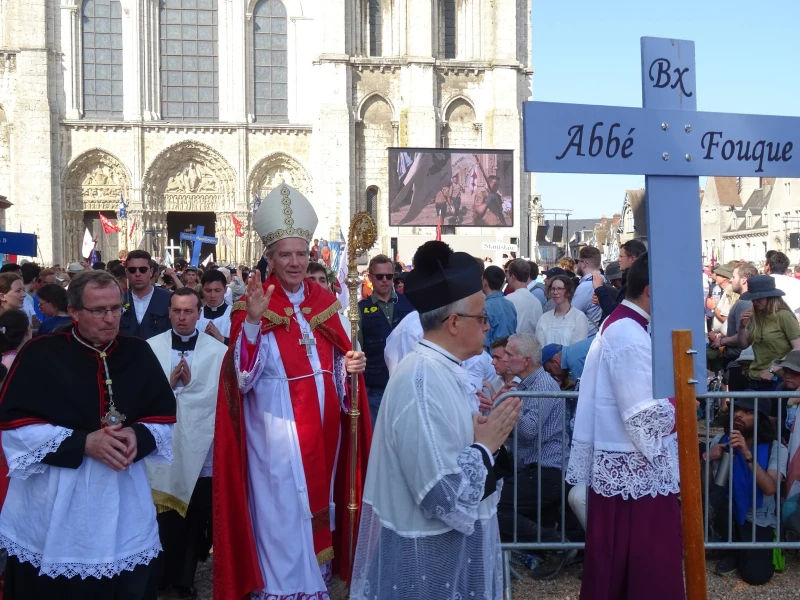
Bishop Philippe Christory of Chartres, France. / Credit: Eichthus, CC BY-SA 4.0, via Wikimedia Commons
ACI Prensa Staff, Oct 23, 2025 / 08:00 am (CNA).
The bishop of Chartres, France, Philippe Christory, addressed a letter to the senators of Eure-et-Loir, a region belonging to his diocese, in which he stated that assisted suicide and euthanasia contradict “an immemorial law: You shall not kill.”
The French prelate’s letter comes at a crucial moment as the “end-of-life” bill is under legislative review after years of political pressure to legalize euthanasia in the country.
The bill, filed last May, introduces the concept of “assistance in dying,” a term that encompasses both euthanasia — where a third party directly administers the lethal substance — and assisted suicide, in which the patient performs the final act.
Although the procedure must be subject to a medical evaluation, the legislative proposal also provides that adults suffering from a serious and incurable condition that causes unbearable physical or psychological suffering could be eligible.
On May 24 of this year, members of the National Assembly approved the creation of an offense for obstructing access to “assistance in dying,” which would criminalize any attempt to prevent the act itself or access to information about it.
In this context, Christory appealed to the right to conscientious objection of those doctors who “cannot contemplate committing a lethal act,” as it would go against their conscience “and the very purpose of their profession, which is to care for and support patients in their life project even if this is moving toward its physical end.”
The bishop denounced the French Legislature’s lack of support for these professionals as “unacceptable,” since “freedom of conscience should never be taken away or limited; it’s a fundamental right of every person.”
After lamenting the high suicide rate in France — more than 8,000 suicides were recorded in 2023 — Christory recalled that the essence of an advanced civilization “is to promote life and support the lives of those who suffer” and noted that those who ask to end their lives often lack support.
“The end of life can be a decisive moment for reconsideration, reconciliation, and sharing with loved ones,” he added. At the end of his letter, he urged the senators to “promote a plan for life, not a plan for death that would stain our culture.”
This story was first published by ACI Prensa, CNA’s Spanish-language news partner. It has been translated and adapted by CNA.
If you value the news and views Catholic World Report provides, please consider donating to support our efforts. Your contribution will help us continue to make CWR available to all readers worldwide for free, without a subscription. Thank you for your generosity!
Click here for more information on donating to CWR. Click here to sign up for our newsletter.
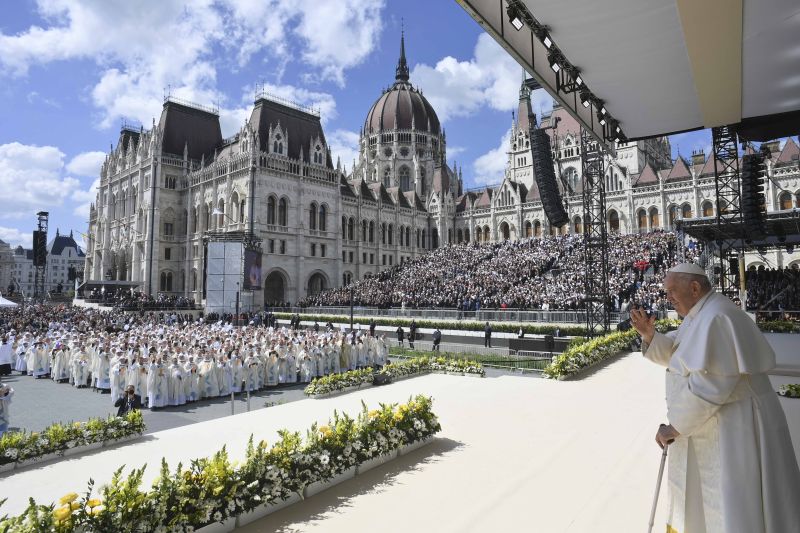
Pope Francis stands on an altar erected outside the Parliament Building in Budapest’s Kossuth Lajos’ Square during a public outdoor Mass on April 30, 2023. / Vatican Media
CNA Staff, Apr 30, 2023 / 05:47 am (CNA).
During an outdoor Mass in Budapest on Good Shepherd Sunday, Pope Francis called on Hungarians to be “open and inclusive,” reflecting on how Jesus wants his flock to share the abundant life they’ve received from him.
“Though we are diverse and come from different communities, the Lord has brought us together, so that his immense love can enfold us in one embrace,” the pope said in his April 30 homily, speaking in bright sunshine to more than 50,000 people gathered in and around the Hungarian capital’s picturesque Kossuth Lajos Square.
“[A]ll of us are called to cultivate relationships of fraternity and cooperation, avoiding divisions,” he said, “not retreating into our own community, not concerned to stake out our individual territory, but rather opening our hearts to mutual love.”
Prior to Mass, held outside the city’s majestic neo-Gothic Parliament building, the pope was transported in his wheelchair to a specially constructed altar platform flanked by banners in the colors of the Vatican and Hungarian flags and simply adorned with a towering wooden crucifix.
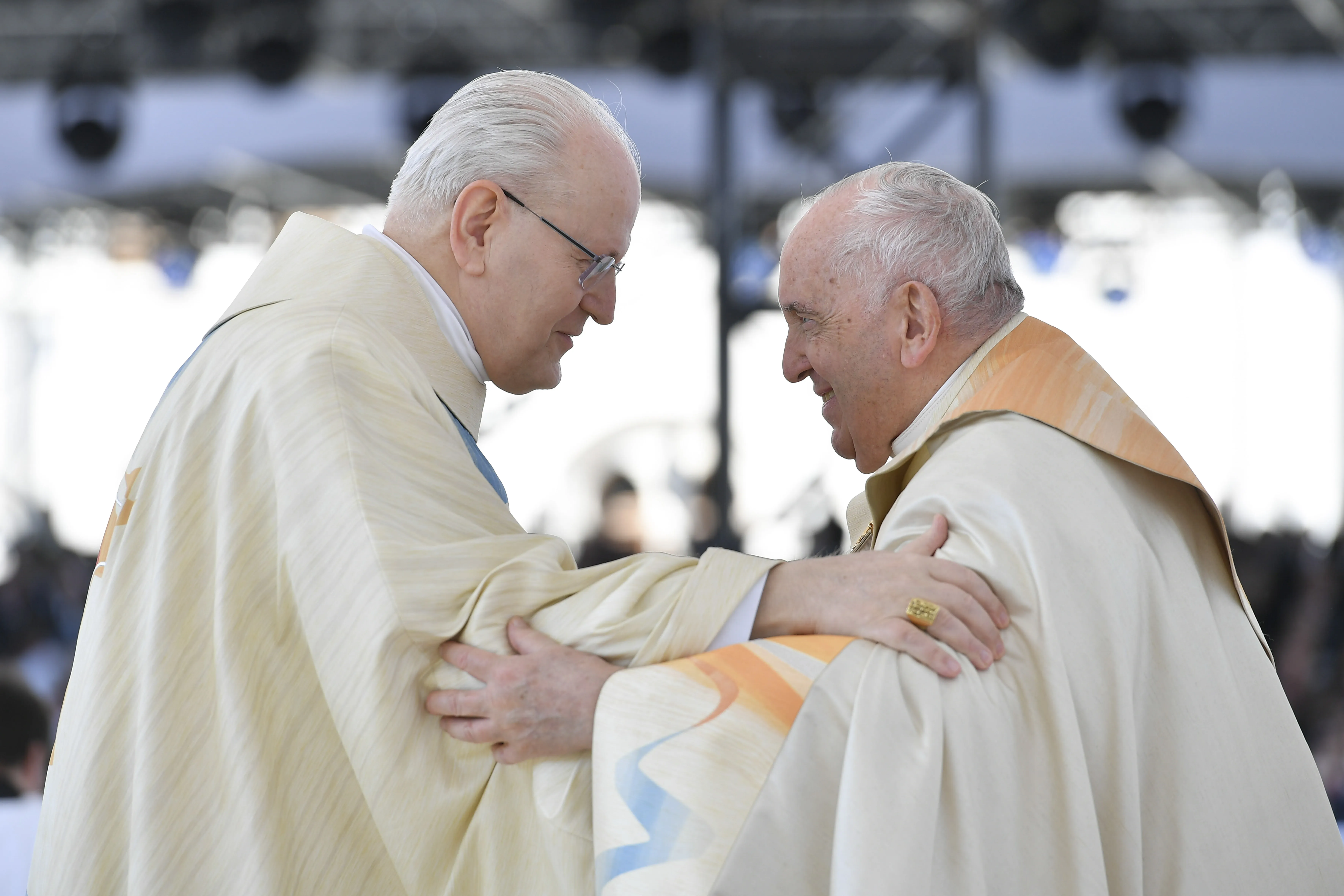
Pope Francis and Cardinal Peter Erdő, the archbishop of Budapest (left) are shown at the outdoor Mass held in Budapest, Hungary, on April 30, 2023. Erdő was the principal celebrant of the Mass; since the pope’s knee injury has impeded his mobility, he has called on cardinals to take his place at the altar. Vatican Media
Cardinal Peter Erdő, the archbishop of Budapest, was the principal celebrant of the Mass; since the pope’s knee injury has impeded his mobility, he has called on cardinals to take his place at the altar.
In his homily, Francis zeroed in on “two specific things that, according to the Gospel, [the Good Shepherd] does for the sheep. He calls them by name, and then he leads them out.”
“The history of salvation does not begin with us, with our merits, our abilities, and our structures. It begins with the call of God,” the pope said.
“[T]his morning, in this place, we sense the joy of our being God’s holy people. All of us were born of his call.”
Pope Francis said he spoke especially “to myself and to my brother bishops and priests: to those of us who are shepherds.” He called on the faithful to be “increasingly open doors: ‘facilitators’ — that’s the word — of God’s grace, masters of closeness; let us be ready to offer our lives, even as Christ … teaches us with open arms from the throne of the cross and shows us daily as the living Bread broken for us on the altar.”
Seeing closed doors is “sad and painful,” the pope said. He referred specifically to the “closed doors of our selfishness with regard to others; the closed doors of our individualism amid a society of growing isolation; the closed doors of our indifference towards the underprivileged and those who suffer; the doors we close towards those who are foreign or unlike us, towards migrants or the poor.”
The pope’s plea was, “Please, let us open those doors! Let us try to be — in our words, deeds, and daily activities — like Jesus, an open door.”
As open doors, the Lord of life can enter our hearts, Pope Francis assured, with “words of consolation and healing.”
Pope Francis speaks during a public outdoor Mass in Kossuth Lajos Square in Budapest, Hungary, on April 30, 2023. Vatican Media
Speaking to his Hungarian hosts, he urged them to be “open and inclusive” and “in this way, help Hungary to grow in fraternity, which is the path of peace,” an apparent reference to the country’s contested migration policies.
While the pope has praised the country for being a leader in assisting persecuted Christians in other countries and welcoming more than a million war refugees from neighboring Ukraine, Prime Minister Viktor Orbán’s curbing of migrants from the Middle East and Africa is generally seen as being at odds with the pope’s call to openness. During the migrant crisis of 2015, Orbán sealed Hungary’s southern border with Serbia, closing off the main land route into Europe.
Pope Francis ended his homily with a reminder that Jesus “calls us by name and cares for us with infinitely tender love. He is the door, and all who enter through him have eternal life. He is our future, a future of ‘life in abundance.’
“Let us never be discouraged,” the pope said. “Let us never be robbed of the joy and peace he has given us. Let us never withdraw into our own problems or turn away from others in apathy. May the Good Shepherd accompany us always: with him, our lives, our families, our Christian communities and all of Hungary will flourish with new and abundant life!”
In his Regina Caeli reflection after the Mass, the pope referenced the ongoing fighting in Ukraine.
“Blessed Virgin, watch over the peoples who suffer so greatly. In a special way, watch over the neighboring, beleaguered Ukrainian people and the Russian people, both consecrated to you,” he said.
“You, who are the Queen of Peace, instill in the hearts of peoples and their leaders the desire to build peace and to give the younger generations a future of hope, not war, a future full of cradles not tombs, a world of brothers and sisters, not walls and barricades.”
Ending his three-day visit to Budapest, the pope is scheduled to deliver a speech on culture and academics Sunday afternoon at the Péter Pázmány Catholic University. He then will have a farewell ceremony at 5:30 p.m. local time before departing on his return flight to Rome.
London, England, Jul 15, 2019 / 02:42 pm (CNA).- As the British parliament continues to consider a bill on Northern Ireland including amendments that would legalize abortion and same-sex marriage, a peeress from the region has warned the amendments are “not workable.”
The bill and its amendments will take effect only if the Northern Ireland Assembly, which has been suspended the past two years due to a dispute between the two major governing parties, is not functional by Oct. 21.
Last week the House of Commons voted to add amendments legalizing same-sex marriage and liberalizing abortion provision in Northern Ireland to the Northern Ireland (Executive Formation) Bill, which is designed to keep the region running in the absence of a functioning devolved government.
Thence the bill passed to the House of Lords, where it is now at the committee stage. It will remain in the upper house until July 17, when it will return to the House of Commons for amendments.
Nuala O’Loan, Baroness O’Loan, a member of the House of Lords from Northern Ireland, told BBC News NI July 15 that the amendments cannot work, and that it is wrong of the British government to “push it through in a situation where the people of Northern Ireland had no say.”
O’Loan said members of parliament had “hijacked” the Northern Ireland bill: “This was a bill that started its life in Parliament with the intention of allowing the secretary of state to postpone the date for an election… to enable the talks which are currently under way to restore the Northern Ireland Assembly to proceed. What happened was it was hijacked in the Commons… various amendments were put in and these should not have been accepted because they were outside the purpose of the bill.”
She added that the amendments don’t work, because “it says the secretary of state must make regulations – the secretary of state can’t.”
Introducing the bill into the House of Lords July 10, Ian Duncan, Baron Duncan of Springbank, said that “crucially, the amendments as drafted do not function properly and so do not enable the government to deliver on the instruction of Parliament.”
Similarly, John Larkin, attorney general for Northern Ireland, said the abortion amendment was not “drafted clearly or consistently” with human rights laws.
O’Loan noted that “100% of the Northern Ireland MPs who have taken their seat in Westminster voted against this.”
A letter opposing the bill was distributed at Masses held in Northern Ireland July 14. Authored by O’Loan and Robin Eames, who was the Church of Ireland’s Archbishop of Armagh from 1986 to 2006, it focused on the bill’s threat to devolution.
Addressed to British prime minister Theresa May, it said the overwhelming vote in the Commons “treats the people of Northern Ireland with contempt,” especially it was “voted for only by MPs who do not represent constituencies in Northern Ireland.”
May has said in the past that abortion should be a devolved issue for Northern Ireland.
The letter stated, “The imposition of this legislation on Northern Ireland in its current form … would represent a massive democratic deficit.”
It adds that the bill “has the capacity to undermine the delicate political calibration between Northern Ireland and Westminster and to cause significant damage to attempts to restore the Northern Ireland Assembly.”
O’Loan and Eames called on the government to withdraw the Northern Ireland (Executive Formation) Bill.
Failing this, they called for an amendment they introduced which would require public consultation and the support of a majority of members of the Northern Ireland Assembly before any change in the region’s legislation.
Bills to legalize abortion in cases of fatal fetal abnormality, rape, or incest failed in the Northern Ireland Assembly in 2016.
Both amendments to the were introduced by Labour MPs.
Stella Creasy, who represents a London constituency and who introduced the abortion amendment, has said the Commons “spoke clearly to say we wouldn’t accept the rights of women in Northern Ireland being ignored any longer”.
Earlier this year Creasy intended to propose an amendment to a draft Domestic Abuse Bill that would give the British parliament jurisdiction over abortion laws throughout the United Kingdom. However, the bill’s scope was restricted to England and Wales by the Conservative government.
She also introduced an amendment to the Northern Ireland (Executive Formation and Exercise of Functions) Act 2018 to repeal Northern Irish law on abortion and gay marriage, which was defeated.
Ahead of last week’s vote in the Commons, Archbishop Eamon Martin of Armagh registered his deep concern that the bill would be hijacked “to remove existing legal protection for unborn babies and to ‘fast track’ the legalisation of abortion on demand in Northern Ireland. How tragic it is for humanity that some legislators would ‘fast track’ the ending of the lives of the most defenceless in our society.”
Abortion and same-sex marriage are both legal in both the United Kingdom and the Republic of Ireland. Elective abortion is legal in the rest of the United Kingdom up to 24 weeks, while currently it is legally permitted in Northern Ireland only if the mother’s life is at risk or if there is risk of permanent, serious damage to her mental or physical health.
Northern Irish women have been able to procure free National Health Service abortions in England, Scotland, and Wales since November 2017.
In June 2018, the Northern Ireland Human Rights Commission challenged the region’s abortion laws in the UK Supreme Court. While the Supreme Court concluded that Northern Ireland’s abortion laws violated human rights law by banning abortion in cases of fatal fetal abnormality, rape, and incest, it threw out the case saying it had not been brought forward by a person who had been wrongfully harmed by the law.
CNA Staff, Feb 16, 2021 / 08:00 am (CNA).- Euthanasia and assisted suicide cases have risen rapidly in Belgium and the Netherlands since the practices were legalized in 2002, according to a bioethics institute.






Leave a Reply