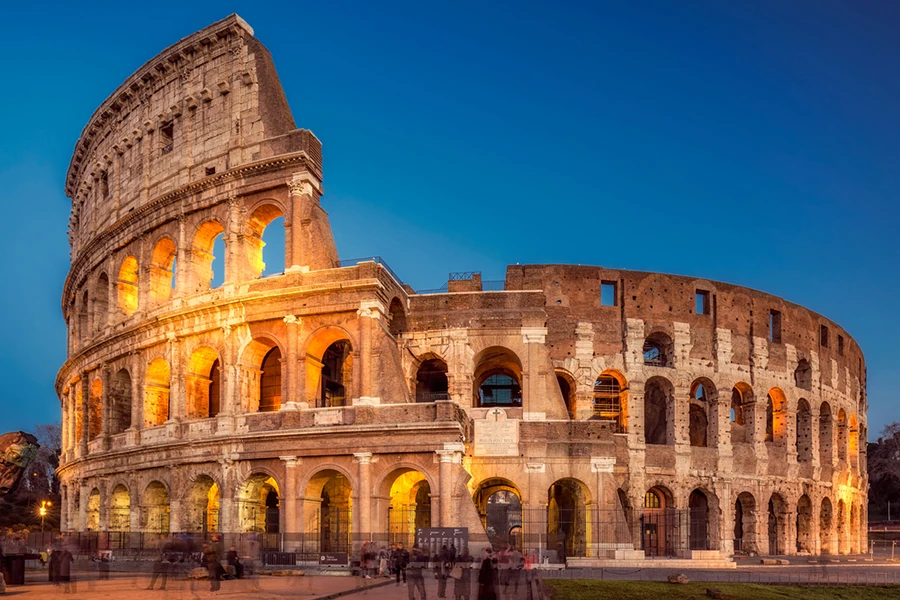
Rome, Italy, Feb 7, 2018 / 01:49 pm (CNA/EWTN News).- The Roman Colosseum will be illuminated by red lights later this month to draw attention to the persecution of Christians around the world, and especially in Syria and Iraq.
On Saturday, Feb. 24, at 6 p.m. the Colosseum will be spotlighted in red, to represent the blood of Christians who have been wounded or lost their lives due to religious persecution.
Simultaneously, in Syria and Iraq, prominent churches will be illuminated with red lights. In Aleppo, the St. Elijah Maronite Cathedral will be lighted, and in Mosul, the Church of St. Paul, where this past Dec. 24, the first Mass was celebrated after the city’s liberation from ISIS.
The event, sponsored by Aid to the Church in Need (ACN), follows a similar initiative last year, which lit-up London’s Parliament building in red, as well as the Basilica of the Sacred Heart in Paris and the cathedral in Manila, Philippines. In 2016, the famous Trevi Fountain in Rome was lit.
Alessandro Monteduro, director of ACN, told journalists Feb. 7 that the “illumination [of the Colosseum] will have two symbolic figures: Asia Bibi, the Pakistani Christian condemned to death for blasphemy and whose umpteenth judgment is expected to revoke the sentence; and Rebecca, a girl kidnapped by Boko Haram along with her two children when she was pregnant with a third.”
“One of the children was killed,” he said, “she lost the baby she was carrying, and then became pregnant after one of the many brutalities she was subjected to by her captors.”
Once she was freed and reunited with her husband, she decided she “could not hate those who caused her so much pain,” Monteduro said.
Aid to the Church in Need released a biennial report on anti-Christian persecution Oct. 12, 2017, detailing how Christianity is “the world’s most oppressed faith community,” and how anti-Christian persecution in the worst regions has reached “a new peak.”
The report reviewed 13 countries, and concluded that in all but one, the situation for Christians was worse in overall terms for the period 2015-2017 than during the prior two years.
“The one exception is Saudi Arabia, where the situation was already so bad it could scarcely get any worse,” the report said.
China, Eritrea, Iraq, Nigeria, North Korea, Pakistan, Saudi Arabia, Sudan, and Syria were ranked “extreme” in the scale of anti-Christian persecution. Egypt, India, and Iran were rated “high to extreme,” while Turkey was rated “moderate to high.”
The Middle East is a major focus for the report.
“Governments in the West and the U.N. failed to offer Christians in countries such as Iraq and Syria the emergency help they needed as genocide got underway,” the report said. “If Christian organizations and other institutions had not filled the gap, the Christian presence could already have disappeared in Iraq and other parts of the Middle East.”
The exodus of Christians from Iraq has been “very severe.” Christians in the country now may number as few as 150,000, a decline from 275,000 in mid-2015. By spring 2017 there were some signs of hope, with the defeat of the Islamic State group and the return of some Christians to their homes on the Nineveh Plains.
The departure of Christians from Syria has also threatened the survival of their communities in the country, including historic Christian centers like Aleppo, ACN said. Syrian Christians there suffer threats of forced conversion and extortion. One Chaldean bishop in the country estimates the Christian population to be at 500,000, down from 1.2 million before the war.
Many Christians in the region fear going to official refugee camps, due to concerns about rape and other violence, according to the report.
ACN also discussed the genocide committed in Syrian and Iraq by the Islamic State and other militants. While ISIS and other groups have lost their major strongholds, ACN said that many Christian groups are threatened with extinction and would likely not survive another attack.
 […]
[…]






I will consider nothing that Leo writes until he apologizes to the entire Catholic Church for backing Cupich’s move to bestow honors on a politician who did everything in his power to advance the cause of abortion in the USA.
I feel your hate.
Unlike that duplicitous footnote to chapter 8 to Amoris Laetitia, might we hope that the possible papal ghostwriter notes a real compass point? Not morally subversive (nor an alleged evasion from temporal desperation), but recalling theological and personal hope in the whole Christ, such as:
“Evangelization will also contain—as the foundation, center and at the same time summit of its dynamism—a clear proclamation that, in Jesus Christ, the Son of God made man, who died and rose from the dead, salvation is offered to all men, as a gift of God’s grace and mercy [fn—Cf. Eph 2:8, Rom 1:16]. And not an immanent salvation, meeting material or even spiritual needs, restricted to the framework of temporal existence and completely identified with temporal desires, hopes, affairs and struggles, but a salvation which exceeds all these limits in order to reach fulfillment in a communion with the one and only divine Absolute: a transcendent and eschatological salvation, which indeed has its beginning in this life but is fulfilled in eternity” (Paul VI, the apostolic exhortation “Evangelii Nuntiandi,” on the 1975 Solemnity of the Immaculate Conception, n. 27).
I will consider everything Leo writes because he is my Pope, the Vicar of Christ.
“Vicar of Christ” Wasn’t that the papal appellation that Bergoglio rejected for himself?
That would be a good first start, followed by a second apology for meeting, encouraging, and supporting James Martin, SCH. We probably shouldn’t hold our breath waiting.
Dilexi te. If indeed you love me, keep my commandments (Jesus in Jn 14:15).
As reported by Pew Research only 9% of Roman Catholics believe in the Most Blessed Trinity. On the face of it that means 91% of those describing themselves as Roman Catholics aren’t.
Emergency for Pope Leo. There are many many who can deal with the poverty issue besides the Pope. The Pope, on the other hand, is perhaps the only voice who can call attention to the tragedy that 91% of self-identified Roman Catholics are deprived of the truths of the Faith.
What will the Pope do? If the current pontificate — which resembles more the Cupich-by-proxy pontificate — it would appear this disaster will be overlooked. Not quite relevant?
Are you referring to this March 2025 Barna Research poll? It’s apparently a “research report from the Cultural Research Center at Arizona Christian University [that] shows that only 11% of American adults, and only 16% of self-proclaimed Christians, believe in the trinity.” I’ve looked at it, and have questions. The methodology is not clear at all. The language is a bit strange; for example: “How Demographic Segments Perceive the Trinity (Percentage who believe in the existence and human influence of each Person of the Trinity)”. What does “human influence” refer to here? The Second Person of the Trinity, who is fully human and fully divine by virtue of the Incarnation, has “human influence”, but how does this apply to the Father and the Holy Spirit. In addition, we read: “Less than half as many Catholics (9%) are trinitarians.” Well, most Catholics don’t use the term “trinitarian” to describe themselves, even though it’s accurate. My guess is that some respondents were confused by the questions, which don’t appear to be available. Bottom line: as poor as catechesis often is, I have a really hard time believing that only 9% of Catholics say they believe in the Trinity.
And reportedly, some seventy-five percent of Catholics deny the Real Presence.
Dilexi te.
Tough love or empathy?
The Way of the Cross or cheap grace?
Is there anything new to say about the poor? – if that is what the
exhortation is about. Perhaps we should get back to the basics of
the faith, to the commandments, to basic morality. Many people are
searching for meaning and purpose in life. Another sermon about
the poor doesn’t address the deepest questions humans have.