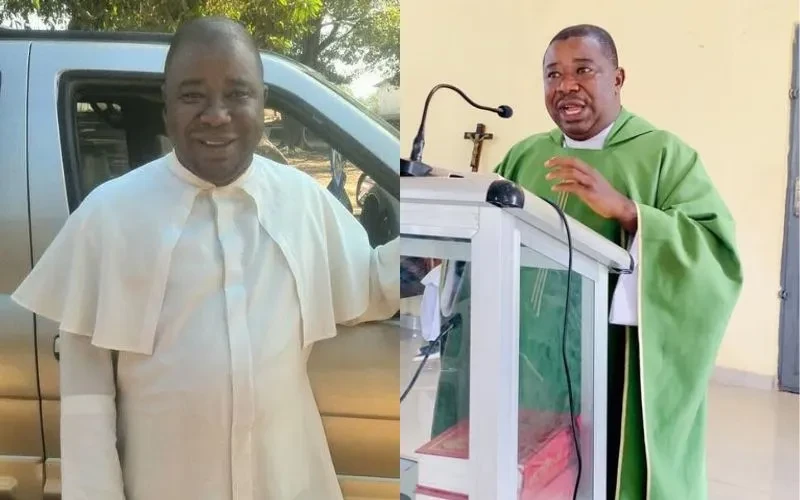
Father Augustine Amadu of Sierra Leone’s Catholic Diocese of Kenema was murdered on Aug. 30 while he was preparing to take on a new mission in the diocese. / Courtesy of the Catholic Diocese of Kenema
ACI Africa, Sep 2, 2025 / 13:05 pm (CNA).
A Catholic priest in Sierra Leone’s Diocese of Kenema was murdered Aug. 30 as he was preparing to take on a new assignment in the diocese.
According to the communication department of the Archdiocese of Freetown in Sierra Leone, Father Augustine Amadu, who served at Kenema’s Immaculate Conception Parish, was preparing for his Sunday, Aug. 31 farewell Mass when suspected robbers ended his life.
His next pastoral assignment would have been at St. John Kailahun Parish in the Kenema Diocese.
“We are saddened by the shocking news reaching us this morning (Sunday, Aug. 31) about the demise of Reverend Father Augustine Amadu who was stabbed to death by armed robbers at his parish house in Kenema Diocese,” the message said.
“Father Amadu was wrapping up his final days of his pastoral work at Immaculate Conception Parish, Kenema, preparing for his farewell Mass on Sunday before departing for his new assignment at St. John Parish, Kailahun after five years of devoted service.”
According to the Sierra Leonean Police (SLP), Amadu was attacked at night in the parish house where he lived alone. The authorities said in a statement on Aug. 30 that parishioners at Immaculate Conception Parish raised the alarm about the murder.
“At about 07:43 hours, the SLP received a report from a Catholic parishioner indicating that Rev. Father Amadu had been attacked overnight by unidentified armed men at his parish residence. The parish house, which the late priest occupied alone, was forcibly entered by the assailants through a damaged window,” read the police report.
“At this stage, it is unclear whether any property was taken away by the perpetrators,” the SLP reported, adding that the remains of Father Amadu had been taken for a post-mortem examination.
According to the Sierra Leonean authorities, no suspects had been identified in the priest’s murder as of Aug. 30. The SLP said, however, that a number of parishioners and church authorities who reported for early morning service at the parish were assisting with the investigation.
“The Sierra Leone Police wishes to assure the public, particularly the Catholic community, that a full-scale investigation is underway to bring the perpetrators of this heinous crime to justice,” the SLP said.
If you value the news and views Catholic World Report provides, please consider donating to support our efforts. Your contribution will help us continue to make CWR available to all readers worldwide for free, without a subscription. Thank you for your generosity!
Click here for more information on donating to CWR. Click here to sign up for our newsletter.
Gaza City, Jan 14, 2020 / 12:47 am (CNA).- With fewer than 1,000 Christians in a population of 1.8 million, the Christian population in Palestine’s Gaza Strip today is less than half of what it was 10 years ago.
“They are — of all the Christian groups in the Holy Land — certainly by far the group that’s facing the most difficulty,” Robert Nicholson, president and founder of the Philos Project, told CNA.
Nicholson is currently leading an initiative to help Gazan Christians. He insists the world does not need to wait for a resolution of the Israeli-Palestinian conflict to help the dwindling Palestinian Christian population.
“Christians are often forgotten in this conflict,” he said. “They are really caught between forces that are much bigger than them … They’re looking for stability, they’re looking for freedom.”
“Strengthening these communities need not necessarily be tied to politics,” Nicholson said.
Humanitarian circumstances for Gaza’s Christians have deteriorated since the radical Islamist Hamas takeover in June 2007, which prompted an Israeli blockade restricting the flow of commercial goods into Gaza. According to Caritas International, 80% of Gaza’s population lives below the poverty line.
The Christian minority in Gaza, which is mostly Greek Orthodox, also faces discrimination from the Muslim majority, according to Nicholson. “They are of course in Gaza being ruled by Hamas, a very extreme Muslim group that is rejected even by the Palestinian Authority. And, as Christians in this very difficult fundamentalist society, they face all kinds of social and political persecution,” he said.
This is one of the many factors that has led more and more Palestinian Christians to try to escape Gaza and to relocate to the West Bank, where many end up living with an irregular status and separated from their families.
“They are living in what is essentially an illegal immigrant status because of the way they moved from Gaza to the West Bank. They are washing dishes, they are cleaning homes. If they get arrested at a check-point, they get sent back to Gaza. And so these people, they’re living on the fringes of the society. Even the Christians of the West Bank are not doing that much for them,” Nicholson said.
Witnessing this struggle led Nicholson to start the Gaza Exodus initiative, which seeks to help reunite Christian families divided by the Green Line.
“We’re working with the Israeli and Palestinian governments to get their status normalized, to help them reunite with their families who are still in Gaza and to provide some basic level of financial support for them to make this transition,” Nicholson told CNA in October.
“There’s like social entrepreneurship that can happen that can lift the status of these Christians,” he said.
The Gaza Exodus initiative raised more than $20,000 in a three-month campaign at the end of 2019 to reunite four Christian families for Christmas.
Days before Christmas, Israeli authorities reversed a Dec. 12 announcement barring Gaza Christians from visiting Bethlehem and Jerusalem in the West Bank. Of the 800 travel permits requested, 316 were granted by Christmas Eve, Reuters reported.
Through the Philos Project, Nicholson has worked since 2014 to expose young people to the plurality of voices in Israel, Palestine, and throughout the Middle East.
The Philos Project brings Christian college students and young professionals on organized trips to the Holy Land to engage with the local religious and political realities. It is an ecumenical initiative with staff and fellows from Catholic, Protestant, Orthodox, and Assyrian backgrounds.
“What I’m trying to do is bring people into an encounter with the birthplace of their faith because there’s power in that encounter,” Nicholson said. “The Middle East is and will remain important.”
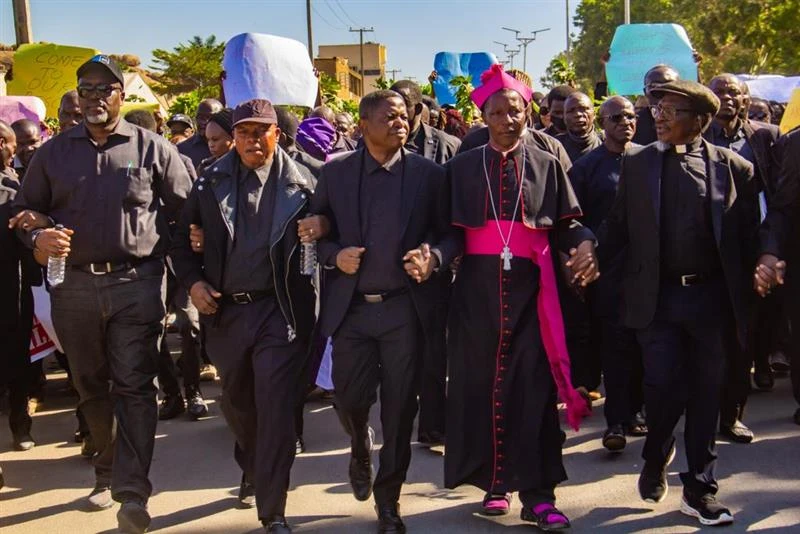
Catholic Archbishop Matthew Ishaya Audu of Jos marches alongside evangelical leader Rev. Dr. Gideon Para-Mallam in front of the Plateau state governor’s office building in Jos, Nigeria, Jan. 8, 2024. / Credit: Photo courtesy of Rev. Dr. Gideon Para-Mallam, photo by Plateau State Government Media Team.
Washington, D.C. Newsroom, Jan 9, 2024 / 15:30 pm (CNA).
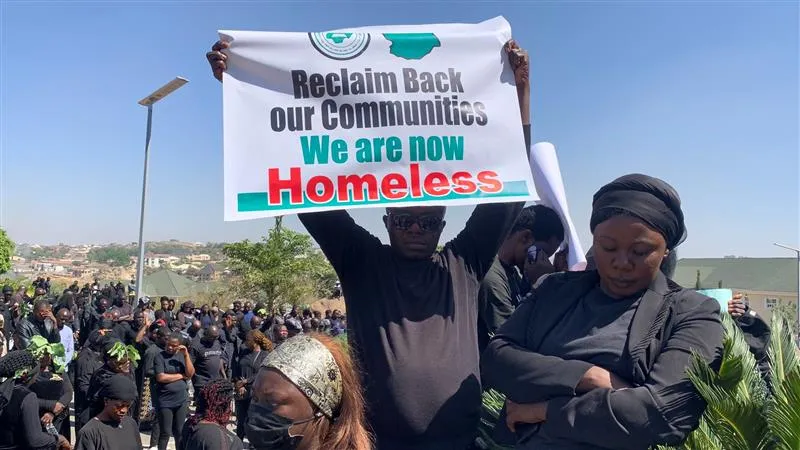
Thousands of Christians rallied yesterday in front of the governor’s office in Nigeria’s Plateau state to demand action after more than 200 were killed in a series of Christmas massacres.
The attacks, which targeted Christian villages beginning Dec. 23 and continuing through Christmas day, left Christian communities in Nigeria’s Plateau state reeling. Photos obtained by CNA after the attack showed villagers burying their slain relatives and loved ones in mass graves.
According to Rev. Dr. Gideon Para-Mallam, an evangelical leader who helped to organize the rally, the attacks also left 15,000 people displaced without homes.
Among the demands being made by the protestors, Para-Mallam said that they asked for an “urgent humanitarian relief material response by the state and federal government” and for the arrest of the perpetrators of the Christmas massacre, which he called a “genocidal,” “terrorist” attack.
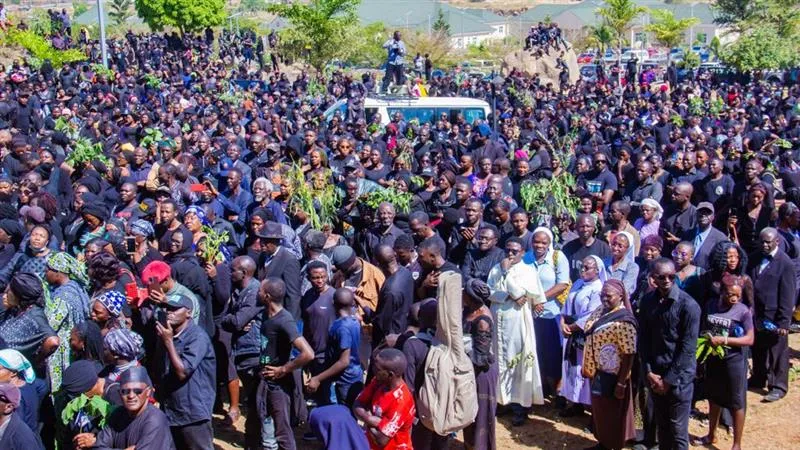
Thousands of Christians peacefully and prayerfully march to a rally in front of the Nigerian Plateau state governor’s office building in protest of the 2023 Christmas massacre that left over 200 Christian Nigerians dead, Jan. 8, 2024. Credit: Photo courtesy of Rev. Dr. Gideon Para-Mallam, photo by Plateau State Government Media Team.
The attack marks the latest instance of terrorists targeting Christian Nigerians on significant Christian feast days. In 2022, on Pentecost Sunday, 39 Catholic worshippers were killed at the St. Francis Xavier Owo Catholic Parish in Ondo Diocese.
Religious freedom advocates believe that militant Muslim Fulani herdsmen were responsible for the Christmas attacks. In Nigeria as a whole, at least 60,000 Christians have been killed in the past two decades. An estimated 3,462 Christians were killed in Nigeria in the first 200 days of 2021, or 17 per day, according to a new study.
Due to continued attacks, Nigeria is one of the most dangerous countries in the world to be a Christian, according to a 2023 report by the advocacy group International Christian Concern.
Para-Mallam told CNA that Nigeria’s middle belt region, of which Plateau state is a part, has “suffered sustained attacks for over a decade now with destruction of lives and properties.”
The thousands of protestors at the rally, he said, were “mournful, angry, but surprisingly joyful.”
Their “central objective,” he explained, was “to ask for an end to the killings not just in Plateau but Nigeria and seek justice for the people.”
Just-In: CAN Plateau State Chapter is having a Peaceful Walk to Government House pic.twitter.com/YbFRqtFI9J
“Above all, it was very peaceful and prayerful,” he added. “The old, the young all together felt that we had to do what we had to do to get our message across.”
According to Para-Mallam, the crowd numbered about 5,000 and included both Catholics and Protestants. Together, he said, they peacefully and prayerfully marched, ending in front of the governor’s office building in the city of Jos. Archbishop Matthew Ishaya Audu of Jos and several Catholic priests also took part in the march and rally, according to Para-Mallam.
The demonstration was “mournful, angry, and surprisingly joyful,” according to Rev. Dr. Gideon Para-Mallam. Credit: Photos by Nigerian multimedia journalist Jœy Shèkwônúzhïbó, used with permission.
The rally was organized with the help of the Christian Association of Nigeria (CAN), a coalition of Nigerian Christian Churches and groups that includes the Catholic Church in Nigeria.
Para-Mallam said the purpose of the demonstration was to “mourn in solidarity” with the devastated communities as well as to show them that the Church “cares” and “identify with them in the moment of suffering and mourning.”
A secondary purpose for the rally, Para-Mallam said, was to “get the Church on the Plateau to unite and to speak with one voice around the issues of social justice” and to “create awareness nationally and globally about the Christmas season attack.”
Para-Mallam said that Plateau’s governor, Caleb Mutfwang, addressed the crowds at the rally and was “sympathetic and understanding and spoke well on the pains of his people.”
Mutfwang condemned the attacks shortly after they occurred in a Dec. 26 statement in which he said: “This has indeed been a gory Christmas for us.”
“He promised to relay our concerns to the president and committed to work with the president to end the killings in the Plateau state,” Para-Mallam said.
Despite the governor and president voicing their support for the impacted communities, several religious freedom advocates have been critical of the lack of government response to the growing terrorist attacks.
Maria Lozano, a representative for the papal relief group Aid to the Church in Need, told CNA after the attacks that tangible government support was largely absent after the Christmas massacre and that a “lack of response from the government” over the years has worsened the situation in the region. The absence of government support, Lozano said, has forced Christian churches to take on the “primary responsibility of providing assistance.”
Para-Mallam asked for Christians outside of Nigeria to help by offering prayer, advocacy, and humanitarian intervention.
“We also want fellow believers to encourage policymakers to encourage the Nigerian government to do more to end the killings in general and particularly those targeted at Christians,” he said.
For several years now, religious freedom advocates have criticized the U.S. government for failing to include Nigeria in the State Department’s “Countries of Particular Concern” list, which some consider to be America’s most effective tool to encourage foreign governments to address the persecutions in their countries.
“There is no justification as to why the State Department did not designate Nigeria or India as a Country of Particular Concern,” said U.S. Commission on International Religious Freedom chair Abraham Cooper and vice chair Frederick Davie in a Jan. 4 statement.
Cooper and Davie mentioned the Christmas massacre as “just the latest example of deadly violence against religious communities in Nigeria.”
Speaking on “EWTN News Nightly” on Monday, Davie said that the decision to leave Nigeria off the list was “particularly” concerning and a “huge mistake.”
Davie told EWTN that “there are some who are saying that the government [of Nigeria] if it is not actively participating in some of this religious persecution is actually standing by and not doing what it can to prevent it.”
“We just believe,” Davie explained, “that by designating Nigeria a Country of Particular Concern, the United States puts itself in a position to work more closely with the government of Nigeria to address some of those fundamental security issues that are going unattended to.”
Despite this, the State Department has left Nigeria off the Countries of Particular Concern list since 2021.
Abu Dhabi, United Arab Emirates, Oct 30, 2018 / 03:01 am (CNA/EWTN News).- Among those calling for a ceasefire in the disastrous Yemen conflict is Bishop Paul Hinder, apostolic vicar for Southern Arabia. Though the path out of war is difficult and requ… […]





Leave a Reply