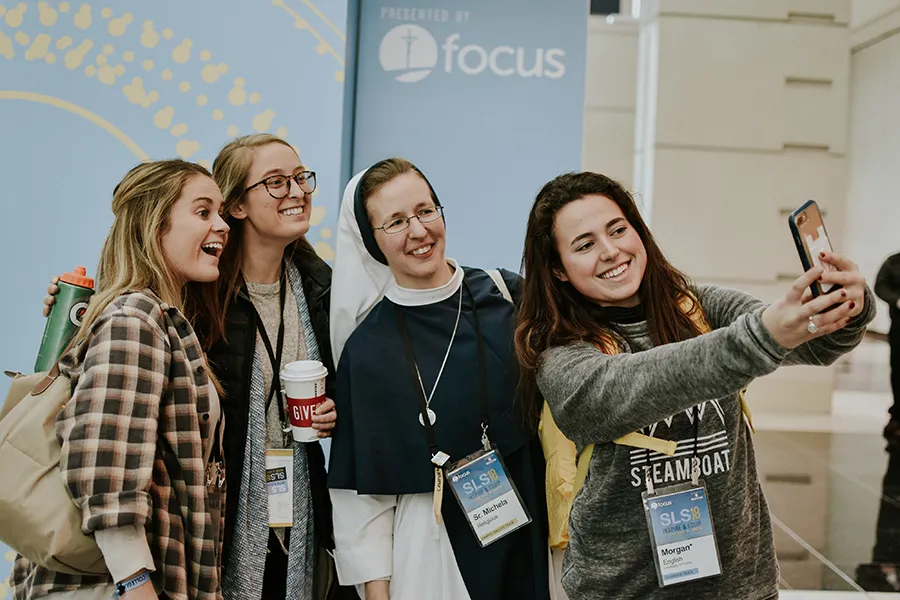
Chicago, Ill., Jan 8, 2018 / 11:50 am (CNA/EWTN News).- The love of God the Father is an inexhaustible source of fulfillment for the human heart, Sr. Bethany Madonna of the Sisters of Life said Thursday at a Catholic youth leadership conference in Chicago.
“So many blessings are coming at us at every second of every day,” Sr. Madonna said Jan. 4 to an audience of approximately 8,000, “and the source of each and every one of these blessings is the blessing the Father gives me with himself.”
Sr. Madonna gave one of the keynote speeches on the third day of the Student Leadership Summit, an event hosted biennially by the Fellowship of Catholic University Students which aims to train young people to be effective evangelists. The theme selected for this year’s conference, which ran January 2-6, was “Inspire & Equip.”
Sr. Madonna is vocations director for the Sisters of Life, a New-York based religious order founded in 1991 by the late Cardinal John O’Connor. Much of their ministry centers around aiding pregnant women and providing healing to those who have had abortions.
“Help us to receive the Father’s love anew, more deeply than we’ve ever received it before,” Sr. Madonna prayed at the start of her talk.
Sister Madonna told the story of a couple named Matt and Lucy, friends of the Sisters, who found out shortly before their wedding that Matt had been diagnosed with cancer and had been given a year to live. The two cancelled their honeymoon in order to begin treatments.
Around the end of Matt’s treatments, doctors urged Lucy to abort their newly conceived child, fearing anomalies due to Matt’s chemo.
Instead, Matt and Lucy “began to pray,” trusting in God. In the end, she said, the only anomaly the child was born with was that two fingers were fused to the palm in such a way that his hands formed the sign for “I love you” in sign language.
“It was remedied with a simple surgery, but Matt and Lucy received it as a message from their Father, brought to them through a son, the Gospel in miniature,” Sr. Madonna said.
However, even in the cases of great defects at a child’s birth, “the Father is saying, ‘I love you’ even more.”
She highlighted the uniqueness of the Father’s love, saying it makes for a relationship like no other. This love “goes to the extremes, indwelling.” She emphasized that only mortal sin can separate human beings from this love.
“When we sever ourselves like this, he holds onto our blessing, and awaits our return,” she said, referencing the parable of the prodigal son.
She told the story of Dr. Michael Brescia, whom the Sisters of Life honored this year with their annual Cardinal O’Connor award. Brescia developed a treatment for kidney disease in 1966, paving the way for the development of ongoing dialysis. Brescia was offered $1 billion to keep his discovery a secret for one year while a patent was developed.
She related a conversation Brescia had with his Italian immigrant father at the time. Brescia’s father, she said, was overcome with joy to know that 50,000 lives a year could be saved by his son’s discovery, but was dismayed to hear of the delay Brescia had accepted.
“‘Don’t think of this world,’” she said Brescia’s father urged. “‘You would let 50,000 people die?’”
Brescia published his discovery the next day. Sr. Madonna said that despite the invention now being worth $60 billion, he never gained anything from it financially. However, “he’s the richest man I know,” she said.
“Lasciare,” she said, using the Italian word for “release” or “let go” that Brescia’s father had spoken to him in urging his son to give up the discovery. “We too have to let go of so many things,” she said, “that keep us from the blessing that is ours.”
Referencing the “discernment of spirits” developed by St. Ignatius of Loyola, founder of the Society of Jesus, Sr. Madonna said that “so often, we hand desolating thoughts and lies a microphone, and we set them on the stage of our hearts.”
“It’s like, ‘Wow, that’s the worst thing I’ve ever heard about myself. Say it again, just this time in surround sound,’” she said.
“Let these thoughts be taken captive,” she urged listeners.
She told a story from a sister in Romania who had worked at an understaffed orphanage, where babies had stopped crying because there was no one there to respond.
“There are places in our hearts that have not yet cried out to the Father because of a lack of faith,” she said. “We have a good Father, and he hears you.”
“Tonight, we break the silence,” she said, as FOCUS staff prepared the stage for adoration.
Speaking to CNA after her talk of how she herself first came to deeply encounter this love, Sr. Madonna told a story of time she had spent praying with the book of Genesis.
“I had a powerful meditation with the the Scripture of Jacob and Esau receiving the blessing of their father,” she said. In this story, Jacob dresses as Esau to receive his father’s blessing. “Sometimes, I feel like I have to dress up, or be someone else, or impress, or pretend, so that he can bless me.”
“Something happened in my heart where I realized basically how sorrowful that is, how far that is from what the Father is actually offering me,” Sr. Madonna stated. “Through the prayer, I felt like the Father wanted my empty hands, and wanted my heart as it is.”
Speaking to CNA on the connection between accepting God the Father’s love, the focus of the SLS conference, Sr. Madonna said that this love changes how we view those we encounter.
“Once we’ve received our own lives as a gift, and once we recognize that every human person is made in the image and likeness of God and is a communication of him,” Sr. Madonna told CNA, “when I encounter another person, I recognize that they were brought into being by God all-mighty, and are beloved of him. He loves them. They are communicating something to me that was actually entrusted to them by him and it’s unique.”
“When I know that, and live it, then every person is going to know that they’re special, they’re worthy of my time. I desire to know their hearts and be with them in solidarity.”
“We have to tell people; we have to invite them.”
Speaking to CNA on how this evangelization of the Father’s love relates to the work of the Sisters of Life, Sr. Madonna drew on the Blessed Mother.
“When we receive Jesus, and we allow him to be conceived in our hearts as she did at the Annunciation, and then when we go out, like the Visitation, and we meet these women who are pregnant, we hope that, just like John the Baptist leapt in Elizabeth’s womb, we hope that something would leap in these women, that they would recognize Christ come to them, that they would experience this joy, the Holy Spirit, coming upon them.”
 […]
[…]




They are NOT immigrants. They are foreigners who entered the USA ILLEGALLY. An immigrant is someone who lawfully applies for entry into the USA and, once approved enters in light of day. Stop your purposeful misidentifying people and behavior; that deception is a form of lying.