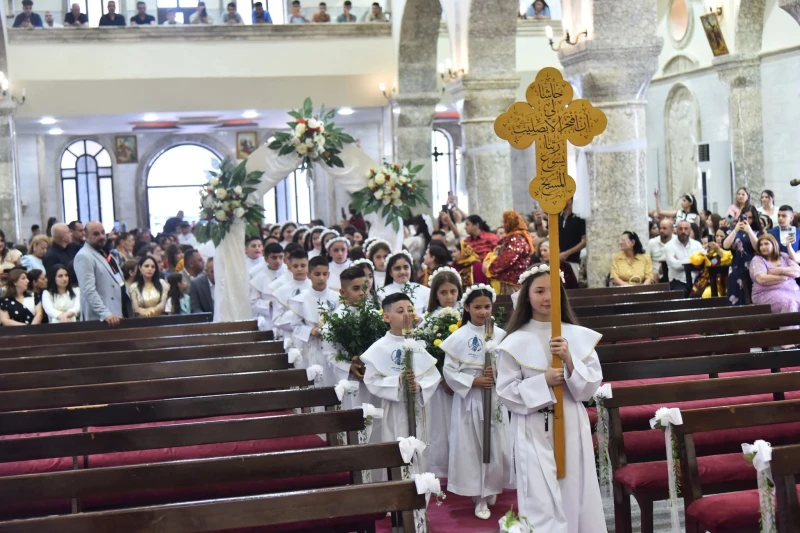
Children process into the St. Mary al-Tahir Church, also known as the Church of the Immaculate Conception, in Baghdad, for their first Communion. / Credit: Chaldean Catholic Church
In Iraq’s capital, Chaldean parishes celebrated first Communion for 50 children, while 32 others received the sacrament at the Syriac Catholic parish.
Most significantly, 11 children took their first Communion at the Syriac Catholic Church of Our Lady of Deliverance — the same church that witnessed a horrific massacre in 2010, when dozens of worshippers and two priests were killed and hundreds wounded.
First Communion recipients during a liturgy in the Chaldean Archdiocese of Erbil. Credit: Chaldean Archdiocese
During his homilies, Hanno praised the faithful’s determination to stay on their ancestral land and their courage in returning after forced displacement. He commended their commitment to preserving their faith and passing it to their children, who have grown up in stable, united, devoted families.
Over 450 boys and girls received their first holy Communion during liturgies held over the past month in various churches of the town of Qaraqosh, Iraq. Credit: Syriac Catholic Archdiocese of Mosul, Iraq
Some celebrate, others wait
In Basra, Christian families have dwindled to fewer than 350 across all denominations — Chaldean, Armenian, Syriac, Presbyterian, and Latin — yet they remain on their land despite harsh living and environmental conditions. This year, the Chaldean and Syriac Catholic dioceses postponed first Communion celebrations, waiting to gather enough children for next year’s celebration.
In Karemlesh, part of the Chaldean Archdiocese of Mosul, 26 children are preparing to receive the Eucharist. Meanwhile, the Chaldean Diocese of Kirkuk and Sulaymaniyah celebrated first Communion for 26 children at Kirkuk’s Cathedral of the Sacred Heart. The Church in Sulaymaniyah, like Basra, is looking ahead to next year.
Towns of northern Iraq
Ankawa’s churches within the Chaldean Diocese of Erbil experienced two extraordinary days.
Archbishop Bashar Matti Warda presided over three Masses where 210 children received first Communion. In his homilies, he emphasized that the sacrament goes far beyond beautiful photos and white gowns: It represents a lifelong commitment that transforms communicants’ homes into places where Jesus’ presence lives through forgiveness, active listening, and generosity.
Children process into the St. Mary al-Tahir Church, also known as the Church of the Immaculate Conception, in Baghdad, for their first Communion.
Also, in Ankawa, 66 children from the Syriac Catholic Diocese of Adiabene received the Eucharist, along with 15 others in Duhok. In the Chaldean Diocese of Duhok, 75 children celebrated first Communion, while 150 did so in neighboring Zakho Diocese. A similar number in Alqosh Diocese, bereaved of its spiritual shepherd, will receive the sacrament in coming days.
The Syriac Orthodox Church also celebrated first Communion for about 70 children in Bartella and 40 in Ankawa, including children from other denominations.
Children gather in St. Mary al-Tahir Church, also known as the Church of the Immaculate Conception, in Baghdad for their first Communion. Credit: Chaldean Catholic Church
This story was first published by ACI MENA, CNA’s Arabic-language news partner. It has been translated for and adapted by CNA.
If you value the news and views Catholic World Report provides, please consider donating to support our efforts. Your contribution will help us continue to make CWR available to all readers worldwide for free, without a subscription. Thank you for your generosity!
Click here for more information on donating to CWR. Click here to sign up for our newsletter.
The Catholic faithful gathered in the Cenacle in Jerusalem for the Mass of the Lord’s Supper that the Franciscan friars celebrated on Holy Thursday, March 28, 2024. The Cenacle is at the center of strong tensions and disputes regarding ownership and rights of access and celebration. An ancient tradition places King David’s tomb here and over the centuries Jews and Muslims have leveraged this to first expel the Franciscans and then to prevent Christian worship, which they deemed sacrilegious. / Credit: Marinella Bandini
Jerusalem, Mar 28, 2024 / 17:15 pm (CNA).
On Holy Thursday, the doors of the Cenacle in Jerusalem were opened to welcome the Franciscans of the Custody of the Holy Land. In this “Upper Room,” called the Cenacle in the Holy Land, Jesus had his Last Supper, washed his apostles’ feet, and instituted the Eucharist.
It was here that the Franciscans celebrated the Mass of the Lord’s Supper, reenacting those same gestures. (At the Basilica of the Holy Sepulcher, however, the celebration is held on Thursday morning due to the Status Quo. Here is Cardinal Pierbattista Pizzaballa’s homily from that Mass.)
Cardinal Pierbattista Pizzaballa, the Latin Patriarch of Jerusalem, kisses the feet of a Franciscan friar during the “Washing of the Feet” ritual at the Mass of the Lord’s Supper celebrated at the Holy Sepulchre on Holy Thursday. The celebration is held on Thursday morning due to the Status Quo. March 28, 2024. Courtesy of the Custody of the Holy Land
The custos of the Holy Land, Father Francesco Patton, presided over the Eucharistic celebration at the Cenacle. In his homily, before washing the feet of six teachers and six students from the Terra Sancta School in Jerusalem, he emphasized the value of the “new commandment” that Jesus gave to his apostles here: “As I have loved you, so you also should love one another” (Jn 13:34).
“To love means to give oneself and to serve,” he said. “In this celebration, we want to nourish ourselves with Jesus because if he is alive within us, then we too will become capable of loving one another as he loved us. And we also want to learn from Jesus not to be served but to serve.”
Some students from the Terra Sancta School in Jerusalem who took part in the “Washing of the Feet” ritual during the Mass of the Lord’s Supper celebrated at the Cenacle in Jerusalem on Holy Thursday, March 28, 2024. Addressing them specifically in his homily, the Custos of the Holy Land emphasized the value of the “new commandment” that Jesus gave to his apostles here: “As I have loved you, so you also should love one another” (John 13:34). Credit: Marinella Bandini
Holy Thursday is the only day, along with Pentecost Sunday, when the Franciscans have the right to gather in the Upper Room to pray. Usually, it is a liturgy of the word, but since 2021 they have celebrated Mass. Outside, Israeli Army personnel ensure security.
The Cenacle is at the center of strong tensions and disputes regarding ownership and rights of access and celebration. An ancient tradition places King David’s tomb here, and over the centuries, Jews and Muslims have leveraged this place to first expel the Franciscans and then to prevent Christian worship, which they deem sacrilegious.
Father Narciso Klimas, historian and archivist of the Custody of the Holy Land, explained to CNA: “The Custody has all the documents confirming our ownership of Mount Zion.” Even today, traces of Christian presence are visible, both in the architecture of the place and in some symbols.
“The presence of the Franciscans at the Cenacle,” Klimas explained, “dates back to 1342, but as early as 1333, the rulers of Naples, Robert of Anjou and Sancha of Majorca, acquired the land and donated it to the friars. This was the first headquarters of the Custody of the Holy Land.” To this day, the official title of the Custos of the Holy Land is “Guardian of Mount Zion and the Holy Sepulchre.”
Father Francesco Patton, custos of the Holy Land, incenses the altar at the beginning of the Mass of the Lord’s Supper that the Franciscan friars celebrated inside the Cenacle in Jerusalem on Holy Thursday, March 28, 2024. This is the only day, along with Pentecost Sunday, that the Franciscans have the right to gather here to pray. Usually, it is a liturgy of the word, but since 2021 they have celebrated Mass. Credit: Marinella Bandini
In 1421, a rabbi submitted a petition to the local emirs, claiming the right for Muslims and Jews to this place due to the presence of King David’s tomb. One hundred years later, Klimas continued, “the Ottomans used this argument to gradually expel the Franciscans, until in 1551 the sultan decreed the total expulsion of the Franciscans from Mount Zion.” The Cenacle first became a mosque and later, in the lower part, also a synagogue.
“Since then,” Klimas recounted, “the Franciscans have never stopped attempting to regain possession of the Cenacle. The friars have always tried to ensure a presence, at least on Holy Thursday and Pentecost, sometimes even with methods that are not exactly orthodox (such as bribing the local guardian).”
Something began to change in the 19th century, during the time of the Ottoman Sultan Abdülmecid. Since then, the Franciscans have had the right to pray at the Cenacle on Holy Thursday and Pentecost. After a failed attempt in the 1930s to regain control of it, the friars managed to purchase adjacent land where they built the convent of San Francesco “ad Coenaculum” (next to the Cenacle).
In 1948, with the founding of the State of Israel, the entire Mount Zion came under Israeli control, and until today, the Israeli state owns the entire complex of the Cenacle. The neighborhood has a strong Jewish religious character and is characterized by the presence of synagogues and rabbinical schools.
The Franciscan friars and the faithful in the Armenian Cathedral of St. James in Jerusalem after the Mass of the Lord’s Supper celebrated at the Cenacle. Here, the friars commemorate the hospitality they received here in the 16th century. After being expelled from the Cenacle, the Franciscans were welcomed by the Armenians for seven years while the convent of St. Saviour was purchased, to this day the headquarters of the Custody of the Holy Land. March 28, 2024. Credit: Marinella Bandini
“Even if the Cenacle cannot return to our hands,” Klimas explained, “we ask at least to celebrate regularly, even with pilgrims, without the need for special permits.”
Negotiations on these matters (taxation and property) have been ongoing for over 25 years between the Holy See and the State of Israel, following the signing of the Fundamental Agreement in 1993 and the agreement recognizing the legal personality of the Catholic Church in Israel in 1997.
Despite the slow pace of diplomatic negotiations, some practical progress can be observed informally. The ability to celebrate Mass on Holy Thursday at the Cenacle is among these developments. Permissions to access the site on other special occasions are usually granted without significant issues as well.
After the Mass at the Cenacle, as tradition dictates, the Franciscans proceeded in a procession to three churches in two other symbolic places: the Armenian churches of St. James and of the Holy Archangels (of the Armenian Apostolic Church), and the Syro-Orthodox Church of St. Mark.
The Franciscan friars and the faithful in the Armenian Church of the Holy Archangels in Jerusalem after the Mass of the Lord’s Supper celebrated at the Cenacle on March 28, 2024. Friars and faithful pray together and receive the blessing from the representative of the Armenian Apostolic Church. Credit: Marinella Bandini
This yearly visit commemorates the hospitality the friars received in the 16th century. After being expelled from the Cenacle, the Franciscans were welcomed by the Armenians for seven years while the convent of St. Saviour was purchased, to this day the headquarters of the Custody of the Holy Land. Friars and faithful prayed together and received the blessing from the representative of the Armenian Apostolic Church.
The Syriac Orthodox Church of St. Mark is said to be built on the house of Mary, the mother of the evangelist Mark. According to Syriac tradition, this is the place where Jesus had the Last Supper. Here as well, those present prayed together and were able to listen to the Lord’s Prayer sung in Aramaic by one of the monks, who then gave a blessing.
The Franciscan friars and the faithful in the Syro-Orthodox church of St. Mark in Jerusalem after the Mass of the Lord’s Supper celebrated at the Cenacle on March 28, 2024. According to Syriac tradition, this is the upper room where Jesus had the Last Supper. Here as well, those present pray together and listen to the Lord’s Prayer sung in Aramaic by one of the monks, who then gives the blessing. Credit: Marinella Bandini
Dakar, Senegal, Sep 7, 2019 / 02:58 pm (CNA).- A prestigious Catholic school in the Senegalese capital of Dakar is going ahead with a ban on students wearing Islamic headscarves, local media is reporting.
Bacolod, Philippines, Sep 2, 2017 / 04:02 pm (CNA/EWTN News).- The grave of Bishop Jean Marie Benoît Bala of Bafia, whom the Cameroonian bishops’ conference claims was murdered, was found desecrated with traces of blood on Monday, prompting the temporary closing of the cathedral where his body rests.
Bishop Bala disappeared in late May, and his body was found a few days later in the Sanga River. The Cameroonian bishops’ conference has asserted he was murdered, based on autopsy results, though civil authorities do not share the bishops’ conclusion.
Local sources have now reported that Bishop Bala’s grave in Bafia’s San Sebastian Cathedral was desecrated sometime between the night of Aug. 27 and the morning of Aug. 28.
“There was a clear act of desecration in the cathedral of Bafia in the night…Traces of blood were found in the cathedral” on the grave of Bishop Bala, said Bishop Sosthène Léopold Bayemi Matjei of Obala, according to Agenzia Fides, a news service of the Pontifical Mission Societies.
“The cathedral is closed to public worship until a penitential rite will be celebrated as prescribed by the Code and the liturgical rite” because of the nature of the desecration, Bishop Bayemi added.
Bishop Bala, who was 58, disappeared the evening of May 30 after being seen leaving his residence alone. His body was found in the Sanga River June 2, about 10 miles from his car, in which was found a note that reportedly read: “Do not look for me! I am in the water.”
The note gave rise to the suspicion that Bishop Bala had committed suicide, but the Cameroonian bishops later determined that he had been murdered, based an autopsy report that showed he had not died by drowning, and that there were signs of torture on his body.
While local government authorities ordered investigations into the death, they have maintained that Bishop Bala committed suicide. The results of two autopsies conducted by Cameroon’s bishops were never made public. An investigation commissioned by the intergovernmental organization Interpol concluded Bishop Bala had died by drowning.
The bishops of Cameroon have called on local authorities to further investigate the case and to make clear the true cause of Bishop Bala’s death. They have also noted there have been a number of clerics and consecrated persons whose murders in the country have never been solved, including: Fr. Joseph Mbassi, killed in 1988; Fr. Antony Fontegh, 1990; Archbishop Yves-Joseph-Marie Plumey, 1991; a group of religious sisters in Djoum, 1992; and Fr. Engelbert Mveng, 1995.
In a June statement, the bishops asked the government “to shed complete light on the circumstances and the motives” for Bishop Bala’s murder and that those responsible be identified and handed over to the authorities.
Joy was in my heart when I heard them sing: “Let’s go to God’s House”.
