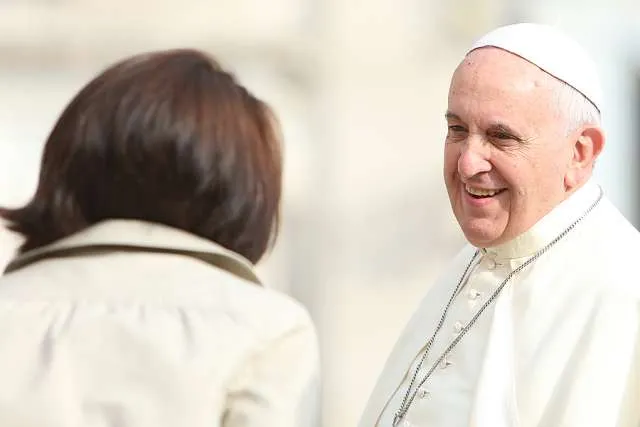
The last three popes — Benedict XVI, Francis, and Leo XIV — have on more than one occasion recommended reading “Lord of the World,” the dystopian science fiction novel written by Robert Hugh Benson in 1907.
This apocalyptic novel depicts the consequences of a society that turned its back on God and presents a social critique of the customs of the West, which has succumbed to capitalism and socialism.
Benson, an Anglican cleric who eventually converted to Catholicism and was ordained a priest in 1904, proposes a reality in which “the forces of secularist materialism, relativism, and state control triumph everywhere.”
This work, praised by the last three popes, also describes the arrival of the Antichrist as a charismatic personality but who also promotes ideals destructive to society.
Cardinal Joseph Ratzinger, the future Pope Benedict XVI, cited this work during a lecture he gave at the Catholic University of Milan in February 1992, stating that the work “gives much food for thought.”
It was also one of Pope Francis’ favorite books. During his meeting with the academic and cultural world as part of his apostolic journey to Budapest, Hungary, in April 2023, Francis explained that this work “shows that mechanical complexity is not synonymous with true greatness and that in the most ostentatious exteriority is hidden the most subtle insidiousness.”
For the Argentine pope, the book was “in a certain sense prophetic.” Although it was written more than a century ago, “it describes a future dominated by technology and in which everything, in the name of progress, is standardized; everywhere a new ‘humanism’ is preached that suppresses differences, nullifying the life of peoples and abolishing religions,” he said.
The original book cover of “Lord of the World” by Robert Hugh Benson. Credit: Public domain, via Wikimedia Commons
Specifically, he emphasized that in the society described in the book, all differences are eradicated, as opposing ideologies merge in a homogenization resulting in “ideological colonization — as humanity, in a world run by machines, is gradually diminished and life in society becomes sad and rarefied.”
Francis noted that in the novel, “everyone seems listless and passive, it seems obvious that the sick should be gotten rid of and euthanasia practiced, as well as national languages and cultures be abolished in order to achieve a universal peace.”
This idea of peace, however, “is transformed into an oppression based on the imposition of consensus, to the point of making one of the protagonists state that the world seems at the mercy of a perverse vitality, which corrupts and confuses everything,” Francis said in his address in the Hungarian capital.
Also, while criticizing ideological colonization, Pope Francis during a press conference he gave to the media on his flight back to the Vatican after his Apostolic Journey to Manila, Philippines, in 2015 recommended reading the book.
Cardinal Robert Prevost, before being elected Pope Leo XIV, also recommended the book in an interview given to the Augustinians from Rome. “It speaks about what could happen in the world if we lose faith,” Prevost explained.
He emphasized that Benson’s work contains passages that give a lot of food for thought “in terms of the world we are living in,” presenting challenges about the importance of “continuing to live with faith but also to continue to live with a deep appreciation of who we are as human beings, brothers and sisters, but understanding the relationship of ourselves with God and the love of God in our lives.”
Furthermore, the cardinal, who became Leo XIV on May 8, noted that his two predecessors had also cited this book on more than one occasion.
This story was first published by ACI Prensa, CNA’s Spanish-language news partner. It has been translated and adapted by CNA.
If you value the news and views Catholic World Report provides, please consider donating to support our efforts. Your contribution will help us continue to make CWR available to all readers worldwide for free, without a subscription. Thank you for your generosity!
Click here for more information on donating to CWR. Click here to sign up for our newsletter.
Swiss Guard cadets prepare their armor in the guards’ barracks at the Vatican on April 30, 2024. / Credit: Matthew Santucci/CNA
Vatican City, May 5, 2024 / 17:00 pm (CNA).
For the newest class of 34 Swiss Guards who will be sworn in on Monday, their service is based on faith and a love for the Church and the pope, as storied as the uniform itself.
“For me it was something, first and foremost, to give something to the Church, because the Catholic Church gave us a lot when I was a child and with this service, I can give something back,” explained Nicolas Hirt, one of the new guards who hails from the Swiss canton of Fribourg.
The cadets, joined by their instructors, gathered for a media event on April 30 in the courtyard behind the barracks adjacent to the Sant’Anna entrance, which was adorned with the flags from each of the Swiss cantons.
The Swiss Guard’s annual swearing-in ceremony will take place on Monday, May 6, in the San Damaso courtyard of the Apostolic Palace. There, the new guards will solemnly raise their right hands, with three fingers extended, representing the Holy Trinity, and proclaim their oath: “I swear I will faithfully, loyally, and honorably serve the Supreme Pontiff and his legitimate successors and I dedicate myself to them with all my strength. I assume this same commitment with regard to the Sacred College of Cardinals whenever the Apostolic See is vacant.”
Swiss Guard cadets drill at the Vatican on April 30, 2024. Credit: Matthew Santucci/CNA
There was a palpable sense of pride, perhaps even a hint of nervousness, as the young men marched last week in the storied corridors, perfecting the ancient rites ahead of a day that will mark a milestone in their lives.
Renato Peter, who comes from a small village near St. Gallen (the first from his village to enter the guards), said he first developed a desire to enter into the service of the papal guards after a trip to Rome in 2012 with his diocese.
“When you work in the Vatican, you have to feel like you go back in history because a lot of European history has been made here,” said Peter, who is mindful that those who wear the iconic tricolor uniform bear a great responsibility and represent a connection to the history of the Church.
“We are the smallest military in the world,” Peter continued, emphasizing that service in the Swiss Guards is like no other. “But, we are not training to make war. We are like the military, yes, but we’re for the security of the Pope.”
The Swiss Guard is indeed the smallest standing army in the world, numbering only 135 members (Pope Francis increased its ranks from 110 in 2018), protecting not only the smallest sovereign territory in the world, Vatican City State, but also acting as the personal security force of the Holy Father.
This year the Swiss Guard celebrated 518 years of service to the Apostolic See. Its history dates back to Jan. 22, 1506, when 150 Swiss mercenaries, led by Captain Kasper von Silenen from the central Swiss canton of Uri, arrived in Rome at the request of Pope Julius II.
But the swearing-in ceremony takes place on May 6, marking the anniversary of the Sack of Rome in 1527 by the Holy Roman Emperor Charles V when 147 guards died protecting Pope Clement VII.
The Swiss Guards form an integral part of the history of the papacy, and a core component of the security apparatus of the Vatican, but they also occupy a special palace in the popular imagination, one underscored by a profound spirituality.
“It’s another world, another culture, and above all doing a fairly unique job, that is to say, there is the protection of the Holy Father,” said Vice-Corporal Eliah Cinotti, spokesman for the guards.
“I don’t think there are many of us who are lucky enough to have the opportunity to serve the Holy Father in that way, therefore the Swiss Guard is a quite unique institution.”
Cinotti observed that for many of the pilgrims coming to Rome, which is often a once-in-a-lifetime experience, the guards act as a point of encounter between the people and the Church, shedding light on an evangelical dimension of their mission.
“Since we are Swiss Guards and represent the pope, we are also there to be Christians, to listen to these people. There is no specific training for this because it already comes from our Christian character to help others.”
Service in the Swiss Guards is both physically and psychologically demanding, and the entry requirements are strict, even though the guards do not face deployment to active war zones, like conventional soldiers.
A prospective guard must hold Swiss citizenship, be Catholic, single, and male (after five years in service the guards are allowed to marry), and be at least 1.74 meters tall (approximately 5’8”). They are required to have completed secondary school (or the equivalent) and have completed mandatory military service.
Despite what some may consider prohibitive entry restrictions, Cinotti noted, during the annual call for applications there are anywhere from 45-50 applicants, and there has not been a problem with recruitment.
During the first round, prospective candidates go through a preliminary screening and, if selected, they will sit with a recruitment officer in Switzerland for an initial interview, which generally lasts anywhere from 30 minutes to one hour. Candidates also have to undergo an intensive psychological test, to assess whether they can withstand the demands of the job.
Should their candidacy proceed, they are then sent to Rome where, for the first two months, they are exposed to the working environment of the Vatican, and around 56 hours of intensive instruction in Italian. Their instruction also includes an emphasis on their cultural and spiritual formation.
Swiss Guard cadets inspect their armor in their barracks at the Vatican on April 30, 2024. Credit: Matthew Santucci/CNA
The cadets are then sent to the Italian-speaking canton of Ticino in Switzerland, where they are instructed in self-defense and the use of firearms by local police. While the guards carry medieval halberds — an ax blade topped with a spike mounted on a long shaft — during official papal events, each is equipped with a 9mm GLOCK 19 Gen4 pistol, taser, and pepper spray.
There is also a two-year minimum service requirement after which they can decide to remain, or return to Switzerland.
“About 80% return to Switzerland and 20% stay,” Cinotti said. “And the 80% who return to Switzerland go to the police or the army or return to their basic profession or go to study at university.”
He also noted there have been some years where a guard will discern a vocation to the priesthood. “And we also had a certain point, people who entered the seminary at the time, one per year more or less.”
He added: “We haven’t had anyone for two years, but I think they will arrive, or rather it’s a question of vocations.”
Swiss Guards stand in the middle of Paul VI Hall during Pope Francis’ general audience on Jan. 10, 2024. Credit: Vatican Media
Cinotti spoke on the myriad security challenges that a guard will have to face in his day-to-day work, which can last anywhere from six to 12 hours of continuous duty, noting that there has been an uptick in the number of people coming to the Vatican for help.
Cinotti also noted that for all of the guards, there has been the additional learning curve of adapting to Pope Francis’ pastoral style, which has brought him in close proximity to the faithful during his audiences in Rome and his travels abroad.
“Pope Francis is like every pope,” Cinotti remarked. “He has his own style, and we must adapt to the pope.”
“If he wants to go to contact the people of God, we must guarantee that, of course, everything is fine, but we cannot prevent it. He does what he wants, he is the pope,” he added.
While this can raise some logistical problems, Cinotti reassured that the guards have been trained to respond to possible threats. He said they have developed a symbiotic, and always professional, relationship with Francis.
“He transmits a certain serenity and a certain awareness that we are there next to him, we are there, like the gendarmerie, which allows us to operate in complete tranquility on the ground without being disturbed,” he said.
“He likes to change plans and will change plans throughout the day,” Cinotti added, “but it suits us very well because we adapt to him and we do this service and for us, it is still important to guarantee his safety.”
Vatican City, Mar 2, 2017 / 11:47 am (CNA/EWTN News).- In his prayer video for March, Pope Francis prays for persecuted Christians, asking for the prayers and aid of the whole Church toward those mistreated on the basis of their beliefs.
“How many people are being persecuted because of their faith, forced to abandon their homes, their places of worship, their lands, their loved ones!” the Pope says in the video.
Released March 2, the video shows people from different countries being photographed as if arrested, then holding up signs reading “Protestant,” “Catholic,” and “Orthodox.”
“They are persecuted and killed because they are Christians,” the Pope says. “Those who persecute them make no distinction between the religious communities to which they belong.”
The video continues with real footage of destroyed churches in the Middle East, followed by clips of adults and children praying in a church, at home, and at a school, and people packing up food at a food bank, as the Pope asks: “how many of you pray for persecuted Christians?”
“Do it with me, that they may be supported by the prayers and material help of all the Churches and communities.”
An initiative of the Jesuit-run global prayer network Apostleship of Prayer, the Pope’s prayer videos are filmed in collaboration with the Vatican Television Center and mark the first time the Roman Pontiff’s monthly prayer intentions have been featured on video.
The Apostleship of Prayer, which produces the monthly videos on the Pope’s intentions, was founded by Jesuit seminarians in France in 1884 to encourage Christians to serve God and others through prayer, particularly for the needs of the Church.
Since the late 1800s, the organization has received a monthly, “universal” intention from the Pope. In 1929, an additional missionary intention was added by the Holy Father, aimed at the faithful in particular.
Starting in January, rather than including a missionary intention, Pope Francis has elected to have only one prepared prayer intention – the universal intention featured in the prayer video – and will add a second intention focused on an urgent or immediate need if one arises.
According to a report released in January, global persecution of Christians has risen for the fourth year in a row and is on a “rapid rise” in Asia.
The advocacy group Open Doors UK warned in its annual report on Christian persecution, released Jan. 12, that “Persecution levels have been rising rapidly across Asia and the Indian subcontinent, driven by extreme religious nationalism which is often tacitly condoned, and sometimes actively encouraged, by local and national governments.”
Overall persecution of Christians has risen from last year, Open Doors UK noted, stating that “Christians are being killed for their faith in more countries than before.”
“Christians living in these countries need the support of their family, the body of Christ, to help them stand firm in their faith,” they stated.
Pope Benedict XVI revealed in a letter to his biographer that insomnia was the "central reason" why resigned in 2013. / Paul Badde/CNA
CNA Newsroom, Jan 29, 2023 / 07:15 am (CNA).
According to papal biographer Peter Seewald, chronic i… […]
4 Comments
We can draw myriad allusions from the three Roman pontiffs. First, Vladimir Soloviev who preceded Fr Hugh Benson both had a virtual like vision of a highly intelligent, charismatic Antichrist with a globalist agenda.
Great Britain and Romanov Russia politically similar and highly cultured produced two similar minded Christian men who envisioned the collapse of religion in competition with a then rapidly becoming industrial political landscape. Could be Fr Benson borrowed from the well known presumed convert to Catholicism Soloviev. Indeed, both were converts. If Soloviev remained Russian Orthodox he was widely known to be an admirer of Catholicism.
Russian Orthodoxy and Roman Catholicism have an innate global vision and call to expand globally differentiating them from other Christians. Soloviev and Benson perceived the technical industrial society as the bete noire of Christianity drawing the sedate Christian into its orbit. Which in one way or another occurred. So the AntiChrist guy would expectedly be a form of high tech genius with a bent toward religiosity. Can Soloviev and Benson be wrong?
Lucifer is optimally clever. From that premise of the unpredictable there are a slew of what ifs. What if for example he or she? [I say she because they’re some progressive sisters who frighten me] were to find a home and emerge from a religion?
No one else seems interested in commenting on a relevant subject matter, Lord of the World referring not to Christ, rather either a form of or the actual Antichrist. Why a woman? I spoke sarcastically of frightening progressive sisters. Wasn’t it a woman who was responsible for getting Mankind into the mess it finds itself in?
A Tolkien Rings character entered my imagination with mention of fearsome sisters. Galadriel. Tempted by the ring. “In place of a Dark Lord you would have a Queen! Not dark but beautiful and terrible as the Dawn! Treacherous as the Seas! Stronger than the foundations of the Earth! All shall love me and despair!”
Woman is man’s other self. Which is why Apostle Paul says a man who loves his wife loves himself. “So husbands ought also to love their own wives as their own bodies. He who loves his wife loves himself” (Ephesians 5:28).
Peter adds, “Wives, in the same way, submit yourselves to your own husbands so that, if any of them do not believe the word, they may be won over without words by the behavior of their wives, when they see the purity and reverence of your lives. Your beauty should not come from outward adornment” (1 Peter 3). Both great Apostles in their insights tailor charisma of the perfect woman the Church will come to recognise in Mary.
We can draw myriad allusions from the three Roman pontiffs. First, Vladimir Soloviev who preceded Fr Hugh Benson both had a virtual like vision of a highly intelligent, charismatic Antichrist with a globalist agenda.
Great Britain and Romanov Russia politically similar and highly cultured produced two similar minded Christian men who envisioned the collapse of religion in competition with a then rapidly becoming industrial political landscape. Could be Fr Benson borrowed from the well known presumed convert to Catholicism Soloviev. Indeed, both were converts. If Soloviev remained Russian Orthodox he was widely known to be an admirer of Catholicism.
Russian Orthodoxy and Roman Catholicism have an innate global vision and call to expand globally differentiating them from other Christians. Soloviev and Benson perceived the technical industrial society as the bete noire of Christianity drawing the sedate Christian into its orbit. Which in one way or another occurred. So the AntiChrist guy would expectedly be a form of high tech genius with a bent toward religiosity. Can Soloviev and Benson be wrong?
Lucifer is optimally clever. From that premise of the unpredictable there are a slew of what ifs. What if for example he or she? [I say she because they’re some progressive sisters who frighten me] were to find a home and emerge from a religion?
No one else seems interested in commenting on a relevant subject matter, Lord of the World referring not to Christ, rather either a form of or the actual Antichrist. Why a woman? I spoke sarcastically of frightening progressive sisters. Wasn’t it a woman who was responsible for getting Mankind into the mess it finds itself in?
A Tolkien Rings character entered my imagination with mention of fearsome sisters. Galadriel. Tempted by the ring. “In place of a Dark Lord you would have a Queen! Not dark but beautiful and terrible as the Dawn! Treacherous as the Seas! Stronger than the foundations of the Earth! All shall love me and despair!”
Woman is man’s other self. Which is why Apostle Paul says a man who loves his wife loves himself. “So husbands ought also to love their own wives as their own bodies. He who loves his wife loves himself” (Ephesians 5:28).
Peter adds, “Wives, in the same way, submit yourselves to your own husbands so that, if any of them do not believe the word, they may be won over without words by the behavior of their wives, when they see the purity and reverence of your lives. Your beauty should not come from outward adornment” (1 Peter 3). Both great Apostles in their insights tailor charisma of the perfect woman the Church will come to recognise in Mary.
For the past few years, the periodical “Inside the Vatican” has included installments of Benson’s “The Lord of the World.”
Here’s a beautiful edition: https://www.exfontibus.com/products/benson-lord