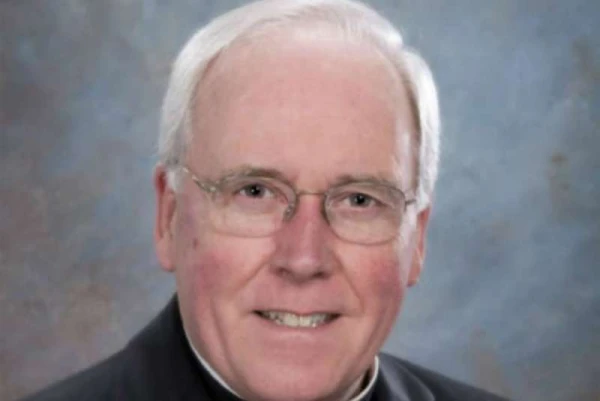
New York City, N.Y., Sep 11, 2019 / 10:59 am (CNA).- Amid calls for his resignation, Bishop Richard J. Malone of Buffalo remains firm in his conviction not to step down from office, even as Cardinal Timothy Dolan of New York assesses whether to open an investigation into Malone’s alleged mishandling of abuse cases.
“Cardinal Dolan has been following the situation in Buffalo very carefully. He is aware of his responsibilities under Vos estis lux mundi, he has been consulting extensively both with individuals in Buffalo, including Bishop Malone, clergy and laity,” Joseph Zwilling, communication director for the New York archdiocese, told CNA in a Sept. 10 interview.
“He has been in touch with the nuncio, and with the Holy See. So he has been remaining on top of it, and I expect that we will hear something, some development sometime in the near future,” Zwilling continued.
Malone took the reigns in Buffalo in 2012. Though no allegations of abuse have been made against Malone, he has recently faced accusations of mishandling or covering up accusations of clerical sexual abuse by priests in the diocese.
Vos estis lux mundi, Pope Francis’ new norms which came into force in June, puts “metropolitan” archbishops in charge of investigations into suffragan bishops, with authorization from the Holy See required.
The motu proprio also calls for an investigation into “actions or omissions intended to interfere with or avoid civil investigations or canonical investigations, whether administrative or penal, against a cleric or a religious.”
In this case, Cardinal Timothy Dolan of the Archdiocese of New York is Malone’s metropolitan archbishop.
“I can’t tell you exactly when, or what the development will be, but I would expect there to be some kind of development in the near future.”
A Buffalo lay group called the Movement to Restore Trust (MRT), which Malone considered an ally after it formed in 2018, on Sept. 5 joined the call for Malone’s resignation.
MRT is calling for the Vatican to appoint a temporary diocesan administrator with no ties to the Diocese of Buffalo while considering the appointment of a permanent bishop.
“Bishop Malone was looking forward to continuing to cooperate with the MRT and regrets that the work will now have to be done without their assistance,” the diocese said in a subsequent statement.
Malone has admitted that he has made mistakes in the past, but denies any criminal wrongdoing and says he will not resign.
Of what is Malone accused?
At least two whistleblowers with high-level access in the diocese— Malone’s former executive assistant and former priest secretary— have gone public with accusations that Malone mishandled several cases of sexual abuse by priests in the diocese, some of which involved minors.
One such case is that of Father Fabian Maryanski, whom a now 50-year-old woman accused of sexually abusing her beginning when she was 15. She reported the abuse in 1995, but a letter from the victim’s attorney seemed to suggest that the woman was in her twenties when the abuse occurred.
The diocesan victim compensation panel found her story believable and offered her compensation, but Bishop Malone said last year that there was still confusion about whether the victim was a minor at the time of the abuse.
As of Jan. 2019, Maryanski’s name was not included on the diocesan page of credibly accused clergy, but it has since been added. Maryanski was removed from ministry last year.
In another case, Father Robert Yetter garnered three sexual harassment complaints. Malone and Grosz reprimanded Yetter, and placed him on “voluntary leave,” WKBW reported late last year. Because the case did not involve minors, the diocese does not publicly list Yetter’s name.
Malone has also faced questions about his handling of the case of Fr. Art Smith, whom Malone’s predecessor Bishop Edward Urban Kmiec placed on leave in 2011, after the mother of a boy at St. Mary of the Lake school complained that the priest was sending inappropriate Facebook messages to her son.
Malone reinstated Smith to ministry in 2012, after the accused priest spent time in a Philadelphia treatment center, according to an investigation by local news station WKBW.
“Maybe I could have looked at it in a different way,” Malone said last November.
“We had decided with Art Smith— because, again, the Facebook incident did not rise technically to be sexual abuse— to keep him in some limited ministry,” Malone told WBEN.
Malone pointed out that he did not again assign Smith to a parish setting. Despite this, the WKBW investigation revealed that while working in nursing home, Smith heard confessions at a diocesan Catholic youth conference attended by hundreds of teenagers in 2013. There were also reports of inappropriate conduct with adults in the nursing home.
“That backfired, too, because even sending him to work in a nursing home…nothing happened with children, but there were some inappropriate actions with adults. So we were dealing with him, but not in a way that I would do now. I admit my failure there,” the bishop said.
He also signed off to allow Smith to become a chaplain on a cruise ship in 2015, and the bishop said now he is “kicking [himself] for that.”
Smith is currently listed on the diocesan page for clergy with substantiated claims of sexual abuse of a minor.
Malone has since suspended a number of clerics, including in Nov. 2018 a young priest from south of Buffalo for alleged sexual misconduct with an adult woman. Most recently, on Sept. 7, the diocese announced that allegations of abuse of a minor against Father Louis S. Dolinic had been substantiated and the priest would remain on administrative leave while the Vatican made a final determination.
In August 2018, WKBW published an investigative report revealing that Malone’s former executive assistant, Siobhan O’Connor, leaked internal diocesan documents to the press which suggested that Malone worked with diocesan lawyers to avoid releasing publicly the names of some diocesan priests accused of misconduct.
Several of the allegations involved boundary violations or sexual misconduct against adults, meaning that the diocese was not required to take action against them in the same way that it would allegations of sexual abuse of minors, under the 2002 Charter for Protection of Children and Young People.
Malone said that while he sought to follow the Charter’s requirements, he “may have lost sight of the Charter’s spirit, which applies to people of all ages.”
O’Connor has been continually calling for Malone’s resignation.
“Be truthful with us, Bishop Malone. Put an end to this toxic secrecy and painful silence,” she wrote in a Nov. 4, 2018 op-ed in The Buffalo News.
“And, if you love us, begin the process of allowing new episcopal leadership to come to our diocese.”
In Sept. 2019, WKBW released recordings of private conversations between Bishop Malone and Fr. Ryszard Biernat, Malone’s former priest secretary, which appear to show that Malone believed sexual harassment accusations made against a diocesan priest months before the diocese removed the priest from ministry.
Biernat recorded the conversations as the bishop discussed how to deal with accusations against Fr. Jeffrey Nowak by then-seminarian Matthew Bojanowski, who accused Nowak of grooming him, sexually harassing him, and violating the Seal of the Confessional.
In an Aug. 2 conversation, Malone can reportedly be heard saying, “We are in a true crisis situation. True crisis. And everyone in the office is convinced this could be the end for me as bishop.”
In one conversation from March, Bishop Malone seems to acknowledge the legitimacy of Bojanowski’s accusation against Nowak months before the diocese removed Nowak from active ministry.
Despite this assessment, Nowak was not removed from ministry until Aug. 7, one day after the seminarian’s mother accused Malone of allowing Fr. Nowak to remain in ministry despite the allegations against him.
Biernat says he made the secret recording after Nowak became jealous of Biernat and Bojanowski’s close friendship. According to a conversation taped Aug. 2, the bishop was concerned that media coverage would focus on a possible “love triangle” between Nowak, Bojanowski, and Biernat.
Biernat also says he was a victim of sexual abuse by Father Art Smith. He alleges that Auxiliary Bishop Grosz threatened to halt his ordination as a priest and have him deported to Poland after Biernat complained in 2004 to Buffalo Diocese administrators that he was sexually assaulted by a priest, according to The Buffalo News.
Grosz has since “categorically” denied the claim.
Reaction in Buffalo
Malone is remaining firm that he will not step down. He reiterated his conviction that he will remain as bishop in a Sept. 6 interview with WBEN Radio.
A lay-led petition calling for his resignation has garnered nearly 10,000 signatures as of press time. A number of clergy have written open letters to local publications calling for Malone’s resignation.
Father Robert Zilliox, of St. Mary’s Catholic Church, drafted a letter in early September calling for Malone and Auxiliary Bishop Grosz to resign.
“We, the People of God that constitute our diocese, are angry, hurt, and in need of authentic, humble, sincere and holy spiritual leadership. We believe that despite your good work in the past you are no longer able to provide that leadership,” the letter reads, as quoted by WKBW.
In mid-August 2019, twenty-two plaintiffs filed a lawsuit against the Diocese of Buffalo, a province of the Society of Jesus, multiple priests, eight parishes, three high schools, a seminary, among others, alleging “a pattern of racketeering activity” that enabled and covered up clerical sexual abuse.
The lawsuit was filed on the first day of a legal “window” allowing for sexual abuse lawsuits to be filed in New York even after their civil statute of limitations had expired.
Among the plaintiffs, who have not been publicly named, are several alleged victims of clerical sexual abuse. The lawsuit alleges specific instances of sexual abuse by priests, and claims that the diocese failed in its duty of care towards children by allowing abusive priests to have contact with minors through parishes and schools.
Calling the diocese and affiliated organizations an “association in fact” for the purposes of federal racketeering laws, the suit alleges “common purpose” in “harassing, threatening, extorting, and misleading victims of sexual abuse committed by priests” and of “misleading priests’ victims and the media” to prevent reporting or disclosure of sexual misconduct.
 […]
[…]






What a journey. All have gathered to sow what was planted. To share the harvest of what grew. To remind us that allare called to go together, Synodaling into the future, following Franciscus. We have style, an attitude, etc., and so on, and so forth.
While time did not permit Leo to stay for the entire afternoon session, it’s grand that they got a few photos before the Pope had to press on…
Synodaling is like a flash mob, eating Tide pods, wearing baggy bell bottoms, sporting a mullet, bowl cut or rat tail. Synodaling is similar to collecting Pet Rocks, Silly Bandz, Pokémon Cards, Chia Pets, Cabbage Patch Kids or Beanie Babies. Synodaling looks like planking or gatherings to each try and solve Rubin’s Cube.
A style and attitude, Holy Father? With respect, did not the Church discover that originally at it’s birth, so what is need for synodality?
Are we witnessing the maturation of Synodality, the finessed articulation of the premises advanced in Amoris Laetitia? Or are we not?
We read of synodality “as a style, an attitude that helps us to be Church.”
Surely, too, as Pope Benedict explained in 1985 (The Ratzinger Report), that even “a Council [or synod] is what the Church DOES, not what the Church IS [as in “TO BE Church”]. So, not a radical deconstruction of governance as with an “inverted-pyramid.”
A subtle memo, here, to post-synodal study groups #9, #14 and #15 on the “hot button issues,” to possibly edit their recent homework (#9: “Theological criteria and synodal methodologies for shared discernment of controversial doctrinal, pastoral, and ethical issues;” #14: “the synodal method;” and #15: “the ‘place’ of the synodal Church in mission.”)
Instead, yes, a valued but clearly defined attitude or style “…promoting authentic experiences of participation and communion.” But not a process to displace the accountable Apostolic Succession with a town-hall non-structure of governance. The distinct “Synod of Bishops… naturally retains its institutional physiognomy.” Likewise the “local Churches.”
What’s not to like about Leo’s succinct and papal style of “walking together” within the acknowledged “hierarchical communion” of the Council (Lumen Gentium)?
It’s prudent and virtuously hopeful to interpret Leo XIV as you have. Some of the wisest say give the man some time. Although on the other hand it’s surprising as you allude to saying ‘What’s not to like’ that so many here who were hoping for a new pontificate and return to clarity and fidelity are roundly disappointed.
Yes, indeed! There’s a very troubling phenomena occurring with Leo, in which people are claiming he’s very different from Francis but they read things into what he says or look at some singular thing he did 10 years ago to justify their view. If Leo was trying to somehow dismiss synodality, he should actually be doing something to dismantle it, but he’s only been encouraging it, including using the same fluffy, vagueness. We’re at a very dangerous point of now accepting the bad things Francis put in place, because we don’t have the nastiness and such that accompanied it, while Leo has resumed some traditional aspects of the papacy. We just want to breathe a sigh of relief and be satisfied with the absence of the outright hostility Francis gave us. As far as substantial actions of Leo go, they’re mostly problematic, e.g., the kind of people he’s been appointing as bishops or officials at the holy see. Even more, we must look at what’s not being done, which is any reversal from Francis. We can’t continue to say “give him time” much longer, as he’s had plenty already to do negative things, e.g., he took time to assign various heterodox cardinals/bishops as advisors to a vatican dicastery this past week, so he could just as well have done something about other vatican posts/people, but he didn’t. And obviously if those are the types he’s appointing, it’s even more doubtful he’ll be replacing Fernandez, Grech, hollerich, Roche(he was one of the above mentioned appointments!) This is even more so as there was no pressing need to do the former.
“Indeed, you are here because the assembly has recognized you as credible interpreters of synodality.”
I can only conclude that I have not only missed this train, but I have bought the wrong ticket at the wrong station for the wrong destination.
I understand that the definition of synodality is that it is a “journey.”
I have missed the critical connections of this “journey” in regard to its starting point, its destination and most important of all, how this synodal journey connects to Jesus Christ, who is the ONLY Way, Truth and Life.
Since Jesus Christ, Sacred Scripture and the Magisterium have given us the fullness of Divine revelation, I am at a loss to understand what the purpose of this “synodal journey” is, and what it is supposed to give the One, Holy, Catholic and Apostolic Church that it must have been sorely lacking up until the pontificate of Francis I.
The unfathomable ambiguity of synodality frightens me, and my instincts tell me to flee from this.
The people who support synodality make me feel uneasy.
For now, I can do nothing but to keep my distance and watch to see what unfolds. My faith and trust is in Christ.
The synodalists have much to do in order to win me over.
“Helps us to be Church.”
That is bureaucrat-speak.
The same phrase jumped out at me as well, Chris — “Helps us be Church.”
Because somehow I didn’t realize the word, “Church,” was an adjective.
I thought it was a verb.
Which would mean, “Helps us to be Church,” becomes, “Helps us to Church.”
And so we become “Churchers,” or, perhaps, “people who Church.”
The Dark Vatican remains dusky, even months after Bergoglio’s departure.
Yes.
It all sends a message “We’re not serious people.”
Exactly. It is the tone used by effeminate men trying to be “hip.”
Modernist double speak.
Well, if it’s a style and an attitude, it isn’t a binding structure, so I’d call Leo’s description an improvement.
Bingo!
“… the current pontiff said. “And the legacy he [Pope Francis ] has left us seems to me to be above all this: that synodality is a style, an attitude that helps us to be Church, promoting authentic experiences of participation and communion.””
It is quite self-descriptive. A style, especially in our time of post-modernism, has no life in itself; give me a bunch of flowers and I can arrange them in many different styles, from baroque to minimalism. Alternatively, I can just trim their stems and put them, unadorned, into the plane glass jar. They still will be the flowers, with their unique life or “flower-substance”, as God designed them. The best style of arranging them is the one which considers that peculiar “flower-substance” and highlights it.
This is why a style is always subordinate to the essence of the phenomenon; a style without the substance (meaning) is meaningless and empty.
As I see it, this principal is true for the Church as well. If it is so, before defining any “style” of whatever the Church does, one must define the core of the Church first, especially its Head, Christ. What “style” would be appropriate for Christ and his Church?
However, the reference to Christ and His Church (not just “church” but “Christ’s Church”) immediately shows that the word “style” does not go well with Christ somehow, probably because it lacks the substance and also because Our Lord never thought and thought in terms of “style”. Pope Leo adds to the word “style” the word “attitude”. It improves the situation a bit, but then he says that the attitude is for “promoting authentic experiences of participation and communion.” The ultimate purpose of “experiences of participation and communion” seems to be a promotion of so-called “synodality” that is “a style”. Or is it that “a style’s = synodality’s” ultimate purpose is to promote “authentic experiences of participation and communion”? I think so; I think I have just come up the most “coherent” explanation of what synodality is. It is an attitude which promotes some “experiences of communion”. There is probably some style in it but no substance whatsoever.
Why am I so certain? Simply because there is only one way “to experience communion” with each other. It is done via partaking from the Chalice and becoming one via Christ. I have to correct myself here: it is a true communion with the other via Christ, not “an experience” of such. Whether we have subjective experiences of that communion or not is quite irrelevant because it is the objective divine action of Christ in us (he is the guarantor of that communion truly happening). As a response to that action, the next step for everyone is to practice an attitude to the other as to A PERSON. An attitude to a person means respect, seeing, hearing, interacting meaningfully and so on. It is often difficult and this is why we need Christ to act in us. This is it. It is not a “style” but a ground reality. It is not about “experiences”. It is about receiving Christ and treating others as He wants us to: not lying and deceiving, not abusing, not brushing off, not devaluing, not trying to use the other for self-satisfaction and so on. And this is all to that. (NB: this true attitude to each other in truth can be very uncomfortable for the other who used to lies; Christ did it and this is why He was not universally liked.)
I have no doubts that one may experience synodality-related activities as “authentic experiences of participation and communion”. However, what are the fruits of those “communion and participation”? The true fruits should be doing away with all that is against that “communion and participation”, namely doing away with all kinds of abuse within the Church (including liturgical), stopping unjust prosecution of the members of the organization which “communes and participates”, weeding out all that is contrary to its Head, Christ. The problem is that it cannot be done “in style”.
Yes. He’s opening up his mindset with catch or buzzwords. Trivializing slogans as you suggest don’t fit well with Christ. Who is our creator, savior, and treasure.
While still early in his Pontificate, Pope Leo is beginning to sound like cross between Pope Francis and fellow Chicagoan-turned-citizen-of-the-world, Barak Obama.
You beat me to it. I was going to say the same thing. “Catholic” Democrat politicians are all breathing a big sigh of relief. Here is a man who speaks their language.
Leo didn’t have time to stay for the whole session?
“… helps us to be Church.” Fabulous. Right out of the 1970s. Francis II is going to be such a terrific pope.
I tend to see attitude and style as less than essential substance. How does Leo define those words? Attitude and style may reflect authentic essence, but they may also screen nothing more than smoke.
Pro-NO liturgist lovers commenting at CWR this past week raged most notably about the attitude and clothing styles of TLM-ers.
Il ne faut pas se fier aux apparences.
I HOPE that Leo’s words about attitude and style simply reflect him biding his time, taking the temperature of those ‘people of God’ around him. He seems a somewhat cautious and prudent character.
Are we hoping against hope or are we seeing into the darkness something truly sinister?
A test of your last sentence may likely be his response to Cdl Raymond Burke’s request for a reversal of Traditionis Custodes and a return to Summorum Pontificum. Progressive Bishops are rapidly prohibiting the TLM in their dioceses.
Leo XIV by calling Synodality a ‘style, an attitude’ attempts to change the actual meaning of Synodality as previously professed as a Synodal Church. He fails in doing so because the manner in which the Synod continues to exercise its function hasn’t changed.
What is Synodality in essence if not a glorified, glorified by universality, parish council? As were the early parish councils, more deliberative than consultative, composed of laity and clergy the former frequently given prominence. Why should it be deemed deliberative when it’s been described as consultative? The end. If we continue to debate permanent doctrine it no longer remains permanent doctrine.
Repeated here is a segment from my comment to the article ‘Synodality is the result of a theological error: Küng vs. Ratzinger 2.0’.
“Essentially, the Church is not a consultative assembly, but rather an assembly around the Word of God and around the Sacrament” (Msgr Grichting). Fr Hans Kung was a close associate of Cdl Carlo Martini Archbishop of Milan who initially devised and promoted the concept of Synodality, a restructuring of the Church as a permanent consultative body formulated at St Gallen Switzerland. Francis I when archbishop of Buenos Aires was mentored by Cdl Martini.
In matters of faith and theological reflection, I am drawn to discourse characterized by lucidity and directness. The use of convoluted or ambiguous language, often termed “word salad,” is not conducive to authentic engagement, as it tends to obscure rather than illuminate the truths being presented. My own disposition, perhaps characterized by a certain theological simplicity, finds such linguistic opacity profoundly unhelpful, bordering on an impediment to spiritual discernment. I would earnestly request a return to the plain and accessible forms of expression found in centuries of English or French theological tradition.
The initial anticipation surrounding the current pontificate is regrettably diminished by the perception of continuity with methodologies that, under the preceding pontiff, ultimately proved to be counterproductive to the Church’s mission. This echo of past strategies evokes a measure of profound disappointment.
Chris in Maryland above – Who is your “bingo” for?
I’m with Rich Leonardi.
I say we give Leo some time. He can’t really come out and say, “You guys are full of hot air. Go home.”
Sure he can. He is the Pope. He just has to have an ounce of common sense and courage.
Any day now, Where Peter Is will be explaining to us that the Pope’s troubling statements are really just faulty translations from his native tongue.