




Vatican City, Jun 22, 2025 / 08:22 am (CNA).
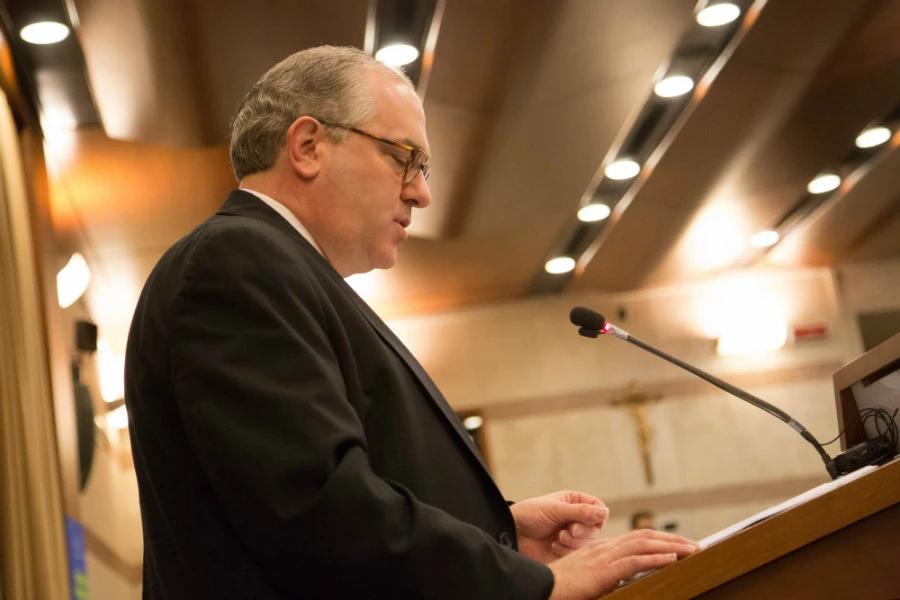
Reacting to what he called the “alarming news” of U.S. airstrikes on nuclear facilities in Iran, Pope Leo XIV on Sunday pleaded with the international community “to stop the tragedy of war before it becomes an irreparable abyss.”
“Today more than ever, humanity cries out and pleads for peace,” the pope said, in remarks following his Angelus reflection June 22, adding that the cry “must not be drowned out by the roar of weapons or by rhetoric that incites conflict.”
U.S. President Donald Trump announced on Saturday night that the U.S. had “obliterated” Iran’s main nuclear sites massive bunker busting bombs. Iran responded by launching a volley of missiles at Israel. Scores of civilians were wounded in a missile strike in Tel Aviv, Reuters reported.
Speaking to pilgrims gathered in St. Peter’s Square from a window in the Apostolic Palace, Leo framed the attacks, which have escalated the conflict between Israel and Iran, within the broader context of regional conflicts.
“In this dramatic scenario, which includes Israel and Palestine, the daily suffering of the population — especially in Gaza and other territories — risks being forgotten, even as the urgency for proper humanitarian support becomes ever more pressing,” he said.
“There are no distant conflicts when human dignity is at stake,” he said. “War does not solve problems — on the contrary, it amplifies them and inflicts deep wounds on the history of nations that take generations to heal.”
The pope also evoked the most heartbreaking human toll of violence. “No armed victory can make up for a mother’s grief, a child’s fear, or a stolen future.”
Finally, he renewed his call for diplomacy and commitment to peace: “Let diplomacy silence the weapons; let nations shape their future through works of peace, not through violence and bloody conflict.”

In his catechesis prior to the Angelus on Sunday, the feast of Corpus Christi, Pope Leo XIV focused on the deep meaning of the Eucharist and the value of sharing.
Reflecting on the day’s Gospel, which recounts the miracle of the loaves and fishes (cf. Lk 9:11–17), he said that “God’s gifts, even the smallest, grow whenever they are shared.”
Pope Leo XVI noted that the supreme act of sharing was “God’s sharing with us.”
“He, the Creator, who gave us life, in order to save us asked one of his creatures to be his mother, to give him a fragile, limited, mortal body like ours, entrusting himself to her as a child,” the pope said. “In this way, he shared our poverty to the utmost limits, choosing to use the little we could offer him in order to redeem us.”
God’s generosity is especially manifested in the gift of the Eucharist, the Holy Father said.
“Indeed, what happens between us and God through the Eucharist is precisely that the Lord welcomes, sanctifies and blesses the bread and wine that we place on the altar, together with the offering of our lives, and he transforms them into the Body and Blood of Christ, the sacrifice of love for the salvation of the world,” Leo said.
“God unites himself to us by joyfully accepting what we bring, and he invites us to unite ourselves to him by likewise joyfully receiving and sharing his gift of love,” he added. “In this way, says Saint Augustine, ‘just as one loaf is made from single grains collected together … so in the same way the body of Christ is made one by the harmony of charity.’”
The pope was scheduled to celebrate Mass for the feast of Corpus Christi at 5 p.m. Sunday, followed by a eucharistic procession through the streets of Rome.
If you value the news and views Catholic World Report provides, please consider donating to support our efforts. Your contribution will help us continue to make CWR available to all readers worldwide for free, without a subscription. Thank you for your generosity!
Click here for more information on donating to CWR. Click here to sign up for our newsletter.


Your Holiness;
Israel only attacks specific targets of military value, and it warns the residents beforehand to give them time to evacuate the area.
Iran, on the other hand – has no problem with TARGETING CIVILIANS. It is, in fact one of their commonly used strategies. E.G. – In their retaliation last night they sent missiles which killed 86 people, and a goodly number of them were residents of an Old Folks’ home.
In any case I understand that in your position you have to speak like this.
I agree with you entirely. Iran has been a terrorist nation for years. We do not discipline (i.e., help change the behavior) unruly or “mean” children by being sweet to them and allowing them to continue to terrorize others. We discipline them, we punish them and make their lives uncomfortable so that they have a motive to stop misbehaving. Yes, we take them to behavioral specialists who sometimes discover physical, mental, or psychological conditions, or environmental conditions (e.g., abusive relative) that causes the child to behave in an unacceptable and “violent” way and we can help that child in various ways (counselling, meds, different schooling, etc.), but often, a child who acts out does so because he/she has been allowed the power to do so by wimpy parents, teachers, etc. And if they are not “stopped” and helped to change their ways, these kids will often grow up to be poor and/or criminals.
We give tickets and occasionally incarceration to people who break traffic laws or other laws of the land–we don’t just overlook it as “their personality” or “their culture.” When someone murders someone, we don’t just say, “He or she had a troubled past.” Yes, sadly, they often did, but that does NOT excuse their horrific behavior. MANY people have a “troubled past”, but they manage to pull themselves out of despair and become good citizens who do much to help their fellow man.
We can’t allow criminals to terrorize our land.
And we should not tolerate national leaders and nations that terrorize their own people along with other nations and put the entire world in danger of planet-wide conflict. We need to teach Iran (or at least the leaders) to “behave” like civilized world citizens and hold them accountable for their many past crimes against humanity.
Pres. Trump gave Iran plenty of warning–it wasn’t a “surprise attack”. They had plenty of chances to change their ways, and they chose to thumb up their noses at the U.S. and other nations and continue their cruel, uncivilized ways in the name of their “religion”. Many Muslims and Muslim nations ARE peaceful, so the “religion” is not telling them to do this awful stuff. It’s the leaders who value power over human life, even the lives of their own people.
Good for Pres. Trump and our American military!
Mrs. Sharon Whitlock: you couldn’t be more correct in what you’ve written here. Our granddaughter just graduated from elementary school. We gifted her with the trilogy Kristen Lavransdatter and in each book we wrote: “The life you have tomorrow will be determined by the choices you make today.” We need to end this ethos that tells everyone they’re a victim and that others reward them on account of it.
We read: “Let diplomacy silence the weapons; let nations shape their future through works of peace, not through violence and bloody conflict.”
Absolutely. In a barbaric age we’re periodically on the brink, and yet globally we’re also like ships passing in the night. In the entirely different context of domestic parties or government agencies at odds with each other, there’s the well-developed path of formal mediation.
Four points:
FIRST, assuming that the parties are symmetrical, potential mediators point to nine criteria which must be met in order to be even eligible for promising mediation. Two of these criteria are that “the issue must be ‘ripe'” (#3, meaning that mediation resolves conflict and does not avert conflict); and that the “agencies [of the same government] are at a point where decisions and actions are ‘needed'” (#7). So far, so good, but criterion #4 is that “‘delay’ serves none of the parties”…
SECOND, this is not to diminish in any way Pope Leo XIV’s plea of reason, but it does admit to complicated communication between a Western culture still rooted somewhat to the incarnational coherence of faith & reason, and the different governments/regimes of a fideistic and non-Trinitarian culture still tied to the non-Western 7th Century. We might be also reminded of the varied understandings of “mokusatsu” by which Bushido Japan either diplomatically “withheld comment” on the final and problematic demand for “unconditional surrender,” or else signaled only to its own captive population that the ultimatum was “unworthy of public notice” (the response was received only as a decoded intercept).
THIRD, these comments, here, are barely even academic and are taken from quite different contexts. Still, in simply trying to decode the Islam world—meaning to understand sectarian and often mutually conflicted Muslim minds (plural)—yours truly, as an un-credentialled layman, now pulls from my shelf a still mostly unread copy of an Islamic compendium: Abdul Aziz Said, Nathan C. Funk, Ayse S. Kadayifci (editors); “Peace and Conflict Resolution in Islam,” University Press of America, 2001).
FOURTH, “Peace and conflict resolution” through plural Muslim lenses?
Diplomacy, yes, but at the same time “a fireman does not negotiate with the fire.” In any event, the recent combination of “rhetoric” plus a stated “60-day deadline” for productive negotiation is now largely history. The state (?) of Iran now pauses to consult with the networked Kremlin…Putin’s strategy in Ukraine of victory-through-delay hasn’t worked so well in Iran.
SUMMARY: No conclusions here, except that words are not always cheap….and with lingering memories from August in 1914 and in 1945.
Thou shall NOT kill.
Your holiness: Why not direct your message of peace to Muslims. They are causing mayhem around the world. In Europe, they are burning Catholic churches, looting, setting cars afire, murdering priests while saying Mass, raping women and young girls. In Africa, Muslims are murdering Christians wholesale. They have kidnapped hundreds of Christian women and forced them to convert to Islam and to worship their god Allah. There isn’t anywhere in the world that’s safe from Muslim predation. They go around bombing schools, hospitals and other civilian targets. In its simple-minded attempt to be “fair”, idiot influencers lay blame on all – Muslim as well as those they refer to as infidels. Frankly, your holiness, somw of us Catholics are tired of our Church leaders tripping over themselves to appear impartial. You can speak to us about Church teavhings but when it come to global politics and civil matters, we’re not listening anymore.
I believe in the concept of just wars. I also believe it is imperative to know your enemy. Iran has been led by a regime of death and destruction from its beginning. There is no path of diplomacy when your enemy is planning your death by any means necessary. Their religious path revels in war and sees war as a path of evangelization as well as a path of creating their desired world order.
The plea for peace is good. But when the lion remains committed to destruction of all around it, it is not time to talk about peace to the lamb.
“War does not solve problems — on the contrary, it amplifies them and inflicts deep wounds on the history of nations that take generations to heal.”
Your Holiness, I strongly suspect that Pope Pius V of Lepanto fame would disagree with you that wars do not solve problems.
And then there is this: ” “No armed victory can make up for a mother’s grief, a child’s fear, or a stolen future.” Really? So are we to infer that a nation that does not resist but allows itself to be destroyed will eliminate a mother’s grief, a child’s fear, or a stolen future?
Good grief! Is this the pacifist pablum we can expect moving forward? Boko Haram may appreciate your rhetoric but I would not want you to address my Marines who are about to go into battle. Respectfully your Holiness, reflect on Ecclesiastes 3:8 please.
Pope Leo: “War does not solve problems; on the contrary, it amplifies them and inflicts deep wounds on the history of peoples, which take generations to heal.”
Pope Francis said similar things. But, if this is the case, then there is no such thing as a just war. However, the possibility of a just war has always been the Church’s position. The Church is not pacifist. Pope John Paul II said as much even when he was objecting to the Gulf war.
Since the issue is about nuclear weapons IMO the very phrase ‘just war’ becomes irrelevant.
“Today more than ever, humanity cries out and pleads for peace…”
.
Honestly, I don’t think that is an accurate statement.
Dear Pope Leo:
The Church holds and teaches that there can be just wars.
Whether this particular situation is such is an important question that deserves attention.
Casual pacifism is not serious.