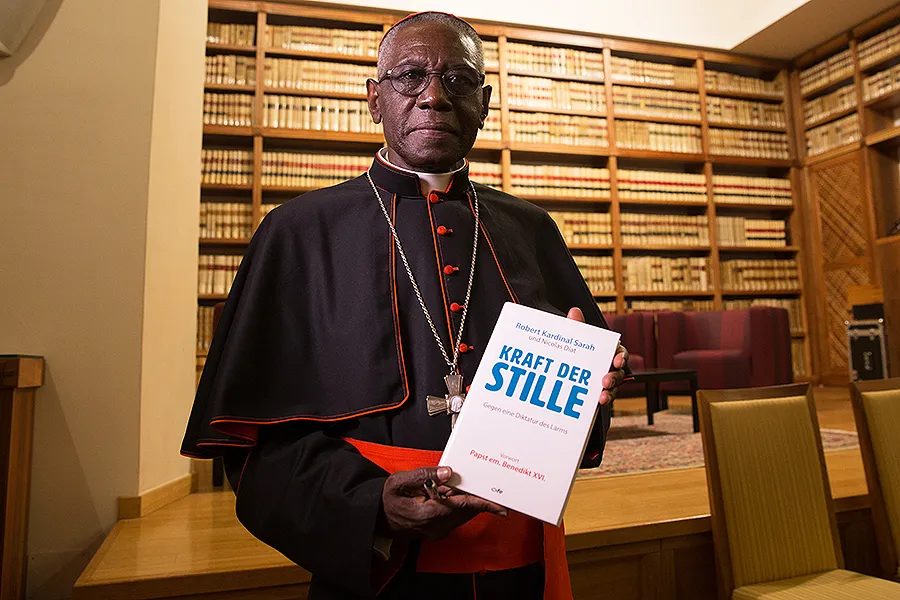
Vatican City, Mar 7, 2018 / 03:05 pm (CNA/EWTN News).- Cardinal Robert Sarah has authored a preface for a newly published book detailing the ascendancy, in the last 50 years, of the reception of Communion in the hand. He has been thanked for his efforts with at least one call for his removal from office. The flare-up offers an opportunity to look in greater detail at the history of the means of receiving Holy Communion.
Sarah, the prefect of the Congregation for Divine Worship and the Discipline of the Sacraments, wrote a preface to La distribuzione della Comunione sulla mano: Profili storici, giuridici e pastorali (The distribution of Communion in the hand: A historical, juridical, and pastoral profile) by Father Federico Bortoli, which was published recently by Edizioni Cantagalli.
The book notes that in 1969, following the Second Vatican Council, the Congregation for Divine Worship issued an instruction which expressed that Blessed Paul VI had determined not to change the means of administering Holy Communion to the faithful – i.e., to retain distribution of the Host on the tongue to those kneeling, rather than allowing communicants to receive the Host in their hands.
The instruction, Memoriale Domini, indicated that where distribution of communion in the hand already prevailed, episcopal conferences should weigh carefully whether special circumstances warranted reception of the Eucharist in the hand, avoiding disrespect or false opinions regarding the Eucharist and ill effects that might follow, and if a two-thirds voting majority decided in the affirmative, such a decision could be affirmed by the Holy See.
Despite this instruction, and subsequent expressions of support for the reception of Holy Communion on the tongue from St. John Paul II and Benedict XVI, the distribution of the Eucharist on the hand has become widely adopted, especially in the West.
The Congregation for Divine Worship’s 2004 instruction on matters regarding the Eucharist, Redemptionis sacramentum, established that: “Although each of the faithful always has the right to receive Holy Communion on the tongue, at his choice, if any communicant should wish to receive the Sacrament in the hand, in areas where the Bishops’ Conference with the recognitio of the Apostolic See has given permission, the sacred host is to be administered to him or her. However, special care should be taken to ensure that the host is consumed by the communicant in the presence of the minister, so that no one goes away carrying the Eucharistic species in his hand. If there is a risk of profanation, then Holy Communion should not be given in the hand to the faithful.”
And the General Instruction of the Roman Missal currently in force in the US simply states that “The consecrated host may be received either on the tongue or in the hand, at the discretion of each communicant.”
Using previously unpublished documentation, Bortoli’s work traces the dynamics which led to the present situation, and argues that reception of Holy Communion in the hand has contributed to a weakening of faith in the real presence of Christ in the Eucharist.
The text of Cardinal Sarah’s preface was published Feb. 22 by La Nuova Bussola Quotidiana, and portions were translated into English by Diane Montagna.
The cardinal wrote that the angel of peace who appeared at Fatima desired that the three children would make reparations for profanations of the Eucharist (such as desecration or sacrilegious reception — by those not in the state of grace or not professing the Catholic faith) and for all that can prevent the sacrament’s fruitfulness.
He then said that the “most insidious diabolical attack is trying to extinguish faith in the Eucharist, by sowing errors and fostering an unsuitable way of receiving it; truly the war between Michael and his Angels on one side, and lucifer on the other, continues in the hearts of the faithful: Satan’s target is the Sacrifice of the Mass and the Real Presence of Jesus in the consecrated Host.”
According to Cardinal Sarah, the demonic attack against the Eucharist follows two tracks: the reduction of the concept of the real presence, and an attempt to remove the sense of the sacred from the hearts of the faithful. He noted that a sense of the sacred can be lost by receiving special food in the same way as ordinary food.
The cardinal wrote that the liturgy “is made up of many small rituals and gestures — each of them is capable of expressing these attitudes filled with love, filial respect and adoration toward God. That is precisely why it is appropriate to promote the beauty, fittingness and pastoral value of a practice which developed during the long life and tradition of the Church, that is, the act of receiving Holy Communion on the tongue and kneeling.”
He pointed to the example of St. John Paul II, who always knelt before the Eucharist despite infirmity, and St. Teresa of Calcutta, who habitually received Communion on the tongue.
“Why do we insist on communicating standing and on the hand? Why this attitude of lack of submission to the signs of God? May no priest dare to impose his authority in this matter by refusing or mistreating those who wish to receive Communion kneeling and on the tongue,” the cardinal wrote. “Let us come as children and humbly receive the Body of Christ on our knees and on our tongue. The saints give us the example. They are the models to be imitated that God offers us!”
He noted that in the case of the distribution of Communion, “a special concession has become the picklock to force and empty the safe of the Church’s liturgical treasures.”
Noting that the process by which Communion in the hand has recently become common “was anything but clear,” he added that “The Lord leads the just along ‘straight paths’, not by subterfuge. Therefore, in addition to the theological motivations shown above, also the way in which the practice of Communion on the hand has spread appears to have been imposed not according to the ways of God.”
Cardinal Sarah voiced hope that Bortoli’s work would encourage both priests and laity who wish to administer or receive the Eucharist in the mouth and kneeling.
“I hope there can be a rediscovery and promotion of the beauty and pastoral value of this method. In my opinion and judgment, this is an important question on which the Church today must reflect. This is a further act of adoration and love that each of us can offer to Jesus Christ … May Fr. Bortoli’s work foster a general rethinking on the way Holy Communion is distributed.”
The cardinal did not propose to change the current ecclesiastical norms governing the reception of Holy Communion.
Nevertheless, writing at Commonweal Feb. 27, commentator Rita Ferrone responded to Cardinal Sarah’s preface by calling for his removal from office. She asserted that “what he really does best is sow division,” and characterized his writing as evaluating the reception of Communion in the hand “as pure evil.”
Ferrone claimed that the cardinal “manages to slander Christians of the first millennium who took communion in the hand regularly for at least nine hundred years” and that his comments “reveal either an appalling ignorance of or an indifference to liturgical history. Does he not know that this practice (standing and receiving in the hand) comes from the apostolic church? Does its venerable antiquity not commend the practice to him as holy, even though he prefers the more recent historical practice of receiving communion kneeling and on the tongue?”
While in in the earliest ages of the Church there are many writings which demonstrate that Communion was received in the hand (most notably St. Cyril of Jerusalem’s Mystagogical Catecheses), there are also early demonstrations of Communion on the tongue, as in the writings of St. Gregory the Great.
As Cardinal Sarah noted in his preface, communion on the tongue is “a practice which developed during the long life and tradition of the Church.” [emphasis added]
The prominent Jesuit liturgist Josef Jungmann wrote in The Mass of the Roman Rite that over time, “growing respect for the Eucharist … led to the practice of placing the Sacred Host in the mouth.”
Reception of Communion in the mouth was widely adopted around the ninth century, and Communion in the hand had disappeared entirely after the 10th and 11th centuries, according to Jungmann. This development removed the worry “that small particles of the sacred bread would be lost”, and the Jesuit wrote that it was probably related to the transition from leavened to unleavened bread.
By the end of the patristic age, the Church had abandoned the practice of Communion in the hand, having found that Communion in the mouth was a better expression of reverence for the Eucharist.
Of course, liturgical practices of the first millenium should not be revered simple because they are old.
In his 1947 encyclical Mediator Dei, Ven. Pius XII wrote that “it is neither wise nor laudable to reduce everything to antiquity by every possible device,” and that it is “obviously unwise and mistaken” to “go back to the rites and usage of antiquity, discarding the new patterns introduced by disposition of divine Providence to meet the changes of circumstances and situation.”
Another Catholic commentator, Fr. Anthony Ruff, OSB, wrote March 6 at the Pray Tell blog that Cardinal Sarah’s preface indicated that “his grasp of what has happened in eucharistic theology in the last 75 years is simply shocking.”
This commentary was a source of confusion for many, because recent magisterial teaching seems to support Cardinal Sarah’s position.
The Congregation for Divine Worship issued its instruction on Holy Communion, which decreed the retention of Communion on the tongue despite some calls for distribution in the hand, five years after the end of the Second Vatican Council, and during the pontificate of Blessed Paul VI.
“It is a matter of great concern to the Church that the Eucharist be celebrated and shared with the greatest dignity and fruitfulness. It preserves intact the already developed tradition which has come down to us,” Memoriale Domini stated. “The pages of history show that the celebration and the receptions of the Eucharist have taken various forms. In our own day the rites for the celebration of the Eucharist have been changed in many and important ways, bringing them more into line with modern man’s spiritual and psychological needs.”
It noted that “It is certainly true that ancient usage once allowed the faithful to take this divine food in their hands and to place it in their mouths themselves.”
But “Later, with a deepening understanding of the truth of the eucharistic mystery, of its power and of the presence of Christ in it, there came a greater feeling of reverence towards this sacrament and a deeper humility was felt to be demanded when receiving it. Thus the custom was established of the minister placing a particle of consecrated bread on the tongue of the communicant.”
“This method of distributing holy communion must be retained … not merely because it has many centuries of-tradition behind it, but especially because it expresses the faithful’s reverence for the Eucharist.”
The congregation also wrote that this traditional practice “ensures, more effectively, that holy communion is distributed with the proper respect, decorum and dignity. It removes the danger of profanation of the sacred species” and “it ensures that diligent carefulness about the fragments of consecrated bread which the Church has always recommended.”
They noted that “A change in a matter of such moment … does not merely affect discipline.”
“It carries certain dangers with it which may arise from the new manner of administering holy communion: the danger of a loss of reverence for the august sacrament of the altar, of profanation, of adulterating the true doctrine.”
When some bishops asked for permission for Communion in the hand, Bl. Paul VI sought the opinion of all the Church’s Roman rite bishops. Of those responding, 57 percent said that attention should not be paid to the desire for the reception of Communion on the hand. Of those bishops who were open to considering the practice, just over one-third had reservations about it.
And 60 percent of bishops did not even wish that Communion in the hand be experimented with in small communities. More than half did not believe the faithful would receive such a change gladly.
So, in 1969, in full consideration of Sacrosanctum Concilium, Bl. Paul VI “ decided not to change the existing way of administering holy communion to the faithful,” considering the remarks and advice of his fellow bishops, the gravity of the matter, and the force of the arguments against it.
The Pope who oversaw much of the Second Vatican Council, and who implemented its liturgical reform, was clearly concerned about the risks of disrespect and false opinions about the Eucharist which could arise from Communion in the hand. The Church’s norms have not shed that concern. Nor did Sarah’s pastoral reflections.
Benedict XVI was well-known for advocating something he called a “hermeneutic of reform” in theological conversation. He meant that historical memory should inform contemporary theological reflection. The alternative, he said, was something he called the “hermeneutic of discontinuity and rupture.”
If Cardinal Sarah, who is responsible for the regulation and promotion of the sacred liturgy, is impugned for raising the very objections against Communion in the hand which were raised by Paul VI fewer than 50 years ago, it’s worth considering whether the idea of the “hermeneutic of reform” has been rejected among Catholic intelligentia.
If nothing else, the affair reveals a very short historical memory among some members of the Catholic press.
It’s also worth noting the strength of the reaction to what Cardinal Sarah in fact wrote was largely a function of media distortion. Sarah is far from removing permissions for Communion in the hand. His stated desire is to foster the “rediscovery and promotion of the beauty and pastoral value” of Communion on the tongue.
The matter also demonstrates the degree to which reactionary Catholic media voices can enflame the kind of sensationalism they might otherwise criticize.
Cardinal Sarah won’t really be removed from his office for suggesting the value and beauty of, to borrow the words of Benedict XVI, “what earlier generations held as sacred.” But in this moment of ecclesial polarization, he will likely continue to be criticized.
 […]
[…]






Your Holiness;
Israel only attacks specific targets of military value, and it warns the residents beforehand to give them time to evacuate the area.
Iran, on the other hand – has no problem with TARGETING CIVILIANS. It is, in fact one of their commonly used strategies. E.G. – In their retaliation last night they sent missiles which killed 86 people, and a goodly number of them were residents of an Old Folks’ home.
In any case I understand that in your position you have to speak like this.
I agree with you entirely. Iran has been a terrorist nation for years. We do not discipline (i.e., help change the behavior) unruly or “mean” children by being sweet to them and allowing them to continue to terrorize others. We discipline them, we punish them and make their lives uncomfortable so that they have a motive to stop misbehaving. Yes, we take them to behavioral specialists who sometimes discover physical, mental, or psychological conditions, or environmental conditions (e.g., abusive relative) that causes the child to behave in an unacceptable and “violent” way and we can help that child in various ways (counselling, meds, different schooling, etc.), but often, a child who acts out does so because he/she has been allowed the power to do so by wimpy parents, teachers, etc. And if they are not “stopped” and helped to change their ways, these kids will often grow up to be poor and/or criminals.
We give tickets and occasionally incarceration to people who break traffic laws or other laws of the land–we don’t just overlook it as “their personality” or “their culture.” When someone murders someone, we don’t just say, “He or she had a troubled past.” Yes, sadly, they often did, but that does NOT excuse their horrific behavior. MANY people have a “troubled past”, but they manage to pull themselves out of despair and become good citizens who do much to help their fellow man.
We can’t allow criminals to terrorize our land.
And we should not tolerate national leaders and nations that terrorize their own people along with other nations and put the entire world in danger of planet-wide conflict. We need to teach Iran (or at least the leaders) to “behave” like civilized world citizens and hold them accountable for their many past crimes against humanity.
Pres. Trump gave Iran plenty of warning–it wasn’t a “surprise attack”. They had plenty of chances to change their ways, and they chose to thumb up their noses at the U.S. and other nations and continue their cruel, uncivilized ways in the name of their “religion”. Many Muslims and Muslim nations ARE peaceful, so the “religion” is not telling them to do this awful stuff. It’s the leaders who value power over human life, even the lives of their own people.
Good for Pres. Trump and our American military!
Mrs. Sharon Whitlock: you couldn’t be more correct in what you’ve written here. Our granddaughter just graduated from elementary school. We gifted her with the trilogy Kristen Lavransdatter and in each book we wrote: “The life you have tomorrow will be determined by the choices you make today.” We need to end this ethos that tells everyone they’re a victim and that others reward them on account of it.
We read: “Let diplomacy silence the weapons; let nations shape their future through works of peace, not through violence and bloody conflict.”
Absolutely. In a barbaric age we’re periodically on the brink, and yet globally we’re also like ships passing in the night. In the entirely different context of domestic parties or government agencies at odds with each other, there’s the well-developed path of formal mediation.
Four points:
FIRST, assuming that the parties are symmetrical, potential mediators point to nine criteria which must be met in order to be even eligible for promising mediation. Two of these criteria are that “the issue must be ‘ripe'” (#3, meaning that mediation resolves conflict and does not avert conflict); and that the “agencies [of the same government] are at a point where decisions and actions are ‘needed'” (#7). So far, so good, but criterion #4 is that “‘delay’ serves none of the parties”…
SECOND, this is not to diminish in any way Pope Leo XIV’s plea of reason, but it does admit to complicated communication between a Western culture still rooted somewhat to the incarnational coherence of faith & reason, and the different governments/regimes of a fideistic and non-Trinitarian culture still tied to the non-Western 7th Century. We might be also reminded of the varied understandings of “mokusatsu” by which Bushido Japan either diplomatically “withheld comment” on the final and problematic demand for “unconditional surrender,” or else signaled only to its own captive population that the ultimatum was “unworthy of public notice” (the response was received only as a decoded intercept).
THIRD, these comments, here, are barely even academic and are taken from quite different contexts. Still, in simply trying to decode the Islam world—meaning to understand sectarian and often mutually conflicted Muslim minds (plural)—yours truly, as an un-credentialled layman, now pulls from my shelf a still mostly unread copy of an Islamic compendium: Abdul Aziz Said, Nathan C. Funk, Ayse S. Kadayifci (editors); “Peace and Conflict Resolution in Islam,” University Press of America, 2001).
FOURTH, “Peace and conflict resolution” through plural Muslim lenses?
Diplomacy, yes, but at the same time “a fireman does not negotiate with the fire.” In any event, the recent combination of “rhetoric” plus a stated “60-day deadline” for productive negotiation is now largely history. The state (?) of Iran now pauses to consult with the networked Kremlin…Putin’s strategy in Ukraine of victory-through-delay hasn’t worked so well in Iran.
SUMMARY: No conclusions here, except that words are not always cheap….and with lingering memories from August in 1914 and in 1945.
Thou shall NOT kill.
Your holiness: Why not direct your message of peace to Muslims. They are causing mayhem around the world. In Europe, they are burning Catholic churches, looting, setting cars afire, murdering priests while saying Mass, raping women and young girls. In Africa, Muslims are murdering Christians wholesale. They have kidnapped hundreds of Christian women and forced them to convert to Islam and to worship their god Allah. There isn’t anywhere in the world that’s safe from Muslim predation. They go around bombing schools, hospitals and other civilian targets. In its simple-minded attempt to be “fair”, idiot influencers lay blame on all – Muslim as well as those they refer to as infidels. Frankly, your holiness, somw of us Catholics are tired of our Church leaders tripping over themselves to appear impartial. You can speak to us about Church teavhings but when it come to global politics and civil matters, we’re not listening anymore.
I believe in the concept of just wars. I also believe it is imperative to know your enemy. Iran has been led by a regime of death and destruction from its beginning. There is no path of diplomacy when your enemy is planning your death by any means necessary. Their religious path revels in war and sees war as a path of evangelization as well as a path of creating their desired world order.
The plea for peace is good. But when the lion remains committed to destruction of all around it, it is not time to talk about peace to the lamb.
“War does not solve problems — on the contrary, it amplifies them and inflicts deep wounds on the history of nations that take generations to heal.”
Your Holiness, I strongly suspect that Pope Pius V of Lepanto fame would disagree with you that wars do not solve problems.
And then there is this: ” “No armed victory can make up for a mother’s grief, a child’s fear, or a stolen future.” Really? So are we to infer that a nation that does not resist but allows itself to be destroyed will eliminate a mother’s grief, a child’s fear, or a stolen future?
Good grief! Is this the pacifist pablum we can expect moving forward? Boko Haram may appreciate your rhetoric but I would not want you to address my Marines who are about to go into battle. Respectfully your Holiness, reflect on Ecclesiastes 3:8 please.
Pope Leo: “War does not solve problems; on the contrary, it amplifies them and inflicts deep wounds on the history of peoples, which take generations to heal.”
Pope Francis said similar things. But, if this is the case, then there is no such thing as a just war. However, the possibility of a just war has always been the Church’s position. The Church is not pacifist. Pope John Paul II said as much even when he was objecting to the Gulf war.
Since the issue is about nuclear weapons IMO the very phrase ‘just war’ becomes irrelevant.
“Today more than ever, humanity cries out and pleads for peace…”
.
Honestly, I don’t think that is an accurate statement.
Dear Pope Leo:
The Church holds and teaches that there can be just wars.
Whether this particular situation is such is an important question that deserves attention.
Casual pacifism is not serious.