


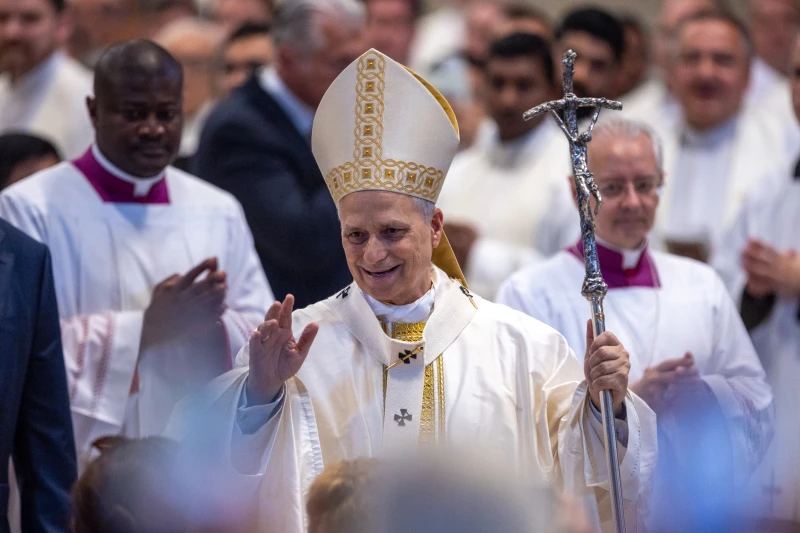
Vatican City, Jun 15, 2025 / 11:46 am (CNA).
Pope Leo XIV presided over the solemnity of the Most Holy Trinity in St. Peter’s Basilica on Sunday and invited Catholics to enter the “dynamism of God’s inner life” and be open to encounter with others.
Celebrating the solemnity, which coincided with the June 14–15 Jubilee of Sport, in the Vatican on the morning of June 15, the Holy Father asked pilgrims who belong to sports teams and associations to glorify God through their daily training.
“Dear athletes, the Church entrusts you with a beautiful mission: to reflect in all your activities the love of the Triune God, for your own good and for that of your brothers and sisters,” the Holy Father said in his Sunday homily.
Though the “juxtaposition” of celebrating the Trinity and sport may seem “somewhat unusual” at first, Leo said the relationship between the two reveals God’s infinite beauty is reflected in “every good and worthwhile human activity.”

“For God is not immobile and closed in on himself, but activity, communion, a dynamic relationship between the Father, the Son, and the Holy Spirit, which opens up to humanity and to the world,” he said.
“Sport can thus help us to encounter the Triune God, because it challenges us to relate to others and with others, not only outwardly but also, and above all, interiorly,” he explained.
Sport as a school of virtue, encounter, and sanctity
According to the Holy Father, in a society marked by solitude, digital communications, and competition, sports are “a precious means for training in human and Christian virtues.”

He said families, communities, schools, and workplaces can be places where genuine encounters among people can take place.
“Where radical individualism has shifted the emphasis from ‘us’ to ‘me,’ resulting in a deficit of real concern for others, sport — especially team sports — teaches the value of cooperating, working together, and sharing,” Leo said.
“These, as we said, are at the very heart of God’s own life,” he added.

Comparing healthy and unhealthy attitudes toward sport, the Holy Father emphasized that sport is more than an “empty competition of inflated egos” and is also a means of sanctification and evangelization.
“St. John Paul II hit the mark when he said that Jesus is ‘the true athlete of God’ because he defeated the world not by strength but by the fidelity of love,” he said.
“It is no coincidence that sport has played a significant role in the lives of many saints in our day,” he continued.

Reflecting on the life of Blessed Pier Giorgio Frassati, the patron saint of athletes who will be canonized on Sept. 7 alongside Blessed Carlo Acutis, Leo told the congregation — several of whom belong to sport teams and associations — “just as no one is born a champion, no one is born a saint.”
“It is daily training in love that brings us closer to final victory and enables us to contribute to the building of a new world,” he said.
First Angelus address
In spite of 95-degree summer heat, thousands of pilgrims spilled into St. Peter’s Square after Mass to listen to Leo’s first Angelus address delivered in front of the basilica.
Continuing his message of sports as a means to foster a “culture of encounter and fraternity,” the Holy Father emphasized the “great need” for peace and an end to “all forms of violence and aggression” in the world.

The Holy Father asked for the intercession of Our Lady Queen of Peace before praying his first Angelus in the square in Latin and urging his listeners to pray for the end of conflicts in different parts of the world.
Calling for the end of conflicts in countries including Myanmar, Ukraine, and the Middle East, the Holy Father gave particular attention to the persecution of Christians in the African countries.
“Some 200 people were murdered, with extraordinary cruelty,” the pope said, referring to a massacre that took place in the village of Yelwata in Nigeria overnight.

“Most of the victims were internal refugees who were hosted by a local Catholic mission,” he lamented.
The Holy Father also appealed for the end to the civil war in Sudan, which began in 2023 and has since claimed thousands of lives, including the life of parish priest Father Luke Jumu, who died from his wounds after a bomb attack in El Fasher.
“I call on the international community to intensify efforts to provide at least basic assistance to the people affected by the grave humanitarian crisis,” he continued.
If you value the news and views Catholic World Report provides, please consider donating to support our efforts. Your contribution will help us continue to make CWR available to all readers worldwide for free, without a subscription. Thank you for your generosity!
Click here for more information on donating to CWR. Click here to sign up for our newsletter.



One question re this report – When did priests (or popes) start presiding over Mass instead of saying it or celebrating it?
The terms are said to by “synonymous” such that members of the laity also join in their own way as baptized members of the Mystical Body of Christ–and not as sacramentally ordained. https://www.catholic.com/qa/is-there-a-difference-between-a-presider-and-a-celebrant
A “Prayer Before Mass” which assumes such a distinction of roles is this from St. Pope John Paul II (published in the National Catholic Register, May 19-22, 2006)
“Eternal Father, we members of your blessed son Jesus Christ’s Mystical Body (His Church),in prayerful union with other members of His Church throughout the world,
especially those who are suffering or living under oppression, and those who desire to go to Mass but are unable to do so;
In spiritual communion with the intentions and affections of The Immaculate Heart of Our Lady of Sorrows on Calvary, the Angels and Saints in Heaven, our patron Saints, our Guardian Angels—
We all join in offering this Holy Sacrifice of the Mass, this unbloody RENEWAL AND
EXTENSION of Christ’s Sacrifice on the Cross for the following intentions:
1) To ADORE and worship God the Father, God the Son, and God the Holy Spirit and to pledge our love and loyalty forever to the God who made us to Know, Love and Serve Him in this world and to be happy with Him forever in Heaven.
2) To THANK Our Lord and Savior Jesus Christ for opening the gates of Heaven by His sacrificial death on Calvary and to thank God for all the blessings and graces He has bestowed upon us throughout our lives especially for the supernatural gifts of Faith, Hope, and Charity; those gifts of Truth, Love and Peace which Christ promised to leave with us.
3) We express our SORROW for having offended God in any way throughout our lives and offer our prayers, works, sufferings, joys and even ourselves [underlined], to the Eternal Father with this sacrifice of the Body, Blood, Soul and Divinity of His Dearly Beloved Son in atonement for our sins and those of the whole world.
4) Finally, we PETITION the Triune God for the Grace from this Eucharist to conform every conscious endeavor of our lives to the will of the Father in all things as did Christ. We also pray for all persons, places and things—absent, present, living and dead—for which we are bound in conscience or have expressed a desire to pray for, especially for an increase in vocations, for peace among nations, for the conversion of Russia and for the end of the unspeakable crime of abortion. AMEN.”
We entered the wood and suddenly encountered the enemy. Encounter suggests an unexpected face to face contact. Not sure why we should speak of our bearing Christ within, and conveying him to others as an encounter. At any rate it seems to this writer being charitably disposed conveys Christ.
Musing further, I envision Paul in Corinth, or Ephesus preaching in synagogues, preaching to gatherings of gentiles. Then there’s Philippi. Paul and his companions went to the riverbank, where they expected to find a place of prayer, and there they met a group of women, including Lidia. This was an encounter. Lidia, a dyer of purple cloth invites him to her home and family – a form of conscientious challenge to Paul, an appeal to his trust that she is a believer.
Learning from the Apostles in Acts we find Peter responding to chance encounters, persons begging when he takes the opportunity to teach.
Otherwise encounters have a simple social content that has some value but not specifically a Christlike event unless we convey Christ through our demeanor.
Sport is life in full flow. “For God is not immobile and closed in on himself, but activity, communion, a dynamic relationship between the Father, the Son, and the Holy Spirit, which opens up to humanity and to the world” – His Holiness Pope Leo XIV.