


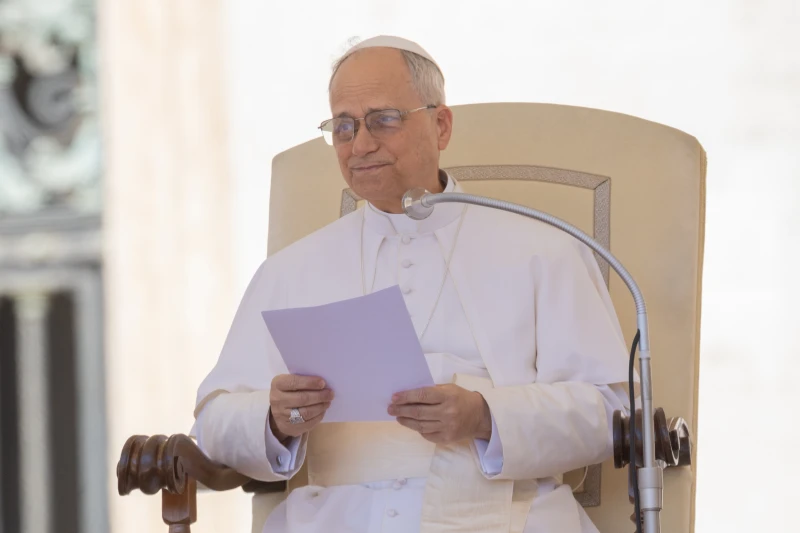
Vatican City, May 28, 2025 / 15:21 pm (CNA).
Pope Leo XIV held the second general audience of his pontificate today in which he reflected on the parable of the good Samaritan.
At the beginning of his catechesis, addressed to the faithful gathered in St. Peter’s Square, the Holy Father recalled that the parables of the Gospel offer an opportunity “to change perspective and open ourselves up to hope.”
The lack of hope, the pontiff explained, is sometimes due “to the fact that we fixate on a certain rigid and closed way of seeing things,” and the parables “help us to look at them from another point of view.”

He then recalled that Jesus proposes this parable to “a doctor of the law,” who asks him: “Teacher, what must I do to inherit eternal life?” (Lk 10:25-37), and then Jesus invites him to love his neighbor.
‘The practice of worship does not automatically lead to compassion’
The scene of the parable of the good Samaritan is a road “as difficult and harsh as life itself,” the pope said. In fact, the man who crosses it “is attacked, beaten, robbed, and left half dead.”
“It is the experience that happens when situations, people, sometimes even those we have trusted, take everything from us and leave us in the middle of the road,” the pontiff emphasized.
Leo XIV then added that “life is made up of encounters, and in these encounters, we emerge for what we are. We find ourselves in front of others, faced with their fragility and weakness, and we can decide what to do: to take care of them or pretend nothing is wrong.”
At his General Audience, Pope Leo XIV speaks to the English-speaking pilgrims reflecting on the parable of the Good Samaritan, reminding us that Christ is our healing hope and calls us to show mercy and become true neighbors. Sacred Heart of Jesus, make our hearts more like… pic.twitter.com/6Qu8QfG89J
— EWTN Vatican (@EWTNVatican) May 28, 2025
He recalled that the priest and the Levite went down that same road and didn’t stop to help him. “The practice of worship does not automatically lead to being compassionate. Indeed, before being a religious matter, compassion is a question of humanity! Before being believers, we are called to be human,” he emphasized.
Haste as an obstacle to compassion
The pope pointed out that “haste, so present in our lives, very often impedes us from feeling compassion. One who thinks his or her journey must be the priority is not willing to stop for another.”
However, the Samaritan, who belonged to a despised people, decided to stop to help the man. Thus, Leo XIV emphasized that “religiosity does not enter into this. This Samaritan simply stops because he is a man faced with another man in need of help.”
He also affirmed that compassion “is expressed through practical gestures,” recalling that the Samaritan “approaches, because if you want to help someone, you cannot think of keeping your distance; you have to get involved, get dirty yourself, perhaps be contaminated.”
“One truly helps if one is willing to feel the weight of the other’s pain,” Pope Leo XIV noted.

“When will we, too, be capable of interrupting our journey and having compassion? When we understand that the wounded man in the street represents each one of us. And then the memory of all the times that Jesus stopped to take care of us will make us more capable of compassion,” he said.
Finally, Pope Leo invited the faithful to pray to “grow in humanity, so that our relationships may be truer and richer in compassion.”
“Let us ask the heart of Jesus for the grace to increasingly have the same feelings he does,” he concluded.
After greeting the pilgrims from different countries, the Holy Father intoned the Our Father in Latin and imparted his blessing to the faithful present, who listened attentively despite the high temperatures and intense Roman spring sun.
This story was first published by ACI Prensa, CNA’s Spanish-language news partner. It has been translated and adapted by CNA.
If you value the news and views Catholic World Report provides, please consider donating to support our efforts. Your contribution will help us continue to make CWR available to all readers worldwide for free, without a subscription. Thank you for your generosity!
Click here for more information on donating to CWR. Click here to sign up for our newsletter.



I wonder if those words “Before being believers, we are called to be human” are of Pope Leo’s or of an editor because it is a false counter positioning.
Indeed, a formal faith i.e. a faith without empathy (most often coupled with pride) can be cruel to others; often is – a typical case is a neophyte who is being completely inconsiderate of his family in his zeal to fulfill all the forms. Or someone who cruelly presses what he thinks are “the norms” of his faith onto others, without compassion and without giving them freedom.
However, a true compassion/empathy has its source only in God, in a living connection with Christ. Because of this, to say “Before being believers, we are called to be human” is wrong. A human being cannot become fully human = Christ-like without first believing in Christ and allowing Him to make him truly human. Faith and being human go together. Our Lord says “love your God with all your strength” and only then “love your neighbor as yourself”. I read it as only our total love for God Who is our Life can give us strength to love our neighbor as ourselves.
I would say that a parable of Samaritan represents not a dichotomy between faith and humanity but between a frozen deathly self-seeking “faith” without empathy and an alive (in God) faith which is a source of empathy.
PS I will add here that people who endured much atrocities early in life often find themselves becoming believers first and only then slowly recovering their true humanity which was abused. Christ teaches them how to be fully human, via granting them an intimate relationship with them, giving to them what their parents failed to give. Those are extreme cases but from my experience we are all impaired as humans and it is our relationship with Our Lord that makes us fully human.
Maybe the expression is simply a variation on the truth that grace builds on nature, or that one must first be a man before he can be a holy man, or that Christian virtue perfects natural virtues….it wouldn’t hurt if some men in high places really were men.
@ Anna
Am in complete agreement. Humanism absent of God is antithetical to true humanism.
In our humanity, we are Called to Holiness, and thus to be Believers in The Power And The Glory Of Perfect Divine Eternal Love Incarnate, Our Savior, Jesus The Christ.
“Man does not live on bread alone, but on every Word That Comes Forth From The Word Of God.”
Our humanity comes from God, thus only in Loving God, can man’s humanity be fully realized.in Loving God, we desire Salvation not only for ourselves, but also for our beloved.
Christ Has Revealed Through His Life, His Passion, And His Death On The Cross, that no Greater Love Is There Than This, To Desire Salvation For One’s Beloved. “He Is Risen.”
I think, when the Pope said: “Indeed, before being a religious matter, compassion is a question of humanity! Before being believers, we are called to be human.” that he was not using “before” as an indicator of what we must perfect first, but rather as a question of what is most fundamental. I.e., natural law has as its most fundamental principle that of loving good and hating evil, the next level requires acting in accord with our bodies, and the last includes the obligation to seek the truth.
I entirely agree that many (probably most) have some sort of obstacles in their life that cannot be approached strictly at its own level, but which requires religious faith to overcome, such that belief must invariably precede, in time, the acquisition of various natural virtues. But I don’t think that is what the Pope was trying to say. He’s discussing the building up of obligations from the most fundamental (natural law) to the highest (religious) rather than giving a temporal order requiring the fulfillment of the natural law before one may “graduate” to religion.
This bears a certain amusing resemblance to objections to JD Vance’s statements on ordo amoris, which is an order of priority, not of time. Many languages are ambiguous on what kind of progression is being moved through with “before”, “then”, etc., and expect us to pick it up from the context.
Amanda,
Thank you. It is unfortunate that the pope was not more clear. It is entirely likely that he intended to speak of a naturally human inclination to do compassionate good.
If we consider the attainment of an ‘age of reason’ (and/or the conversion to practice virtue in accordance with the Catholic faith), the natural inclination to good actually often does temporally precede the profession and practice of perfecting our belief.
“Before being believers, we are called to be human” – Well said. Human beings cannot afford to behave like robots. To give pleasure to a single heart by a single act is better than a thousand heads bowing in prayer – Mahatma Gandhi
Actually Dr Coelho, we’re not called to be human. We’re created human. We’re called to be Christians.
Here is Gandhi, on a Catholic web site, talking about pleasure, which he does not define.
I know a few people who would adamantly agree, having spent large portions of their lives giving pleasure. Jesus would not classify all acts (which give pleasure) as Christian.
It’s better to give pleasure to a single human heart than to give a thousand pleasures to the Divine Heart?
This is certainly one way to remember that Ghandi was a pagan.
There is plenty of evidence that catchy quotes and incessant hagiographies aside, the Ghandi public image conceals a very dark individual. One biography said he slept in the nude with his niece and other young women and the same source suggests he left his wife for a German bodybuilder. Even if this more salacious claims are true, there is enough well documented things that should put his character into question.
I’m not so sure Christians should affirmingly quote him so approvingly, adding to a mystique that maybe would be shattered if the entirety of his life was well known.
Great Soul by Joseph Lelyveld
While we may presume, with some degree of legitimacy as does Leo XIV, that our humanness should precede our faith in Christ Jesus [here Leo likely alludes to clericalism] – that proposition is acceptable insofar it is a man, Leo XIV, who is already a follower of Christ and is knowledgeable of Christ’s commandments.
Otherwise, the proposition is a fallacy.
That’s because not all out yonder are believers, and who have their own fallible positions. Insofar as Leo is Roman pontiff he speaks to the world at large. Consequently, his proposal will be interpreted as identical with secular humanism. Which is why I fully agree with Anna’s take on the issue.
I think one thing you can’t do is to co-operate with evil act because you are first meant to show compassion.
I am not referring to double effect situations.
Also by evil act I mean both the singular moment type as well as the practice or way of life en vivant.
What I am seeing is that this would apply immediately to both converted and unconverted according to each in his given setting; and it can apply at times to both converted and unconverted in the same setting at the same time over the same issue.
In addition, I believe, a wrong reading of and meaning to compassion are already in the root of Pelagianism. It has suggested to me (a long time) that even when you are not converted, the teaching of the faith speaks you in and with authentic and motivating sense.
Pelagianism speaks about the many errors people have been claiming as faith through the 20th Century and then using VATICAN II to say it is what the Church teaches. People who are caught in heresy like Pelagianism -any heresy- are easy prey to Modernism.
Converted and non-converted co-operating in evil occurs as well in the deployment of the deceptions of Modernism. In Modernism, the fact that you are not converted does not make you immune or clean of deception; and the fact you are converted makes you a poison at the level of faith.
Elias insofar as Modernism is a wide spread mentality/ideology, it’s become the norm for conveying Church doctrine as a fusion, the apposition of two diverse elements faith and secularism. An example:
“The future Pope replied: Pope Francis has made it very clear that he doesn’t want people to be excluded simply on the basis of choices that they make, whether it be lifestyle, work, way to dress, or whatever. Doctrine hasn’t changed, and people haven’t said yet, you know, we’re looking for that kind of change. But we are looking to be more welcoming and more open, and to say all people are welcome in the church” (Cdl Prevost interview by Francis X. Rocca, senior Vatican analyst for Ewtn News 2023 in NCReg).
Pope Leo to date appears to be practicing this outlook seen in his appointments, responses to queries. I don’t believe he intends the worst scenario, rather that he’s self assured things will work out, as Francis once said by the Holy Spirit. Nonetheless, it’s the mirror perspective of Pope Francis’ dual messaging. It’s a seductive position reconciling all while claiming to retain the essence of the faith. The scenario occurring in Charlotte NC and Bishop Martin, the leak of details, was said by some to be a ‘test case’.
Personally, I can only express my opinion as a priest with long history that if the present policy, including the contentious actions of local ordinaries like Martin continue, we will not achieve unity. Division is assured. I hope Pope Leo XIV realizes this or will come to realize it.
Fr., the insight is just there and I put it here. And I must say, it is what the Church will teach. God be praised.
Borrowing once more the grammar of JPII, this “approach about teaching” is the “point of departure” of VATICAN II.
Which is to say it is meant to be THE point of departure. Nothing substitutes.
Thus we have to be noticing too how much there is littered all about the place and staggered along the timeline, trying out as substitutions and not hearing.
Yes. Agreed Elias the true doctrines will be preached. Although there will be the dilemma of interpretation for the faithful because two propositions are placed before them, one is to enter the Church with access to all the sacraments exactly as you are regardless of lifestyle.
The other is penance for the remission of sins, which requires conversion and change of manners. Weak Mankind fallen from grace is apt to choose the less demanding option.This is the new paradigm of mercy rather than rules.
If one were to invent a fundamental option that removed all concerns for attaining salvation I cannot conceive anything more alluring.
Christ Open Arms On The Cross are an Invitation to all who desire Holiness And Conversion, they are not a call to remain in our sins.
“Hail The Cross, Our Only Hope.” “Blessed are they who are Called to The Marriage Supper Of The Lamb.” “For where your treasure is there will your heart be also.”
We read: “Pope Francis has made it very clear that he doesn’t want people to be excluded simply on the basis of choices that they make, whether it be lifestyle, work, way to dress, or whatever [2023].”
Today and for some, “lifestyle” is code language for the homosexual lifestyle as an accepted subculture, and “way of dress” is anything from a rainbow banner to—in historical Revolutionary France—a prostitute dancing nude on the altar of Notre Dame Cathedral.
For the near future, might we remain confident that the Church and Pope Leo XIV will in time clarify the difference between a “welcome” mat and a doormat? As in Leo’s parsing of the unambiguous St. Augustine: “For you I am a pope [!], and with you I am a Christian.”
And, about the conceptually promiscuous term “whatever,” yours truly feels invited to link an author interview for his book entitled “A Generation Abandoned: Why ‘whatever’ [!] is not enough” (Hamilton Books, 2017).https://www.catholicworldreport.com/2018/03/29/a-generation-abandoned-why-whatever-is-not-enough/
Indeed, we hope so. As of now the first two appointments leave that questionable.
As to your book I’ve read years past, per gratis tuo and recall the important point you make about whatever. I do hope, although he appears to have that openness edge that can lead to a contained sense of tolerance [let’s say homosexual behavior] or laissez faire. A blessing in terms of a measured exception with conversion the end, or the curse of accommodation.
Also needed, a corrective to “progress theology” which looks ever more like the Islamic principle of “abrogation.”
A good SIGN would be a clear understanding of the difference between an “ecclesial assembly” and an adulterated synodality…Cardinal Grech’s dangling proposition for a “2028 Ecclesial Assembly” need not be further confused with the “hierarchical communion” of the Church (Lumen Gentium). Nor should it usurp the role of any “synod of bishops” or even ecumenical councils.
ABOUT legitimate and needed sense of ecclesial assembly, here’s something positive that Ratzinger had to say over forty years ago about the partial loss of the “ecclesial assembly”—or “communio”— probably at Trent…
In necessary response to Protestantism, a restored understanding of the distinct difference between the baptized and the sacrament of Holy Orders with the priest as more than a seeming “cult-minister” (Ratzinger’s term). This clarification led to too much of a separation of the laity from the clergy—the loss of communio—”the problem of the laity, which arose at this time and still haunts us today.” The “original meaning of the word ‘ecclesia’—that is, a ‘coming together’” (“Successio Apostolica,” as Chapter 2 in Ratzinger, “Principles of Catholic Theology,” Ignatius, 1982/Ignatius 1987).
Three years later, and again fully in step with Vatican II, Ratzinger added that “A Council [or a synod] is something that the Church DOES, but not what the Church IS” (“The Ratzinger Report,” 1985). The process isn’t the message.
SO, how to do—without recent distortion—both the ecclesial assembly/communio and distinct synods of bishops and future councils? Why not recognize the dicastery-for-the-doctrine-of-the- Faith as more than one voice in a flat roundtable/synod of dicasteries? Maybe even reinstituted as a Congregation? As if the Apostolic Succession has something foundational to offer our 21st-century experiment in global chaos theory?
With not much concentration, we might even surmise a good appointment as Prefect…
I have to agree that Pope Leo’s believers/human statement is troubling.
Theoretically if we lived perfectly by the interior rules of natural law we exhibit a divinely ordained degree of true humanness, which would substantiate Amanda’s comments on Natural Law. Natural Law is a reflexion of the Eternal Law. Although fallen man, meaning fallen human nature lacking the gifts of grace does not, cannot live out the natural law within as he should.
As such prior to embracing Christianity and the graces conferred by the sacraments Mankind, living an imperfect reflexion of the Eternal Law due to lack of grace, obscured attentiveness to the Natural Law Within – he develops his own form of humanism called secular. If we understand humanness to be a fulfillment of the Natural Law it’s requisite that he embrace Christianity to exhibit a natural law motivated humanness.
Nevertheless, there have been exceptions in human history of men who were not Christian and exhibited features of true humanness. Cicero, Aristotle, Cyrus are examples of those rarities.
A final note. It needs be kept in mind that the positive response of the secular non believer to Christianity is the work of grace, rather than their meritorious sense of humanness.
Also his passive “noticing of it”, I say. Doctrine itself is (already)pastoral.
That sometimes requires firmness. Hence the reductio in “rigidity” etc. also now left unattended.
God will correct it.
Same for believer.
Thanks to Fr. for kind attention. As we are wont to share around here: Bless.
Yes. It comes down to “The pope pointed out that haste, so present in our lives, very often impedes us from feeling compassion. One who thinks his or her journey must be the priority is not willing to stop for another”. Which is quite true.
However, he juxtaposed religion with humanness, as if the latter precedes the former, whereas that is true only when we make religion our priority to the extent of excluding the demands of charity. Although it’s our Christianity that emphasizes natural law and charity whenever and wherever it’s required.
We should by nature be disposed to charity, but the existential reality is original sin, and those without faith in Christ may not be so attentively disposed to the natural law and charity.
Addendum: However, he juxtaposed religion with humanness, as if the latter [supersedes] the former.
I have appreciated most of the homilies by Pope Leo that I have read so far, but this one, not so much. He falls into a popular sentimental reading of the parable which contrasts the “humanity” of tbe Samaritan with the insensitive, uncaring behavior of the priest and the Levite, with the implication being that religion doesn’t prevent believers fron lacking human compassion. But the issue set up in the parable is not whether these religious leaders are failing to practice compassion. Instead, they are failing to follow the part of the First Commandment about loving their neighbor as themselves. In other words, they are failing to practice what their religion requires. (I’m not sure who first pointed this out to me but it transformed my understanding if the parable.)
This is more apparent when you look at the framing of the parable. The questioner is seeking to test Jesus on his understanding of the Law, so when he asks Jesus ““And who is my neighbor?” , that is a challenge. When Jesus responds withe the parable and asks “Which of these three, in your opinion, was neighbor to the robbers’ victim?”, the questioner has to admit that the Samaritan is the one treating the injured man as a neighbor and thus following the Commandment.
Mary, Thank you. The lesson then, seems to be that people without formal religion are capable of neighborly love, empathy, and compassion. People professing a religion does not guarantee they will act upon their religious beliefs. The road to acting like a pharisee is broad, and many travel there.
One final post on this OP:
Aquinas’ Catena Commentary on Luke contains thoughts of many Fathers. Lectio 8 and 9 on Luke Chapter 10 has Chrystotom, Bede, Augustine, Cyril, Basil, Theophyllus, Ambrose, among others.
Augustine’s analysis is most interesting. He sees:
the wounded man as fallen mankind, Adam and his descendents;
the thieves and robbers as the bad angels or demons;
the Levite and the priest (the Law and the Prophets), not willing/able to help;
the Samaritan, the man from the land estranged to man was the only one who could help, represents Christ, come down from Jerusalem (heaven) to Jericho (one of the oldest known inhabited cities on earth);
the inn-keeper, an apostle who continues Christ’s work;
Christ will ‘return’ to repay (reward) the inn-keeper for further debt he accrued in caring for the man’s wound.
Ambrose ends the section: “For relationship does not make a neighbor, but compassion, for compassion is according to nature. For nothing is so natural as to assist one who shares our nature.”