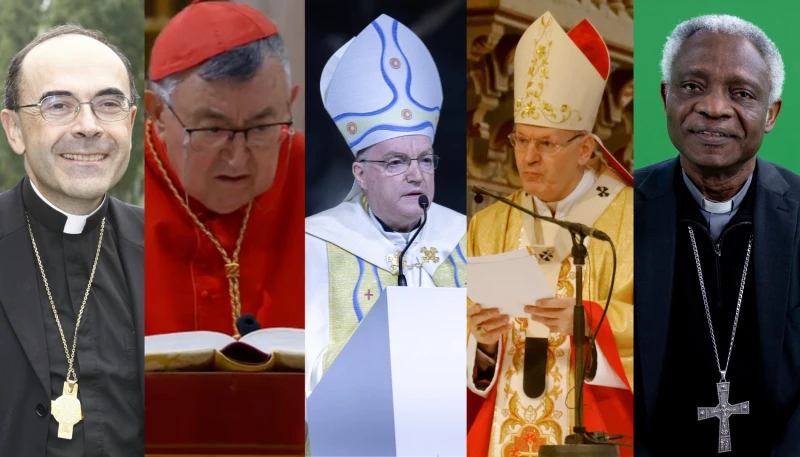
Left to right: Cardinal Philippe Barbarin, Cardinal Vinko Puljić, Cardinal Josip Bozanić, Cardinal Péter Erdő, and Cardinal Peter Turkson. / Credit: MEDEF, CC BY-SA 2.0, via Wikimedia Commons/ EWTN News screenshot/ Pelz, CC BY-SA 3.0, via Wikimedia Commons/ Daniel Ibañez/CNA
Vatican City, May 7, 2025 / 16:29 pm (CNA).
With the start of the conclave May 7, there are five cardinal electors who bring a significant amount of experience to the process.
Four electors — Cardinals Peter Turkson, Philippe Barbarin, Péter Erdő, and Josip Bozanić — became members of the College of Cardinals in 2003 and have participated in two conclaves before this one.
Cardinal Vinko Puljić, the archbishop emeritus of Sarajevo, received the red hat in 1994, making him the elector with the most years — nearly 31 — as cardinal. He has also participated in two conclaves: the 2005 conclave that elected Benedict XVI and the 2013 conclave that elected Francis.
At 79 years old, Puljić is able to vote in the 2025 conclave by a margin of just four months. On Sept. 8, he will turn 80 and lose the privilege to elect a pope.
The archbishop emeritus of Sarajevo, he is known for his role during the war in Bosnia, where he distinguished himself as a voice for peace and a defender of human rights. He was also president of the bishops’ conference of Bosnia and Herzegovina for a long time.
Cardinal Peter Turkson, 76, was chancellor of the Pontifical Academy of Sciences and the Pontifical Academy of Social Sciences from 2022.
A biblical scholar and influential voice for social justice, the Ghanaian’s first role in the Vatican was as president of the Pontifical Council for Justice and Peace from 2009 to 2017. Pope Francis then chose him as inaugural prefect of the Dicastery for the Promotion of Integral Human Development from 2017 to 2021.
Cardinal Philippe Barbarin, 74, is a from France, where he was archbishop of Lyon from 2002 to 2020. In 2020, he was acquitted on appeal of a 2019 conviction of failing to report sexual abuse.
Born in Rabat, Morocco, at the time under French protectorate, he served as a missionary in Madagascar and a professor of theology. He was bishop of Moulins from 1998 to 2002.
The 72-year-old Cardinal Péter Erdő, archbishop of Esztergom-Budapest and primate of Hungary, is a canonist and academic who has led the Hungarian and European bishops’ conferences for years. He is the author of over 250 studies in the fields of canon law and spirituality. In addition to the 2005 and 2013 conclaves, he has participated in a number of synods.
Cardinal Josip Bozanić, 76, archbishop emeritus of Zagreb, Croatia, was a prominent figure in dialogue between the Croatian Church and state, and in promoting justice and peace. He also served for many years as the president of the Croatian bishops’ conference.
If you value the news and views Catholic World Report provides, please consider donating to support our efforts. Your contribution will help us continue to make CWR available to all readers worldwide for free, without a subscription. Thank you for your generosity!
Click here for more information on donating to CWR. Click here to sign up for our newsletter.
Cardinal Giovanni Angelo Becciu, center, in 2015. / Alan Holdren/CNA.
Vatican City, Jul 3, 2021 / 11:50 am (CNA).
The Vatican’s court announced Saturday that it had indicted 10 individuals, including Cardinal Angelo Becciu, on charges including … […]
A participant captures Pope Francis on their phone during the Jubilee of Communication event at the Paul VI Hall, Jan. 25, 2025. / Credit: Vatican Media
CNA Newsroom, Jan 25, 2025 / 07:00 am (CNA).
“Communication means stepping outside ourselve… […]
Pope Francis meets with the Order of Malta’s Fra’ Marco Luzzago on June 25, 2021. / Vatican Media
Vatican City, Mar 7, 2022 / 09:35 am (CNA).
The Order of Malta’s future is in Pope Francis’ hands. After a meeting with senior members on Feb. 26, the pope will take time to ponder the proposals for renewal and eventually decide on a path of reform.
Cardinal Silvano Maria Tomasi, the papal delegate to the organization, reported on the meeting in a letter to confreres of the order.
Tomasi stressed that “we explained to the Holy Father that the reform under study keeps and better frames the order as a lay religious order and at the same time consents to the continuation of its charitable, diplomatic and humanitarian action for ‘our lords the sick’ and at the service of the Church.”
The Italian cardinal added that the pope had “decided to keep listening to us, and granted us another hearing. After the meetings, the pope will rule about the projects presented to him.”
Also present at the papal meeting were Fra’ Marco Luzzago, Lieutenant of the Grand Master, members of Tomasi’s working group for the reform, and a delegation representing the order’s members.
In a Feb. 27 press release, the 1,000-year-old institution stressed that “the focus of the meeting was the Order of Malta’s reform.”
It said that “in a letter sent to the Order of Malta’s leaders worldwide, Marwan Sehnaoui, chairman of the steering committee for the constitutional reform process, expressed his gratitude to ‘His Holiness for having dedicated two hours of his valuable time to the Order of Malta.’”
Sehnaoui said: “The Holy Father began and ended the audience by stating that he had taken himself the final decision-making of the critical issues regarding the order’s constitutional reform.”
“Pope Francis listened carefully to the presentations and interventions of both sides. After exchanging views, the Holy Father said there is no urgency in making a final decision. His Holiness also said that he wishes to gather and review more information and that he would probably convene another audience.”
These statements require a close reading. First, by explaining that the order’s diplomatic and humanitarian work will not be affected by the reform, Tomasi implicitly addressed a criticism raised after the circulation of a draft reform text, which described the Order of Malta as “subject to the Holy See.” This triggered concern that the new statutes would dilute the order’s sovereignty.
Cardinal Silvano Maria Tomasi. Martin Micallef/Maltese Association Order of Malta via Flickr.
Although it possesses no real territory, the order has the hallmarks of sovereignty, such as its own official currency, postage stamps, and vehicle registration plates. It has diplomatic relations with more than 100 states and permanent observer status at the United Nations. It also oversees a flourishing humanitarian network that is currently delivering aid to refugees fleeing Ukraine.
Speaking with the National Catholic Register on Jan, 23, Tomasi stressed that in a subsequent draft, the order was no longer described as subject to the Holy See.
“We didn’t keep that expression,” he said, “and it’s not going to be in the text of the constitution that we’re going to circulate.”
He continued: “In a letter to the order, I said that, when we would be finished with the work under the constitution, government, and working group of the special delegate, we would send the text to the ‘fras’ — the religious — to the presidents of the associations, to the sovereign council and the members of the government so that we have everybody’s input and objections — if there were aspects of the constitution or the text that weren’t acceptable or considered objectionable.”
The most important reform is, in the end, that of fras, who are known as first-class knights. Only first-class knights who descend from a family of four quarters of nobility are eligible to be elected as the Grand Master, the order’s religious superior and sovereign. This provision means that fewer than 40 people in the order are able to be considered for the role.
Pope Francis took over the reform process after a fierce debate within the order.
The working group entrusted to draft the new statutes was composed of the canon law expert Father Gianfranco Ghirlanda, Msgr. Brian Ferme, secretary of the Vatican’s Council for the Economy, Maurizio Tagliaferri, Federico Marti, and Gualtiero Ventura.
Albrecht von Boeselager. Daniel Ibáñez/CNA.
The group was later enlarged with the addition of a few senior members of the order, including the Grand Chancellor Albrecht von Boeselager. But Boeselager announced in January that he was stepping down from the expanded group. Sehnaoui, president of the order’s Lebanese association, was appointed to take Boeselager’s place, assisted by Péter Szabadhegÿ.
Tomasi refused to recognize the Sehnaoui appointment, and so he could not attend the two-day meeting to discuss the draft text.
It is particularly significant, then, that Sehnaoui was included in the group that met with the pope on Feb. 26. Sehnaoui’s presence might be considered a gesture of detente.
Tomasi sent a letter to the knights after a private meeting with the pope on Jan 29, after the two-day reform meeting, held on Jan. 25-26.
The cardinal said that “the pope has decided that he wants to meet the mixed working group with some members representing the professed, the government of the order, the procurators of the priories and the presidents of the associations, to present to him concrete reform projects.”
So, Tomasi wrote, “the Holy Father, therefore, decided to suspend all other activities until this meeting is taking place, following which he will make a final decision.”
“Therefore, the meeting of the mixed working group of Feb. 22-23 is suspended, and the meetings of the steering committee chaired by President Marwan Sehnaoui are also suspended.”
The Magistral Villa of the Sovereign Military Order of Malta in Rome. Lalupa via Wikimedia (CC BY-SA 3.0).
Tomasi stressed that “any other activity before the meeting with the pope will be considered an act of disobedience to the Holy Father.”
It was a notably harsh statement which indicated that the pope would be taking responsibility for the process.
Knights who took part in the papal meeting told CNA that “they had a positive feeling” and that the pope “listened carefully to their issues.”
Members of the order must now wait to see what the pope decides. It will eventually become clear whether he has chosen to treat the order principally as a religious order or will also consider the vast humanitarian network overseen by this sovereign entity with no territory.
Leave a Reply
