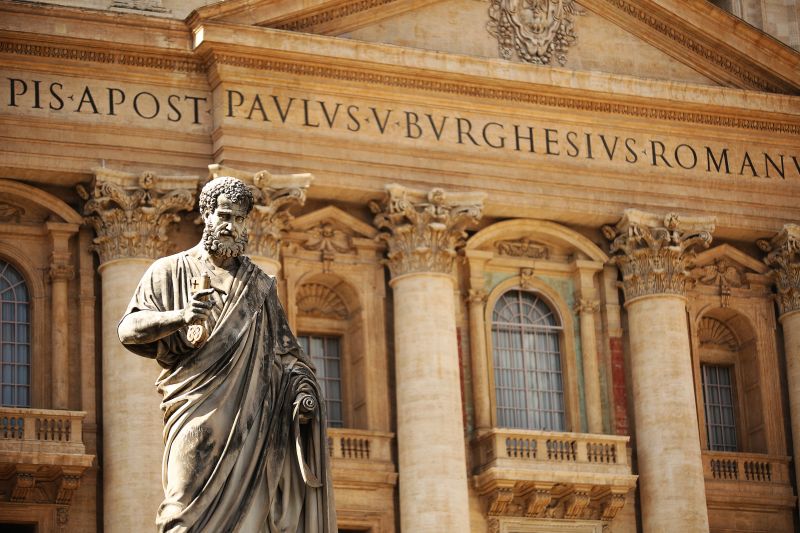
 Statue of St. Peter in front of St. Peter’s Basilica. / Credit: Vatican Media
National Catholic Register, Oct 2, 2023 / 02:34 am (CNA).
Five cardinals have sent a set of questions to Pope Francis to express their concerns and seek clarification on points of doctrine and discipline ahead of this week’s opening of the Synod on Synodality at the Vatican.
The cardinals said they submitted five questions, called “dubia,” on Aug. 21 requesting clarity on topics relating to doctrinal development, the blessing of same-sex unions, the authority of the Synod on Synodality, women’s ordination, and sacramental absolution.
Dubia are formal questions brought before the pope and the Dicastery for the Doctrine of the Faith (DDF) aimed at eliciting a “yes” or “no” response, without theological argumentation. The word “dubia” is the plural form of “dubium,” which means “doubt” in Latin. They are typically raised by cardinals or other high-ranking members of the Church and are meant to seek clarification on matters of doctrine or Church teaching.
The dubia were signed by German Cardinal Walter Brandmüller, 94, president of the Pontifical Committee for Historical Sciences; American Cardinal Raymond Burke, 75, prefect emeritus of the Apostolic Signatura; Chinese Cardinal Zen Ze-Kiun, 90, bishop emeritus of Hong Kong; Mexican Cardinal Juan Sandoval Íñiguez, 90, archbishop emeritus of Guadalajara; and Guinean Cardinal Robert Sarah, 78, prefect emeritus of the Dicastery for Divine Worship and the Discipline of the Sacraments.
The same group of senior prelates say they submitted a previous version of the dubia on these topics on July 10 and received a reply from Pope Francis the following day.
But they said that the pope responded in full answers rather than in the customary form of “yes” and “no” replies, which made it necessary to submit a revised request for clarification.
Pope Francis’ responses “have not resolved the doubts we had raised, but have, if anything, deepened them,” they said in a statement to the National Catholic Register, CNA’s partner news outlet. They therefore sent the reformulated dubia on Aug. 21, rephrasing them partly so they would elicit “yes” or “no” replies.
The cardinals declined the Register’s requests to review the pope’s July 11 response, as they say the response was addressed only to them and so not meant for the public.
They say they have not yet received a response to the reformulated dubia sent to the pope on Aug. 21.
The Register sought comment from the Vatican on Sept. 29 and again on Oct. 1 but had not received a response by publication time.
The cardinals explained in a “Notification to Christ’s Faithful” dated Oct. 2 that they decided to submit the dubia “in view of various declarations of highly placed prelates” made in relation to the upcoming synod that have been “openly contrary to the constant doctrine and discipline of the Church.”
Those declarations, they said, “have generated and continue to generate great confusion and the falling into error among the faithful and other persons of goodwill, have manifested our deepest concern to the Roman pontiff.”
The initiative, the cardinals added, was taken in line with canon 212 § 3, which states it is a duty of all the faithful “to manifest to the sacred pastors their opinion on matters which pertain to the good of the Church.”
The practice of issuing dubia has come to the fore during this pontificate. In 2016, Cardinals Burke and Brandmüller along with late Cardinals Carlo Caffarra and Joachim Meisner submitted a set of five dubium to Pope Francis seeking clarification on the interpretation of Francis’ apostolic exhortation Amoris Laetitia, particularly regarding the admission of divorced and remarried Catholics to the sacraments. They did not receive a direct response to their questions.
In 2021, the DDF issued a “responsa ad dubium” giving a simple “no” to a dubium on whether the Church has “the power to give the blessing to unions of persons of the same sex.” That same year, the Dicastery for Divine Worship issued a responsa ad dubia on various questions relating to the implementation of Traditionis Custodes, Pope Francis’ motu proprio restricting the Traditional Latin Mass.
Then in January of this year, Jesuit Father James Martin directly sent Pope Francis a set of three dubium seeking clarification of comments the Holy Father had given the Associated Press on the issue of homosexuality. The pope replied to the questions with a handwritten letter two days later.
What both dubia contain
The first dubium (question) concerns development of doctrine and the claim made by some bishops that divine revelation “should be reinterpreted according to the cultural changes of our time and according to the new anthropological vision that these changes promote; or whether divine revelation is binding forever, immutable and therefore not to be contradicted.”
The cardinals said the pope responded July 11 by saying that the Church “can deepen her understanding of the deposit of faith,” which they agreed with, but that the response did “not capture our concern.” They reinstated their concern that many Christians today argue that “cultural and anthropological changes of our time should push the Church to teach the opposite of what it has always taught. This concerns essential, not secondary, questions for our salvation, like the confession of faith, subjective conditions for access to the sacraments, and observance of the moral law,” they said.
They therefore rephrased their dubium to say: “Is it possible for the Church today to teach doctrines contrary to those she has previously taught in matters of faith and morals, whether by the pope ex cathedra, or in the definitions of an Ecumenical Council, or in the ordinary universal magisterium of the bishops dispersed throughout the world (cf. Lumen Gentium, 25)?”
In the second dubium on blessing same-sex unions, they underscored the Church’s teaching based on divine revelation and Scripture that “God created man in his own image, male and female he created them and blessed them, that they might be fruitful” (Gen 1:27-28), and St. Paul’s teaching that to deny sexual difference is the consequence of the denial of the Creator (Rom 1:24-32). They then asked the pope if the Church can deviate from such teaching and accept “as a ‘possible good’ objectively sinful situations, such as same-sex unions, without betraying revealed doctrine?”
The pope responded July 11, the cardinals said, by saying that equating marriage to blessing same-sex couples would give rise to confusion and so should be avoided. But the cardinals said their concern is different, namely “that the blessing of same-sex couples might create confusion in any case, not only in that it might make them seem analogous to marriage, but also in that homosexual acts would be presented practically as a good, or at least as the possible good that God asks of people in their journey toward him.”
They therefore rephrased their dubium to ask if it were possible in “some circumstances” for a priest to bless same-sex unions “thus suggesting that homosexual behavior as such would not be contrary to God’s law and the person’s journey toward God?” Linked to that dubium, they asked if the Church’s teaching continues to be valid that “every sexual act outside of marriage, and in particular homosexual acts, constitutes an objectively grave sin against God’s law, regardless of the circumstances in which it takes place and the intention with which it is carried out.”
Question about synodality
In the third dubium, the cardinals asked whether synodality can be the highest criterion of Church governance without jeopardizing “her constitutive order willed by her Founder,” given that the Synod of Bishops does not represent the college of bishops but is “merely a consultative organ of the pope.” They stressed: “The supreme and full authority of the Church is exercised both by the pope by virtue of his office and by the college of bishops together with its head the Roman pontiff (Lumen Gentium, 22).”
The cardinals said Pope Francis responded by insisting on a “synodal dimension to the Church” that includes all the lay faithful, but the cardinals said they are concerned that “synodality” is being presented as if it “represents the supreme authority of the Church” in communion with the pope. They therefore sought clarity on whether the synod can act as the supreme authority on crucial issues. Their reformulated dubium asked: “Will the Synod of Bishops to be held in Rome, and which includes only a chosen representation of pastors and faithful, exercise, in the doctrinal or pastoral matters on which it will be called to express itself, the supreme authority of the Church, which belongs exclusively to the Roman pontiff and, una cum capite suo, to the college of bishops (cf. can. 336 C.I.C.)?”
Holy Orders and forgiveness
In the fourth dubium, the cardinals addressed statements from some prelates, again “neither corrected nor retracted,” which say that as the “theology of the Church has changed,” so therefore women can be ordained priests. They therefore asked the pope if the teaching of the Second Vatican Council and St. John Paul II’s apostolic letter Ordinatio Sacerdotalis, which “definitively held the impossibility of conferring priestly ordination on women, is still valid.” They also sought clarification on whether or not this teaching “is no longer subject to change nor to the free discussion of pastors or theologians.”
In their reformulated dubium, the cardinals said the pope reiterated that Ordinatio Sacerdotalis is to be held definitively and “that it is necessary to understand the priesthood, not in terms of power, but in terms of service, in order to understand correctly Our Lord’s decision to reserve holy orders to men only.” But they took issue with his response that said the question “can still be further explored.”
“We are concerned that some may interpret this statement to mean that the matter has not yet been decided in a definitive manner,” they said, adding that Ordinatio Sacerdotalis belongs to the deposit of faith. Their reformulated dubium therefore comprised: “Could the Church in the future have the faculty to confer priestly ordination on women, thus contradicting that the exclusive reservation of this sacrament to baptized males belongs to the very substance of the sacrament of orders, which the Church cannot change?”
Their final dubium concerned the Holy Father’s frequent insistence that there’s a duty to absolve everyone and always, so that repentance would not be a necessary condition for sacramental absolution. The cardinals asked whether the contrition of the penitent remains necessary for the validity of sacramental confession, “so that the priest must postpone absolution when it is clear that this condition is not fulfilled.”
In their reformulated dubium, they note that the pope confirmed the teaching of the Council of Trent on this issue, that absolution requires the sinner’s repentance, which includes the resolve not to sin again. “And you invited us not to doubt God’s infinite mercy,” they noted, but added: “We would like to reiterate that our question does not arise from doubting the greatness of God’s mercy, but, on the contrary, it arises from our awareness that this mercy is so great that we are able to convert to him, to confess our guilt, and to live as he has taught us. In turn, some might interpret your answer as meaning that merely approaching confession is a sufficient condition for receiving absolution, inasmuch as it could implicitly include confession of sins and repentance.” They therefore rephrased their dubium to read: “Can a penitent who, while admitting a sin, refuses to make, in any way, the intention not to commit it again, validly receive sacramental absolution?”
Vatican context
The public release of the documents, obtained by the Register and other news outlets, comes two days before the opening of the 16th Ordinary General Assembly of the Synod of Bishops, a pivotal and highly controversial event in the Catholic Church.
The gathering in Rome marks a historic moment for the Church because for the first time in its history, laypeople, women, and other non-bishops will participate as full voting synod delegates, though the pope will ultimately decide whether to accept any of the assembly’s recommendations.
Pope Francis, either directly or through the Roman Curia, has previously addressed the topics brought up by the five cardinals and their dubia.
On the issue of the development of doctrine and possible contradictions, Pope Francis has frequently described a vision of doctrinal expansion grounded in a particular understanding of St. Vincent of Lerins’ maxim that Christian dogma “progresses, consolidating over the years, developing with time, deepening with age.” The pope has said doctrine expands “upward” from the roots of the faith as “our understanding of the human person changes with time, and our consciousness deepens.”
For instance, the Holy Father has said that while the death penalty was accepted and even called for by previous Catholic doctrine, it is “now a sin.” “The other sciences and their evolution also help the Church in this growth of understanding,” the pope said. In Evangelii Gaudium, Pope Francis said that this kind of approach might be considered “imperfect” by those who “dream of a monolithic doctrine defended by all without nuance,” but “the reality is that such variety helps us to better manifest and develop the different aspects of the inexhaustible richness of the Gospel.”
On the topic of blessing same-sex unions, which have been pushed for in places like Germany, the Vatican’s chief doctrinal office, the Dicastery for the Doctrine of the Faith, weighed in on the matter in 2021, clarifying that “the Church does not have, and cannot have, the power to bless unions of persons of the same sex.” However, some have speculated that, in spite of the DDF text referencing his approval, Pope Francis was displeased by the document. Relatedly, Antwerp’s Bishop Johan Bonny claimed in March that the pope did not disapprove of the Flemish-speaking Belgian bishops plan to introduce a related blessing, although this claim has not been substantiated and it is not clear that the Flemish blessing is, in fact, the kind explicitly disapproved by the DDF guidance.
Regarding the DDF text, Vatican Secretary of State Cardinal Pietro Parolin cited it in his criticism of the German Synodal Way’s decision to move forward with attempted blessings of same-sex unions, but he also added that the topic would require further discussion at the upcoming universal synod. More significantly, new DDF prefect Cardinal Victor Manuel Fernández, a close confidant of Pope Francis, stated in July that while he was opposed to any blessing that would confuse same-sex unions with marriage, the 2021 DDF guidance “lacked the smell of Francisco” and could be revisited during his tenure.
Regarding the authority of the forthcoming synod, although Pope Francis has expanded voting rights in the Synod of Bishops beyond the episcopacy, he has also repeatedly emphasized that the synod “is not a parliament” but a consultative, spiritual gathering meant to advise the pope. The pope did adjust canon law in 2018 to allow for the final document approved by a Synod of Bishops to “participate in the ordinary magisterium of the successor of Peter,” though only if “expressly approved by the Roman pontiff.”
On the possibility of the sacramental ordination of women, Pope Francis reaffirmed in 2016 that St. John Paul II’s clear “no” via Ordinato Sacederdotalis (1994) was the “final word” on the subject. In 2018, then-DDF prefect Cardinal Luis Ladaria confirmed that the male-only priesthood is “definitive.” In a 2022 interview with America magazine, Pope Francis again affirmed that women cannot enter ordained ministry and said that this should not be seen as a “deprivation.”
The pope has established two separate commissions to consider the question of a female diaconate, but the first, historically-based commission did not come to any definitive consensus and the second, focusing on the issue from a theological perspective, seems similarly unlikely to offer univocal support for a female diaconate. However, the synod’s Instrumentum Laboris does ask if “it is possible to envisage” women’s inclusion in the diaconate “and in what way?”
Finally, regarding withholding absolution in the confessional, the pope has previously referred to priests who refrain from offering absolution for certain moral sins without the bishop’s permission as “criminals” and told the Congolese bishops in February that they must “always forgive in the sacrament of reconciliation,” going beyond the Code of Canon Law to “risk on the side of forgiveness.”
Jonathan Liedl, senior editor of the National Catholic Register, contributed to this story.
[…]


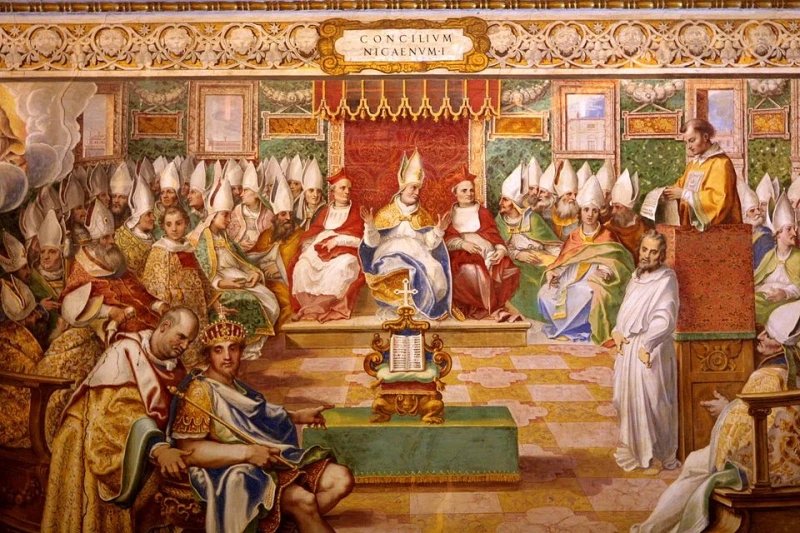



We read: “It was in Nicaea that the Church’s unity and mission were first expressed emblematically at a universal level (and from here, it draws its designation as an ecumenical council) through the synodal form of that ‘walking together’ which is proper to the Church…”
“Walking together” as successors of the Apostles, so also and therefore excluding (!) Arianism.
The faith expressed at Nicaea is the opening revelation to the world depicting Christ as God from God, Light from Light, True God from True God. A truth that remains indelible and resistible to modification.
“The faith expressed at Nicaea is the opening revelation to the world depicting Christ as God from God, Light from Light, True God from True God. A truth that remains indelible and resistible to modification.”
As does the Filioque, which in affirming The Unity of The Holy Ghost, In The Ordered Communion Of Perfect Complementary Eternal Love, The Most Holy And Undivided Blessed Trinity, affirms the fact that there is only One Divine Son Of God, thus The Spirit Of Perfect Love Between The Father And His Only Son, Must Proceed From Both The Father And The Son, for both The Father And The Son, Exist, In Essence,
As A Communion Of Eternal Divine Love.
Well done for this magnificent and well-worded reminder!
But did you notice that the document from the International Theological Commission only mentioned the Filioque once, in order to repudiate it very bluntly?
Everything suggests that it should be sacrificed on the altar of ecumenism, and this seems to me to be an offense to the good Catholic people, an incredible regression, and I fear even worse, since it is written in paragraph 12 “The Father also gives everything to the Spirit,” which is a radical novelty in Catholic tradition, and I wonder if this might not be heresy because of the confusion it creates between the two persons, the Son and the Spirit, since they are supposed to be distinguished by their mode of procession from the Father.
What do you think?
“…repudiate it bluntly”?
As you report, the term filioque does appear only once (n.4, in connection with accurately noted “misunderstandings”), but it is hardly repudiated. For the meaning but not the term, see n. 13 “[….] he is the Spirit of the Father and Spirit of the Son (Gal 4:6; Rom 8:9) [….]”. Here’s the link: https://www.vatican.va/roman_curia/congregations/cfaith/cti_documents/rc_cti_doc_20250403_1700-nicea_en.html
Possibly more troublesome might be the initial wording about “synods” [of bishops!], but this term (appearing 51 times), too, as it is used, and as it is explicitly clarified especially in n. 113 which recalls “Apostolic Tradition” (in contrast with today’s unmentioned and mixed town hall meetings).
Also, about the filioque inserted into the Creed, here’s a history:
The filioque (the Holy Spirit proceeds from the Father “and from the Son”) was present in the ancient texts and put forth by the Synod of Aachen in 809 (I think I’ve read, by Charlemagne in response to rekindled Arianism in Iberia), and introduced universally in Rome only in 1014. It was adopted by the Greeks and the Latins at the Councils of Lyon (II, 1274), and Florence (1438-1445) where it was initially agreed that the Greek “through the Son” did not differ essentially from “from the Son.” But the Greeks back home quickly disagreed—likely inflamed in part by the long memory of the earlier destruction of Constantinople by the Latin Crusaders in 1204? (Following the loss of a weakened Constantinople to Islam in 1453, the Eastern Church has disintegrated into local national Churches.)
SUMMARY: Councils [and real synods] are what the Church DOES, not what the Church IS (Benedict XVI). How always to better do communio/ecclesial assemblies remains a distinctly different work in progress.
I note that your casual rebuttal of my assertion sidesteps three major problems:
1) The Filioque is indeed set aside by the ITC text through the quotation of a very explicit ecumenical text (in note 8), whereas this document was supposed to contribute to putting Christ, and therefore the Son of God, back at the center.
2) Even though the Filioque is set aside, the statement “The Father also gives everything to the Spirit” (in n.12) is an assertion that implicitly refutes it, which is why it makes absolutely no sense in the Catholic tradition. You will find no trace of it anywhere except in Orthodox “literature.”
3) This serious doctrinal difficulty has not been noted anywhere in the Catholic media. ND’s commentary is almost unique in linking both the ITC text and the Filioque.
I think we are faced with a serious difficulty here, and I look forward to reading your response, as I have no doubt that you will recognize the surprising nature of this observation, whatever conclusions may be drawn from it.
PS: Charlemagne was indeed responsible for the spread of the Filioque in the Christian West, but precisely because he categorically rejected the “per Filium.”
Fn. 8: “Pontifical Council for Promoting Christian Unity, ‘The Greek and the Latin Traditions Regarding the Procession of the Holy Spirit’: «The Catholic Church acknowledges the conciliar, ecumenical, normative and irrevocable value, as expression of the one common faith of the Church and of all Christians, of the Symbol professed in Greek at Constantinople in 381 by the Second Ecumenical Council. No profession of faith peculiar to a particular liturgical tradition can contradict this expression of the faith taught and professed by the undivided Church» (Eng. trans. from: L’Osservatore Romano, 13 September 1995).”
I do see your point, but it is still not clear why the ITC language about the added Filioque risks contradiction—rather than remaining a non-contradictory clarification or development.
At a general audience on Nov. 7,1990, Pope John Paul II was still able to conclude with the optimism that “the formula ‘Filioque’ does not constitute an essential obstacle to the dialogue itself and to its development, which all hope for and pray for in the Holy Spirit” (“The Filioque Debate,” in The Pope Speaks, Our Sunday Visitor, 36:2, March/April 1971). In the article—about development—he cites Gospel passages (prior to ‘Orthodox literature’) and the long history of the debate, and refers to both sides (the East: Ephraim, Athanasius, Basil, Epiphanius, Cyril of Alexandria, Maximus, John Damascene; The West: Tertullian, Hilary, Ambrose, Augustine, Aquinas).
Recalling the high point, short-lived, when a common definition was adopted by both the Greeks and the Latins in 1439: “In the name of the Holy Trinity, Father, Son and Holy Spirit, with the approval of this sacred and universal Council of Florence, we establish that this truth of faith must be believed and accepted by all Christians: and thus all must profess that the Holy Spirit IS ETERNALLY OF THE FATHER AND THE SON [caps added], that He has His existence and His subsistent being FROM THE FATHER AND THE SON together, and that He proceeds from the one and from a single principle and from a single spiration [….] We establish…that the explanation given of the expression ‘Filioque’ has been added to the Creed licitly and with reason, in order to render the through clearer and because of the incumbent needs of those times.”
My non-professional (evasive?) and overarching thought is, that within earthbound history, the culture of the West seems to need more precise and explicit clarifications, while the culture of the East remains more levitated and atmospheric. About the challenges of history in the West, the (schismatic) East remains apart from not only Florence but all of the other twenty-one ecumenical councils after the first seven.
After a thousand years, maybe there’s a place for partly cross-cultural (?) dialogue on the Filioque.
Let’s be clear: the Filioque is not “added,” it is set aside by the ITC document.
What is added is the idea, which is absolutely contradictory to the Filioque, that “the Father also gives everything to the Spirit.”
This is unprecedented in Catholic doctrine because it is incompatible with the way the Filioque has always been understood since Augustine.
Do you see the problem now?
‘ INTERNATIONAL THEOLOGICAL COMMISSION
Jesus Christ, Son of God, Saviour
1700th anniversary of the Ecumenical Council of
325-2025
Preliminary note
In the course of its tenth quinquennium, the International Theological Commission chose to carry out an in-depth study of the First Ecumenical Council of Nicaea and its dogmatic relevance today. The work was carried out by a special Sub-Commission, chaired by Fr. Philippe Vallin and composed of the following members: Mgr Antonio Luiz Catelan Ferreira, Mgr Etienne Vetö, I.C.N., Fr. Mario Ángel Flores Ramos, Fr Gaby Alfred Hachem, Fr. Karl-Heinz Menke, Prof. Marianne Schlosser, and Prof. Robin Darling Young.
General discussions on this subject took place both at the various meetings of the Sub-Commission and at the plenary sessions of the Commission itself, held in the years 2022-2024. This text was put to the vote and unanimously approved in forma specifica by the members of the International Theological Commission at the plenary session of 2024. The document was then submitted for approval to its President, His Eminence Cardinal Víctor Manuel Fernández, Prefect of the Dicastery for the Doctrine of the Faith, who, after receiving the favourable opinion of the Holy Father, Pope Francis, authorised its publication on 16 December 2024. ‘
https://www.vatican.va/roman_curia/congregations/cfaith/cti_documents/rc_cti_doc_20250403_1700-nicea_en.html