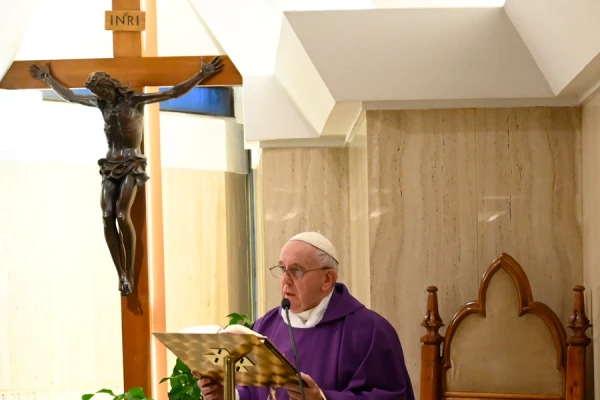
Pope Francis addresses bishops gathered in St. Peter’s Basilica at the Vatican for the Synod on Synodality closing Mass on Oct. 27, 2024. (Credit: Vatican Media)
CNA Newsroom, Mar 15, 2025 / 10:15 am (CNA).
The Vatican announced Tuesday that Pope Francis has approved a special Ecclesial Assembly for October 2028 to evaluate how Catholic communities worldwide have implemented the recently concluded Synod on Synodality recommendations.
Cardinal Mario Grech, Secretary General of the Synod, detailed the plans in a letter to bishops worldwide, emphasizing that this gathering will not constitute a new Synod but rather serve as the culmination of a structured three-year implementation process.
“The goal is not to add work upon work but to help Churches walk in a synodal style,” Cardinal Grech wrote.
The cardinal further said that local churches would actively receive and apply the synod’s final document, which Pope Francis directly approved following the conclusion of the Synod in October 2024.
The new implementation timeline begins in May 2025 with the publication of detailed guidelines, followed by a “Jubilee of Synodal Teams” in October.
Throughout 2027, evaluation assemblies will take place at diocesan, national, and international levels, with continental gatherings scheduled for early 2028.
Cardinal Grech highlighted the essential role of local “synodal teams” composed of “priests, deacons, consecrated men and women, and laypeople” working alongside their bishops. These teams, he noted, should be “valued” and, where necessary, “renewed, reactivated, and appropriately integrated.”
“This process does not diminish the role of each Church in receiving and applying the fruits of the synod in its own unique way,” the cardinal wrote. “Rather, it encourages a great co-responsibility that values local Churches while associating the episcopal college with the pope’s ministry.”
Cardinal Grech concluded his letter with an invitation for prayers for Pope Francis, who has been hospitalized at Rome’s Gemelli Clinic since Feb. 14.
If you value the news and views Catholic World Report provides, please consider donating to support our efforts. Your contribution will help us continue to make CWR available to all readers worldwide for free, without a subscription. Thank you for your generosity!
Click here for more information on donating to CWR. Click here to sign up for our newsletter.
Pallbearers carry the wooden coffin of Pope Francis, marked with a cross, into St. Peter’s Square for the funeral Mass on April 26, 2025. / Credit: Daniel Ibáñez/CNA
Vatican City, Apr 26, 2025 / 05:03 am (CNA).
More than 200,000 people filled St. Peter’s Square for the funeral of Pope Francis on Saturday as the world said goodbye to the first Latin American pope who led the Catholic Church for the past 12 years.
Under the bright Roman sun and amid crowds extending down the Via della Conciliazione, the funeral Mass unfolded within the great colonnade of St. Peter’s Basilica. Heads of state, religious leaders, and pilgrims from across the globe gathered for the historic farewell.
An aerial view of St. Peter’s Square filled with thousands of mourners, clergy, and dignitaries gathered for Pope Francis’s funeral Mass under clear blue skies in Vatican City on April 26, 2025.`. Credit: Daniel Ibáñez/CNA
Cardinal Giovanni Battista Re, the dean of the College of Cardinals, presided over the Mass, delivering a homily that paid tribute to Francis’ missionary vision, human warmth, spontaneity, witness to mercy, and “charisma of welcome and listening.”
“Evangelization was the guiding principle of his pontificate,” Re said.
Pope Francis “often used the image of the Church as a ‘field hospital’ after a battle in which many were wounded; a Church determined to take care of the problems of people and the great anxieties that tear the contemporary world apart; a Church capable of bending down to every person, regardless of their beliefs or condition, and healing their wounds.”
As bells tolled solemnly, the funeral rite began with the intonation of the entrance antiphon: “Eternal rest grant unto him, O Lord, and let perpetual light shine upon him.”
The late pope’s closed plain wooden coffin lay in front of the altar throughout the Mass.
A view of the coffin of Pope Francis resting before the altar at the funeral Mass on St. Peter’s Square, April 26, 2025. Credit: Daniel Ibáñez/CNA
“In this majestic Saint Peter’s Square, where Pope Francis celebrated the Eucharist so many times and presided over great gatherings over the past twelve years, we are gathered with sad hearts in prayer around his mortal remains,” Re said.
“With our prayers, we now entrust the soul of our beloved Pontiff to God, that he may grant him eternal happiness in the bright and glorious gaze of his immense love,” he added.
View of St. Peter’s Basilica during the Funeral Mass of Pope Francis on April 26, 2025. Peter Gagnon / EWTN
Among the more than 50 heads of state present were U.S. President Donald Trump and First Lady Melania Trump, alongside former President Joe Biden. Also in attendance were Ukrainian President Volodymyr Zelensky, Argentine President Javier Milei, Italian Prime Minister Giorgia Meloni, French President Emmanuel Macron, and European Commission President Ursula von der Leyen.
Philippine President Ferdinand Marcos Jr. and Brazilian President Luiz Inácio Lula da Silva joined the throng of international dignitaries along with representatives of religious traditions from around the world.
Royal families also paid their respects, with Prince William representing King Charles III and Spanish King Felipe VI and Queen Letizia seated near the altar.
Pilgrims arrived before sunrise to claim their spots in St. Peter’s Square for the Mass with the first in line camping out the night before.
The funeral followed the Ordo Exsequiarum Romani Pontificis, the official liturgical order for papal funerals, which was updated at Pope Francis’ own request in 2024. Scripture readings included Acts 10:34-43, Philippians 3:20–4:1, Psalm 22, and the Gospel of John 21:15-19 — a passage in which the risen Christ tells Peter: “Feed my sheep.”
More than 200 cardinals and 750 bishops and priests concelebrated the funeral Mass. More than 4,000 journalists representing 1,800 media outlets reported on the event. All told, the Holy See said more than 250,000 mourners attended.
In his homily, Cardinal Re reflected on key moments in Pope Francis’ pontificate from his risk-defying trip to Iraq to visit Christians communities persecuted by the Islamic State to his Mass on the border between Mexico and the United States during his journey to Mexico.
“Faced with the raging wars of recent years, with their inhuman horrors and countless deaths and destruction, Pope Francis incessantly raised his voice imploring peace and calling for reason and honest negotiation to find possible solutions,” the cardinal said, causing the crowd to erupt in spontaneous applause.
Pope Francis’ coffin lies in St. Peter’s Square during the papal funeral Mass on Saturday, April 26, 2025. Credit: EWTN News
“Pope Francis always placed the Gospel of mercy at the center, repeatedly emphasizing that God never tires of forgiving us. He forgives, whatever the situation might be of the person who asks for forgiveness and returns to the right path,” Re reflected. “Mercy and the joy of the Gospel are two key words for Pope Francis.”
The cardinal presided over the final commendation and farewell for Pope Francis, praying: “Dear brothers and sisters, let us commend to God’s tender mercy the soul of Pope Francis, bishop of the Catholic Church, who confirmed his brothers and sisters in the faith of the resurrection.”
“Let us pray to God our Father through Jesus Christ and in the Holy Spirit; may he deliver him from death, welcome him to eternal peace and raise up him on the last day,” he said.
After the crowd chanted the Litany of Saints in Latin, Cardinal Baldassare Reina, vicar general of the Diocese of Rome, offered a final prayer: “O God, faithful rewarder of souls, grant that your departed servant and our bishop, Pope Francis, whom you made successor of Peter and shepherd of your Church, may happily enjoy forever in your presence in heaven the mysteries of your grace and compassion, which he faithfully ministered on earth.”
A poignant moment followed as Eastern Catholic patriarchs, major archbishops, and metropolitans from the “sui iuris” Churches approached the coffin while a choir chanted a Greek prayer from the Byzantine Funeral Office.
Re blessed the coffin with holy water and incense as the choir sang in Latin: “I know that my Redeemer lives: on the last day I shall rise again.”
At the end of the Mass, the traditional antiphon “In Paradisum” was sung in Latin, asking for the angels to guide the pope’s soul to heaven.
“May the angels lead you into paradise; may the martyrs come and welcome you and take you to the holy city, the new and eternal Jerusalem. May choirs of angels welcome you and with Lazarus, who is poor no longer, may you have eternal rest.”
In keeping with his wishes, Pope Francis will not be buried in the Vatican grottoes alongside his predecessors. Instead, his body will be taken in procession through the streets of Rome in a vehicle to the Basilica of St. Mary Major, a church he visited over 100 times in his lifetime to pray before an icon of the Virgin Mary, “Salus Populi Romani,” particularly before and after his papal journeys.
Pope Francis’ wooden coffin is transported on the popemobile through the streets of Rome as crowds of faithful line the procession route from St. Peter’s Basilica to the Basilica of Santa Maria Maggiore, April 26, 2025. Credit: Daniel Ibáñez/CNA
In Rome’s most important Marian basilica, Pope Francis will be laid to rest in a simple tomb marked with a single word: Franciscus.
Remembering Pope Francis
Jorge Mario Bergoglio was born on Dec. 17, 1936, in Buenos Aires, Argentina, and entered the Society of Jesus at age 21. Following his ordination in 1969, he served as a Jesuit provincial, seminary rector, and professor before St. John Paul II appointed him auxiliary bishop of Buenos Aires in 1992. He became archbishop of the Argentine capital in 1998 and was created cardinal in 2001.
The surprise election of Cardinal Bergoglio on March 13, 2013, at age 76 marked several historic firsts: He became the first Jesuit pope, the first from the Americas, and the first to choose the name Francis, inspired by St. Francis of Assisi’s devotion to poverty, peace, and creation.
His 12-year pontificate was characterized by a focus on mercy, care for creation, and attention to what he called the “peripheries” of both the Church and society. He made 47 apostolic journeys outside Italy, though he never visited his native Argentina.
During his tenure, Pope Francis canonized 942 saints — more than any other pope in history — including his predecessors John XXIII, Paul VI, and John Paul II. He published four encyclicals and seven apostolic exhortations while promulgating 75 motu proprio documents.
Throughout his papacy, Francis significantly reshaped the College of Cardinals through 10 consistories, creating 163 new cardinals. His appointments reflected his vision of a global Church, elevating prelates from the peripheries and creating cardinals in places that had never before had one, including Mongolia and South Sudan.
Health challenges marked the pope’s final years. He underwent surgery in July 2021 and in June 2023. In November 2023, he suffered from pulmonary inflammation, and in February 2025, he was hospitalized at Rome’s Gemelli Hospital for bronchitis and a respiratory infection.
His papacy faced unprecedented challenges, including the global COVID-19 pandemic, during which he offered historic moments of prayer for humanity, notably the extraordinary urbi et orbi blessing in an empty St. Peter’s Square in March 2020. He also repeatedly called for peace amid conflicts in Ukraine and the Holy Land.
Francis convoked four synods, including the Synod on Synodality, whose second session concluded in October 2024. He implemented significant reforms of the Roman Curia and took several steps to address the clergy abuse crisis, including the 2019 motu proprio Vos Estis Lux Mundi.
Pope Francis’ funeral marks the first day in the Catholic Church’s traditional nine-day mourning period that will include nine days of requiem Masses to be offered for the repose of his soul.
“Pope Francis used to conclude his speeches and meetings by saying, ‘Do not forget to pray for me,’ Re recalled at the end of his homily.
“Dear Pope Francis, we now ask you to pray for us. May you bless the Church, bless Rome, and bless the whole world from heaven as you did last Sunday from the balcony of this Basilica in a final embrace with all the people of God, but also embrace humanity that seeks the truth with a sincere heart and holds high the torch of hope.”
Vatican City, Dec 5, 2017 / 05:19 pm (CNA).- Despite the recent inclusion of Pope Francis’ 2016 letter to the Buenos Aires bishops on Amoris laetitia in the Holy See’s official text of record, neither the Church’s discipline nor its doctrine have changed.
The move is the latest in the debate over the admission of the divorced-and-remarried to Communion. The Second Vatican Council, St. John Paul II, and Benedict XVI – as well as the Congregation for the Doctrine of the Faith and the Pontifical Council for Legislative Texts under them – all firmly opposed proposals to admit to eucharistic communion the divorced-and-remarried who do not observe continence.
The debate has received renewed impetus under Pope Francis. His 2016 apostolic exhortation on love in the family, Amoris laetitia, has been met with varied reception and interpretation within the Church. Its eighth chapter, entitled “Accompanying, Discerning, and Integrating Weakness,” deals with, among other things, the pastoral care of the divorced-and-remarried, those who may not be admitted to Communion unless they have committed to living in continence, eschewing the acts proper to married couples.
Yet, for many Church leaders and theologians, ambiguous language in that chapter has led to uncertainties about this practice, and about the nature and status of the apostolic exhortation itself. Some have maintained that it is incompatible with Church teaching, and others that it has not changed the Church’s discipline. Still others read Amoris laetitia as opening the way to a new pastoral practice, or even as a development in continuity with St. John Paul II.
Some Church leaders have noted that Amoris laetitia has led to the disorientation and great confusion of many of the faithful, and at least one respected theologian has argued that Francis’ pontificate has fostered confusion, diminished the importance of doctrine in the Church’s life, and cause faithful Catholics to lose confidence in the papacy.
Pope Francis has been understood to encourage those who interpret Amoris laetitia as opening the way to a new pastoral practice – as he seemed to do in a letter to the bishops of the Buenos Aires region, which is the subject of the latest furor.
His letter approves those bishops’ pastoral response to the divorced-and-remarried, based on Amoris laetitia. The response had said that ministry to the divorced-and-remarried must never create confusion about Church teaching and the indissolubility of marriage, but may also allow access to the sacraments under specific limits. These might include specific situations when a penitent in an irregular union is under attenuated culpability, as when leaving such a union could cause harm to his children, although the circumstances envisioned are not precisely delineated, which, some theologians say, has contributed to the confusion.
The Pope’s Sept. 5, 2016 letter addressed to Bishop Sergio Alfredo Fenoy of San Miguel said, “The text is very good and makes fully explicit the meaning of the eighth chapter of ‘Amoris Laetitia’. There are no other interpretations. And I am sure it will do a lot of good. May the Lord reward you for this effort of pastoral charity.”
It was reported this weekend that Pope Francis’ letter, as well as the pastoral response of the Buenos Aires bishops, were promulgated in the October 2016 issue of the Acta Apostolicae Sedis, a Vatican publication in which official documents of the Pope and the Roman Curia are published, and through which universal ecclesiastical laws are promulgated.
Dr. Edward Peters, a professor of canon law at Sacred Heart Major Seminary in Detroit, wrote Dec. 4 that the Buenos Aires document contains assertions “running the gamut from obviously true, through true-but-oddly-or-incompletely phrased, to a few that, while capable of being understood in an orthodox sense, are formulated in ways that lend themselves to heterodox understandings.”
He noted that what prevents the admission of the divorced-and-remarried to eucharistic communion is canon 915 “and the universal, unanimous interpretation which that legislative text, rooted as it is in divine law, has always received.” The canon states that those “obstinately persevering in manifest grave sin are not to be admitted to holy communion.”
In an August 2017 post anticipating the possible publication in AAS of the Buenos Aires letter or the Pope’s commendation of it, Peters had written that “many, nay most, papal documents appearing in the Acta carry no canonical or disciplinary force.”
He wrote that “Unless canon 915 itself is directly revoked, gutted, or neutered, it binds ministers of holy Communion to withhold that most august sacrament from, among others, divorced-and-remarried Catholics except where such couples live as brother-sister and without scandal to the community.”
“Nothing I have seen to date, including the appearance of the pope’s and Argentine bishops’ letters in the Acta Apostolicae Sedis, makes me think that Canon 915 has suffered such a fate.”
He added: “Neither the pope’s letter to the Argentines, nor the Argentine bishops’ document, nor even Amoris laetitia so much as mentions Canon 915, let alone do these documents abrogate, obrogate, or authentically interpret this norm out of the Code of Canon Law.”
While the Pope’s letter and the Buenos Aires bishops’ pastoral response do contain ambiguous “disciplinary assertions”, they are insufficient “to revoke, modify, or otherwise obviate” canon 915, Peters wrote.
Aside from the canonical problems with the admission of the divorced-and-remarried to eucharistic communion is the question of what it means that the Buenos Aires document and the Pope’s letter in support of it are intended to be a part of the Church’s Magisterium.
A rescript from Cardinal Pietro Parolin, Vatican Secretary of State, in the AAS notes that their promulgation was intended “as authentic Magisterium.”
The Magisterium is a part of teaching office of bishops, by which they are charged with interpreting and preserving the deposit of faith. In its 1990 declaration Donum veritatis, the Congregation for the Doctrine of the Faith noted that the Magisterium “has the task of discerning, by means of judgments normative for the consciences of believers, those acts which in themselves conform to the demands of faith and foster their expression in life and those which, on the contrary, because intrinsically evil, are incompatible with such demands.”
Catholics are bound to assent to divinely revealed teachings with faith; to firmly embrace and retain those things which are required to safeguard reverently and to expound faithfully the deposit of faith; and to give religious submission of intellect and will to doctrines on faith or morals given through the authentic Magisterium.
The critical question regarding Amoris laetitia is what, precisely, it teaches with regard to faith and morals, and what it doesn’t, or even, can’t, teach. On the latter question, especially, the Church’s existent doctrine is helpful.
Even while some bishops, such as those of the Buenos Aires region and those of Malta, have interpreted the apostolic exhortation as allowing a new pastoral practice, many others have maintained that it changes nothing of doctrine or discipline.
For example, while prefect of the Congregation for the Doctrine of the Faith, Cardinal Gerhard Müller said that Amoris laetitiahas not eliminated Church discipline on marriage, nor has it has permitted in some cases the divorced-and-remarried “to receive the Eucharist without the need to change their way of life.”
“This is a matter of a consolidated magisterial teaching, supported by scripture and founded on a doctrinal reason: the salvific harmony of the sacrament, the heart of the ‘culture of the bond’ that the Church lives.”
The prefect of the CDF said that if Pope Francis’ exhortation “had wanted to eliminate such a deeply rooted and significant discipline, it would have said so clearly and presented supporting reasons.”
“There is however no affirmation in this sense; nor does the Pope bring into question, at any time, the arguments presented by his predecessors, which are not based on the subjective culpability of our brothers, but rather on their visible, objective way of life, contrary to the words of Christ,” Cardinal Müller stated.
It has been the constant teaching of the Church that marriage is indissoluble, that people not married to each other may not legitimately engage in acts of sexual intimacy, that the Eucharist may not be received by those conscious of grave sin, and that absolution requires the purpose of amending one’s life, even with a diminished or limited capacity to exercise the will.
And the Catechism of the Catholic Church teaches that “If the divorced are remarried civilly, they find themselves in a situation that objectively contravenes God’s law. Consequently, they cannot receive Eucharistic communion as long as this situation persists … Reconciliation through the sacrament of Penance can be granted only to those who have repented for having violated the sign of the covenant and of fidelity to Christ, and who are committed to living in complete continence.”
St. John Paul II promulgated the Catechism in 1992 by the apostolic constitutionFidei depositum, in which he wrote that it “is a statement of the Church’s faith and of Catholic doctrine, attested to or illumined by Sacred Scripture, Apostolic Tradition and the Church’s Magisterium. I declare it to be a valid and legitimate instrument for ecclesial communion and a sure norm for teaching the faith.”
“The approval and publication of the Catechism of the Catholic Church represents a service which the Successor of Peter wishes to offer to the Holy Catholic Church … of supporting and confirming the faith of all the Lord Jesus’ disciples, as well as of strengthening the bonds of unity in the same apostolic faith. Therefore, I ask the Church’s Pastors and the Christian faithful to receive this catechism in a spirit of communion and to use it assiduously in fulfilling their mission of proclaiming the faith and calling people to the Gospel life. This catechism is given to them that it may be a sure and authentic reference text for teaching Catholic doctrine.”
Critical to understanding the character of the Church’s teaching on these issues is a declaration the Pontifical Council for Legislative Texts wrote in 2000 that canon 915’s prohibition on admitting to Holy Communion those who obstinately persist in manifest grave sin is applicable to the divorced-and-remarried.
“Any interpretation of can. 915 that would set itself against the canon’s substantial content, as declared uninterruptedly by the Magisterium and by the discipline of the Church throughout the centuries, is clearly misleading,” it said.
This prohibition, the pontifical council continued, is “by its nature derived from divine law and transcends the domain of positive ecclesiastical laws: the latter cannot introduce legislative changes which would oppose the doctrine of the Church.”
This declaration defines a kind of a limit on how the Magisterium can develop; by invoking divine law, the council says that no pastoral approach can transgress the norms of Sacred Scripture and Sacred Tradition. While considering questions of subjective culpability do not exceed those norms, the council’s directive explains that the Church can not, and will not, redefine the deposit of faith.
The deposit of faith has not been changed, and nor has canon law. Despite a great deal of anxiety and media attention, truth remains unchanged, and unchanging.
While some find the Pope’s writing to be ambiguous, truth is not. Amoris laetitia must be interpreted in a way that does not contravene truth.
Even when such an interpretation is not readily apparent.
New York City, N.Y., May 22, 2018 / 08:30 pm (CNA/EWTN News).- The Archbishop of New York said Tuesday that while some recent comments about homosexuality attributed to Pope Francis are “orthodox teaching,” the pope’s reported remarks could require clarification.
Cardinal Timothy Dolan affirmed the pope’s recent affirmation of God’s love for a gay man with whom the pontiff visited in Rome, saying: “Jesus would have said that, and so would I. That’s conservative, traditional, Catholic, orthodox teaching. The ‘Catechism’ insists on that.”
“While any sexual expression outside of a man and woman in marriage is contrary to God’s purpose, so is not treating anyone, including a gay person, with anything less than dignity and respect,” Dolan added, speaking May 22 during his weekly radio show on Sirius XM’s The Catholic Channel.
“What he says is beautiful, don’t you think?” Dolan asked.
The remarks were a response to questions about Juan Carlos Cruz, a Chilean victim of sexual abuser Fr. Fernando Karadima, who told the Spanish newspaper El Pais on Friday that Pope Francis told him that it did not matter that he was gay.
“He told me ‘Juan Carlos, that you are gay does not matter. God made you like that and he loves you like that and I do not care. The Pope loves you as you are, you have to be happy with who you are,’” Cruz recalled.
Asked about the most controversial aspect of the Holy Father’s remarks, regarding whether God wills that someone experience same sex attraction, Dolan was circumspect, citing “ongoing debate” among “professional circles.”
“Is one born that way, or is it – is it nature or nurture?… I don’t think the Holy Father would feel competent to speak on that.”
Dolan noted that while he had no reason to doubt Cruz’s account, the pope’s reported remarks were “third hand: what the pope said to him, he said to the press, so one would want to get a clarification.”
He said his remarks were qualified by “a little bit of ‘wait and see’” adding “let’s find out exactly what the Holy Father said.”
Too much of an echo chamber for the illuminati? Three comments and a question:
FIRST, the synodal style, by itself, is something for the next conclave to think about, twice. In 2028 Cardinal Grech might even be awarded two minutes to say his piece. One key innovation, here, is “consensus,” and we ask, “consensus about what”? A second devolution is the meaning of the word “alongside.” As successors of the Apostles (apostello: “sent”), the ordained bishops are firstly the guardians of the Deposit of Faith, which is our institutional, charismatic, sacramental, and personal incorporation into the life of Jesus Christ (the Mystical Body of Christ).
SECOND, yes, to some credible process to get the ordained clergy and the laity to support and leaven each other within the “universal call to holiness.” But, what still of Vatican II—which Grech mentions—which retains clarity about the vital “difference in kind as well as degree” (Lumen Gentium). Also a distinction between the realm of Revelation (Dei Verbum) and the realm of the world (Gaudium et Spes).
THIRD, so, in the full text of this initiative (https://www.vaticannews.va/en/vatican-city/news/2025-03/grech-a-new-path-to-help-the-church-walk-in-a-synodal-style.html), why are the terms “Synod” (of Bishops) and “Assembly” used interchangeably? In a deeper way, the presence of the entire Communion of Saints (!) already happens at each celebration of the Mass—as an “extension and continuation” (St. John Paul II, drawing from St. John Chrysostom) of the one event of Calvary. The center of universal human history; not simply an episode within one narrative among many.
So, yes, to reinvigorating a religious and therefore fully human alternative to a post-World War II, post-modern, and flat-earth world moving backward into global spheres of influence. But, alone, the synodal “style” does not replace content. This by procedurally substituting (?) the vertical altar with horizontal roundtables of various sizes.
QUESTION: What does the synodal “style” have to offer to what is, in fact, a new Apostolic Age?
By then we will have a different Pope and this “Synodality” nonsense would have been tossed into the trash can of history and forgotten, where it belongs.
Put not your trust in princes, in a son of man, in whom there is no help. When his breath departs he returns to his earth; on that very day his plans perish.
If not before. Most sons of men have their plans perish long before they die. If the plans happen to persist after the death of the planner, it is only because someone else made it his plan. (John Kennedy had less to do with the moon landing than he is usually credited.)
The question, then, is whether the new pope will take up Francis’s plans. That, of course, is completely unknowable. Many people point to the number of cardinals Francis has appointed, but ALL of the cardinals who elected Francis had been appointed either by Benedict XVI or by John Paul II. As we see, this did not guarantee the election of a like-minded pope. Even so, it is by no means certain that the next pope will change even the most obviously disastrous aspects of Francis’s papacy.
Team Francis, Cdls Grech, Hollerich, Cupich, Farrell, Roche, Tobin, how can we neglect McElroy are pressing forward despite hopeful expectations of the more traditional Catholic. 2028. The Synodal Church sails on regardless of passenger recalcitrance, disenchantment and turmoil.
Where does she sail? Paradise Island. A dreamy place where the brutality of rigorist legalism doesn’t exist. Where good is evil and evil is good. Didn’t Zoroaster foretell the day? A truly happy place in the minds of the enlightened progressives freed from tradition. That insufferable past.
Perchance Leviathan [wasn’t the bronze serpent an effigy?] himself will providentially wreck her, the survivors a new beginning.
“The brutality of legalism doesn’t exist …” except if we need it to enforce the synodal dance. After all, as Cardinal Grech reminded us, this is an expression of “the ordinary Magisterium.” And if a cleric said it, it must be true. Expect this process to be somewhat like the Vatican’s survey last summer: we want to “hear” you until what you start to say is not what we want to hear.
I’m hoping that by 2028 the Synod on Synodality will be a vague memory that only about two or three Catholics will remember with embarrassment, if he or she is unfortunate to remember it at all.
How best to manage the worldwide Church? Circular roundtables of layered synodality (local, national, continental)?
Two comments and a question:
FIRST, a thought experiment…what if in 2025 we are tutored by the inner circle that the Council of Nicaea (1700th anniversary) was really in management of inclusion, rather than a recalling of what was/is believed from the beginning and, therefore, a rejection (non-inclusion!) of Arianism (read Pachamama, Fiducia Supplicans, etc.)? AND, then in 2026 or so, we read that the protocol for electing a subsequent pope is modernized to involve, in some way, the advice or even consent of the 2028 Assembly.
SECOND, about management of such a community-based (or Lutheran) remodel of the ecclesial Catholic Church of the Apostolic Succession (with a validly ordained priesthood and stuff like that), clearly rooted in Matthew (28:19) and in Pentecost (Acts 2:1-31)—“listening” to Benedict XVI we hear that the message is not to “turn back”, but rather “to return to the authentic texts of the original Vatican II” (The Ratzinger Report, 1985):
“But the Church of Christ is not a party, not an association, not a club. Not setting the clock back, but setting in right. Her deep and permanent structure is not democratic but sacramental, consequently hierarchical” (49). “Real reform is to strive to let what is ours disappear as much as possible so what belongs to Christ may become more visible…what the Church needs in order to respond to the needs of man in every age is holiness, not management” (53).
QUESTION: Does the replacement of Synods of Bishops with mongrel-democratic Synodality teach/imply/ signal and morph that the process of management IS holiness?
What, exactly, about the post-synodal Study Group #9 possibly anguishing over how to elevate today’s theologians and maybe an Assembly above the Church’s magisterium(?)—that is, assigned to develop “Theological criteria [?] and synodal methodologies [?] for shared discernment of controversial doctrinal [?], pastoral [?], and ethical [?] issues.”
My walk toward Christ is full of failures. My desire has been to follow him, but I fall short of that on a daily basis. I take the responsibility of sharing the message of the Good News with my neighbors seriously. I firmly believe that the role of the Church is to be the bridge between Good and all of humanity. The Church is supposed to serve as community to unite believers as one body in Christ. She is the beacon that clearly, without hesitation and full of clarity, announces the teachings of Christ to the world.
Anything, any movement, any teaching that attempts to move the Church from her purpose is heretical and must be cast out. In my weakness, I strive to walk in truth. I am not in a position, and I am unworthy to condemn another, but I know Jesus Christ and choose to walk with him. I ignore everything else.
The Synod was a “meeting about meeting” we were told. I guess the post-Synodal Synod will be a meeting about meeting about meeting. Just think of it this way: it’s the Vatican’s version of Festivus.
“The goal is not to add work upon work but to help Churches walk in the Synodal style” according to Cardinal Grech.
Help Churches walk in the synodal style. Hmm… that sounds eerily like “I’m from the Federal Government and I’m here to help.” More to the point, the 2028 Synod will be where the teeth come out to “help Churches walk in the Synodal style.” Well, that could prove problematic for Churches faithful to Tradition that exhibit bureaucratic resistance to walking in the Synodal style.
It is my prayer that Mssrs. Johann du Toit and Ken T are correct in their prediction that post-Francis, synodalism will be discarded. I am not so optimistic. I fear that 2028 will be the beginning of the final crackdown. The Church of Accompaniment directing us to accompany together into the cattle car taking us to banquet of rotten fruit compliments of the Synodal Way.
What? More?
Too much of an echo chamber for the illuminati? Three comments and a question:
FIRST, the synodal style, by itself, is something for the next conclave to think about, twice. In 2028 Cardinal Grech might even be awarded two minutes to say his piece. One key innovation, here, is “consensus,” and we ask, “consensus about what”? A second devolution is the meaning of the word “alongside.” As successors of the Apostles (apostello: “sent”), the ordained bishops are firstly the guardians of the Deposit of Faith, which is our institutional, charismatic, sacramental, and personal incorporation into the life of Jesus Christ (the Mystical Body of Christ).
SECOND, yes, to some credible process to get the ordained clergy and the laity to support and leaven each other within the “universal call to holiness.” But, what still of Vatican II—which Grech mentions—which retains clarity about the vital “difference in kind as well as degree” (Lumen Gentium). Also a distinction between the realm of Revelation (Dei Verbum) and the realm of the world (Gaudium et Spes).
THIRD, so, in the full text of this initiative (https://www.vaticannews.va/en/vatican-city/news/2025-03/grech-a-new-path-to-help-the-church-walk-in-a-synodal-style.html), why are the terms “Synod” (of Bishops) and “Assembly” used interchangeably? In a deeper way, the presence of the entire Communion of Saints (!) already happens at each celebration of the Mass—as an “extension and continuation” (St. John Paul II, drawing from St. John Chrysostom) of the one event of Calvary. The center of universal human history; not simply an episode within one narrative among many.
So, yes, to reinvigorating a religious and therefore fully human alternative to a post-World War II, post-modern, and flat-earth world moving backward into global spheres of influence. But, alone, the synodal “style” does not replace content. This by procedurally substituting (?) the vertical altar with horizontal roundtables of various sizes.
QUESTION: What does the synodal “style” have to offer to what is, in fact, a new Apostolic Age?
By then we will have a different Pope and this “Synodality” nonsense would have been tossed into the trash can of history and forgotten, where it belongs.
Put not your trust in princes, in a son of man, in whom there is no help. When his breath departs he returns to his earth; on that very day his plans perish.
If not before. Most sons of men have their plans perish long before they die. If the plans happen to persist after the death of the planner, it is only because someone else made it his plan. (John Kennedy had less to do with the moon landing than he is usually credited.)
The question, then, is whether the new pope will take up Francis’s plans. That, of course, is completely unknowable. Many people point to the number of cardinals Francis has appointed, but ALL of the cardinals who elected Francis had been appointed either by Benedict XVI or by John Paul II. As we see, this did not guarantee the election of a like-minded pope. Even so, it is by no means certain that the next pope will change even the most obviously disastrous aspects of Francis’s papacy.
Team Francis, Cdls Grech, Hollerich, Cupich, Farrell, Roche, Tobin, how can we neglect McElroy are pressing forward despite hopeful expectations of the more traditional Catholic. 2028. The Synodal Church sails on regardless of passenger recalcitrance, disenchantment and turmoil.
Where does she sail? Paradise Island. A dreamy place where the brutality of rigorist legalism doesn’t exist. Where good is evil and evil is good. Didn’t Zoroaster foretell the day? A truly happy place in the minds of the enlightened progressives freed from tradition. That insufferable past.
Perchance Leviathan [wasn’t the bronze serpent an effigy?] himself will providentially wreck her, the survivors a new beginning.
“The brutality of legalism doesn’t exist …” except if we need it to enforce the synodal dance. After all, as Cardinal Grech reminded us, this is an expression of “the ordinary Magisterium.” And if a cleric said it, it must be true. Expect this process to be somewhat like the Vatican’s survey last summer: we want to “hear” you until what you start to say is not what we want to hear.
So when are we supposed to stop Synodaling and share the Word of God with someone else?
“Putting away falsehood, let every one speak the truth with his neighbor, for we are members one of another.”
(Ephesians 4:25)
Idiots.
O Lord, when will this affliction of walking talking and ending up actually doing and producing NOTHING will end!!!!!!
The church is being manipulated from the top.
I’m hoping that by 2028 the Synod on Synodality will be a vague memory that only about two or three Catholics will remember with embarrassment, if he or she is unfortunate to remember it at all.
Malice in Wonderland
Hilarious!!!
And perfect..,
How best to manage the worldwide Church? Circular roundtables of layered synodality (local, national, continental)?
Two comments and a question:
FIRST, a thought experiment…what if in 2025 we are tutored by the inner circle that the Council of Nicaea (1700th anniversary) was really in management of inclusion, rather than a recalling of what was/is believed from the beginning and, therefore, a rejection (non-inclusion!) of Arianism (read Pachamama, Fiducia Supplicans, etc.)? AND, then in 2026 or so, we read that the protocol for electing a subsequent pope is modernized to involve, in some way, the advice or even consent of the 2028 Assembly.
SECOND, about management of such a community-based (or Lutheran) remodel of the ecclesial Catholic Church of the Apostolic Succession (with a validly ordained priesthood and stuff like that), clearly rooted in Matthew (28:19) and in Pentecost (Acts 2:1-31)—“listening” to Benedict XVI we hear that the message is not to “turn back”, but rather “to return to the authentic texts of the original Vatican II” (The Ratzinger Report, 1985):
“But the Church of Christ is not a party, not an association, not a club. Not setting the clock back, but setting in right. Her deep and permanent structure is not democratic but sacramental, consequently hierarchical” (49). “Real reform is to strive to let what is ours disappear as much as possible so what belongs to Christ may become more visible…what the Church needs in order to respond to the needs of man in every age is holiness, not management” (53).
QUESTION: Does the replacement of Synods of Bishops with mongrel-democratic Synodality teach/imply/ signal and morph that the process of management IS holiness?
What, exactly, about the post-synodal Study Group #9 possibly anguishing over how to elevate today’s theologians and maybe an Assembly above the Church’s magisterium(?)—that is, assigned to develop “Theological criteria [?] and synodal methodologies [?] for shared discernment of controversial doctrinal [?], pastoral [?], and ethical [?] issues.”
My walk toward Christ is full of failures. My desire has been to follow him, but I fall short of that on a daily basis. I take the responsibility of sharing the message of the Good News with my neighbors seriously. I firmly believe that the role of the Church is to be the bridge between Good and all of humanity. The Church is supposed to serve as community to unite believers as one body in Christ. She is the beacon that clearly, without hesitation and full of clarity, announces the teachings of Christ to the world.
Anything, any movement, any teaching that attempts to move the Church from her purpose is heretical and must be cast out. In my weakness, I strive to walk in truth. I am not in a position, and I am unworthy to condemn another, but I know Jesus Christ and choose to walk with him. I ignore everything else.
Amen brother! You’re for sure on the right road.
YADA YADA YADA!!
BLAH BLAH BLAH!!
FURTHERMORE – asxovvnddiuertn434&&9999v330fgjv..!!
AND THIS TIME – I MEAN IT!!!
LOL, I can’t help but agree
Sounds like you’re all ready for the Jubilee of Synodal Teams!
The Synod was a “meeting about meeting” we were told. I guess the post-Synodal Synod will be a meeting about meeting about meeting. Just think of it this way: it’s the Vatican’s version of Festivus.
Serious question. Has a single parish made a single change because of the Synod?
Ours has not, not that I can tell
“The goal is not to add work upon work but to help Churches walk in the Synodal style” according to Cardinal Grech.
Help Churches walk in the synodal style. Hmm… that sounds eerily like “I’m from the Federal Government and I’m here to help.” More to the point, the 2028 Synod will be where the teeth come out to “help Churches walk in the Synodal style.” Well, that could prove problematic for Churches faithful to Tradition that exhibit bureaucratic resistance to walking in the Synodal style.
It is my prayer that Mssrs. Johann du Toit and Ken T are correct in their prediction that post-Francis, synodalism will be discarded. I am not so optimistic. I fear that 2028 will be the beginning of the final crackdown. The Church of Accompaniment directing us to accompany together into the cattle car taking us to banquet of rotten fruit compliments of the Synodal Way.