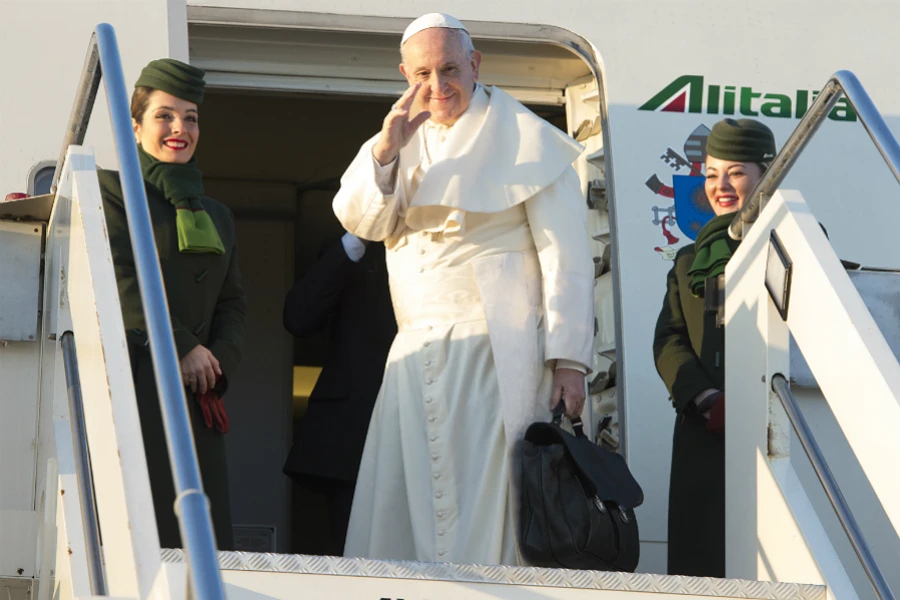
Aboard the papal plane, Sep 25, 2018 / 03:06 pm (CNA/EWTN News).- Pope Francis took responsibility Tuesday for the agreement between the Holy See and the People’s Republic of China, noting that in any such negotiation, “both sides lose something.”
He was asked about the agreement Sept. 25 during the flight from Tallinn to Rome by Antonio Pelayo of Vida Nueva.
The agreement on the appointment of bishops in mainland China was signed Sept. 22 in Beijing. It will allow for bishops who are in communion with the Holy Father and at the same time are recognized by the Chinese government.
Francis said the agreement was the fruit of a dialogue that has taken several years.
“The Vatican team worked a lot,” he said. He noted the efforts of Archbishop Claudio Maria Celli, president emeritus of the Pontifical Council for social Communications; Fr. Rota Graziosi, an official of the Roman curia; and Cardinal Pietro Parolin, the Vatican Secretary of State.
Cardinal Parolin, he said, “has a special devotion to the lens; he studies all of the documents down to the period, comma, notes, and this gives me a great assurance.”
“You know that when you make a peace agreement or a negotiation, both sides lose something,” Pope Francis reflected. “This is the law. Both sides. And you move ahead.”
The Bishop of Rome said that the dialogue which led to the agreement was a process of going two steps forward and one step back. “Then, months passed without speaking to each other and then the time of God, which appears to be [the time of the] Chinese. Slowly. This is wisdom, the wisdom of the Chinese.”
He said that “the bishops who were in difficulty were studied case-by-case,” and that “dossiers came on to my desk about each one. And I was responsible for signing the case of the bishops.”
Following this, drafts of the agreement were put on his desk, Pope Francis said. They were discussed and “I gave my ideas.”
“I think of the resistance, the Catholics who have suffered. It’s true. And they will suffer. Always, in an agreement, there is suffering. They have a great faith.”
He said they have written him, saying that “what the Holy See, what Peter says, is that which Jesus says. The martyrial faith of these people today goes ahead. They are the great ones!”
“I signed the agreement,” Pope Francis stated. “I am responsible.”
“The others, whom I appointed, in all have worked for more than 10 years. It’s not an improvisation. It’s a path, a true path.”
He noted that after a “famous communique of an ex-apostolic nuncio, the episcopates of the world wrote me, saying clearly that they felt close, that they were praying for me.”
“The Chinese faithful wrote and the signature of this writ was from a bishop, let’s say it this way, of the traditional Catholic Church and from a bishop of the patriotic Church, together and faithful, both of them. For me, it was a sign from God,” Pope Francis stated.
The pope also recalled, saying “thanks be to God that this is over”, that in Latin America “for 350 years it was for the king of Portugal and of Spain to appoint the bishops, and the Pope only gave jurisdiction.”
“We forget the case of the Austro-Hungarian Empire: Maria Teresa was tired of signing the appointments of bishops and gave jurisdiction to the Vatican. These were other times, and thanks be to God that they aren’t repeated.”
He stated that under the agreement with China, the Chinese government will not appoint the bishops: “No, this is a dialogue about eventual candidates but Rome appoints, the Pope appoints.”
“And let us pray for the suffering of some who don’t understand, and who have behind them so many years of being clandestine.”
Announcing the deal on Saturday, the Holy See had said that “the shared hope is that this agreement may favor a fruitful and forward-looking process of institutional dialogue and may contribute positively to the life of the Catholic Church in China, to the common good of the Chinese people and to peace in the world.”
Beijing established the Chinese Patriotic Catholic Association in 1957 to regulate Catholics living in China, and Catholics in the country have been divided between members of the patriotic Church and the “underground Church”.
The agreement between the Holy See and the People’s Republic is meant to end the split between the patriotic and underground Churches.
The Chinese Catholic Patriotic Association is under the day-to-day direct supervision of the Chinese Communist Party since a March 2018 decision by which the Chinese government shifted direct control of religious affairs to the Chinese Communist Party’s United Front Work Department.
In recent years, Chinese authorities have cracked down on underground Christian churches, as well as on Muslims throughout western provinces.
 […]
[…]






What? More?
Too much of an echo chamber for the illuminati? Three comments and a question:
FIRST, the synodal style, by itself, is something for the next conclave to think about, twice. In 2028 Cardinal Grech might even be awarded two minutes to say his piece. One key innovation, here, is “consensus,” and we ask, “consensus about what”? A second devolution is the meaning of the word “alongside.” As successors of the Apostles (apostello: “sent”), the ordained bishops are firstly the guardians of the Deposit of Faith, which is our institutional, charismatic, sacramental, and personal incorporation into the life of Jesus Christ (the Mystical Body of Christ).
SECOND, yes, to some credible process to get the ordained clergy and the laity to support and leaven each other within the “universal call to holiness.” But, what still of Vatican II—which Grech mentions—which retains clarity about the vital “difference in kind as well as degree” (Lumen Gentium). Also a distinction between the realm of Revelation (Dei Verbum) and the realm of the world (Gaudium et Spes).
THIRD, so, in the full text of this initiative (https://www.vaticannews.va/en/vatican-city/news/2025-03/grech-a-new-path-to-help-the-church-walk-in-a-synodal-style.html), why are the terms “Synod” (of Bishops) and “Assembly” used interchangeably? In a deeper way, the presence of the entire Communion of Saints (!) already happens at each celebration of the Mass—as an “extension and continuation” (St. John Paul II, drawing from St. John Chrysostom) of the one event of Calvary. The center of universal human history; not simply an episode within one narrative among many.
So, yes, to reinvigorating a religious and therefore fully human alternative to a post-World War II, post-modern, and flat-earth world moving backward into global spheres of influence. But, alone, the synodal “style” does not replace content. This by procedurally substituting (?) the vertical altar with horizontal roundtables of various sizes.
QUESTION: What does the synodal “style” have to offer to what is, in fact, a new Apostolic Age?
By then we will have a different Pope and this “Synodality” nonsense would have been tossed into the trash can of history and forgotten, where it belongs.
Put not your trust in princes, in a son of man, in whom there is no help. When his breath departs he returns to his earth; on that very day his plans perish.
If not before. Most sons of men have their plans perish long before they die. If the plans happen to persist after the death of the planner, it is only because someone else made it his plan. (John Kennedy had less to do with the moon landing than he is usually credited.)
The question, then, is whether the new pope will take up Francis’s plans. That, of course, is completely unknowable. Many people point to the number of cardinals Francis has appointed, but ALL of the cardinals who elected Francis had been appointed either by Benedict XVI or by John Paul II. As we see, this did not guarantee the election of a like-minded pope. Even so, it is by no means certain that the next pope will change even the most obviously disastrous aspects of Francis’s papacy.
Team Francis, Cdls Grech, Hollerich, Cupich, Farrell, Roche, Tobin, how can we neglect McElroy are pressing forward despite hopeful expectations of the more traditional Catholic. 2028. The Synodal Church sails on regardless of passenger recalcitrance, disenchantment and turmoil.
Where does she sail? Paradise Island. A dreamy place where the brutality of rigorist legalism doesn’t exist. Where good is evil and evil is good. Didn’t Zoroaster foretell the day? A truly happy place in the minds of the enlightened progressives freed from tradition. That insufferable past.
Perchance Leviathan [wasn’t the bronze serpent an effigy?] himself will providentially wreck her, the survivors a new beginning.
“The brutality of legalism doesn’t exist …” except if we need it to enforce the synodal dance. After all, as Cardinal Grech reminded us, this is an expression of “the ordinary Magisterium.” And if a cleric said it, it must be true. Expect this process to be somewhat like the Vatican’s survey last summer: we want to “hear” you until what you start to say is not what we want to hear.
So when are we supposed to stop Synodaling and share the Word of God with someone else?
“Putting away falsehood, let every one speak the truth with his neighbor, for we are members one of another.”
(Ephesians 4:25)
Idiots.
O Lord, when will this affliction of walking talking and ending up actually doing and producing NOTHING will end!!!!!!
The church is being manipulated from the top.
I’m hoping that by 2028 the Synod on Synodality will be a vague memory that only about two or three Catholics will remember with embarrassment, if he or she is unfortunate to remember it at all.
Malice in Wonderland
Hilarious!!!
And perfect..,
How best to manage the worldwide Church? Circular roundtables of layered synodality (local, national, continental)?
Two comments and a question:
FIRST, a thought experiment…what if in 2025 we are tutored by the inner circle that the Council of Nicaea (1700th anniversary) was really in management of inclusion, rather than a recalling of what was/is believed from the beginning and, therefore, a rejection (non-inclusion!) of Arianism (read Pachamama, Fiducia Supplicans, etc.)? AND, then in 2026 or so, we read that the protocol for electing a subsequent pope is modernized to involve, in some way, the advice or even consent of the 2028 Assembly.
SECOND, about management of such a community-based (or Lutheran) remodel of the ecclesial Catholic Church of the Apostolic Succession (with a validly ordained priesthood and stuff like that), clearly rooted in Matthew (28:19) and in Pentecost (Acts 2:1-31)—“listening” to Benedict XVI we hear that the message is not to “turn back”, but rather “to return to the authentic texts of the original Vatican II” (The Ratzinger Report, 1985):
“But the Church of Christ is not a party, not an association, not a club. Not setting the clock back, but setting in right. Her deep and permanent structure is not democratic but sacramental, consequently hierarchical” (49). “Real reform is to strive to let what is ours disappear as much as possible so what belongs to Christ may become more visible…what the Church needs in order to respond to the needs of man in every age is holiness, not management” (53).
QUESTION: Does the replacement of Synods of Bishops with mongrel-democratic Synodality teach/imply/ signal and morph that the process of management IS holiness?
What, exactly, about the post-synodal Study Group #9 possibly anguishing over how to elevate today’s theologians and maybe an Assembly above the Church’s magisterium(?)—that is, assigned to develop “Theological criteria [?] and synodal methodologies [?] for shared discernment of controversial doctrinal [?], pastoral [?], and ethical [?] issues.”
My walk toward Christ is full of failures. My desire has been to follow him, but I fall short of that on a daily basis. I take the responsibility of sharing the message of the Good News with my neighbors seriously. I firmly believe that the role of the Church is to be the bridge between Good and all of humanity. The Church is supposed to serve as community to unite believers as one body in Christ. She is the beacon that clearly, without hesitation and full of clarity, announces the teachings of Christ to the world.
Anything, any movement, any teaching that attempts to move the Church from her purpose is heretical and must be cast out. In my weakness, I strive to walk in truth. I am not in a position, and I am unworthy to condemn another, but I know Jesus Christ and choose to walk with him. I ignore everything else.
Amen brother! You’re for sure on the right road.
YADA YADA YADA!!
BLAH BLAH BLAH!!
FURTHERMORE – asxovvnddiuertn434&&9999v330fgjv..!!
AND THIS TIME – I MEAN IT!!!
LOL, I can’t help but agree
Sounds like you’re all ready for the Jubilee of Synodal Teams!
The Synod was a “meeting about meeting” we were told. I guess the post-Synodal Synod will be a meeting about meeting about meeting. Just think of it this way: it’s the Vatican’s version of Festivus.
Serious question. Has a single parish made a single change because of the Synod?
Ours has not, not that I can tell
“The goal is not to add work upon work but to help Churches walk in the Synodal style” according to Cardinal Grech.
Help Churches walk in the synodal style. Hmm… that sounds eerily like “I’m from the Federal Government and I’m here to help.” More to the point, the 2028 Synod will be where the teeth come out to “help Churches walk in the Synodal style.” Well, that could prove problematic for Churches faithful to Tradition that exhibit bureaucratic resistance to walking in the Synodal style.
It is my prayer that Mssrs. Johann du Toit and Ken T are correct in their prediction that post-Francis, synodalism will be discarded. I am not so optimistic. I fear that 2028 will be the beginning of the final crackdown. The Church of Accompaniment directing us to accompany together into the cattle car taking us to banquet of rotten fruit compliments of the Synodal Way.