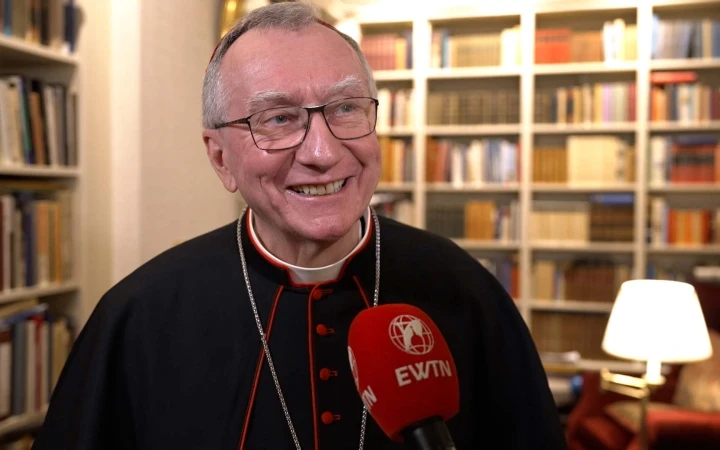
Cardinal Pietro Parolin speaks to EWTN News in Oslo, Norway, on Jan. 17, 2025. / Credit: Fabio Gonella/EWTN News
Vatican City, Feb 18, 2025 / 16:45 pm (CNA).
Cardinal Pietro Parolin, the Vatican secretary of state, said that Europe must “rediscover itself” in order to be able to face the “major challenges” of culture, commerce, and migration.
In a Feb. 15 interview with the daily Eco di Bergamo, the Vatican official recalled the “warning of St. John Paul II,” which Pope Francis has also taken up: “Europe, rediscover yourself, be yourself.”
The cardinal stressed that the Old Continent is suffering from a “crisis of ideas” that prevents it from facing the future: “Europe currently has good antibodies to hold up under crises and challenges. But the most serious problem is the lack of ideas for the future that allow it to respond with determination to international competitors,” he said.
Parolin specified that this weakness is due to the relationship that Europe has with its own history, the result of “a deep, and partly justified, fear of its past.” However, he emphasized that along with the dark episodes of its history, “there are many bright moments.”
In this regard, he referred to the debates on the European Constitution, in which an explicit reference to the continent’s Judeo-Christian roots was avoided, advocating for a generic mention of its “cultural, humanist, and religious heritage.”
According to the cardinal, this weakened the continent’s awareness and the sense of European identity: “Instead of building Europe on its deep foundations and roots, a changing consensus of values has been preferred. But the future can only be built on the past,” he pointed out.
Although Parolin said there were reasons to be concerned, especially in the face of “practical atheism, populism, and religious illiteracy,” he praised other “encouraging phenomena” such as the increase in requests for baptism by young French people. In light of this, he urged Catholics to ask themselves whether, with their witness, faith, hope, and charity, the Gospel continues to be “challenging.”
In his interview with the Italian newspaper, the Vatican secretary of state also reflected on the ceasefire in Gaza, hoping that it would be “permanent and put an end to the suffering of the Palestinian people,” both in the Gaza Strip and “in the rest of Palestine.”
“Now we have to give signs of hope to both: to the Israelis and the Palestinians,” he noted.
Regarding the situation in Syria, he emphasized that “it is necessary to understand where we are going” and to accompany “on the path of inclusion and harmonious coexistence.”
Regarding the war in Ukraine, three years old on Feb. 24, Parolin argued that “solutions should never be sought through unilateral impositions,” since it would mean “trampling on the rights of entire peoples” and thus “there will never be a just and lasting peace.”
This story was first published by ACI Prensa, CNA’s Spanish-language news partner. It has been translated and adapted by CNA.
If you value the news and views Catholic World Report provides, please consider donating to support our efforts. Your contribution will help us continue to make CWR available to all readers worldwide for free, without a subscription. Thank you for your generosity!
Click here for more information on donating to CWR. Click here to sign up for our newsletter.
Pope Francis prayed before a relic of St. Therese of Lisieux at the beginning of his general audience in St. Peter’s Square, and shortly before going to the hospital for an abdominal surgery, on June 7, 2023. / Daniel Ibanez/CNA
Vatican City, Jun 7, 2023 / 04:37 am (CNA).
One of Pope Francis’ last gestures before undergoing abdominal surgery on Wednesday was to pray before a relic of St. Therese of Lisieux.
A relic of the French Carmelite nun, also known as St. Therese of the Child Jesus, was present on the platform in front of St. Peter’s Basilica during the pope’s weekly general audience June 7.
Before beginning the audience, Francis venerated the relics of St. Therese in a moment of silent prayer. He also placed a single, white rose on the table in front of the reliquary.
Pope Francis was taken to Rome’s Gemelli Hospital for abdominal surgery under general anesthesia at the end of the morning audience, shortly after 11:00 a.m. Rome time, the Vatican said.
Relics of St. Therese’s parents, Sts. Louis and Zélie Guérin Martin, were also present at the meeting with the public June 7. The relics of all three saints will visit different churches in Rome through June 16.
Relics of St. Therese of Lisieux and her parents, Sts. Louis and Zelie Guerin Martin, were on the platform in front of St. Peter’s Basilica during Pope Francis’ general audience June 7, 2023. The relics made a pilgrimage to Rome June 6-16, 2023. Daniel Ibanez/CNA
Pope Francis said Wednesday he intends to publish an apostolic letter on St. Therese of Lisieux, “patroness of the missions,” to mark the 150th anniversary of her birth.
“She was a Carmelite nun who lived her life according to the way of littleness and weakness: she defined herself as ‘a small grain of sand,’” he said in St. Peter’s Square.
“Having poor health, she died at the age of only 24,” he added. “But though her body was sickly, her heart was vibrant, missionary.”
“Here before us are the relics of St. Therese of the Child Jesus, universal patroness of missions,” he said. “It is good that this happens while we are reflecting on the passion for evangelization, on apostolic zeal. Today, then, let us allow the witness of St. Therese to help us. She was born 150 years ago, and I plan to dedicate an apostolic letter to her on this anniversary.”
🎥HIGHLIGHTS | Before commencing the General Audience in St. Peter’s Square, Pope Francis shared a beautiful moment of prayer before the sacred relics of St. Therese of Lisieux, Doctor of the Church and Patroness of the Missions. As a symbol of his devotion, the Holy Father… pic.twitter.com/lRJeWuSx8n
St. Therese of Lisieux was born on Jan. 2, 1873, in Alençon, France. Her mother died when she was four, leaving her father and older sisters to raise her. She received papal permission to enter the Carmelite Monastery at the young age of 15, where she lived until her death from Tuberculosis at the age of 24.
She was proclaimed a Doctor of the Church by St. Pope John Paul II in 1997 and is the patron saint of missions.
Pope Francis reflected on the saint’s life as part of a series of lessons on evangelical zeal.
“She is patroness of the missions, but she was never sent on mission,” Francis explained in his catechesis. “She recounts in her ‘diary’ that her desire was that of being a missionary, and that she wanted to be one not just for a few years, but for the rest of her life, even until the end of the world.”
St. Therese did this, he said, by becoming a spiritual sister to several missionaries, whom she accompanied through her prayers, letters, and sacrifices from within the monastery walls.
“Without being visible, she interceded for the missions, like an engine that, although hidden, gives a vehicle the power to move forward,” the pope said.
“Missionaries, in fact — of whom Therese is patroness — are not only those who travel long distances, learn new languages, do good works, and are good at proclamation,” he added. “No, a missionary is anyone who lives as an instrument of God’s love where they are.”
Pope Francis spoke about St. Therese of Lisieux, the patroness of missions, during his general audience June 7, 2023. Relics of St. Therese and her parents, Sts. Louis and Zelie Guerin Martin, were present on the platform beside the pope for the audience. Daniel Ibanez/CNA
Pope Francis recounted two episodes from St. Therese’s life that help to explain the source of her zeal and missionary strength.
The first happened during Christmas 1886, when Therese was almost 14 years old.
St. Therese was pampered as the youngest child of the family, he explained. But her father was tired after midnight Mass for Christmas and did not feel like being present when his daughter opened her gifts, so he said he was glad it was the last year she would receive gifts.
“Therese, who was very sensitive and easily moved to tears, was hurt, and went up to her room and cried,” the pope said.
“But she quickly suppressed her tears, went downstairs and, full of joy, she was the one who cheered her father,” he said. “What had happened? On that night, when Jesus had made himself weak out of love, her soul became strong: in just a few moments, she had come out of the prison of her selfishness and self-pity; she began to feel that ‘charity entered her heart’ — so she said — ‘with the need to forget herself’ (cf. Manuscript A, 133-134).”
“From then on, she directed her zeal toward others, that they might find God…”
The second event happened after St. Therese became a Carmelite. Pope Francis said the nun became aware of a hardened criminal, Enrico Pranzini, who was sentenced to death by guillotine for having murdered three people.
Therese had a special zeal for saving sinners, and so “she took him into her heart and did all she could: she prayed in every way for his conversion, so that he, whom, with brotherly compassion she called ‘poor wretched Pranzini,’ might demonstrate a small sign of repentance and make room for God’s mercy,” Francis said.
The day after his execution, she read in the newspaper that before laying his head on the chopping block, Pranzini had, “‘all of a sudden, seized by a sudden inspiration, turned around, grabbed a Crucifix that the priest handed to him and kissed three times the sacred wounds’ of Jesus,” he continued.
“Then his soul,” St. Therese wrote, “went to receive the merciful sentence of the One who declared that in Heaven there will be more joy for a single sinner who repents than for the ninety-nine righteous who have no need of repentance!”
Pope Francis said: “With so many means, methods, and structures available, which sometimes distract from what is essential, the Church needs hearts like Therese’s, hearts that draw people to love and bring people closer to God.”
“Let us today ask this saint, whose relics we have here,” he added, “let us ask this saint for the grace to overcome our selfishness and for the passion to intercede that Jesus might be known and loved.”
Pope Francis gives his Angelus address June 29, 2023. / Credit: Vatican Media
Vatican City, Jul 30, 2023 / 07:26 am (CNA).
Pope Francis on Sunday encouraged Christians to learn how to seek and find the precious things in life, including a relat… […]
2 Comments
All well and good except Vatican policy has countered attempts for European nations to manage affairs with conviction of their national identity, to retain that identity both religiously and culturally – with a Vatican ideological policy of absolute freedom for migration across the borders of European nations by hordes of Muslims, unwilling to assimilate with European Christian culture, hordes from the Mideast and Africa plus the liberalization of Roman Catholic doctrine attacking the faith from within and from without.
Cdl Parolin rather than muse on Europe’s demise must review has failed China policy that allows for subversion of Catholic Christianity, engage in personal penitence, openly admit his grievous failures in foreign policy – and begin to reverse his policy by acknowledging religious freedom in China and the supremacy of Catholic Christianity in Europe to the detriment of Muslim immigration invasion. If not he must submit his resignation as Secretary of State.
Vatican policy to rediscover identity in order to meet modern challenges is a half truth dilemma. Truth lies in the naked wording, the false premise is the bankrupt policy of doctrinal progressivism and efforts to identify with global interests rather than the rudiments of revelation, which brought us where we’re at.
Exaggerated conformity with the world presumably justified by Vat II and the requirement for the Church to become more comprehensible to the modern world has failed. Simply put without entering into a meticulous point by point approach – on that score the Synod continues to produce an abundance of wind, we obviously require to engage the world while retaining the exact meaning of revelation as it was given at the time of Christ and the Apostles.
Engagement, intellectual development and transmission must emphasize not deemphasize the radical challenge of Christianity.
All well and good except Vatican policy has countered attempts for European nations to manage affairs with conviction of their national identity, to retain that identity both religiously and culturally – with a Vatican ideological policy of absolute freedom for migration across the borders of European nations by hordes of Muslims, unwilling to assimilate with European Christian culture, hordes from the Mideast and Africa plus the liberalization of Roman Catholic doctrine attacking the faith from within and from without.
Cdl Parolin rather than muse on Europe’s demise must review has failed China policy that allows for subversion of Catholic Christianity, engage in personal penitence, openly admit his grievous failures in foreign policy – and begin to reverse his policy by acknowledging religious freedom in China and the supremacy of Catholic Christianity in Europe to the detriment of Muslim immigration invasion. If not he must submit his resignation as Secretary of State.
Vatican policy to rediscover identity in order to meet modern challenges is a half truth dilemma. Truth lies in the naked wording, the false premise is the bankrupt policy of doctrinal progressivism and efforts to identify with global interests rather than the rudiments of revelation, which brought us where we’re at.
Exaggerated conformity with the world presumably justified by Vat II and the requirement for the Church to become more comprehensible to the modern world has failed. Simply put without entering into a meticulous point by point approach – on that score the Synod continues to produce an abundance of wind, we obviously require to engage the world while retaining the exact meaning of revelation as it was given at the time of Christ and the Apostles.
Engagement, intellectual development and transmission must emphasize not deemphasize the radical challenge of Christianity.
