


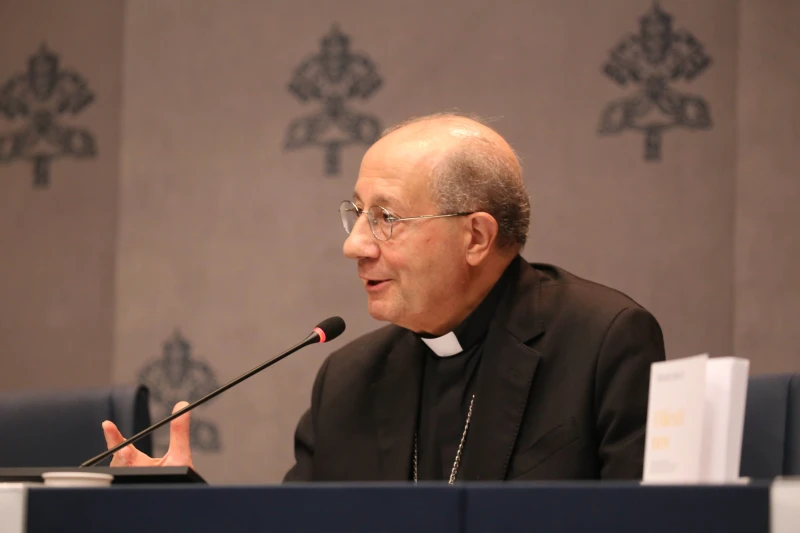
Vatican City, Oct 24, 2024 / 12:00 pm (CNA).
A prominent Italian theologian and archbishop has called Pope Francis’ new encyclical on the Sacred Heart “the key to his entire pontificate” and “the inspiring motive of [his] whole ministry and magisterium.”
Archbishop Bruno Forte of Chieti-Vasto presented Dilexit Nos (“He Loved Us”) at a press conference at the Vatican on Oct. 24.
A prolific spiritual writer, Forte, who became a member of the Dicastery for the Doctrine of the Faith in June, called the encyclical “extremely timely” for its attention to “the centrality of God’s love in Jesus Christ” and to the “dramatic challenges of the present time.”
Pope Francis released Dilexit Nos on Thursday, calling for a renewed understanding of devotion to the Sacred Heart in the modern era and its many pressing challenges.

Forte said Pope Francis’ magisterium is “far from being … restricted to social issues, as it has sometimes been clumsily understood,” and his message “to the entire human family stems from a single spring, presented here in a more explicit, clear way: Christ the Lord, his love for humanity.”
“It is the truth on which Jorge Mario Bergoglio has staked his whole life and continues to spend it passionately as bishop of Rome, pastor of the universal Church,” the archbishop added.
He emphasized that the encyclical “can really be considered a compendium of everything that Pope Francis, the pope that God gave the Church in these not-easy years, wanted and wants to say to every brother and sister in humanity.”

Forte presented the encyclical together with Sister Antonella Fraccaro, superior general of the Disciples of the Gospel (Discepole del Vangelo), who said: “The encyclical calls us to be missionaries.”
We are called to be “missionaries,” she added, “who transmit love, who love therefore with witness, with presence alone, with words when needed, without the need to engage in proselytism.”
If you value the news and views Catholic World Report provides, please consider donating to support our efforts. Your contribution will help us continue to make CWR available to all readers worldwide for free, without a subscription. Thank you for your generosity!
Click here for more information on donating to CWR. Click here to sign up for our newsletter.


Certainly it would be wonderful, if what theologian Archbishop Bruno Forte suggests is the golden key to understanding the benevolent love that permeates Pope Francis’ pontificate. The sacred heart of Jesus the key, boundless mercy constrained by a misconceived rigidity. A love that conquers all. Francis once said, isn’t it wonderful to be free?
Here we are addressing again the attraction of such an epiphany, the reconciliation of a wounded humanity embraced by a loving father. Reception of the Eucharist the consoling gift of reconciliation. Certainly it’s an attractive sentiment. An emotive catharsis if it were true. Although reconciliation is not gained in receiving Christ’s body and blood. It’s the sacrament of penance, the confession of sins and reparation that reconciles us. That is the true key to understanding Francis’ pontificate, which seeks to replace one sacrament with another, the one that heals with the one that strengthens. To receive the Eucharist in one’s sins strengthens the sins.
Our conscience is battered, now for 11 years accused of condemning sinners to death with doctrines as hard as stones. Black is not white. Good is not evil. If this were true, Christ would never have had desire to accept condemnation and crucifixion. Simply because there would be no need for so severe a sacrifice to satisfy justice, to suffer the condemnation we deserve. Why then? He did because Dilexit Nos.
Apocrypha and bad archaeology can have common types of failings and errors: they misread, misinterpret and misrepresent the findings, artefacts, relevance, tests, conditions, proportions, significance, etc., of what they recover. The longer and more expansive the transgressing the worse the problem gets.