Sen. Jon Tester, D-Montana, speaks as Planned Parenthood Action Fund President and CEO Alexis McGill Johnson (right) looks on during a rally on Sept. 5, 2024, in Bozeman, Montana. The Right to Abortion Initiative will be on the Nov. 5 ballot as an amendment to Montana’s constitution. Tester attended the rally in support of the initiative. / Credit: William Campbell/Getty Images
CNA Staff, Oct 16, 2024 / 16:10 pm (CNA).
A pro-life group is combating a Montana “Right to Abortion” ballot measure with a $2 million advertisement campaign, saying pro-abortion leaders go “too far,” even as the American Civil Liberties Union (ACLU) is set to spend $1.2 million in Montana on the abortion issue.
Montana’s “Right to Abortion Initiative,” CI-128, would enshrine in the state’s constitution a right to abortion up to viability with exceptions for the health and life of the mother.
Montana is one of 10 states with abortion on the ballot. Abortion is currently legal in Montana until the baby is viable outside of the womb.
If passed, the initiative would amend the state constitution “to expressly provide a right to make and carry out decisions about one’s own pregnancy, including the right to abortion,” the measure reads.
The pro-life organization Women Speak Out PAC, a partner of Susan B. Anthony Pro-Life America, is combating the abortion mandate and advocating against Democratic Sen. Jon Tester. The incumbent senator has been vocal about his support of abortion and is up for reelection this year.
The series of advertisements highlights the importance of laws protecting minors by requiring parental permission for abortion as well as the importance of providing resources for moms in need. The advertisements are also critical of Vice President Kamala Harris, the Democratic presidential nominee, for her pro-abortion stance.
One ad highlights Tester’s support for removing parental consent requirements for minors seeking abortions as well as his support of taxpayer-funded and late-term abortions.
SBA Pro-Life America’s president, Marjorie Dannenfelser, said Montana pro-abortion leaders “are drastically out of touch with the people they claim to support.”
“That’s why, in Montana and key battleground states across the nation, we are hard at work to reach 10 million voters … to expose the truth of the Democrats’ pro-abortion extremism and educate Americans about the lives at stake in this election,” Dannenfelser said in an Oct. 11 statement.
The ad campaign is just one of many pro-life campaigns by the group. SBA Pro-Life America plans to spend $92 million across America to protect life, reaching out to voters in eight battleground states including Arizona, Pennsylvania, and Ohio.
But other Montana groups are campaigning on the abortion issue as well.
The ACLU and ACLU of Montana announced last month that they are set to spend $1.3 million on a campaign — the most the ACLU has ever spent on a Montana campaign — to educate voters on candidates’ positions on abortion and other matters. Akilah Deernose, executive director of ACLU of Montana, noted in a statement that “every person deserves the autonomy to make personal medical decisions during pregnancy, free from government interference.”
The ACLU announced it is spending more than $25 million nationwide during the electoral cycle, with a focus on “protecting and expanding abortion” and voting rights, according to a June press release.
The Montana Catholic bishops condemned the ballot initiative earlier this year, saying the bill “seeks to enshrine … late-term abortion of babies who will feel pain, abortion of babies who have been partially delivered, [and] abortion by dismemberment of children growing in the womb.”
In August, the Montana Supreme Court unanimously overturned a 2013 law protecting minors by requiring parental permission for abortions, citing a 1999 Montana Supreme Court ruling that used the “right to privacy” as justification for pre-viability abortions.
While Montana is a red state, the state has a history of splitting the vote. In 2022, Montanans rejected the Born Alive Infant Protection Act ballot initiative, which would have protected babies who are born alive after attempted abortions, but elected a pro-life candidate, Rep. Ryan Zinke, to its 1st Congressional District seat.
If you value the news and views Catholic World Report provides, please consider donating to support our efforts. Your contribution will help us continue to make CWR available to all readers worldwide for free, without a subscription. Thank you for your generosity!
Click here for more information on donating to CWR. Click here to sign up for our newsletter.
Minneapolis, Minn., Aug 31, 2018 / 05:55 pm (CNA).- Auxiliary Bishop Andrew H. Cozzens of the Archdiocese of St. Paul and Minneapolis released Friday his account of a now-controversial 2014 investigation into allegations against Archbishop John Nienste… […]
New York City, N.Y., Dec 10, 2018 / 03:01 am (CNA/EWTN News).- Seven decades after its proclamation, the Universal Declaration of Human Rights is still being hailed as “a great triumph achieved at a tremendous cost,” in the words of St John Paul II.
The landmark declaration was proclaimed by the United Nations General Assembly in Paris Dec. 10, 1948. It includes a preamble and 30 articles that provide for individual freedoms, denounce torture and slavery, and affirm the equal dignity of all people.
The Vatican’s diplomatic representative to the United Nations recently praised the declaration, saying the anniversary presented an opportunity to “reaffirm faith in fundamental human rights,” but also warned that parts of the world are experiencing the consequences of failing to uphold those rights.
Archbishop Bernardito Auza, Permanent Observer of the Holy See to the United Nations, offered his reflections at a Dec. 4 conference commemorating the document’s 70th anniversary.
Since Auza was in Katowice, Poland for another conference, his remarks were read by Msgr. Tomasz Grysa. The conference was jointly hosted by the Holy See and Alliance Defending Freedom International at the UN headquarters in New York.
He said the then-recent atrocities of the Holocaust and two World Wars had “revealed that there are some actions so wicked that no one can or will justify them, and certain fundamental values that no one will dispute.”
Archbishop Auza hearkened back to St. John Paul II’s praise for the declaration, which he offered a year after being elected Bishop of Rome.
“When Pope John Paul II spoke to the General Assembly of the United Nations in 1979, he called [the declaration] the ‘fundamental document,’ the ‘basic inspiration and cornerstone of the United Nations Organization,’ and a ‘milestone on the long and difficult path of the moral progress,’” Auza wrote.
“After the horrors of the first half of [the 20th] century, it was obvious that human progress could not be measured only by scientific and technological advances, since even those could become weapons against the innocent,” Auza wrote, affirming that “human progress” includes ethical development as well.
Auza noted that the preamble of the UN charter affirms “faith in fundamental human rights, in the dignity and worth of the human person, and in the equal rights of men and women and of nations large and small,” but does not specify what rights are to be upheld. The Commission on Human Rights later elaborated both political and civil human rights in the declaration, making them “practical” so as to guide action.
“[The rights] were framed not only in relation to the State but also to various mediating institutes like the family, human community, and religious groups, since human beings are persons in solidarity and fraternity rather than isolated individuals,” Auza wrote.
The original declaration itself did not contain any enforcement mechanisms per se, but later agreements such as the 1966 International Covenant on Civil and Political Rights sought to incorporate human rights principles into the legal systems of individual nations. The United States ratified that covenant in 1992.
On the occasion of the declaration’s 70th anniversary, Azua highlighted three of the document’s “fundamental presuppositions” that he said “are perhaps not as widely and deeply appreciated today as they were by the framers and the delegates who voted for its adoption” because of cultural changes since the 1940s.
He spoke of the document’s universality, which he characterized as an attempt to formulate rights that would be valid regardless of time, place, and culture, which presumes that there exist universal human rights rooted in human nature. This ties into the document’s objectivity, Azua said; if human nature is objectively the same everywhere, then this prevents the universality of the rights “to be denied for cultural, political, social, philosophical or religious reasons.”
“Human rights are premised on the existence of a nature objectively shared by all members of the human race by the very fact of their humanity,” the archbishop wrote.
“From that nature flows human dignity, which refers to the intrinsic worth of the person, no matter one’s circumstances, no matter how young or old, rich or poor, strong or vulnerable, healthy or sick, wanted or undesired, economically productive or incapacitated, politically influential or insignificant.”
In other words, this recognition presupposes that all human beings are equal in value.
Finally, Auza highlighted the unity of the declaration— the importance of applying all the rights listed, rather than picking and choosing which rights to honor “piecemeal, according to trends or selective choices”— as an important element that was highlighted by Benedict XVI in 2008.
“The Declaration, [Pope Benedict] was saying, is not, and cannot be allowed to become, a menu of rights from which one can choose according to personal, national, or international taste,” Auza wrote.
To this point, Auza highlighted some of the notable instances of human rights violations in the world today.
For example, an estimated one in ten children will be subjected to child labor, and “tens of millions are ensnared by various forms of so-called modern slavery.”
Article 18 of the declaration upholds the freedom of “thought, conscience, and religion,” but “in so many places changing one’s religion or even practising one’s faith is still a death sentence or a reason to be discriminated against.”
Many countries, such as Sudan, have laws that criminalize apostasy, or converting from the state religion, usually Islam.
Auza noted that Pope Francis has spoken out against the reinterpretation of some rights over the years that conflict with each other, leading to, among others things, a breakdown of the family.
“Human rights in general, and the Universal Declaration in particular, were not meant to be used as weapons to advance political, economic, military or cultural agendas contrary to the fundamental human rights,” he wrote.
Ricky Reyes dribbles the ball up court as now-Father Peter Schirripa follows behind at the national basketball tournament for seminaries in 2022. / Credit: St. John’s Seminary
CNA Staff, Nov 6, 2023 / 14:40 pm (CNA).
Imagine the scene: The alarm clock starts beeping and it’s 4 a.m. Basketball practice starts in an hour. It’s time for a group of bleary-eyed young men to grab their gear, meet their teammates, and begin a one-mile uphill jog in the middle of New England’s freezing weather to the basketball facility.
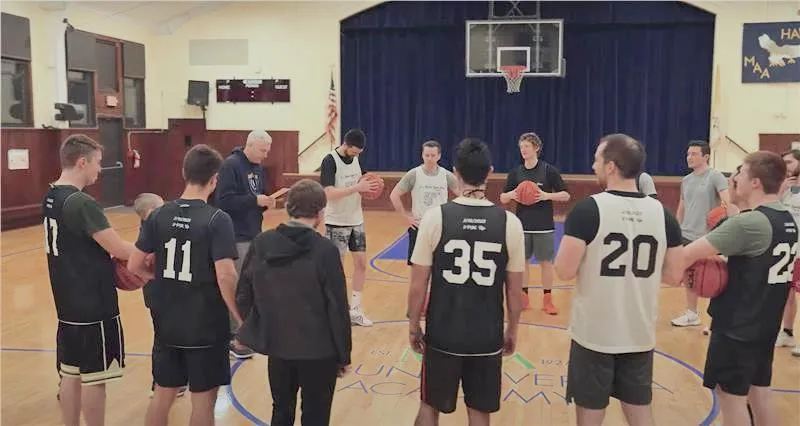
Once inside the gym, the work begins: stretching, sprints, layups, scrimmaging, shooting, defensive posture, all with one goal in mind — winning.
This type of intense training is all in a day’s work for one team of men in Boston.
No, it’s not the Division I team at Boston College, Boston University, or Northeastern University.
Rather, it’s how a team of seminarians at St. John’s Seminary in Boston trains. And their goal of winning is twofold: victory in the spiritual life and a championship trophy at the national tournament for seminaries, which is held once a year.
But what does playing basketball have to do with priestly formation? Well, according to the seminarians who play for the St. John’s Eagles, quite a lot.
St. John’s Seminary’s basketball team at practice. Credit: St. John’s Seminary/YouTube May 18, 2023
A ‘microcosm of the spiritual life’
When 27-year-old Deacon Marcelo Ferrari, the team’s co-captain, first entered seminary, he saw the game as more of an extracurricular activity, “a good opportunity to spend some time with close friends and maybe build some fraternity.”
“But very quickly it became clear that the basketball team is just a microcosm of the spiritual life,” Ferrari, of Monterrey, Nuevo León, Mexico, said.
Playing the game together imitates the spiritual life in that “you experience a lot of humiliation, especially if you’re not as skilled like me,” said Ferrari, who has more experience in soccer than in basketball.
“But you also just learn a real sense of what sacrifice means,” he said. “Even practice just being at 5 in the morning is enough to demand a lot of the human heart.”
The experience of being on the team aided in Ferrari’s priestly formation in “so many ways,” he said, adding that “it became a critical space for me to recognize especially more of those subtle movements of the heart.”
“There’s nothing like team sports to bring out every part of you,” he said.
An uphill climb
Ferrari had never played organized basketball until he entered St. John’s Seminary. It wasn’t until another seminarian who established the team, now-recently ordained Father Peter Schirripa, asked him to join that he considered it.
“He saw me playing soccer and was like, ‘Oh, this guy’s mildly athletic. Let’s see if we can get him a basketball and see what he can do,’” Ferrari said.
This type of recruiting was par for the course for Schirripa, 30, who grew up in Lexington, Massachusetts, and had the idea for the team when he first entered seminary more than six years ago.
But Schirripa, who had experience in basketball, track and field, and soccer, credits the founder of the media apostle Word on Fire, Bishop Robert Barron, with the conception of the idea.
Schirripa was visiting his alma mater St. Anselm College during its 2017 graduation ceremony, the spring before his entrance to seminary, when he met Barron, who was giving the commencement address. Barron mentioned to him that there was a national basketball tournament for seminaries and encouraged Schirripa to put together a team from St. John’s.
So, Schirripa brought the idea to his superiors at the seminary and got a green light to start building a team for the national tournament.
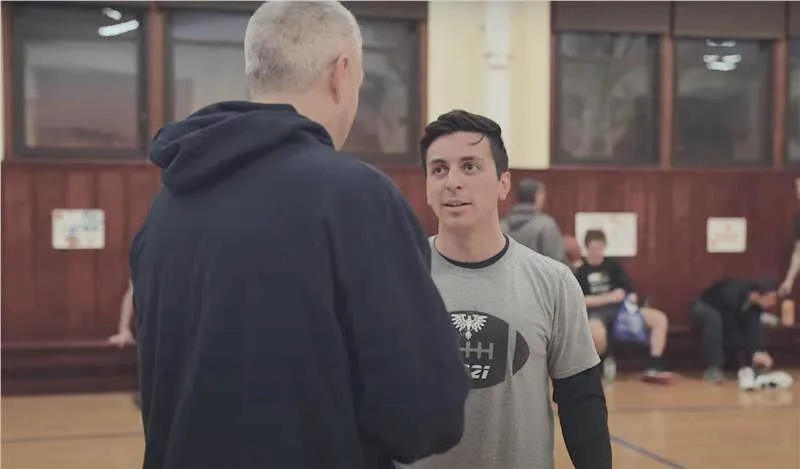
Deacon Marcelo Ferrari at one of St. John’s Seminary’s basketball practices. Credit: St. John’s Seminary/YouTube May 18, 2023
“The leadership was like, ‘Sure, you can do it if you can pull it off.’ But I was a first pre-theologian. I’d been there for, like, three weeks,” Schirripa said.
“And let’s just say there was not a robust athletic or even really communal culture at St. John’s at the time. And so trying to inspire guys to do this and play on the team, it was like I was just taking whatever warm body I could get,” he said.
Eventually, enough seminarians wanted in, and Schirripa’s idea came to fruition, which culminated in St. John’s taking a squad of 15 guys to the national tournament at Mundelein Seminary in Mundelein, Illinois, and winning two games in 2018.
“We went out to it and we won two games, which is crazy because we were so bad,” he said.
He noted that the games were livestreamed and their brother seminarians were watching.
“The whole common room was watching it and I think people couldn’t believe that we did it,” he said.
“And the rest,” Schirripa said, “is history.”
St. John’s has been sending a team to the national tournament ever since. The best they’ve done is third place in a tournament that typically consists of between 12 and 16 teams.
The future of the church
Part of St. John’s success can be attributed to their volunteer coach, Patrick Nee, 44, a practicing Catholic in the greater Boston area who was a Division I basketball player at Brown University in the 1990s.
Nee had coached on the high school level, on travel teams, and even on his young children’s teams, but what made this coaching experience different was the “shock” of being immersed in seminary culture.
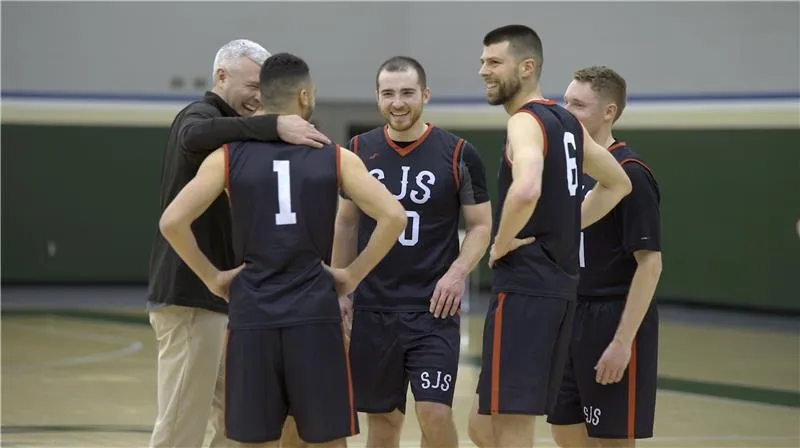
“It’s not an experience like I’d ever had before, just being in a gym with 15 seminarians, being on a bus or being on a plane with them and just realizing how good it was,” he said. “And these guys are really holy guys that are just terrific. Getting to know them all, it has just been really inspiring for me.”
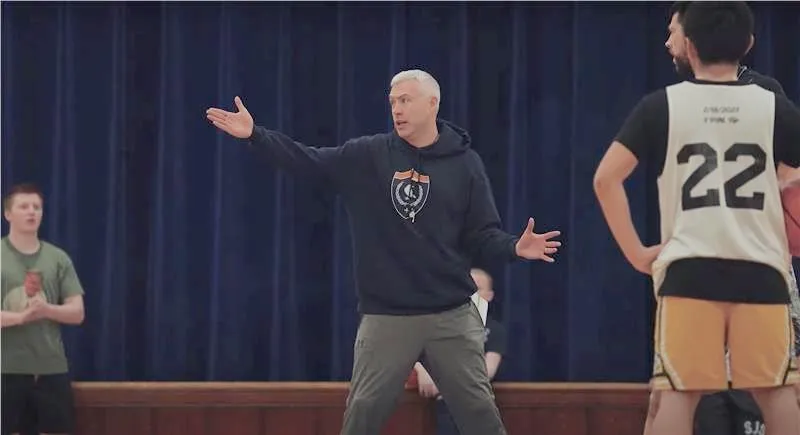
Patrick Nee coaches St. John’s Seminary’s basketball team. Credit: St. John’s Seminary/YouTube May 18, 2023
Nee, a high school state champion from St. Raphael Academy in Pawtucket, Rhode Island, said that he stopped practicing his Catholic faith during his college years and didn’t come back to it until his late 20s.
He said that when he returned to the Church it took him on “a journey.” And over the last five years, that journey has “intensified” even more, he said, adding that “this experience has played a role in that.”
Nee said that it’s overwhelming “in the best way” when he is at the tournaments and “every guy you meet is this on-fire guy who’s studying to be a priest.”
One of those men on fire for the faith is Brian Daley, a member of the St. John’s team, Ferrari said. He recalled an incident at practice one day when a newer seminarian began to indulge in “light mockery” of the other teams they would be playing in the tournament.
Ferrari said that Daley reminded his teammate: “No, these men that we’ll be competing against are all giving their lives for Christ and they’re great examples for us.”
Ferrari called it a moment of “deep fraternity” for the team, who were all inspired by the wisdom Daley shared.
The deacon also said that as a team that fire is seen at every practice through prayer.
At every practice, each player is handed a sheet of prayer intentions to offer up their labor on the court so that all of their work is “done with an eye that sacrifice is fruitful.”
Seeing all of the hard work the teams put in for one weekend showed Nee that they care a lot about winning, “but they never lose track of the bigger picture.”
St. John’s Seminary basketball coach Patrick Nee guides his players during the 2022 tournament. Credit: St. John’s Seminary/YouTube May 18, 2023
He said that being a part of the team has strengthened his faith and added that the whole experience inspired him to tell Schirripa that “we need to share this with people.”
“I wish other people could see this. I mean, if you know anyone who is negative about the future of the Church, it’s like, well, walk into this gym for five minutes and you’ll change your mind immediately,” he said.
Nee’s vision for sharing the experience with others became a reality five months ago when St. John’s Seminary released “Souls in the Game,” a documentary that “highlights priestly formation beyond the study of philosophy and theology.”
The 28-minute documentary follows the team’s journey from the early morning practices to the recruiting and training of the seminarians to the final tournament.
“There is no pressure at all. Go out and play. We have brought life to St. John’s Seminary. God has used this team and let’s go out there and show everyone that we love each other, we love our vocations, and we’re going to represent St. John’s,” Schirripa says to his team during a pregame speech in the documentary.
Viewers might be surprised by how competitive the games are, especially in the scene where 6-foot-4 Schirripa is shown slamming it down during the tournament, which resulted in a technical foul for the team.
Despite the penalty, the team was roaring with excitement at Schirripa’s slam dunk, a feat that not many players ever get to experience on a 10-foot hoop.
“We were ready to storm the court,” Ferrari said in excitement in the documentary.
That documentary can be seen below.
Physical exercise such as can be had playing on a basketball team is something that every seminary should “absolutely” have, Schirripa said.
“I think it’s absolutely essential because you need a physical outlet and you need to obviously have a healthy body, mind, and soul. But it also teaches you to work towards something that’s bigger than yourself, which ultimately is the apostolate,” he said.
“And so it’s such a great venue for formation,” he said.







Leave a Reply