Denver, Colo., Aug 8, 2017 / 06:01 am (CNA/EWTN News).- Candid Camera, the show that caught video of unwitting people in bizarre situations, premiered in 1984 and is considered by most to be the birth of the reality TV genre.
Today, the genre dominates a large corner of both regular and cable programming, with entire channels dedicated to reality shows. But there’s an element of life that nearly all of these shows consistently fail to address – faith.
That was something Catholic speaker, author, and youth minister Chris Stefanick wanted to change.
“Most reality TV leaves out the most important things,” he told CNA.
“It struck me watching (reality TV chef) Anthony Bourdain’s trip to the Philippines, and Catholicism didn’t come up once,” he said. Approximately 86 percent of the country identifies as Catholic.
“I thought, man, you have to try really hard to go the Philippines and avoid Catholicism. We’re not really getting reality when we turn the TV on, so I thought, I want to show the full picture.”
That’s why, when approached by EWTN about creating a new Catholic TV show, Stefanick pitched the idea of “Real Life Catholic”, a travel documentary of sorts that involves telling the stories of people’s lives and faith in their own element.
The idea, and the name, are based off his experiences with his ministry “Real Life Catholic”, for which he as traveled extensively and met Catholics all over the US and the world. Stefanick said he felt called to share the stories of Catholics he had seen in his travels.
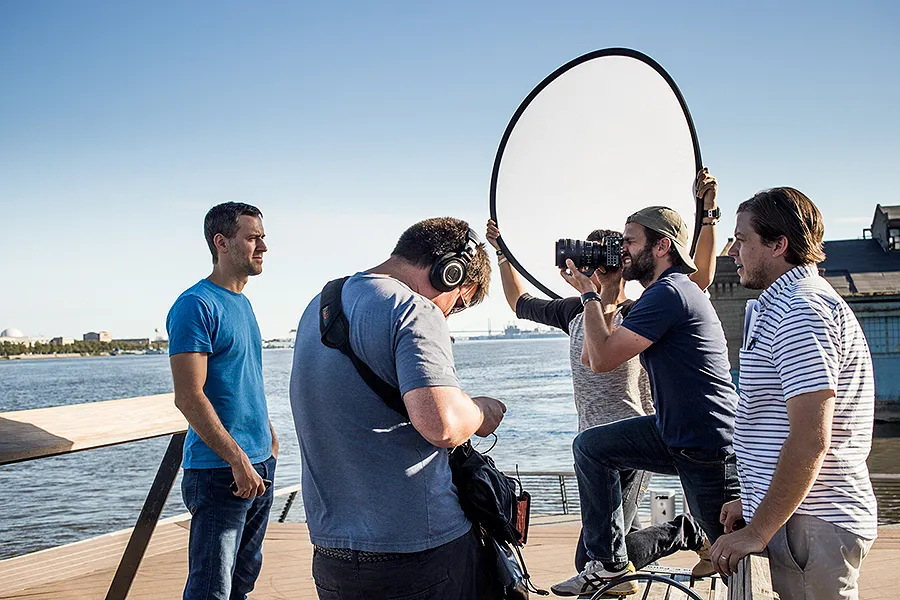
For the project, Stefanick partnered with film production company Lux Lab, founded by Nick Falls and John Wojtasek, two filmmakers who first met as missionaries for the Fellowship of Catholic University Students.
The team then started scouting locations, planning episodes, and looking for stories of faith to tell around the country for the new show.
Filming would take them all around the US and the world, including Krakow with Pope Francis and more than a million young people for World Youth Day.
Throughout the episodes, Stefanick has adventures with the Catholics he encounters, such as surfing in Hawaii, flying over cranberry bogs in Wisconsin, or walking the streets of Denver and meeting the city’s homeless. He gets his hands dirty in order to learn and showcase the Catholic culture of the particular area where he finds himself.
“It’s an incarnational going out into real life, experiencing the world of real life Catholics,” said Falls, who directed the show.
It was important, Stefanick said, to encounter Catholics and their culture in their own homes and lives, rather than talk about them from a studio. The experience has given him a new appreciation for Catholicism in his country, he said.
“A lot of the country doesn’t know just how Catholic south Louisiana is, or how amazing New Mexico is, and that it has a unique Catholic culture that is not Mexican but New Mexican.”
Stylistically, Wojtasek said it was important for him as a filmmaker that the show be as accessible as possible.
Since travel documentaries and other kinds of reality TV shows are so popular, he said he wanted the show to have a similar look and feel in order to pique people’s interest, even if they might not be Catholic.
“We wanted it to be something that someone could find and relate to, even if they came in late,” he said. “So we put those stories (of faith) within the framework of something that is very much in style and form like any other documentary or travel show or cooking show that people might want to watch and stick around for.”
“But we also don’t shy away from the deepest reality, in that we’re all made human, and we all have a spiritual component and a desire for God.”
Besides Stefanick having fun by getting out of his element, woven into every story and conversation with the people in each episode is how their Catholic faith has impacted their lives.
Through these real stories, the show tackles topics like how disabled people impact those around them, what it means to really serve the homeless, and what death with dignity means in a culture that increasingly promotes assisted suicide.
The death with dignity episode in particular “was sacred material for me,” Stefanick said, because he knew the family personally, whose wife and mother passed away within the course of two different filmings of the episode.
“To go into someone’s life and family and see how they’re coping with the death of a mom of young children, and the single dad raising the kids himself…to go into that and to see just how amazing grace is, the love, the faith, the hope that’s still there, that’s because the message of the Gospel is as real as ever,” he said.
God’s presence was felt not only on camera, but off camera as well. Wojtasek said that while he and Falls both are filmmakers by trade, they are also Catholics by faith, and God made his work and timing evident throughout the filming process.
“There’s a component of this where we recognize that there’s only so much planning we can do” before God’s timing and plans take over, he said.
For example, the last episode, which airs Aug. 8, shows Stefanick surfing in the icy-cold waters of Lake Michigan off the shores of Sheboygan, Wisc. in February, when the surrounding temperature was just 35 degrees.
On the afternoon of the shoot “it started dropping snow like crazy,” said Falls, which worried him and Wojtasek, whose film equipment isn’t waterproof.
“It was terrifying, the snow was terrifying especially for Chris, but he just had this grace that made him tackle this surfing in Lake Michigan with heavy snow falling. We couldn’t even really see through our cameras because of it, but he did it easily, the adrenaline just kind of kicked in and forced him to do it, to sacrifice for the shot,” he said.
“We were freezing, we couldn’t see, so we just had to trust we were getting the right shot,” he said. After they checked the tape, they realized the shots turned out beautifully.
“It was amazing to have the climax of our show,” he said.
Wojtasek said the show demonstrates that the universal Church is alive and active throughout the country and the world.
“To see the family of the Church has been profound, because everyone has their own story, their own journey, but we’re all pilgrims on the same road. Watching the show, what it boils down to is we’re all living life the best we can, united in this common faith,” he said.
Stefanick said the process of creating the show taught him that he needs to be more aware of the presence of God in his everyday life, and he hopes that viewers take that away from the show as well.
“It was my job as the host to put away the notes, the agenda, my email and my phone, and to pay attention to the grace of God in that moment, so that I could alert the viewer to God’s presence in the life of the person in front of me,” he said.
“And practicing that helped me a better person, and I hope people watching the show come away with that and that I continue to do that. Because life is very busy, and it’s difficult to do, but God’s calling us to find him in the moment.”
The final episode of Season 1 of “Real Life Catholic” airs Aug. 8, but episodes will be re-run on EWTN through October.
The future of the show is uncertain, depending on funding and on feedback received from viewers. The team already has plans to pitch the show to Netflix, and they have also received many invitations from the U.S. and abroad for future episodes.
Stefanick said he is encouraged by the number of people who have approached him with new ideas for episodes, because that means the show was successful at giving people a voice.
“I think of the show ‘Dirty Jobs’ and its popularity – it gave a voice to people who usually don’t have one in terms of media,” he said. “When people give me show ideas, that’s encouraging because it shows me that it successfully gives a voice. The show isn’t about me, it’s about the people that we’re highlighting.”
It’s also about reclaiming the narrative about Catholics that too often has been hijacked by secular media, who often portray Catholics as driven by guilt, or as followers of ancient and strict rules and rituals.
“The purpose was to give the average Catholic a voice and say, this is who we are, this is what we look like, it’s something beautiful, joyful, it gives us life to the full. It presents faith as something attractive, and there’s a real evangelistic power to that witness.”
 […]
[…]



Leave a Reply