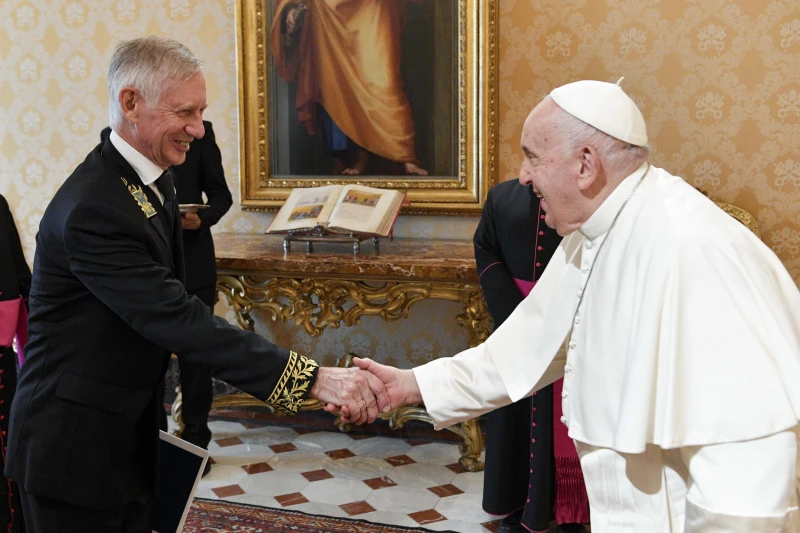
Pope Francis meets with Russia’s new ambassador to the Vatican Ivan Soltanovsky on Sept. 18, 2023, at the Vatican. / Credit: Vatican Media
CNA Staff, Jun 25, 2024 / 13:45 pm (CNA).
Pope Francis on June 22 met with Ivan Soltanovsky, Russia’s ambassador to the Holy See, in their first meeting since Soltanovsky presented his diplomatic letters to the pontiff last September.
Soltanovsky, a 69-year-old career diplomat, was appointed to his current role in May 2023. No details of the pair’s most recent meeting have yet been released.
Soltanovsky told Russia’s official Tass News Agency earlier this month that the Holy See remains one of the few global players who favor diplomacy, peace, and dialogue based on mutual respect and consideration of interests.
“In a situation where traditional methods of building peace no longer work, the Vatican has tirelessly been looking for new ways and opportunities and is willing, as Pope Francis said, to ‘think out of the box,’” the Russian diplomat told Tass.
Pope Francis has condemned Russia’s war of aggression and called for peace in Ukraine on numerous occasions but has also occasionally received criticismfrom Ukrainians for the way he has expressed himself. He has offered to act as a mediator between the two countries.
Pope Francis paid an unusual visit to Soltanovsky’s predecessor, Aleksandr Avdeyev, at the Russian embassy on Feb. 25, 2022, the day after Russia’s full-scale invasion began. The Vatican said the pope went to the embassy “to show his concern for the war.” Later, in September 2022, Pope Francis said he was involved in a prisoner swap between Russia and Ukraine, which involved calling Avdeyev “to see if something could be done, if an exchange of prisoners could be speeded up.”
In mid-2023, ahead of Soltanovsky’s appointment, Pope Francis asked Italian Cardinal Matteo Zuppi to serve as a papal envoy to “initiate paths of peace” between Russia and Ukraine. Zuppi has since made several diplomatic visits across the world to promote peace between Russia and Ukraine, including stops in Kyiv, Ukraine; Moscow; and Washington, D.C.
In recent weeks, prominent Vatican officials have reaffirmed the pope’s desire to maintain communication with both Russia and Ukraine. Secretary of State Cardinal Pietro Parolin also said the Holy See is greatly concerned about the tragic humanitarian consequences of the war “and is especially committed to facilitating the repatriation of children and encouraging the release of prisoners, especially seriously wounded soldiers and civilians.”
If you value the news and views Catholic World Report provides, please consider donating to support our efforts. Your contribution will help us continue to make CWR available to all readers worldwide for free, without a subscription. Thank you for your generosity!
Click here for more information on donating to CWR. Click here to sign up for our newsletter.
Members of the community arrive ahead of a vigil to remember the victims of last week’s knife attack near the Atkinson on Aug. 5, 2024, in Southport, England. / Credit: Dan Kitwood/Getty Images
CNA Staff, Aug 7, 2024 / 15:08 pm (CNA).
One of th… […]
CNA Staff, Jan 17, 2024 / 13:30 pm (CNA).
A bill under consideration in Congress would head off the White House’s attempts to strip federal funding from some crisis pregnancy centers throughout the U.S. … […]
Altar of the Chair in St. Peter’s Basilica, where Bernini’s gorgeous bronze monument to the Chair of Peter acts as a massive
bronze reliquary for the historic wooden chair. / Credit: Vatican Media
Vatican City, Nov 9, 2024 / 06:00 am (CNA).
For the first time in over a century, the historic Chair of St. Peter, a wooden throne symbolizing the pope’s magisterial authority, has been removed from its gilded bronze reliquary in St. Peter’s Basilica to be displayed for public veneration.
Pilgrims and visitors can now behold this storied relic directly in front of the basilica’s main altar, just above the tomb of St. Peter, where it will remain on display until Dec. 8, the solemnity of the Immaculate Conception.
The last major public viewing of the chair occurred in 1867, when Pope Pius IX exposed the Chair of Peter for the veneration of the faithful for 12 days on the 1,800th anniversary of the martyrdoms of St. Peter and St. Paul, according to Pietro Zander, head of the Necropolis and Artistic Heritage Section of the Vatican.
It was the first time that the centuries-old wooden throne had been exhibited to the public since 1666 when it was first encased within Gian Lorenzo Bernini’s monumental bronze sculpture under the stained-glass Dove of the Holy Spirit window at the basilica’s apse.
The historic wooden Chair of St. Peter as it is currently on display in St. Peter’s Basilica. Credit: Courtney Mares/CNA
Formally known as the Cathedra Sancti Petri Apostoli, or more simply as Cathedra Petri, the chair has held a revered place in Catholic tradition over the centuries, representing papal authority from St. Peter to the present.
“The chair is meant to be understood as the teacher’s ‘cathedra,’” art historian Elizabeth Lev told CNA. “It symbolizes the pope’s duty to hand down the teaching of Christ from generation to generation.”
“It’s antiquity [ninth century] speaks to a papacy that has endured through the ages — from St. Peter who governed a church on the run trying to evangelize with the might of the Roman Empire trying to shut him down, to the establishment of the Catholic Church and its setting down of roots in the Eternal City, to our 266th successor of St. Peter, Pope Francis,” she explained.
Pope Francis venerates the Chair of St. Peter at the end of the closing Mass of the Synod on Synodality on Oct. 27, 2024, the first day the chair was displayed for public veneration. Credit: Vatican Media
A storied history
The wooden chair itself is steeped in history. According to the Vatican, the wooden seat was likely given by the Holy Roman Emperor Charles the Bald to Pope John VIII in A.D. 875 for the emperor’s Christmas coronation in the old St. Peter’s Basilica. A depiction of the emperor appears on the crossbeam of the chair, and its ivory panels illustrate the labors of Hercules along with other scenes from Greek mythology.
The informational sign near the chair in St. Peter’s Basilica informs visitors that “shortly after the year 1000, the Cathedra Petri began to be venerated as a relic of the seat used by the apostle Peter when he preached the Gospel first in Antioch and then in Rome.”
The Fabric of St. Peter, the organization responsible for the basilica’s upkeep, maintains that “it cannot be ruled out that this ninth-century imperial seat may have later incorporated the panel depicting the labors of Hercules, which perhaps originally belonged to an earlier and more ancient papal seat.”
Before returning the chair to its place within Bernini’s monumental reliquary, Vatican experts will conduct a series of diagnostic tests with the Vatican Museums’ Cabinet of Scientific Research. The ancient seat was last removed and studied from 1969 to 1974 under Pope Paul VI but was not shown to the public.
Closer details can be seen of the historic relic of the Chair of St. Peter. For the first time in over a century, the wooden throne symbolizing the pope’s magisterial authority has been removed from its gilded bronze reliquary in St. Peter’s Basilica to be displayed for public veneration. Credit: Daniel Ibanez
The recent restoration of Bernini’s works in the basilica, funded by the Knights of Columbus in preparation for the Catholic Church’s 2025 Jubilee Year, made it possible for the chair to be moved from the bronze sculpture in August.
Pope Francis got a sneak peak of the relic in early October and a photo of the moment — showing him sitting in a wheelchair before the Chair of St. Peter — quickly went viral. Afterward, the pope requested that the relic be displayed for public veneration.
Francis ultimately decided that the Chair of St. Peter — a symbol of the Church’s unity under the instruction of Christ — would be unveiled for the public at the closing Mass for the Synod on Synodality.
“Pope Francis has been exceptionally generous to the faithful about displaying relics,” Lev said. “He brought out the bones of St. Peter shortly after his election, he had the Shroud of Turin on view in 2015, and now he has taken the Chair of Peter out for veneration in the basilica.”
“In our virtual age, where much confusion reigns between what is real and what is not, Pope Francis has encouraged us to come face to face with these ancient witnesses of our faith and our traditions.”
Pope Francis venerates the Chair of St. Peter at the end of the closing Mass of the Synod on Synodality on Oct. 27, 2024, in Rome. Credit: Vatican Media
Feast of the Chair of St. Peter
The Feast of the Chair of St. Peter, celebrated each year on Feb. 22, dates back to the fourth century. St. Jerome (A.D. 347–420) spoke of his respect for the “Chair of Peter,” writing in a letter: “I follow no leader save Christ, so I enter into communion with … the Chair of Peter, for this I know is the rock upon which the Church is built.”
As Pope Benedict XVI explained in a 2006 catechesis: “‘Cathedra’ literally means the established seat of the bishop, placed in the mother church of a diocese, which for this reason is known as a ‘cathedral.”
“It is the symbol of the bishop’s authority and in particular, of his ‘magisterium,’ that is, the evangelical teaching which, as a successor of the apostles, he is called to safeguard and to transmit to the Christian community,” he said.
When a bishop takes possession of the particular Church that has been entrusted to him, he sits on the cathedra, Benedict explained: “From this seat, as teacher and pastor, he will guide the journey of the faithful in faith, hope, and charity.”
“The Church’s first ‘seat’ was the upper room, and it is likely that a special place was reserved for Simon Peter in that room where Mary, mother of Jesus, also prayed with the disciples,” he added.
Benedict XVI described Peter’s ministry as a journey from Jerusalem to Antioch, where he served as bishop, and ultimately to Rome. He noted that the See of Rome, where Peter ultimately “ended his race at the service of the Gospel with martyrdom,” became recognized as the seat of his successors, with the cathedra representing the mission entrusted to Peter by Christ.
“So it is that the See of Rome, which had received the greatest of honors, also has the honor that Christ entrusted to Peter of being at the service of all the particular Churches for the edification and unity of the entire people of God,” he said.
The Altar of the Chair in St. Peter’s Basilica, where Bernini’s bronze monument to the Chair of Peter acts as a massive bronze reliquary for the historic wooden chair. Credit: Vatican Media
Bernini’s Baroque masterpiece
Bernini’s monumental reliquary for the chair, commissioned by Pope Alexander VII and completed in 1666, is one of the most iconic artworks in St. Peter’s Basilica. Bernini encased the wooden relic within a bronze-gilded throne, dramatically raised and crowned by a stained-glass depiction of the Holy Spirit, symbolized as a dove, surrounded by sculpted angels.
The bronze throne is supported by massive statues of four doctors of the Church — two from the West, St. Augustine and St. Ambrose, and two from the East, St. John Chrysostom and St. Athanasius — symbolizing the unity of the Church through the ages, bringing together the teachings of both the Latin and Greek Church Fathers. And at the top of the throne, cherubs hold up a papal tiara and keys symbolizing papal authority.
On the chair itself, there are three gold bas-reliefs representing the Gospel episodes of the consignment of the keys (Matthew 16:19), “feed my sheep” (John 21:17), and the washing of the feet (John 13:1-17).
The ongoing restoration of Bernini’s monument at the Altar of the Chair, along with the recently finished restoration of the baldacchino, is significant not only in light of the 2025 Jubilee Year but also the upcoming 400th anniversary of the consecration of the current St. Peter’s Basilica in 2026.
“Celebrating the ‘Chair’ of Peter,” Benedict XVI said, “means attributing a strong spiritual significance to it and recognizing it as a privileged sign of the love of God, the eternal Good Shepherd, who wanted to gather his whole Church and lead her on the path of salvation.”
To deny The Unity Of The Holy Ghost (Filioque), is to deny The Divinity Of The Ordered Communion Of Perfect Love, The Most Holy And Undivided Blessed Trinity, Father, Son, And Holy Ghost.
Dear Blessed Mother Mary, Mirror Of Justice And Destroyer Of All Heresy, Who Through Your Fiat, Affirmed The Filioque, and thus the fact that There Is Only One Son Of God, One Word Of God Made Flesh, One Lamb Of God Who Can Taketh Away The Sins Of The World, Our Only Savior, Jesus The Christ, thus there can only be, One Spirit Of Perfect Complementary Love Between The Father And The Son, Who Must Proceed From Both The Father And The Son, In The Ordered Communion Of Perfect Complementary Love, The Most Holy And Undivided Blessed Trinity (Filioque), hear our Prayer.
“Penance, Penance, Penance”
At the heart of Liberty Is Christ, “4For it is impossible for those who were once illuminated, have tasted also the heavenly gift and were made partakers of the Holy Ghost, 5Have moreover tasted the good word of God and the powers of the world to come…”, to not believe that Christ’s Sacrifice On The Cross will lead us to Salvation, but we must desire forgiveness for our sins, and accept Salvational Love, God’s Gift Of Grace And Mercy; believe in The Power And The Glory Of Salvation Love, and rejoice in the fact that No Greater Love Is There Than This, To Desire Salvation For One’s Beloved. “Hail The Cross, Our Only Hope.”
“Blessed are they who are Called to The Marriage Supper Of The Lamb.”
“For where your treasure is there will your heart be also.”
“Behold your Mother.” – Christ On The Cross
“And Russia will spread her error…”
To deny The Unity Of The Holy Ghost (Filioque), is to deny The Divinity Of The Ordered Communion Of Perfect Love, The Most Holy And Undivided Blessed Trinity, Father, Son, And Holy Ghost.
Dear Blessed Mother Mary, Mirror Of Justice And Destroyer Of All Heresy, Who Through Your Fiat, Affirmed The Filioque, and thus the fact that There Is Only One Son Of God, One Word Of God Made Flesh, One Lamb Of God Who Can Taketh Away The Sins Of The World, Our Only Savior, Jesus The Christ, thus there can only be, One Spirit Of Perfect Complementary Love Between The Father And The Son, Who Must Proceed From Both The Father And The Son, In The Ordered Communion Of Perfect Complementary Love, The Most Holy And Undivided Blessed Trinity (Filioque), hear our Prayer.
“Penance, Penance, Penance”
At the heart of Liberty Is Christ, “4For it is impossible for those who were once illuminated, have tasted also the heavenly gift and were made partakers of the Holy Ghost, 5Have moreover tasted the good word of God and the powers of the world to come…”, to not believe that Christ’s Sacrifice On The Cross will lead us to Salvation, but we must desire forgiveness for our sins, and accept Salvational Love, God’s Gift Of Grace And Mercy; believe in The Power And The Glory Of Salvation Love, and rejoice in the fact that No Greater Love Is There Than This, To Desire Salvation For One’s Beloved. “Hail The Cross, Our Only Hope.”
“Blessed are they who are Called to The Marriage Supper Of The Lamb.”
“For where your treasure is there will your heart be also.”
“Behold your Mother.” – Christ On The Cross
https://catholicism.org/heavens-icon.html
One hopes he didn’t start with meeting with “oh what a wonderful country you have!”