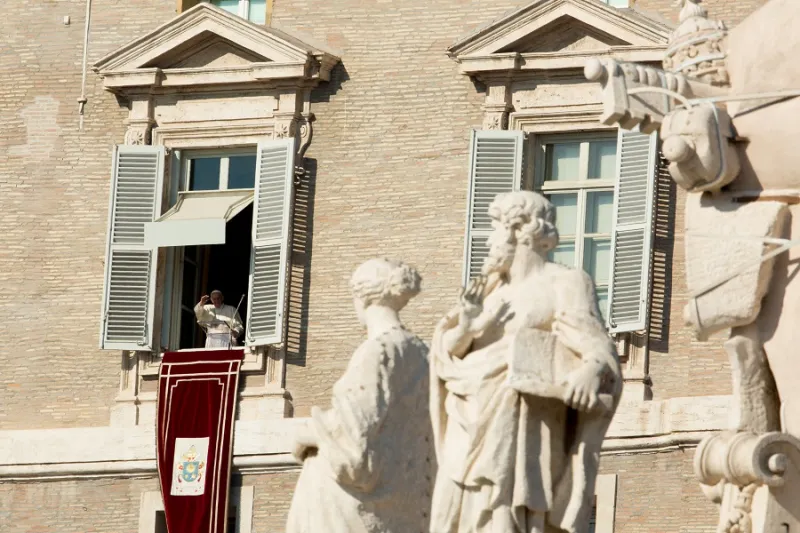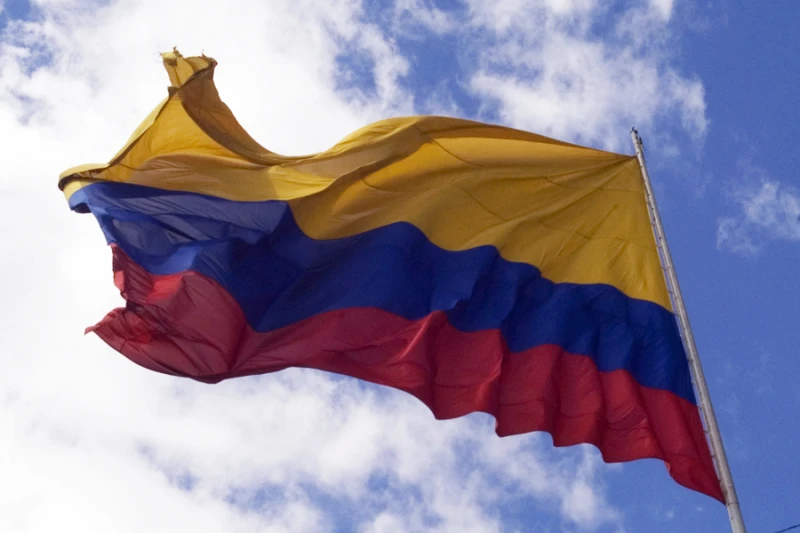
The flag of Colombia. / Politicnico Grancolombiano Departamento de Comunicaciones via Flickr (CC BY-NC 2.0)
ACI Prensa Staff, Jun 18, 2024 / 17:50 pm (CNA).
The bishops of the dioceses located in the Valle del Cauca district of Colombia have demanded that armed groups stop their actions that continue to cause more deaths in the southwestern part of the country and have called on the authorities to “find the solutions” that would bring peace to the country.
The prelates issued a statement on June 14 signed by the archbishop of Cali, Luis Fernando Rodríguez; the bishop of Buenaventura, Rubén Darío Jaramillo; Bishop César Alcides Balbín of Cartago; Bishop José Roberto Ospina of Buga; as well as the bishop-elect of Palmira, Father Rodrigo Gallego Trujillo, and the apostolic administrator of the same diocese, Bishop Edgar de Jesús García.
In their statement, the prelates decried “the worsening of polarization, threats, harassment, extortion, attacks, murders, and other acts of violence in Valle del Cauca and in a good part of southwestern Colombia, resulting in uncertainty, sadness, pain, and death, creating fear and eroding the hope of citizens.”
Given the situation, the prelates strongly reiterated their call to the armed groups “to cease these actions.”
“In the name of the Lord, we exhort those who plan and carry out these insane acts to become aware of the evil they do to the population and even to themselves. Nothing justifies violence!” the bishops stated.
They also asked the authorities on behalf of “the population that feels overwhelmed and afraid” to join forces with civil society “in order to find the solutions that will lead to overcoming this disturbing and painful situation.”
In their statement, the bishops of the Valle del Cauca district also reiterated the commitment of the Catholic Church “to continue accompanying all efforts to foster bridges of dialogue that would make it possible to achieve the pacification of hearts and the silencing of weapons.”
The Institute of Studies for Development and Peace (Indepaz) noted on its X account that on the same day that the bishops issued their statement, “three people were shot to death in the Nuevo Horizonte neighborhood of Florida, Valle of Cauca.”
According to Indepaz, the Dagoberto Ramos Front of the Western Bloc, local gangs, the Adán Izquierdo Company, with “Front 57 possibly moving in,” operate in this area.
The Dagoberto Front and Front 57 are factions of the marxist Revolutionary Armed Forces of Colombia (FARC) that rejected the 2016 peace agreement with the government.
Indepaz also noted that in its early warning 031/23, the People’s Ombudsman’s Office stated that “between southern Valle del Cauca and the northern Cauca there is a worsening of the armed conflict and direct violence, not only due to the presence and territorial control of the groups present but also for the entry into these areas of other illegal armed elements.”
Indepaz said these groups were not executing a “permanent incursion or operations” in these regions “beyond sporadic transiting or pamphleting.”
This story was first published by ACI Prensa, CNA’s Spanish-language news partner. It has been translated and adapted by CNA.
If you value the news and views Catholic World Report provides, please consider donating to support our efforts. Your contribution will help us continue to make CWR available to all readers worldwide for free, without a subscription. Thank you for your generosity!
Click here for more information on donating to CWR. Click here to sign up for our newsletter.
Caracas, Venezuela, Jan 18, 2018 / 12:00 am (CNA).- The President of Venezuela, Nicolas Maduro, called for an investigation of two bishops accused of committing “hate crimes” in homilies they gave on the Feast of the Divine Shepherdess, Jan. 14, a popular Marian feast day in the country.
On Monday, the Venezuelan president gave a speech before the Constitutional Assembly asking the Supreme Court of Justice, the Comptroller’s Office and the Public Prosecutor’s Office to investigate the Archbishop of Barquisimeto, Antonio López Castillo; and the Bishop of San Felipe, Víctor Hugo Basabe.
Venezuela’s El Nacional reports that the bishops “cried out for the end of hunger and corruption” in their homilies. Bishop Basabe made reference to a “corrupt plague” causing starvation in the country, and Archbishop Castillo prayed the country would be saved from corruption, according to the report.
In his speech, Maduro said that “a devil comes in a cassock to call for violent confrontations, to call for civil war…and I thank the people of the state of Lara who alerted me to this filth, because I really don’t listen to [the bishops]. We don’t listen to those bandits.”
Maduro’s allegations came just days after the Venezuelan bishops’ conference called for international monitors to oversee the country’s 2018 presidential elections, calling the Constitutional Assembly controlled by Maduro “unconstitutional and illegitimate.”
Archbishop Castillo told reporters Tuesday that he had received a phone call of support from Pope Francis, according to a report from El Impulso.
“We received Pope Francis’ message and he supports us as well as the people of Venezuela,” he said.
Bishop Basabe responded to Maduro’s accusations through a letter obtained by ACI Prensa–CNA’s Spanish language sister agency. Basabe stated that his “conscience in no way reproaches him” because his “only crime seems to be serving the truth.”
“Mr. Maduro has put in my mouth words I never said. How sad it is that a national public official would so scandalously lie in front of the whole country on National Teacher’s Day. What’s worse is he accuses me committing a crime while he commits one himself,” the bishop said.
“I knew that my words would upset those who deep down in their consciences know they are responsible for the tragedy that this people whom I love is going through,” Basabe added.
“Here I am in my own church with my only weapons: my faith in Christ and the certainty that my life is in his hands. [My fate] is up to those who will not be pardoned by conscience or history,” he concluded.
Bishop Mario Moronta Rodriguez, vice-president of the Venezuelan bishops’ conference, also repudiated Maduro’s accusations. On Jan. 16, he appeared on the television program Circuito Éxitos, arguing that the accusations made against Lopez and Castillo are accusations “against the entire episcopate and the entire Catholic Church.”
“What they did was to simply make a statement reflecting everything we have been saying for a long time and it touches on a wound or sore,” he added.
Finally, he said that “when the bishops are called ‘devils in a cassock,’ [Maduro] is also inciting hatred.”
“There are a lot of people going hungry. If that’s calling for hatred then the dramatic nature of that law has to be changed,” he concluded.
In a Jan 16 press release, the Venezuelan bishops’ conference expressed their solidarity with Lopez and Basabe, and said that President Maduro, “totally twisted the message” given by both of them, “with the purpose of claiming the bishops were committing a crime.”
“The truth about what is happening in the country was evidenced in the homilies given that day. The gestures of the thousands of parishioners present at the Mass on Venezuela Avenue showed they agreed with what they were hearing,” the statement added.
Venezuela’s hate crime law “criminalizes any demonstrations” against the government, the bishops noted.
“We exhort all the parishioners of the Archdiocese of Barquisimeto and the Diocese of San Felipe to care for your pastors, to be alert to any move against them, which could attack their human dignity,” the statement added.
This article was originally published by our sister agency, ACI Prensa. It has been translated and adapted by CNA
Pope Francis interacted with an energetic crowd of 65,000 young adults and catechists at Martyrs’ Stadium in Kinshasa, Democratic Republic of Congo, on Feb. 2, 2023. / Vatican Media
Rome Newsroom, Feb 2, 2023 / 05:45 am (CNA).
To bring about peace, “prayer is the most powerful weapon there is,” Pope Francis told thousands of young adults and catechism teachers in the Democratic Republic of Congo on Thursday.
The meeting in Martyrs’ Stadium in Kinshasa, the capital city of the DRC, took place on Feb. 2, the third day of the pope’s visit to the central African country. On Feb. 3, Francis will fly to Juba, South Sudan, for the second leg of his peace pilgrimage.
Pope Francis on Thursday interacted with an enthusiastic crowd of about 65,000 young people and adults, some of whom traveled days to be present for the papal visit.
Pope Francis interacted with an energetic crowd of 65,000 young adults and catechists at Martyrs’ Stadium in Kinshasa, Democratic Republic of Congo, on Feb. 2, 2023. Vatican Media
“Yes, prayer conquers fear and enables us to take our future into our hands. Do you believe this?” the pope said. “Do you want to make prayer your secret, as refreshing water for the soul, as the one weapon you carry, as a traveling companion on each day’s journey?”
During the second half of his speech, the pope was repeatedly drowned out by the energetic audience, which broke out in cheering, singing, and dancing despite the hot weather.
Pope Francis interacted with an energetic crowd of 65,000 young adults and catechists at Martyrs’ Stadium in Kinshasa, Democratic Republic of Congo, on Feb. 2, 2023. Vatican Media
In his talk, Francis used the imagery of the hand to speak about the future of the DRC.
“God has placed the gift of life, the future of society and the future of this great country in those hands of yours,” he said.
“Dear brother, dear sister, do your hands not seem small and frail, empty and unsuited to so great a task? It’s true,” he said. “Let me tell you something: your hands all look alike, they all look alike, but none of them is exactly the same. No one has hands just like yours, and that is a sign that you are a unique treasure, an unrepeatable and incomparable treasure.”
He invited those present in the stadium to open and close their hands while meditating on whether they wanted to choose peace or violence.
Pope Francis interacted with an energetic crowd of 65,000 young adults and catechists at Martyrs’ Stadium in Kinshasa, Democratic Republic of Congo, on Feb. 2, 2023. Vatican Media
“Notice how you can squeeze your hand, closing it to make a fist. Or you can open it, to offer it to God and to others,” he said.
“You who dream of a different future: from your hands, tomorrow can be born, tomorrow can be born from your hands, from your hands peace so lacking in this country can at last come about.”
Bishop Donatien Bafuidinsoni Maloko-Mana from the Diocese of Inongo, in western DRC, was at the meeting.
He told EWTN News that people from his diocese traveled in boats on the Congo River for two to four days to arrive in Kinshasa.
Bafuidinsoni said the Congolese people were disappointed last year when the pope’s visit was canceled, but “now that the pope is here it’s a big joy for us all.”
Even those who are following the trip from home “are really happy,” he added. “It’s a message of joy, of peace, and of hope for all.”
Sister Asterie Neema, 29, is from Rutshuru in eastern DRC, where her brother was brutally killed last year. Elias Turk/CNA
Sister Asterie Neema, 29, is from Rutshuru in eastern Congo, where, she told EWTN News, they are under the control of an armed group called M23.
Neema said her older brother was killed in 2022 by unidentified rebels in front of his 12- and 7-year-old children.
In her 29 years of life, she said, her region of the DRC has never seen peace. Neema added that she has forgiven her brother’s killers, but she hopes for peace in her country.
Not everyone in the audience was Catholic. Two young Muslim men also attended the youth gathering with Pope Francis.
Yassine Mumbere, from Butembo in eastern DRC, told EWTN News that he came to the event because all young people were invited. He also studied at a Catholic school.
Muslim Yassine Mumbere, 35, from Butembo in eastern Congo, (R) with his friend (L) at the youth gathering with Pope Francis in Kinshasa, DRC on Feb. 2, 2023. Elias Turk/CNA
The 35-year-old Muslim Scout leader said he hopes the pope’s trip will help bring peace to the DRC’s eastern region.
In his speech, Pope Francis encouraged those present to be careful of the temptation to point fingers at people, or to exclude others because of “regionalism, tribalism, or anything that makes you feel secure in your own group, but at the same time is unconcerned with the life of the community.”
“You know what happens: first, you believe in prejudices about others, then you justify hatred, then violence, and in the end, you find yourself in the middle of a war,” he said.
To create a concrete sign of community, Francis invited the crowd to hold hands with those beside them and to sing a song together: “Imagine yourselves as one Church, a single people, holding hands.”
Pope Francis interacted with an energetic crowd of 65,000 young adults and catechists at Martyrs’ Stadium in Kinshasa, Democratic Republic of Congo, on Feb. 2, 2023. Vatican Media
“Yes, brother and sister, you are indispensable and you are responsible for your Church and for your country,” he said after the song. “You are part of a greater history, one that calls you to take an active role as a builder of communion, a champion of fraternity, an indomitable dreamer of a more united world.”
After Pope Francis spoke against corruption — inviting everyone to shout together, “Go away, corruption!” — the stadium broke out in loud singing and cheering.
The event’s emcee had to invite the crowd to quiet down before the pope could continue speaking.
Francis also drew attention to two Congolese martyrs and their examples of faith: Blessed Isidore Bakanja and Blessed Marie-Clémentine Anuarite.
Statues of Blessed Isidore Bakanja and Blessed Marie-Clémentine Anuarite, young Congolese martyrs beatified by Pope John Paul II, in Martyrs’ Stadium in Kinshasa, DRC, on Feb. 2, 2023. Elias Turk/CNA
Blessed Marie-Clémentine Anuarite, a member of the Sisters of the Holy Family, was killed during the civil war in 1964 at the age of 24. Anuarite was beatified by Pope John Paul II during his visit to the DRC, then known as the Republic of Zaire, in 1985.
Blessed Isidore Bakanja was a Catholic convert at the age of 18. He became a catechist and was devoted to Our Lady of Mount Carmel. He died in 1909, around the age of 21 or 22, after succumbing to an infection caused by a beating and other torture he received at the hands of a European manager for refusing to remove his brown scapular at work. Bakanja was beatified in 1994 by Pope John Paul II.
Statues of the two blesseds were present at the youth meeting, where people in the crowd shouted and held signs asking the pope to make them “santi subito!”
The pope pointed to another example of virtue from the DRC, Floribert Bwana Chui, who was killed in 2007 in Goma.
The 26-year-old man, who worked as a customs manager, was killed for refusing to cooperate with corruption; specifically, he did not allow the passage of expired food products.
A spectator at Martyrs’ Stadium in Kinshasa, DRC, on Feb. 2, 2023, holds a sign with the phrase “santi subito” in reference to two Congolese blesseds. Elias Turk/CNA
“He could easily have turned a blind eye; nobody would have found out, and he might even have gotten ahead as a result,” Francis said. “But, since he was a Christian, he prayed. He thought of others and he chose to be honest, saying no to the filth of corruption.”
“Now I want to tell you something important,” he added. “Listen closely: If someone offers you a bribe, or promises you favors and lots of money, do not fall into the trap. Do not be deceived; do not be sucked into the swamp of evil. Do not be overcome by evil!”
Leave a Reply