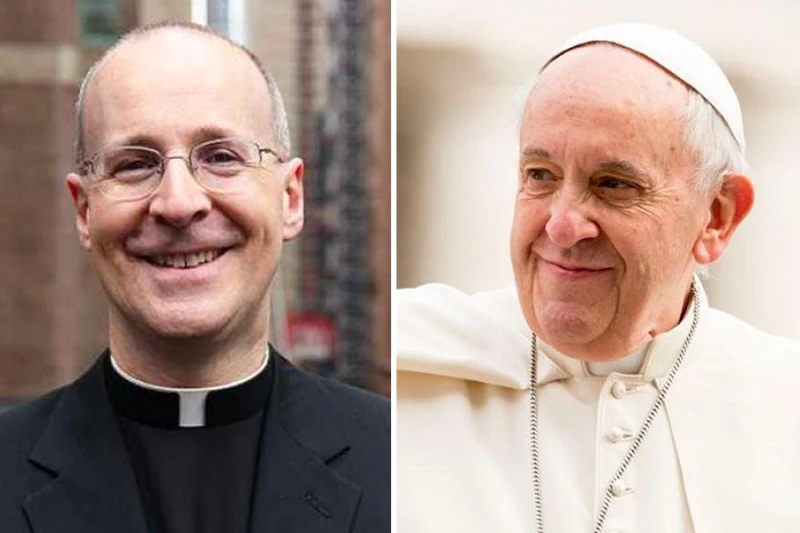
Father James Martin, SJ, and Pope Francis. / Credit: Kerry Weber via Wikipedia cc 4.0; Daniel Ibáñez/CNA.
CNA Staff, Jun 3, 2024 / 16:05 pm (CNA).
Pope Francis has penned an introduction to the Italian version of a new book by Jesuit Father James Martin on the topic of Jesus’ healing of Lazarus, in which the pope wrote that Martin’s book serves as a reminder that “Jesus isn’t afraid of our death, or our sin.”
In the March 11 introduction, released by Vatican News, Pope Francis said Jesus’ raising from the dead of his friend Lazarus, which is recounted in the Gospel of John, shows that “Jesus isn’t scared of coming close to sinners — to any sinner, even the most brazen and undaunted.”
‘[Jesus] has one single preoccupation: that no one goes missing, that none are deprived of the possibility of feeling the loving embrace of his Father,” Pope Francis wrote.
Pope Francis has on several occasions received the controversial Jesuit priest in private audiences at the Vatican and has expressed support for Martin’s ministry to those identifying as LGBT, urging him to “continue this way.” Martin’s most recent book, released in the U.S. in September 2023, is titled “Come Forth: The Raising of Lazarus and the Promise of Jesus’ Greatest Miracle.”
Describing Martin as “the author of many other books that I know and appreciate,” Pope Francis said: “Father James has the perspective of a person who has fallen in love with the Word of God.”
“As I read the careful arguments and exegeses of the biblical scholars he cites, it made me wonder how often we manage to approach Scripture with the ‘hunger’ of a person who knows that that word really is the Word of God,” the pope wrote.
“The fact that God ‘speaks’ should give us a little jolt each and every day. The Bible truly is the nourishment we need to handle our lives. It’s the ‘love letter’ that God has sent — since long ago — to men and women living in every time and place.”
Engaging with the Bible daily, the pope wrote, helps “us grasp the extent to which Scripture is a living body, an open book, a vibrant witness to a God that is not dead and buried on the dusty shelves of history.”
The Christian faith, Francis wrote, is a comingling of “the divine and the human — never one without the other,” thanks to the incarnation of Jesus as a man. Jesus, who described himself as “the resurrection and the life,” made eternal life possible even for sinners.
“All of us, then, are Lazarus. Rooting himself firmly in the Ignatian tradition, Father Martin brings us directly into the story of this friend of Jesus. We’re his friends, too — ’dead’ as we sometimes are on account of our sins, our failings and infidelities, the despondency that discourages us and crushes our spirits. Jesus is hardly afraid to get close to us — even when we ‘reek’ like a dead body that’s been buried for three days,” the pope wrote.
“No, Jesus isn’t afraid of our death, or our sin. He waits just outside the closed door of our hearts, that door that only opens from within, that we lock with a double bolt whenever we think God could never forgive us.”
Pope Francis noted the insight that “our lives all point toward the infinite … We are made for eternity.”
“Of course, the dead rise, but how true it is to recall that we the living never die! Yes, death does come, not just for us, but for our families and those dear to us — for everyone, really. We see so much death all around, unjust and painful death, death caused by war, by violence, by Cain’s abuse of power toward Abel. But we men and women are destined for eternity. All of us are,” he wrote.
Critics have over the years accused Martin of rejecting Catholic teaching on the sinfulness of homosexual acts, but he has insisted that he does not reject the teaching of the Church. Last winter, after the Vatican issued the declaration Fiducia Supplicans, which opened the door for priests to pastorally bless same-sex couples, Martin said on social media: “Along with many priests, I will now be delighted to bless my friends in same-sex unions.”
Pope Francis last year chose Martin to be one of the 364 bishops, priests, religious, and laypeople who voted in the Synod on Synodality in October 2023.
If you value the news and views Catholic World Report provides, please consider donating to support our efforts. Your contribution will help us continue to make CWR available to all readers worldwide for free, without a subscription. Thank you for your generosity!
Click here for more information on donating to CWR. Click here to sign up for our newsletter.
CNA Staff, Jul 27, 2020 / 03:20 pm (CNA).- The archbishop of Portland, Oregon is urging Catholics to learn about and study how to respond to the sin of racism, while at the same time condemning the violence accompanying many of the protests in the city… […]
Washington, D.C. Newsroom, Nov 19, 2020 / 12:01 pm (CNA).- The U.S. will be working against the use of technology to suppress religious minorities, the religious freedom ambassador announced this week.
Massachusetts Gov. Maura Healey walks across the campus of St. John’s Prep in Danvers, Massachusetts, on April 9, 2024. / Credit: Screenshot of St. John’s Prep Facebook page last visited April 19, 2024
Boston, Mass., Apr 23, 2024 / 16:45 pm (CNA).
Pro-lifers in the Archdiocese of Boston are criticizing Cardinal Seán O’Malley over two recent appearances at Catholic education events by the pro-abortion governor of Massachusetts.
Earlier this month, Massachusetts Gov. Maura Healey, a Democrat who supports legal and publicly funded abortion and who has taken steps to make abortions easier to obtain, spoke at a fundraiser for The Catholic Schools Foundation, which raises money for Catholic schools in the archdiocese and helps poor students attend.
O’Malley, the archbishop of Boston, is the chairman of the board of trustees of the foundation, though he was in Rome at the time of the gala and did not attend it.
Healey also recently visited a Catholic school north of Boston, speaking to students and answering questions.
C.J. Doyle, executive director of the Catholic Action League of Massachusetts, called Healey’s appearances “a grave scandal.”
“Cardinal O’Malley should be ashamed of himself. Is Maura Healey an inspiring role model for Catholic students?” Doyle said.
Thomas Harvey, chairman of the Massachusetts Alliance to Stop Taxpayer Funded Abortions, called including Healey at the Catholic events “really disgraceful,” and he placed the blame on O’Malley.
“Maura Healey is a huge proponent of killing babies in the womb, in direct defiance of Catholic teaching, and yet here she is being presented to impressionable Catholic students as if she were a Catholic role model,” Harvey told the Register by text. “And the clear message being sent to Catholic students here is that killing babies in the womb is just not that big a deal.”
In June 2004, the U.S. Conference of Catholic Bishops approved a document called “Catholics in Public Life,” which states: “The Catholic community and Catholic institutions should not honor those who act in defiance of our fundamental moral principles. They should not be given awards, honors, or platforms which would suggest support for their actions.”
Terrence Donilon, a spokesman for the Archdiocese of Boston, pointed out that Healey was not an honoree at the gala or during her earlier appearance at the Catholic school.
Since Healey is the governor of the state, Donilon said, Cardinal O’Malley has worked with her “on a number of issues important to Catholics and the wider community,” including public funding for the archdiocese’s charitable work providing “basic needs assistance, job training, child care services, and immigration and refugee assistance to thousands of residents,” as well as building “badly needed affordable housing” and trying “to stem gun violence.”
“At the same time, the cardinal has been a leader in the pro-life movement for over 50 years and his commitment in being a staunch promoter of life is well known and unwavering,” Donilon said.
O’Malley, 79, a Capuchin Franciscan, has frequently attended the March for Life in Washington, D.C., and has spoken at pro-life rallies. Last week, The Boston Globe published a column by O’Malley urging state legislators to oppose a bill that would legalize physician-assisted suicide.
But critics such as Doyle claim that O’Malley during his time as archbishop has seemed to mix easily and uncritically with abortion-supporting Catholic politicians, including the late U.S. Sen. Edward Kennedy (whose funeral Mass he celebrated), the late Boston mayor Thomas Menino, former Boston mayor Marty Walsh, and the current governor, Healey, with whom he co-authored a column in The Boston Globe in September 2017 on immigration.
Donilon, O’Malley’s spokesman, addressing Healey’s participation in The Catholic Schools Foundation gala last week, said that “the governor has been a vocal supporter of Catholic education. … Our Catholic schools save cities and towns hundreds of millions of dollars in education costs. Our families benefit from an outstanding education based in an excellent faith-based environment.”
Gov. Maura Healey speaks to students at St. John’s Prep on April 9, 2024. Credit: Screenshot of St. John’s Prep Facebook page last visited on April 9, 2024.
Who is Maura Healey?
Healey, 53, was elected Massachusetts attorney general in 2014 with an endorsement from Planned Parenthood Advocacy Fund. She served two terms as attorney general before being elected governor of Massachusetts in November 2022.
As an elected official, Healey has frequently supported public policies that clash with Catholic teachings on life and sexuality.
She has verbally attacked pro-life pregnancy centers, steered state government money to private abortion funds, and, in April 2023, quietly arranged for the flagship campus of the state-run University of Massachusetts to purchase 15,000 doses of abortion pills.
Healey’s administration in June 2023 successfully proposed a curriculum framework for public schools that calls for teaching between third and fifth grades “the differences between biological sex and gender identity” and “how one’s outward behavior and appearance does not define one’s gender identity or sexual orientation.”
Healey appeared Thursday, April 11, at the annual gala of The Catholic Schools Foundation at a hotel in Boston.
“So I didn’t have the benefit of going to Catholic school,” Healey said, according to a text of her remarks provided by a spokesman. “My mom went to Catholic school, and my nephew goes to Catholic school; we have priest[s] at the dinner table every Sunday. But I do know, both having been your attorney general and now as your governor, what your work means. And I can see that experience firsthand.”
She also said she wants to find ways “to partner” with the foundation “in the important work that you [are] doing.”
“And I want you to know that, as governor, I value our vibrant mix of education, our public schools, our private schools, and our religious schools,” Healey said.
Two days earlier, on Tuesday, April 9, Healey spent about 50 minutes with a group of 120 students at St. John’s Preparatory High School, a Catholic boys’ school founded by the Xaverian Brothers in Danvers, about 18 miles northeast of Boston, according to a description of the visit published on the school’s website. The school is in the Archdiocese of Boston, though it is not run by the archdiocese.
Healey had never visited the school before, “but it was quickly clear her personal values are closely aligned with those of the Xaverian Brothers,” the school’s write-up states.
Healey emphasized leadership and empathy during her remarks. The governor also told the students that while she believes in civil discourse, “there are some basic values that have kept our society intact,” and she told students they should “call out hate when you see it.”
“We can have differences of opinion on things,” Healey said, according to the school’s write-up, “but, to me, equality has got to abide. Respect for the dignity and worth of each person is something I call on people to really adhere to.”
Robert Joyce, a lawyer and member of the board of the Pro-Life Legal Defense Fund, which provides legal representation for pro-lifers, said that St. John’s Prep last fall turned down an offer he made to provide a pro-life assembly for students featuring a canon lawyer, a physician, and a vocations director. (The head of school, Edward Hardiman, did not respond to requests for comment by deadline.)
Joyce called Healey’s recent appearances at the gala and at the school “abominations for Catholic education.”
“They send the clear message to Catholic students and parents that critical, fundamental precepts of the Catholic faith are not all that important. In simple terms, they declare that protection of innocent unborn life and the defense of traditional marriage are negotiable with these Catholic educators,” Joyce indicated.
Healey is also a featured speaker at the annual Spring Celebration of Catholic Charities Boston scheduled for Wednesday, May 29, at the Boston Harbor Hotel in Boston. O’Malley is expected to receive an award at the event for his work in welcoming immigrants.
Healey and the Catholic Church
Healey does not often talk about religion in public, but she occasionally identifies herself as a Catholic.
In October 2018, when she was state attorney general, she led off a brief column in The Boston Globe with the words: “As a member of law enforcement and as a Catholic …”
In April 2022, when Healey criticized Bishop Robert McManus of Worcester for calling for a Catholic school to take down a rainbow flag, she added, according to MassLive.com: “And I speak as a Catholic …”
In October 2022, during a debate while she was running for governor, Healey used a Catholic reference while defending herself from a claim by her Republican opponent that a bill she had supported effectively legalized infanticide, as the National Catholic Register subsequently reported. “You know, my mom goes to Mass every morning,” Healey said.
Healey is widely thought of as a potential candidate for other offices. She would be an obvious Democratic nominee for U.S. Senate in Massachusetts if either of the two incumbents (both in their 70s) leaves office.
Additionally, just hours before her appearance at The Catholic Schools Foundation gala, Healey participated in an event at Northeastern University in Boston honoring former Massachusetts governor and 1988 Democratic presidential nominee Michael Dukakis. The moderator floated Healey as a potential future candidate for president of the United States, to applause from the audience.
This story was first published by the National Catholic Register, CNA’s sister news partner, and is reprinted here on CNA with permission.
Should you post a comment I cannot believe it would be anything other than a spiritual work of mercy. Some truths go down hard but who can exist long without the truth?
Pope Francis is not making sense in this area with homosexualism and the other area with James Martin. Truth remains absent. The FS. The misrepresenting of Benedict. The mocking of seminary faggotry. The telling the expelled one to “follow your vocation”. The “legalize homosexual civil union”.
He could have any number of reasons for deliberately positioning those things.
Yet here we are sustained by the Spirit of God contrary to your assertion. This is the Catholic experience, I say, as when a Christian is thrown into a cell without explanation or recourse and endures the effacement in the love of God.
Your conceptions of belief and works are off. Maybe you’re like James Martin, you would just have them for simmering for their own sakes and your penchants’?
The article: “Pope Francis said Jesus’ raising from the dead of his friend Lazarus, which is recounted in the Gospel of John, shows that “Jesus isn’t scared of coming close to sinners — to any sinner, even the most brazen and undaunted.”
It is risky to comment on something I have not read. I base my words on what is said in the article.
The words of the Pope “Jesus isn’t scared of coming close to sinners” registered with me as being out of a place. The word “scared” is the key here as somewhat inappropriate in this contact, if accessed by a heart. It makes Our Lord small. Also, the very Incarnation was dropping into the thicket of human sinfulness permeated with the evil which caused Christ constant suffering. If He was not “afraid” of that – He was eager to save us then He cannot be “afraid” of the proximity of sinners.
But well, supposedly the obvious fact that Christ did not see beneath Himself to deal sinners has to be stated. Would it not be appropriate then to pick up an example of yet unreformed sinners which are abundant in the Gospels like woman caught in adultery or tax collectors or others? In fact, Our Lord went around sinners (including Pharisees) non-stop!
However, Lazarus is not an unreformed sinner. First, he was a disciple who later was to become the Bishop of the Church in Cyprus, according to Church tradition. We do not know whether Lasarus was a thick sinner before meeting Jesus or not. It is quite clear though that he and his sisters were disciples of Jesus and that Jesus used to stay in their house quite often; unlike a mere dining with sinners, it was a place of respite for Him. How Martha and Mary relate to Jesus also shows the depth of their discipleship. Them and Lasarus were definitely not dead because of sins. And so, Lasarus’s death and resurrection is a very poor illustration of “sins which make us dead”. Noteworthy, just like in “Jesus was not afraid” Our Lord was made somewhat small Lazarus also was made small here, for the need of an analogy. This is an important and prominent feature of homilies given for the sake of “a current agenda” which subtly twists the Church’s teaching. To match the agenda, a speaker has to reduce or twist the character from the Scriptures he uses to back his point.
Second and very important, a poor empathy/understanding of human relationship/attachment is evident here. Gospels state that Our Lord loved Lasarus’s family dearly. When one loves someone, he is not “afraid” to approach him or his body after death. I am speaking here about a totally human reasoning which seems to be missing in the Pope’s and Fr Martin’s discourse. Speaking superhumanly, Our Lord went to resurrect Lasarus because he wanted to reveal to his disciples the power of God and strengthen them before His Passion. By definition, He could not be “scared” of his friend’s dead body because He loved him or of any body because He is the Creator of those bodies, God and Man together in one Person. Being Life Himself, He would be naturally repelled by death but not “afraid”.
And so, both dead in body Lazarus and Jesus Who came to resurrect him for the same of showing the glory of the Kingdom appear to be a very bad paradigm for “spiritual death of sin which the Lord is not afraid of” the Pope was talking about. In fact, the story of the resurrection of Lazarus is the exact opposite of that. Lazarus is alive in spirit because of his discipleship and he is dead in body. An unrepentant sinner is dead in spirit and alive in body, just like the pharisees were. Pharisees then would be a far better example – and it is very evident that Our Lord could hardly be around them because not only they were dead, they were proud of their own deadness = unrepentance (very narcissistic), just like many of those in the modern world who reject Christ and His Words.
It appears that an analogy “Lasarus – dead in sin” was caused not by contemplation of the Scriptures but by the need to back the agenda “You, faithful, must go to sinners (modern pharisees) and be with them as if they were not sinning, just like Our Lord went to dead Lazarus in the tomb”. I repeat, the problem is that Our Lord, the Truth and the Life, made Lasarus’ spirit permanently alive first when He met him via manifesting to him the Truth and then resurrected his body later. If we are to follow Our Lord here, we are to try to make sinners (modern Pharisees) alive via preaching/manifesting the truth to them – i.e. doing the exact opposite of what the Pope wants.
Hence, I think it would be far better for Fr Martin and the Pope to draw on Our Lords’ dealing with Pharisees who refused to acknowledge the Truth when they beheld Him.
Yes, “none are deprived of the possibility of feeling the loving embrace of his Father…” But, on the one hand and on Calvary Christ promised paradise to one robber (actually an insurrectionist), but not to the other. So, why is that?…
Well, clearly, Jesus Christ hadn’t read the new book (all genuflect, a book!) by guru James Martin! Problem solved!
Even when we reek of death after three days, that is the death of sin as made clear by Fr Martin and Pope Francis that is proffered as analogous to Lazarus being raised from the grave by Christ, a miracle to demonstrate his divinity. What the drift of the book says, as analyzed by Francis, is the suggestion that whatever our sins [our door to reconciliation locked with a double bolt] Christ will save us.
That then is what dead Lazarus encourages us to believe, that whatever the sin, even an unrepentant death will not prevent Christ from absolving us. This is consistent in context of a favorite Francis religious homoerotic artifact, a naked Christ carrying a naked Judas over his shoulder. There aren’t many, perhaps any clergy who accommodate homosexuality who hold belief in Christ’s judgment and the prospect of eternal punishment [that’s usually consistent with condoning, or remaining silent on contraception and abortion]. It would be wonderful if we could rest assured that we’ll all be saved. Reality, what’s revealed by Christ and conveyed by the Apostles assures us that’s a false hope.
As a postscript to my initial comment, “false hope” regards salvation for all has varied perspectives, one being that we may hope that all from this given point all will be saved. Some say that’s what von Balthasar, Bishop Barron, including my own perspective on the theological virtue of hope. Then there’s the looming questing of the dead prior to that given point in time. Here the Church in its wisdom offers no judgment, although as many point the words of Christ regarding Judas ‘better he had not been born’. Then there’s the possibility, for some at least, that prayer and intercession after the fact [of death] may possess real value regarding judgment, that based on the timeless dimension in which God is, who is pure act, a reality beyond our complete comprehension.
Is Pope Francis referring to a form of judgment beyond the limits of time? Or is he saying that whatever our sins, God’s mercy is greater than ourselves? Judgment requires an either or decision to be definitive as judgment. We do know that Angels were condemned and remain so. Fr Martin’s book, insofar as its commentary by Francis does not deny that judgment can be favorably affected by post death intercession – after all Judas Maccabeus ordered his troops pray for the fallen, all of whom wore condemnable talismans. However neither Martin nor Francis speak of intercessory prayer. They paint a picture of a dead Lazarus as one who died in his sins, reeking of the stench of sin that doesn’t prevent an all merciful God from forgiveness. This is the anomaly that would interpret the crucifixion as a universal act of salvation regardless of whether we repent of our sins. A prescription to do as we wish, the justice due to the effect of sin removed.
First it’s several private meetings at the Vatican, then public endorsement of his book. What’s Francis’ end game with Martin here? Is the pope preparing the way for promoting this homosexualist priest to a higher office in the church? What’s the agenda here?
That there is something of Christian value in a homosexual “relationship” so long as it is acknowledged “it is not marriage”, is a spurious non-correlation on more than one level.
First it remains homosexual, it does not derive a “relationship” of Christian or natural merit.
Second, it does not address the a priori issues or precedent problems, that apart from the question of marriage and irrespective of such a question, the homosexualism is abhorrent both in itself and to society in general. Which is where the real matter lies.
The “resolving of the question of marriage” is a total irrelevance, not just “non-resolving”; yet that also sets up serious prejudice against true teaching and method (pedagogy) while impugning the sincerity of the protagonist.
And it doesn’t matter who does the acknowledging of the non-marriage aspect of the “relationship” or of the “relationship”.
Philosophy is taught in seminary to help the priesthood guard itself. It isn’t taught because it is “something Catholic and traditional how to remain in a lag” and “to restrain acting on difficulties by holding them inside complexity”.
Some of what we are hearing about being accommodating of everyone, can come under the heading “Rogerian”. See in the WIKIPEDIA link. Whatever the merits might be in Rogerianism, many things can conform to Christian charity but Christian charity is not limited by them nor is it defined and determined by them.
“Even the non-believers can be Rogerian” -it doesn’t just so equate with Christianity or find an equivalence.
The priest is called to let homosexuals know they must separate.






If I were to comment about Father Martin’s book and Bergoglio’s endorsement I’d be having to march myself off to Confession. Therefore, I’ll refrain.
Should you post a comment I cannot believe it would be anything other than a spiritual work of mercy. Some truths go down hard but who can exist long without the truth?
Pope Francis is not making sense in this area with homosexualism and the other area with James Martin. Truth remains absent. The FS. The misrepresenting of Benedict. The mocking of seminary faggotry. The telling the expelled one to “follow your vocation”. The “legalize homosexual civil union”.
He could have any number of reasons for deliberately positioning those things.
Yet here we are sustained by the Spirit of God contrary to your assertion. This is the Catholic experience, I say, as when a Christian is thrown into a cell without explanation or recourse and endures the effacement in the love of God.
Your conceptions of belief and works are off. Maybe you’re like James Martin, you would just have them for simmering for their own sakes and your penchants’?
https://onepeterfive.com/francis-appoints-homosexualists-to-shape-doctrine/
(I posted this earlier but seems not to be coming through; so I try again, its’ worth it.)
Bergoglio is way, way wrong. Jesus isn’t resigned to sin. He doesn’t accept sin. He doesn’t surrender to sin.
And, because He loves us — infinitely, ecstatically, insanely — Jesus doesn’t abandon us to sin.
Because embracing sin is not “understanding,” or “walking with,” or “acceptance.”
Accepting sin results only and always in death and misery, destruction and despair.
And, trust me, I know what I’m talking about, being a sinner from way back.
yawn
The article: “Pope Francis said Jesus’ raising from the dead of his friend Lazarus, which is recounted in the Gospel of John, shows that “Jesus isn’t scared of coming close to sinners — to any sinner, even the most brazen and undaunted.”
It is risky to comment on something I have not read. I base my words on what is said in the article.
The words of the Pope “Jesus isn’t scared of coming close to sinners” registered with me as being out of a place. The word “scared” is the key here as somewhat inappropriate in this contact, if accessed by a heart. It makes Our Lord small. Also, the very Incarnation was dropping into the thicket of human sinfulness permeated with the evil which caused Christ constant suffering. If He was not “afraid” of that – He was eager to save us then He cannot be “afraid” of the proximity of sinners.
But well, supposedly the obvious fact that Christ did not see beneath Himself to deal sinners has to be stated. Would it not be appropriate then to pick up an example of yet unreformed sinners which are abundant in the Gospels like woman caught in adultery or tax collectors or others? In fact, Our Lord went around sinners (including Pharisees) non-stop!
However, Lazarus is not an unreformed sinner. First, he was a disciple who later was to become the Bishop of the Church in Cyprus, according to Church tradition. We do not know whether Lasarus was a thick sinner before meeting Jesus or not. It is quite clear though that he and his sisters were disciples of Jesus and that Jesus used to stay in their house quite often; unlike a mere dining with sinners, it was a place of respite for Him. How Martha and Mary relate to Jesus also shows the depth of their discipleship. Them and Lasarus were definitely not dead because of sins. And so, Lasarus’s death and resurrection is a very poor illustration of “sins which make us dead”. Noteworthy, just like in “Jesus was not afraid” Our Lord was made somewhat small Lazarus also was made small here, for the need of an analogy. This is an important and prominent feature of homilies given for the sake of “a current agenda” which subtly twists the Church’s teaching. To match the agenda, a speaker has to reduce or twist the character from the Scriptures he uses to back his point.
Second and very important, a poor empathy/understanding of human relationship/attachment is evident here. Gospels state that Our Lord loved Lasarus’s family dearly. When one loves someone, he is not “afraid” to approach him or his body after death. I am speaking here about a totally human reasoning which seems to be missing in the Pope’s and Fr Martin’s discourse. Speaking superhumanly, Our Lord went to resurrect Lasarus because he wanted to reveal to his disciples the power of God and strengthen them before His Passion. By definition, He could not be “scared” of his friend’s dead body because He loved him or of any body because He is the Creator of those bodies, God and Man together in one Person. Being Life Himself, He would be naturally repelled by death but not “afraid”.
And so, both dead in body Lazarus and Jesus Who came to resurrect him for the same of showing the glory of the Kingdom appear to be a very bad paradigm for “spiritual death of sin which the Lord is not afraid of” the Pope was talking about. In fact, the story of the resurrection of Lazarus is the exact opposite of that. Lazarus is alive in spirit because of his discipleship and he is dead in body. An unrepentant sinner is dead in spirit and alive in body, just like the pharisees were. Pharisees then would be a far better example – and it is very evident that Our Lord could hardly be around them because not only they were dead, they were proud of their own deadness = unrepentance (very narcissistic), just like many of those in the modern world who reject Christ and His Words.
It appears that an analogy “Lasarus – dead in sin” was caused not by contemplation of the Scriptures but by the need to back the agenda “You, faithful, must go to sinners (modern pharisees) and be with them as if they were not sinning, just like Our Lord went to dead Lazarus in the tomb”. I repeat, the problem is that Our Lord, the Truth and the Life, made Lasarus’ spirit permanently alive first when He met him via manifesting to him the Truth and then resurrected his body later. If we are to follow Our Lord here, we are to try to make sinners (modern Pharisees) alive via preaching/manifesting the truth to them – i.e. doing the exact opposite of what the Pope wants.
Hence, I think it would be far better for Fr Martin and the Pope to draw on Our Lords’ dealing with Pharisees who refused to acknowledge the Truth when they beheld Him.
Sin is not love. Sin is death.
And I don’t think love is enabling friends to live in sin and confusion. What sort of friend does that?
Yes, “none are deprived of the possibility of feeling the loving embrace of his Father…” But, on the one hand and on Calvary Christ promised paradise to one robber (actually an insurrectionist), but not to the other. So, why is that?…
Well, clearly, Jesus Christ hadn’t read the new book (all genuflect, a book!) by guru James Martin! Problem solved!
Anna above – Thanks for your patient analysis of what is wrong with Pope Francis’ reading of the story of Lazarus.
Even when we reek of death after three days, that is the death of sin as made clear by Fr Martin and Pope Francis that is proffered as analogous to Lazarus being raised from the grave by Christ, a miracle to demonstrate his divinity. What the drift of the book says, as analyzed by Francis, is the suggestion that whatever our sins [our door to reconciliation locked with a double bolt] Christ will save us.
That then is what dead Lazarus encourages us to believe, that whatever the sin, even an unrepentant death will not prevent Christ from absolving us. This is consistent in context of a favorite Francis religious homoerotic artifact, a naked Christ carrying a naked Judas over his shoulder. There aren’t many, perhaps any clergy who accommodate homosexuality who hold belief in Christ’s judgment and the prospect of eternal punishment [that’s usually consistent with condoning, or remaining silent on contraception and abortion]. It would be wonderful if we could rest assured that we’ll all be saved. Reality, what’s revealed by Christ and conveyed by the Apostles assures us that’s a false hope.
As a postscript to my initial comment, “false hope” regards salvation for all has varied perspectives, one being that we may hope that all from this given point all will be saved. Some say that’s what von Balthasar, Bishop Barron, including my own perspective on the theological virtue of hope. Then there’s the looming questing of the dead prior to that given point in time. Here the Church in its wisdom offers no judgment, although as many point the words of Christ regarding Judas ‘better he had not been born’. Then there’s the possibility, for some at least, that prayer and intercession after the fact [of death] may possess real value regarding judgment, that based on the timeless dimension in which God is, who is pure act, a reality beyond our complete comprehension.
Is Pope Francis referring to a form of judgment beyond the limits of time? Or is he saying that whatever our sins, God’s mercy is greater than ourselves? Judgment requires an either or decision to be definitive as judgment. We do know that Angels were condemned and remain so. Fr Martin’s book, insofar as its commentary by Francis does not deny that judgment can be favorably affected by post death intercession – after all Judas Maccabeus ordered his troops pray for the fallen, all of whom wore condemnable talismans. However neither Martin nor Francis speak of intercessory prayer. They paint a picture of a dead Lazarus as one who died in his sins, reeking of the stench of sin that doesn’t prevent an all merciful God from forgiveness. This is the anomaly that would interpret the crucifixion as a universal act of salvation regardless of whether we repent of our sins. A prescription to do as we wish, the justice due to the effect of sin removed.
First it’s several private meetings at the Vatican, then public endorsement of his book. What’s Francis’ end game with Martin here? Is the pope preparing the way for promoting this homosexualist priest to a higher office in the church? What’s the agenda here?
Who would read anything from either of these gents…
Jesuits are doing themselves in…poor things need pity (& prayer)
That there is something of Christian value in a homosexual “relationship” so long as it is acknowledged “it is not marriage”, is a spurious non-correlation on more than one level.
First it remains homosexual, it does not derive a “relationship” of Christian or natural merit.
Second, it does not address the a priori issues or precedent problems, that apart from the question of marriage and irrespective of such a question, the homosexualism is abhorrent both in itself and to society in general. Which is where the real matter lies.
The “resolving of the question of marriage” is a total irrelevance, not just “non-resolving”; yet that also sets up serious prejudice against true teaching and method (pedagogy) while impugning the sincerity of the protagonist.
And it doesn’t matter who does the acknowledging of the non-marriage aspect of the “relationship” or of the “relationship”.
Philosophy is taught in seminary to help the priesthood guard itself. It isn’t taught because it is “something Catholic and traditional how to remain in a lag” and “to restrain acting on difficulties by holding them inside complexity”.
Some of what we are hearing about being accommodating of everyone, can come under the heading “Rogerian”. See in the WIKIPEDIA link. Whatever the merits might be in Rogerianism, many things can conform to Christian charity but Christian charity is not limited by them nor is it defined and determined by them.
“Even the non-believers can be Rogerian” -it doesn’t just so equate with Christianity or find an equivalence.
The priest is called to let homosexuals know they must separate.
https://en.wikipedia.org/wiki/Rogerian_argument
https://en.wikipedia.org/wiki/Fallacy_of_the_single_cause
Life and eternal life are precious gifts. Lazarus is an inspiration to the living and to the dead.