People participate in a funeral procession of president Ebrahim Raisi and his seven aides in Tabriz, East Azerbaijan province, on May 21, 2024. / Credit: Photo by AZIN HAGHIGHI/MOJ News Agency/AFP via Getty Images
CNA Staff, May 21, 2024 / 11:56 am (CNA).
Pope Francis on Monday offered prayers to the Islamic Republic of Iran after the country’s president was killed in a helicopter crash on Sunday.
Iranian President Ebrahim Raisi was among eight killed in the Iranian Air Force helicopter crash in the country’s East Azerbaijan Province on May 19.
Iranian Foreign Minister Hossein Amir-Abdollahian was also among those killed. The cause of the crash is still under investigation.
In a telegram signed by Pope Francis on Monday, the Holy Father wrote that he sent “condolences upon the deaths of President Ebrahim Raisi, Foreign Minister Hossein Amir-Abdollahian, and all who perished” in the disaster.
“Entrusting the souls of the deceased to the mercy of the Almighty, and with prayers for those who mourn their loss, especially their families, I send the assurance of spiritual closeness to the nation at this difficult time,” the pope said.
The letter was addressed to Grand Ayatollah Sayyed Ali Hosseini Khamenei, the supreme leader of the Islamic republic.
The Holy Father had spoken with Raisi last November about a month after the outbreak of the Israel-Hamas war. In that discussion, the Iranian president reportedly asked the pope to use his influence to bring an end to Israel’s offensive in Gaza.
Raisi reportedly also asked the pope to “correctly explain the position of the oppressor and the oppressed” in the conflict. Iran and Israel have been engaged in a decades-long “proxy war.”
Amir-Abdollahian, meanwhile, spoke with Vatican foreign minister Archbishop Paul Gallagher in October, with the two diplomats also discussing the Israel-Hamas war.
Mohammad Mokhber, formerly the vice president of Iran, is currently serving as acting president of the country following Raisi’s death.
If you value the news and views Catholic World Report provides, please consider donating to support our efforts. Your contribution will help us continue to make CWR available to all readers worldwide for free, without a subscription. Thank you for your generosity!
Click here for more information on donating to CWR. Click here to sign up for our newsletter.
Swiss Guard cadets prepare their armor in the guards’ barracks at the Vatican on April 30, 2024. / Credit: Matthew Santucci/CNA
Vatican City, May 5, 2024 / 17:00 pm (CNA).
For the newest class of 34 Swiss Guards who will be sworn in on Monday, their service is based on faith and a love for the Church and the pope, as storied as the uniform itself.
“For me it was something, first and foremost, to give something to the Church, because the Catholic Church gave us a lot when I was a child and with this service, I can give something back,” explained Nicolas Hirt, one of the new guards who hails from the Swiss canton of Fribourg.
The cadets, joined by their instructors, gathered for a media event on April 30 in the courtyard behind the barracks adjacent to the Sant’Anna entrance, which was adorned with the flags from each of the Swiss cantons.
The Swiss Guard’s annual swearing-in ceremony will take place on Monday, May 6, in the San Damaso courtyard of the Apostolic Palace. There, the new guards will solemnly raise their right hands, with three fingers extended, representing the Holy Trinity, and proclaim their oath: “I swear I will faithfully, loyally, and honorably serve the Supreme Pontiff and his legitimate successors and I dedicate myself to them with all my strength. I assume this same commitment with regard to the Sacred College of Cardinals whenever the Apostolic See is vacant.”
Swiss Guard cadets drill at the Vatican on April 30, 2024. Credit: Matthew Santucci/CNA
There was a palpable sense of pride, perhaps even a hint of nervousness, as the young men marched last week in the storied corridors, perfecting the ancient rites ahead of a day that will mark a milestone in their lives.
Renato Peter, who comes from a small village near St. Gallen (the first from his village to enter the guards), said he first developed a desire to enter into the service of the papal guards after a trip to Rome in 2012 with his diocese.
“When you work in the Vatican, you have to feel like you go back in history because a lot of European history has been made here,” said Peter, who is mindful that those who wear the iconic tricolor uniform bear a great responsibility and represent a connection to the history of the Church.
“We are the smallest military in the world,” Peter continued, emphasizing that service in the Swiss Guards is like no other. “But, we are not training to make war. We are like the military, yes, but we’re for the security of the Pope.”
The Swiss Guard is indeed the smallest standing army in the world, numbering only 135 members (Pope Francis increased its ranks from 110 in 2018), protecting not only the smallest sovereign territory in the world, Vatican City State, but also acting as the personal security force of the Holy Father.
This year the Swiss Guard celebrated 518 years of service to the Apostolic See. Its history dates back to Jan. 22, 1506, when 150 Swiss mercenaries, led by Captain Kasper von Silenen from the central Swiss canton of Uri, arrived in Rome at the request of Pope Julius II.
But the swearing-in ceremony takes place on May 6, marking the anniversary of the Sack of Rome in 1527 by the Holy Roman Emperor Charles V when 147 guards died protecting Pope Clement VII.
The Swiss Guards form an integral part of the history of the papacy, and a core component of the security apparatus of the Vatican, but they also occupy a special palace in the popular imagination, one underscored by a profound spirituality.
“It’s another world, another culture, and above all doing a fairly unique job, that is to say, there is the protection of the Holy Father,” said Vice-Corporal Eliah Cinotti, spokesman for the guards.
“I don’t think there are many of us who are lucky enough to have the opportunity to serve the Holy Father in that way, therefore the Swiss Guard is a quite unique institution.”
Cinotti observed that for many of the pilgrims coming to Rome, which is often a once-in-a-lifetime experience, the guards act as a point of encounter between the people and the Church, shedding light on an evangelical dimension of their mission.
“Since we are Swiss Guards and represent the pope, we are also there to be Christians, to listen to these people. There is no specific training for this because it already comes from our Christian character to help others.”
Service in the Swiss Guards is both physically and psychologically demanding, and the entry requirements are strict, even though the guards do not face deployment to active war zones, like conventional soldiers.
A prospective guard must hold Swiss citizenship, be Catholic, single, and male (after five years in service the guards are allowed to marry), and be at least 1.74 meters tall (approximately 5’8”). They are required to have completed secondary school (or the equivalent) and have completed mandatory military service.
Despite what some may consider prohibitive entry restrictions, Cinotti noted, during the annual call for applications there are anywhere from 45-50 applicants, and there has not been a problem with recruitment.
During the first round, prospective candidates go through a preliminary screening and, if selected, they will sit with a recruitment officer in Switzerland for an initial interview, which generally lasts anywhere from 30 minutes to one hour. Candidates also have to undergo an intensive psychological test, to assess whether they can withstand the demands of the job.
Should their candidacy proceed, they are then sent to Rome where, for the first two months, they are exposed to the working environment of the Vatican, and around 56 hours of intensive instruction in Italian. Their instruction also includes an emphasis on their cultural and spiritual formation.
Swiss Guard cadets inspect their armor in their barracks at the Vatican on April 30, 2024. Credit: Matthew Santucci/CNA
The cadets are then sent to the Italian-speaking canton of Ticino in Switzerland, where they are instructed in self-defense and the use of firearms by local police. While the guards carry medieval halberds — an ax blade topped with a spike mounted on a long shaft — during official papal events, each is equipped with a 9mm GLOCK 19 Gen4 pistol, taser, and pepper spray.
There is also a two-year minimum service requirement after which they can decide to remain, or return to Switzerland.
“About 80% return to Switzerland and 20% stay,” Cinotti said. “And the 80% who return to Switzerland go to the police or the army or return to their basic profession or go to study at university.”
He also noted there have been some years where a guard will discern a vocation to the priesthood. “And we also had a certain point, people who entered the seminary at the time, one per year more or less.”
He added: “We haven’t had anyone for two years, but I think they will arrive, or rather it’s a question of vocations.”
Swiss Guards stand in the middle of Paul VI Hall during Pope Francis’ general audience on Jan. 10, 2024. Credit: Vatican Media
Cinotti spoke on the myriad security challenges that a guard will have to face in his day-to-day work, which can last anywhere from six to 12 hours of continuous duty, noting that there has been an uptick in the number of people coming to the Vatican for help.
Cinotti also noted that for all of the guards, there has been the additional learning curve of adapting to Pope Francis’ pastoral style, which has brought him in close proximity to the faithful during his audiences in Rome and his travels abroad.
“Pope Francis is like every pope,” Cinotti remarked. “He has his own style, and we must adapt to the pope.”
“If he wants to go to contact the people of God, we must guarantee that, of course, everything is fine, but we cannot prevent it. He does what he wants, he is the pope,” he added.
While this can raise some logistical problems, Cinotti reassured that the guards have been trained to respond to possible threats. He said they have developed a symbiotic, and always professional, relationship with Francis.
“He transmits a certain serenity and a certain awareness that we are there next to him, we are there, like the gendarmerie, which allows us to operate in complete tranquility on the ground without being disturbed,” he said.
“He likes to change plans and will change plans throughout the day,” Cinotti added, “but it suits us very well because we adapt to him and we do this service and for us, it is still important to guarantee his safety.”
A view of the Notre Dame College administration building from the south, including its tower. / Credit: Josephgg216, CC BY-SA 4.0, via Wikimedia Commons
CNA Staff, Mar 4, 2024 / 09:15 am (CNA).
After more than 100 years in Ohio, Notre Dame Coll… […]
The Catholic faithful gathered in the Cenacle in Jerusalem for the Mass of the Lord’s Supper that the Franciscan friars celebrated on Holy Thursday, March 28, 2024. The Cenacle is at the center of strong tensions and disputes regarding ownership and rights of access and celebration. An ancient tradition places King David’s tomb here and over the centuries Jews and Muslims have leveraged this to first expel the Franciscans and then to prevent Christian worship, which they deemed sacrilegious. / Credit: Marinella Bandini
Jerusalem, Mar 28, 2024 / 17:15 pm (CNA).
On Holy Thursday, the doors of the Cenacle in Jerusalem were opened to welcome the Franciscans of the Custody of the Holy Land. In this “Upper Room,” called the Cenacle in the Holy Land, Jesus had his Last Supper, washed his apostles’ feet, and instituted the Eucharist.
It was here that the Franciscans celebrated the Mass of the Lord’s Supper, reenacting those same gestures. (At the Basilica of the Holy Sepulcher, however, the celebration is held on Thursday morning due to the Status Quo. Here is Cardinal Pierbattista Pizzaballa’s homily from that Mass.)
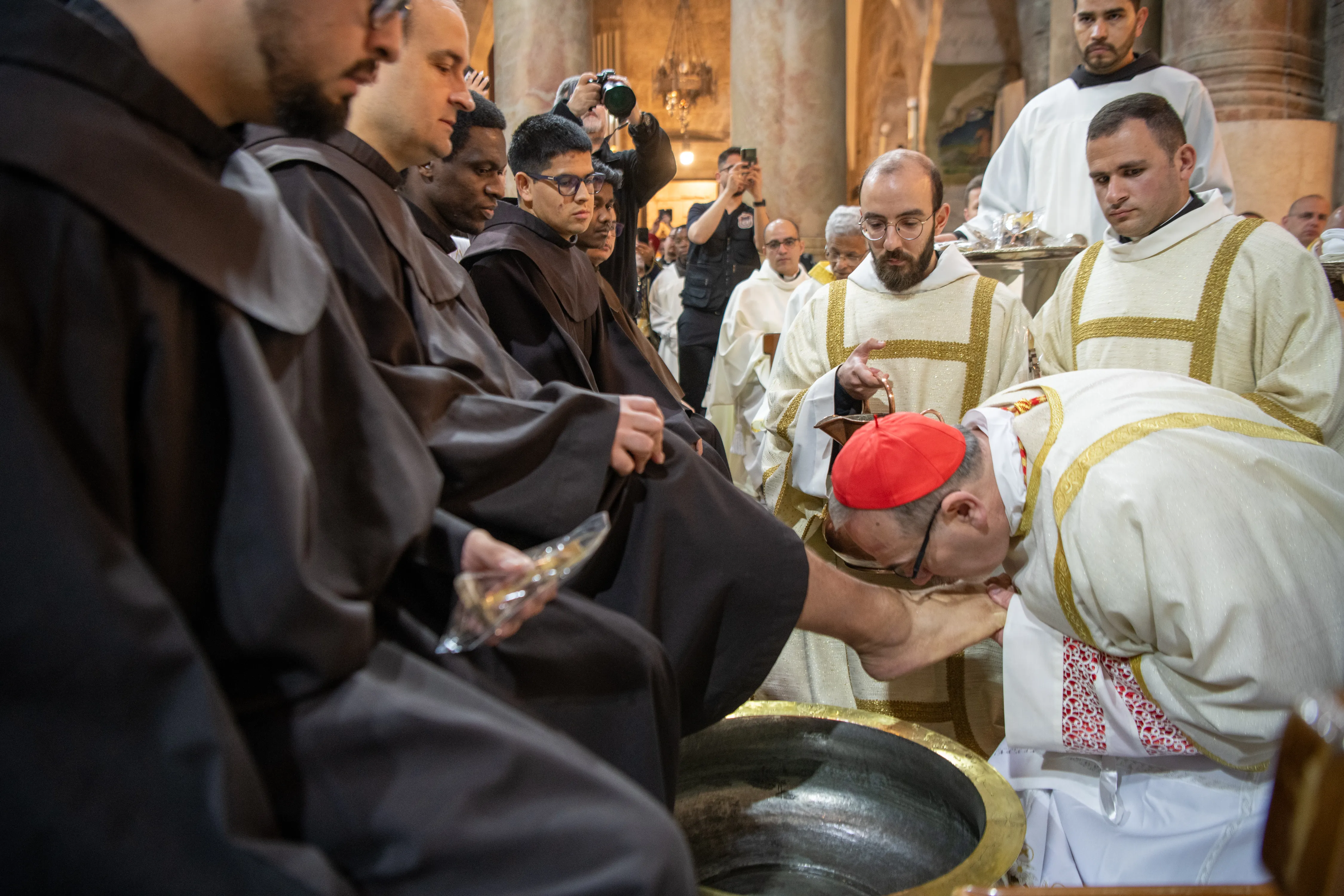
Cardinal Pierbattista Pizzaballa, the Latin Patriarch of Jerusalem, kisses the feet of a Franciscan friar during the “Washing of the Feet” ritual at the Mass of the Lord’s Supper celebrated at the Holy Sepulchre on Holy Thursday. The celebration is held on Thursday morning due to the Status Quo. March 28, 2024. Courtesy of the Custody of the Holy Land
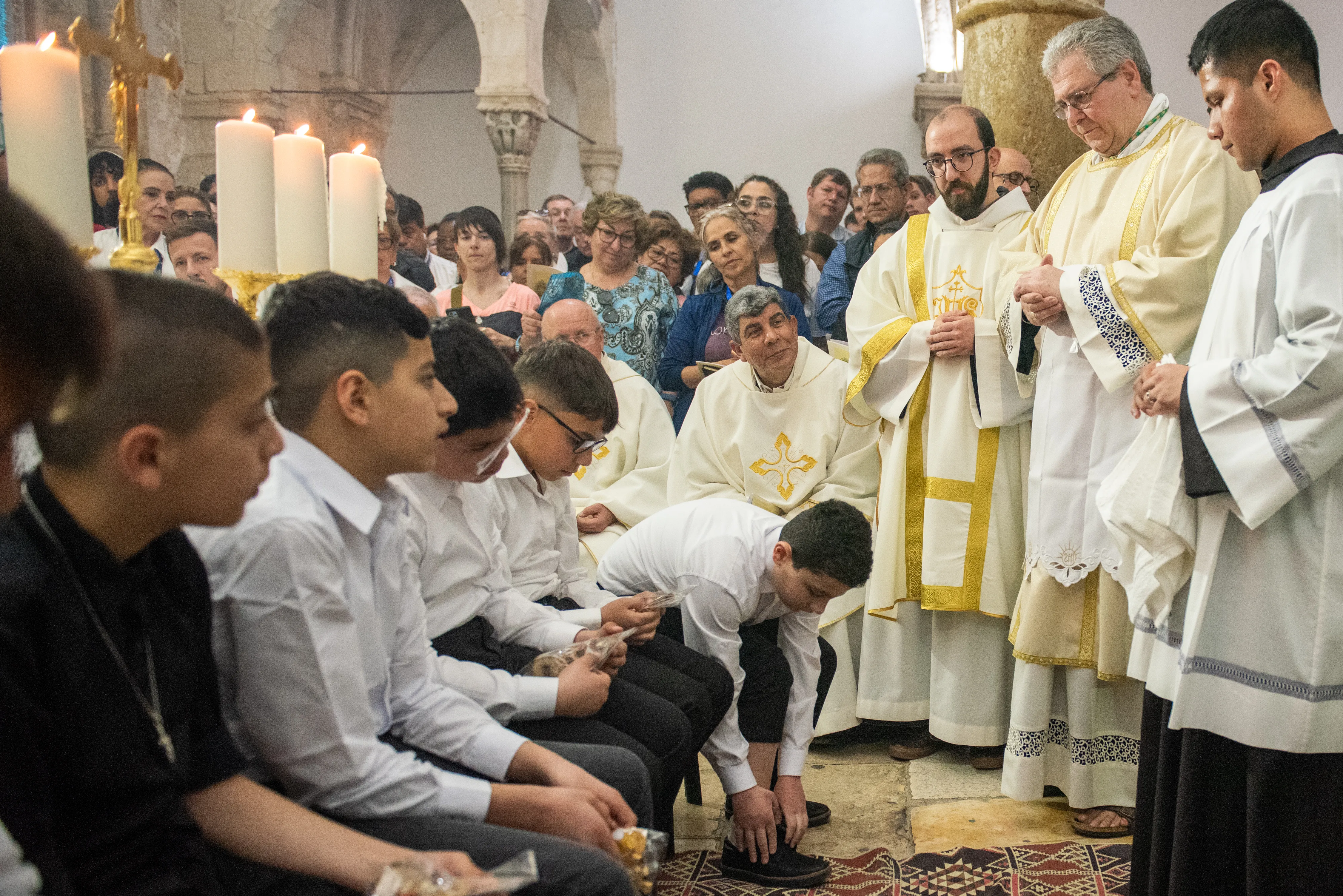
The custos of the Holy Land, Father Francesco Patton, presided over the Eucharistic celebration at the Cenacle. In his homily, before washing the feet of six teachers and six students from the Terra Sancta School in Jerusalem, he emphasized the value of the “new commandment” that Jesus gave to his apostles here: “As I have loved you, so you also should love one another” (Jn 13:34).
“To love means to give oneself and to serve,” he said. “In this celebration, we want to nourish ourselves with Jesus because if he is alive within us, then we too will become capable of loving one another as he loved us. And we also want to learn from Jesus not to be served but to serve.”
Some students from the Terra Sancta School in Jerusalem who took part in the “Washing of the Feet” ritual during the Mass of the Lord’s Supper celebrated at the Cenacle in Jerusalem on Holy Thursday, March 28, 2024. Addressing them specifically in his homily, the Custos of the Holy Land emphasized the value of the “new commandment” that Jesus gave to his apostles here: “As I have loved you, so you also should love one another” (John 13:34). Credit: Marinella Bandini
Holy Thursday is the only day, along with Pentecost Sunday, when the Franciscans have the right to gather in the Upper Room to pray. Usually, it is a liturgy of the word, but since 2021 they have celebrated Mass. Outside, Israeli Army personnel ensure security.
The Cenacle is at the center of strong tensions and disputes regarding ownership and rights of access and celebration. An ancient tradition places King David’s tomb here, and over the centuries, Jews and Muslims have leveraged this place to first expel the Franciscans and then to prevent Christian worship, which they deem sacrilegious.
Father Narciso Klimas, historian and archivist of the Custody of the Holy Land, explained to CNA: “The Custody has all the documents confirming our ownership of Mount Zion.” Even today, traces of Christian presence are visible, both in the architecture of the place and in some symbols.
“The presence of the Franciscans at the Cenacle,” Klimas explained, “dates back to 1342, but as early as 1333, the rulers of Naples, Robert of Anjou and Sancha of Majorca, acquired the land and donated it to the friars. This was the first headquarters of the Custody of the Holy Land.” To this day, the official title of the Custos of the Holy Land is “Guardian of Mount Zion and the Holy Sepulchre.”
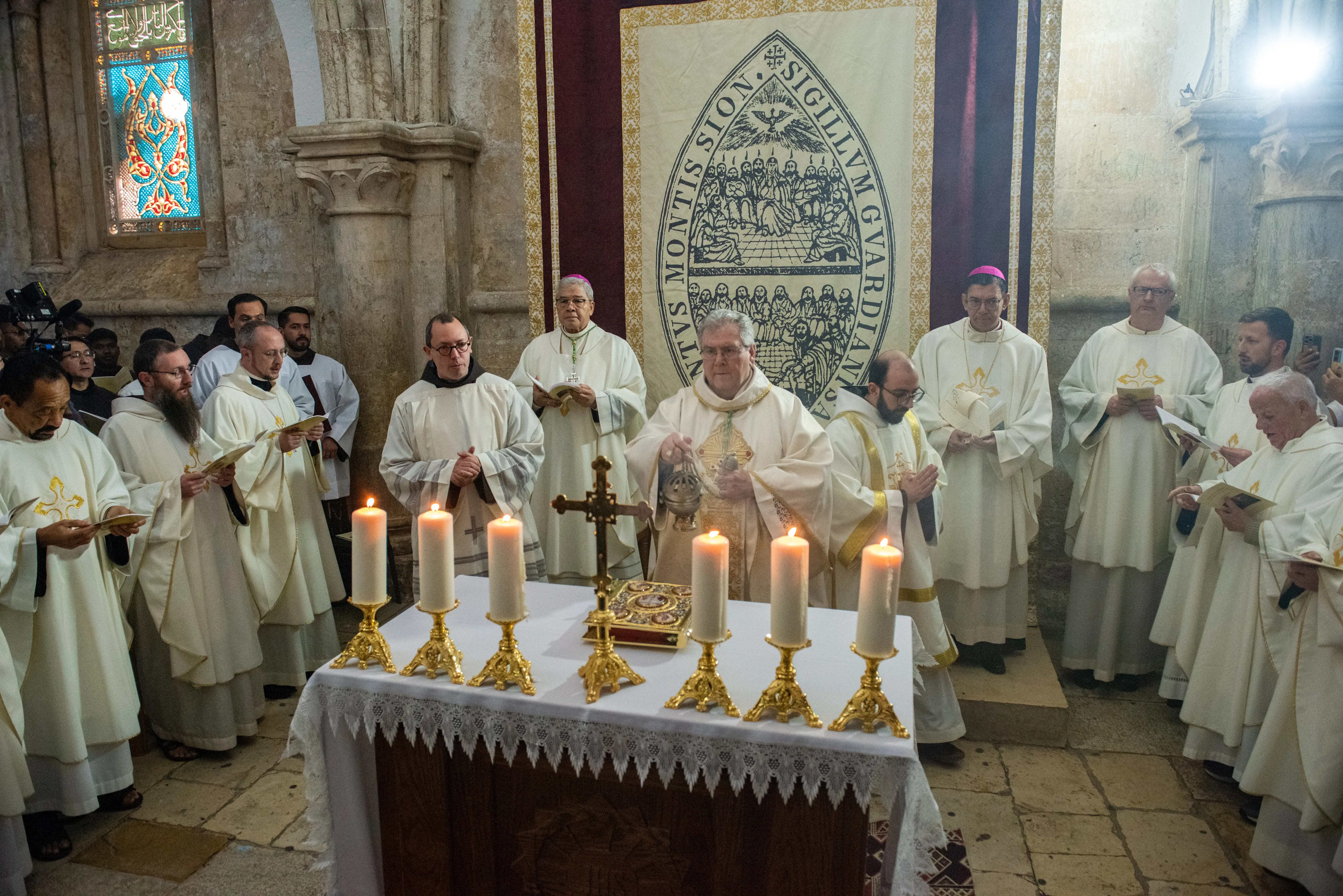
Father Francesco Patton, custos of the Holy Land, incenses the altar at the beginning of the Mass of the Lord’s Supper that the Franciscan friars celebrated inside the Cenacle in Jerusalem on Holy Thursday, March 28, 2024. This is the only day, along with Pentecost Sunday, that the Franciscans have the right to gather here to pray. Usually, it is a liturgy of the word, but since 2021 they have celebrated Mass. Credit: Marinella Bandini
In 1421, a rabbi submitted a petition to the local emirs, claiming the right for Muslims and Jews to this place due to the presence of King David’s tomb. One hundred years later, Klimas continued, “the Ottomans used this argument to gradually expel the Franciscans, until in 1551 the sultan decreed the total expulsion of the Franciscans from Mount Zion.” The Cenacle first became a mosque and later, in the lower part, also a synagogue.
“Since then,” Klimas recounted, “the Franciscans have never stopped attempting to regain possession of the Cenacle. The friars have always tried to ensure a presence, at least on Holy Thursday and Pentecost, sometimes even with methods that are not exactly orthodox (such as bribing the local guardian).”
Something began to change in the 19th century, during the time of the Ottoman Sultan Abdülmecid. Since then, the Franciscans have had the right to pray at the Cenacle on Holy Thursday and Pentecost. After a failed attempt in the 1930s to regain control of it, the friars managed to purchase adjacent land where they built the convent of San Francesco “ad Coenaculum” (next to the Cenacle).
In 1948, with the founding of the State of Israel, the entire Mount Zion came under Israeli control, and until today, the Israeli state owns the entire complex of the Cenacle. The neighborhood has a strong Jewish religious character and is characterized by the presence of synagogues and rabbinical schools.
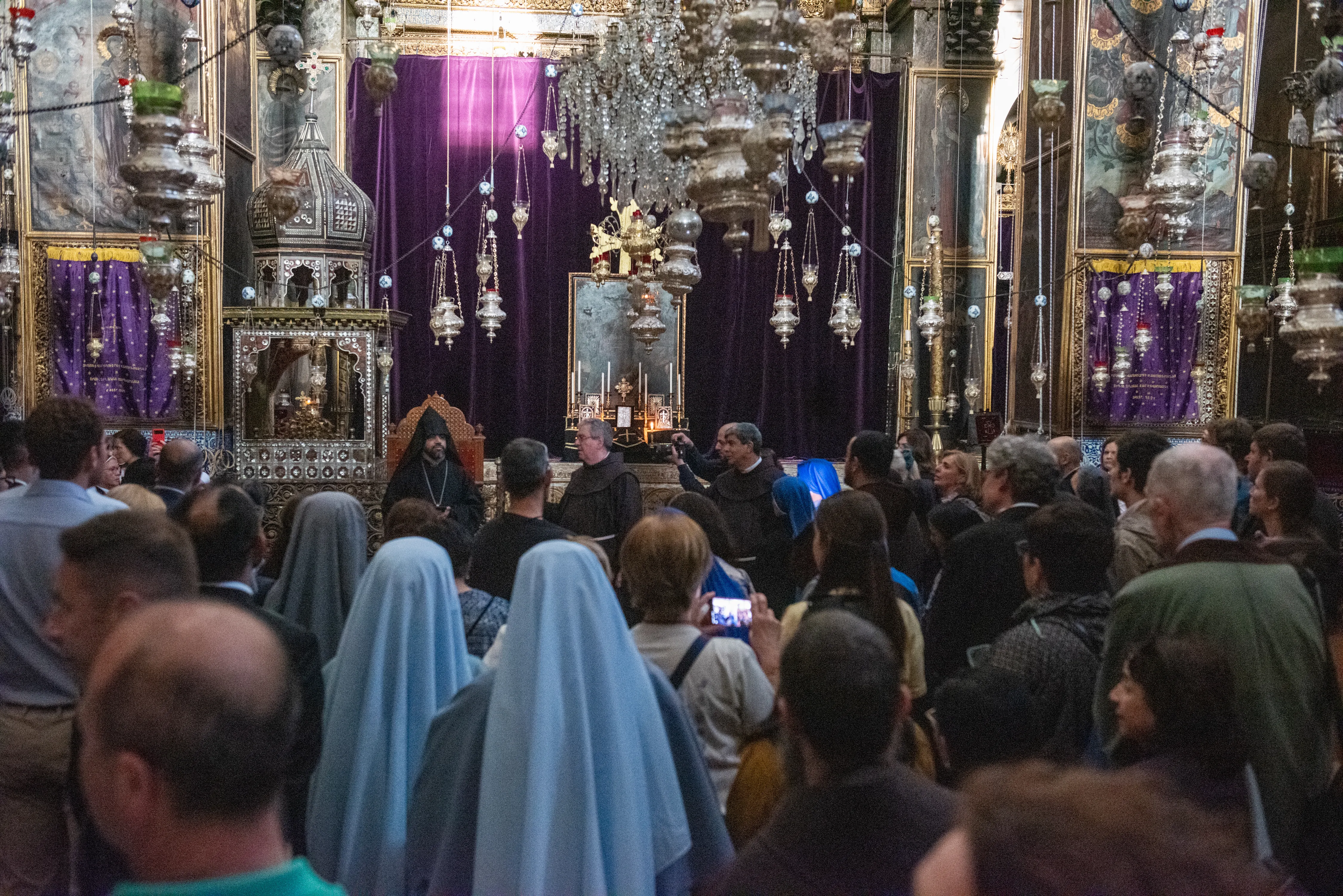
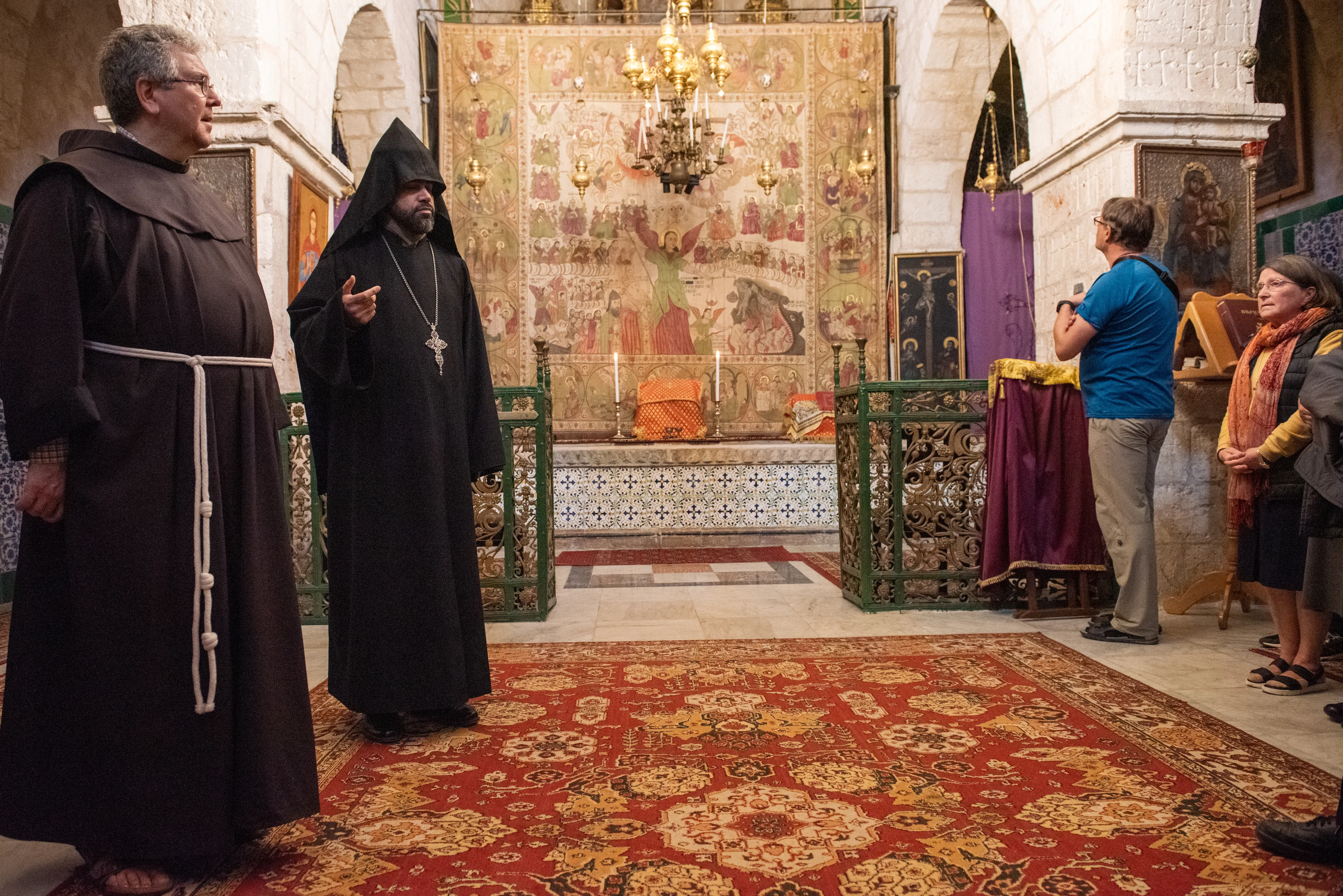
The Franciscan friars and the faithful in the Armenian Cathedral of St. James in Jerusalem after the Mass of the Lord’s Supper celebrated at the Cenacle. Here, the friars commemorate the hospitality they received here in the 16th century. After being expelled from the Cenacle, the Franciscans were welcomed by the Armenians for seven years while the convent of St. Saviour was purchased, to this day the headquarters of the Custody of the Holy Land. March 28, 2024. Credit: Marinella Bandini
“Even if the Cenacle cannot return to our hands,” Klimas explained, “we ask at least to celebrate regularly, even with pilgrims, without the need for special permits.”
Negotiations on these matters (taxation and property) have been ongoing for over 25 years between the Holy See and the State of Israel, following the signing of the Fundamental Agreement in 1993 and the agreement recognizing the legal personality of the Catholic Church in Israel in 1997.
Despite the slow pace of diplomatic negotiations, some practical progress can be observed informally. The ability to celebrate Mass on Holy Thursday at the Cenacle is among these developments. Permissions to access the site on other special occasions are usually granted without significant issues as well.
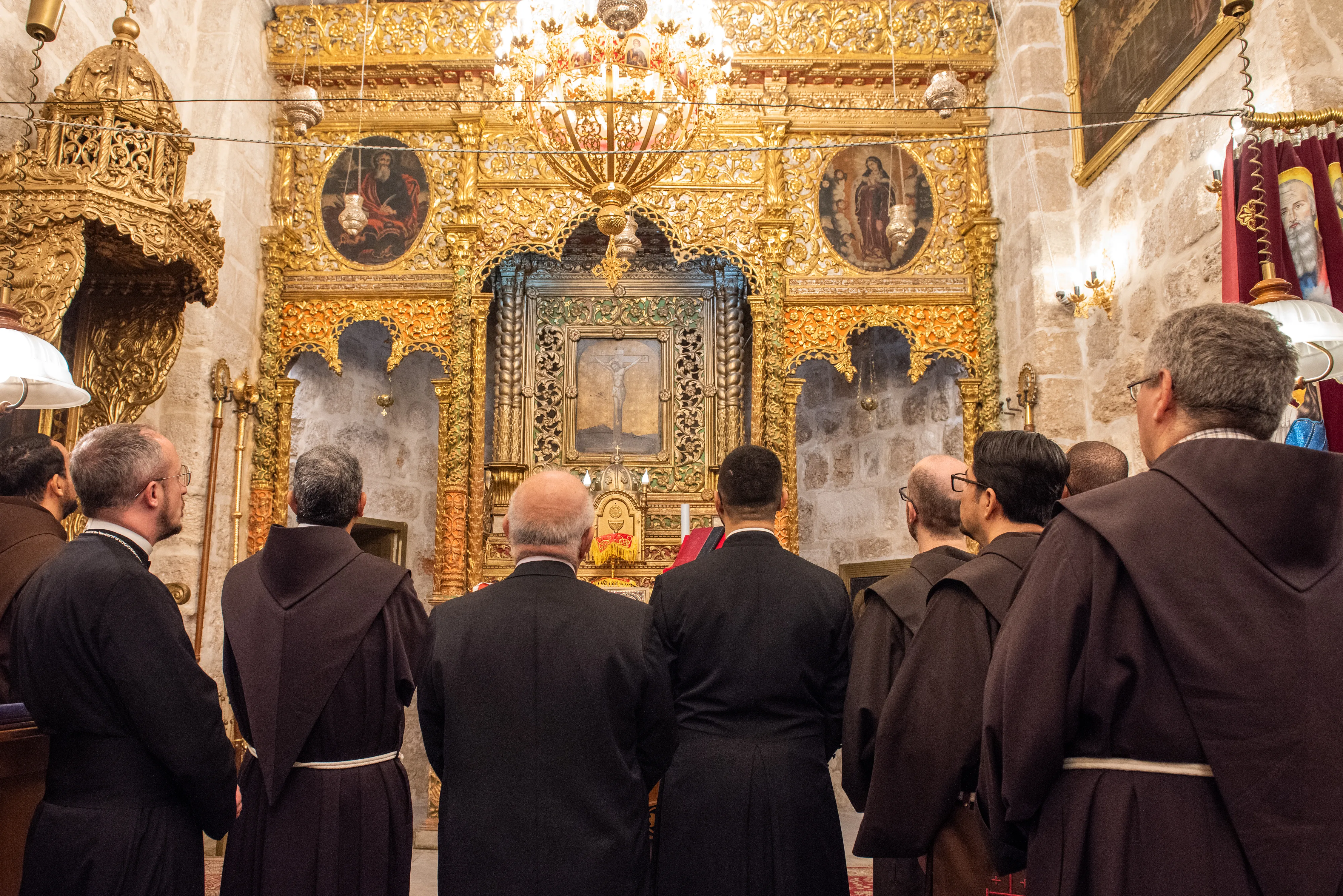
After the Mass at the Cenacle, as tradition dictates, the Franciscans proceeded in a procession to three churches in two other symbolic places: the Armenian churches of St. James and of the Holy Archangels (of the Armenian Apostolic Church), and the Syro-Orthodox Church of St. Mark.
The Franciscan friars and the faithful in the Armenian Church of the Holy Archangels in Jerusalem after the Mass of the Lord’s Supper celebrated at the Cenacle on March 28, 2024. Friars and faithful pray together and receive the blessing from the representative of the Armenian Apostolic Church. Credit: Marinella Bandini
This yearly visit commemorates the hospitality the friars received in the 16th century. After being expelled from the Cenacle, the Franciscans were welcomed by the Armenians for seven years while the convent of St. Saviour was purchased, to this day the headquarters of the Custody of the Holy Land. Friars and faithful prayed together and received the blessing from the representative of the Armenian Apostolic Church.
The Syriac Orthodox Church of St. Mark is said to be built on the house of Mary, the mother of the evangelist Mark. According to Syriac tradition, this is the place where Jesus had the Last Supper. Here as well, those present prayed together and were able to listen to the Lord’s Prayer sung in Aramaic by one of the monks, who then gave a blessing.
The Franciscan friars and the faithful in the Syro-Orthodox church of St. Mark in Jerusalem after the Mass of the Lord’s Supper celebrated at the Cenacle on March 28, 2024. According to Syriac tradition, this is the upper room where Jesus had the Last Supper. Here as well, those present pray together and listen to the Lord’s Prayer sung in Aramaic by one of the monks, who then gives the blessing. Credit: Marinella Bandini






Leave a Reply